



КЕТРАФЛЮКС 3 мг/мл Капли для глаз, раствор

Рассмотрение рецепта онлайн
Врач рассмотрит ваш случай и примет решение о назначении рецепта, если это медицински оправдано.

Поговорите с врачом об этом лекарстве
Обсудите симптомы и возможные дальнейшие шаги на онлайн-консультации.



Инструкция по применению KETRAFLUX
Содержание инструкции
Cetraflux 3 mg/ml eye drops, solution
Ciprofloxacin
Read this leaflet carefully before using this medicine.
- Keep this leaflet. You may need to read it again.
- If you have any questions, ask your doctor or pharmacist.
- This medicine has been prescribed for you. Do not give it to other people, even if their symptoms are the same as yours, as it could be harmful.
- If any of the side effects gets worse, or if you notice any side effects not listed in this leaflet, tell your doctor or pharmacist.
Contents of this leaflet:
- 1. What Cetraflux is and what it is used for
- 2. What you need to know before you use Cetraflux
- 3. How to use Cetraflux
- 4. Possible side effects
- 5. How to store Cetraflux
- 6. Contents of the pack and other information
1. What is Cetraflux and what is it used for
Cetraflux is available in the form of eye drops, solution. It is an antibiotic belonging to the family
of medicines called quinolones and to the subgroup of fluoroquinolones. It is used for the treatment
of bacterial eye infections: purulent bacterial conjunctivitis, keratitis (inflammation
of the cornea caused by bacteria), corneal ulcers, corneal abscesses.
2. What you need to know before using Cetraflux
Do not use Cetraflux
If you are allergic to ciprofloxacin or to any other quinolone antibiotic or to any
of the other ingredients of this medicine listed in section 6.
Ask your doctor for advice.
Warnings and precautions
- Use this medicine only in the eyes. Do not inject it, do not ingest it.
- In case of severe allergic reactions, rash, hives, itching or difficulty breathing, stop using the medicine immediately and consult your doctor as this may occur after the first dose.
- If symptoms worsen or return suddenly, consult your doctor. With the use of this medicine, you may become more sensitive to other infections.
- If pain, swelling or inflammation of the tendons appear during or shortly after using the eye drops, stop treatment and consult your doctor.
- If you wear contact lenses:
- the use of contact lenses is not recommended during treatment.
- If you are taking other medicines, see section “Other medicines and Cetraflux”.
Other medicines and Cetraflux
Tell your doctor or pharmacist if you are taking, have recently taken or might
take any other medicines, including those available without a prescription.
Pregnancy, breastfeeding and fertility
If you are pregnant, suspect you are pregnant or are planning to become pregnant, or if you are breastfeeding
with breast milk, ask your doctor for advice before using Cetraflux.
It is preferable to avoid the use of this medicine during pregnancy, unless the
expected therapeutic benefit outweighs the potential risk to the fetus.
Ciprofloxacin is excreted in breast milk. If you are breastfeeding with breast milk, ask
your doctor for advice before using Cetraflux.
Driving and operating machinery
If your vision is altered in any way following the use of Cetraflux, you should not drive
or operate machinery.
Important information if you wear contact lenses
The use of contact lenses is not recommended during the treatment of an eye infection,
as this may worsen your condition. Do not apply the eye drops if you still have contact lenses in your eyes. Wait at least 15 minutes after applying the eye drops before
reinserting the lenses.
If you have any doubts about the use of Cetraflux, ask your doctor or pharmacist.
3. How to use Cetraflux
Use this medicine following the doctor's instructions exactly. If you have any doubts,
consult your doctor or pharmacist.
The recommended dose depends on whether you are being treated for corneal abscess or for some other
bacterial eye infection.
Adults, newborns, children and adolescents:
Corneal abscess
The ophthalmic solution should be administered at the following intervals, even during the night.
Day 1: 2 drops every 15 minutes for the first 6 hours, then 2 drops every 30 minutes in the affected
eye for the rest of the day.
Day 2: 2 drops every hour in the affected eye.
From Day 3 to Day 14: 2 drops every 4 hours in the affected eye.
Your doctor will tell you if the treatment needs to be continued for more than 14 days.
Other bacterial infections
For the first two days: one or two drops every two hours in the affected eye when awake.
Subsequently: one or two drops every four hours when awake.
Your doctor will tell you the duration of treatment.
It is important that you continue using Cetraflux for the entire treatment period as indicated by
your doctor.
Method of administration
Use Cetraflux following the doctor's instructions exactly. If you have any doubts, consult your
doctor or pharmacist.
- 1. Wash your hands before starting.
- 2. Detach the single-dose vial from the packaging. (figure 1)
- 3. Remove the cap from the vial by twisting it off. (figure 2)
- 4. Hold the vial between your thumb and other fingers, pointing downwards.
- 5. Tilt your head back.
- 6. Lower the lower eyelid with a finger, until a
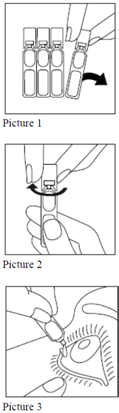
"pocket" is created between the eyelid and the eye. Drop the drop in this
position (figure 3).
- 7. Bring the tip of the vial close to the eye. If it can be helpful, use a mirror.
- 8. Do not touch the eye, eyelid, surrounding areas or other surfaces with the vial. The eye drops could become infected.
- 9. Gently press on the base of the vial to release one drop at a time.
- 10. Do not press the vial too hard, a slight pressure on the base is sufficient.
- 11. After releasing the drop, press the edge of the eye near the nose to prevent the medicine from passing into the throat.
- 12. If you are using the eye drops in both eyes, repeat the steps above for the other eye. Firmly replace the cap on the vial immediately after use.
If a drop does not enter the eye correctly, try again.
If you use more Cetraflux than you should
The eye can be rinsed with warm water. Do not administer another dose until the
next one.
Contact your doctor or pharmacist
If you forget to use Cetraflux
Do not use a double dose to make up for a missed dose. If you forgot to
administer a dose, do so as soon as you remember and administer the next dose as usual. If it is almost time for the next dose, do not administer the forgotten dose.
Administer only the next dose as usual.
4. Possible side effects
Like all medicines, Cetraflux can cause side effects, although not everybody gets them.
You may experience some or all of the following effects in one or both eyes:
Common(1 in 10 people): corneal deposits, eye discomfort, ocular hyperemia
Uncommon(1 in 100 people): keratopathy (non-inflammatory disease of the cornea),
corneal infiltrates, corneal spots, photophobia (sensitivity to light), reduced visual acuity
(reduced vision), eyelid edema (eyelid swelling), blurred vision, eye pain,
eye dryness, eye swelling, eye itching, foreign body sensation in the eyes,
increased tearing, eye discharge, crusting on the eyelid margin,
eyelid scaling, conjunctival edema, eyelid erythema (redness inside the
eyelid)
Rare (1 in 1,000):eye toxicity, punctate keratitis (destruction of pinpoint areas
in the outer layer of the cornea), keratitis (inflammation of the cornea), conjunctivitis,
corneal pathology, corneal epithelial defects, diplopia (double vision), hypoesthesia
of the eye (reduced sensitivity to stimulation), asthenopia (eye strain), eye irritation,
eye inflammation, conjunctival hyperemia. If you notice white particles
in your eyes, continue to use Cetraflux but inform your doctor immediately.
You may also experience effects in other areas of the body, such as:
Infections and infestations:
Rare(1 in 1,000): stye, rhinitis (inflammation of the mucous membranes inside the
nose)
Immune system disorders:
Rare(1 in 1,000): allergic reactions such as rash, itching, swelling,
difficulty breathing )
Nervous system disorders:
Common(1 in 10 people): unpleasant taste in mouth
Uncommon(1 in 100 people): headache
Rare(1 in 1,000): dizziness
Ear disorders:
Rare(1 in 1,000): ear pain
Respiratory disorders:
Rare(1 in 1,000): hypersecretion of the paranasal sinuses
Gastrointestinal disorders:
Uncommon (1 in 100 people):nausea
Rare(1 in 1,000): diarrhea, abdominal pain
Skin disorders:
Rare(1 in 1,000): dermatitis (skin inflammation)
Systemic disorders :
Rare(1 in 1,000): drug intolerance
Diagnostic tests:
Rare(1 in 1,000): abnormal laboratory test
In case of an allergic reaction, stop using Cetraflux and see your doctor.
Reporting of side effects
If you get any side effects, talk to your doctor or pharmacist. This includes any side effects not listed
in this leaflet. You can also report side effects directly through the national reporting system at
www.agenziafarmaco.gov.it/it/responsabili. By reporting side effects you can help provide more
information on the safety of this medicine.
5. How to store Cetraflux
Keep out of the reach and sight of children.
Do not store at a temperature above 30°C. Store in the original packaging to
protect the medicine from light. Do not use the eye drops after the expiry date (indicated as
“EXP”) which is stated on the vial, the blister and the carton, after “EXP.”. The expiry
date refers to the last day of that month.
Period of validity after first opening of the blister pack: 90 days
Period of validity after opening the single-dose container: the contents of the vial must
be used immediately after opening the single-dose vial. Any unused contents
must be discarded.
Do not dispose of any medicine in wastewater or household waste. Ask your pharmacist
how to dispose of medicines you no longer use. This will help protect the environment.
Do not give this medicine to other people, even if their symptoms are the same as yours, because
it could be dangerous
6. Contents of the pack and other information
What Cetraflux contains
The active ingredient is ciprofloxacin 3 mg/ml (as hydrochloride).
The other ingredients are mannitol, disodium edetate, glacial acetic acid, sodium acetate
trihydrate, sodium hydroxide, purified water.
Description of the appearance of Cetraflux and contents of the pack.
Cetraflux is a transparent, colourless or slightly yellowish aqueous solution, supplied in a
pack containing 10, 15 or 20 vials. Each single vial provides 0.25 ml drop by drop. The
vials are contained in a protective blister made of aluminium foil.
Advice/medical education
Antibiotics are used to treat bacterial infections. They are ineffective against viral
infections.
If your doctor has prescribed antibiotics, you must take them strictly for the illness you
currently suffer from.
Despite antibiotics, some bacteria may survive or proliferate. This phenomenon is
called resistance: some antibiotic treatments become ineffective.
The improper use of antibiotics increases resistance. It could even help bacteria to
become resistant and thus delay your recovery or reduce the effectiveness of antibiotics if you do not
correctly observe
- the dosages;
- the timings;
- the duration of the treatment.
Consequently, to preserve the effectiveness of this medicine:
- 1 - Use antibiotics only when they are prescribed to you.
- 2 - Follow the prescription carefully.
- 3 - Do not reuse an antibiotic without a medical prescription, even if you intend to treat a similar illness.
- 4 - Do not give your antibiotic to another person, it may not be suitable for their illness.
- 5 - After completing the treatment, return all unused medicines to your pharmacist to ensure they are disposed of correctly.
Marketing authorisation holder and manufacturer
LABORATORIOS SALVAT, S.A.
Gall 30 - 36
08950 Esplugues de Llobregat
Barcelona (Spain)
For further information on this medicine, contact the local representative of the marketing
authorisation holder.
Spain
LABORATORIOS SALVAT, S.A.
Gall 30 - 36
08950 Esplugues de Llobregat (Barcelona)
Portugal
LABORATORIOS SALVAT, S.A.
Gall 30 - 36
08950 Esplugues de Llobregat (Barcelona)
France
LABORATORIOS SALVAT, S.A.
Gall 30 - 36
08950 Esplugues de Llobregat (Barcelona)
Italy
LABORATORIOS SALVAT, S.A.
Gall 30 - 36
08950 Esplugues de Llobregat (Barcelona)

Не уверены, подходит ли вам это лекарство?
Обсудите симптомы и варианты лечения с врачом онлайн.

Уже начали прием и появились вопросы?
Обсудите свое состояние и дальнейшие шаги с врачом онлайн.
- Страна регистрации
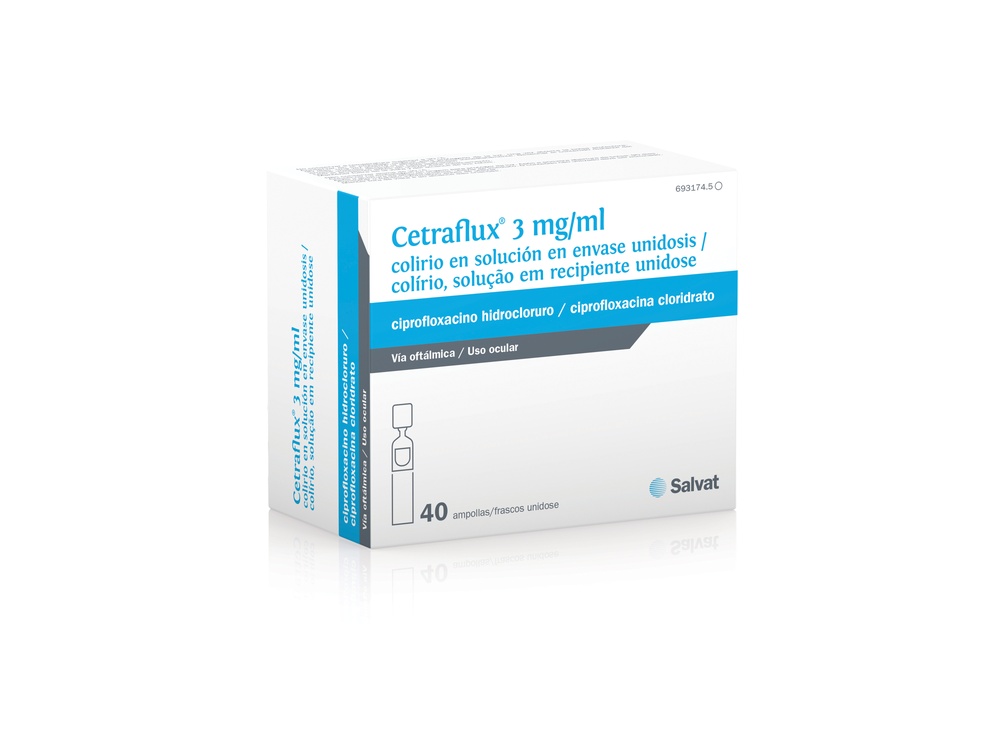
- Форма выпускаEye drops, solution, 3 MG/ML
- Код АТХS01AE03
- Действующее вещество
- Отпускается по рецептуДа
- Производитель
- Информация на этой странице носит справочный характер и не является медицинской консультацией. Перед началом приема лекарства обязательно проконсультируйтесь с врачом.
- Аналоги KETRAFLUXФорма выпуска: Eye drops, solution, 0.3%Действующее вещество: ЦипрофлоксацинПроизводитель: NTC S.R.L.Отпускается по рецептуФорма выпуска: Eye drops, solution, 5 MG/MLДействующее вещество: левофлоксацинаПроизводитель: DOC GENERICI SRLОтпускается по рецептуФорма выпуска: Eye drops, solution, 3 MG/MLДействующее вещество: ОфлоксацинПроизводитель: BIONATIVA S.P.A.Отпускается по рецепту
Аналоги KETRAFLUX в других странах
Лекарства с тем же действующим веществом, доступные в других странах.
Аналог KETRAFLUX в Польша
Аналог KETRAFLUX в Испания
Врачи онлайн по KETRAFLUX
Обсудите применение KETRAFLUX и возможные следующие шаги — по оценке врача.









Получите рецепт на KETRAFLUX онлайн
Заполните форму за 2 минуты
Расскажите о симптомах, истории болезни и нужном препарате.
Выберите врача или мы назначим
Выберите специалиста или мы подберём ближайшего доступного врача.
Врач рассматривает ваш случай
Обычно в течение 30 минут. Может задать уточняющие вопросы в чате.
Получите в любой аптеке
Электронный рецепт отправляется на вашу почту — действителен по всей Польше.
Часто задаваемые вопросы
KETRAFLUX требует рецепта в Италия. Вы можете уточнить у врача онлайн, подходит ли это лекарство для вашей ситуации.
Действующее вещество KETRAFLUX — Ципрофлоксацин. Эта информация помогает определить лекарства с тем же составом под другими торговыми названиями.
KETRAFLUX производится компанией LABORATORIOS SALVAT S.A.. Упаковка и торговое название могут отличаться в зависимости от дистрибьютора.
Врачи, включая Семейные врачи, Психиатры, Дерматологи, Кардиологи, Эндокринологи, Гастроэнтерологи, Пульмонологи, Нефрологи, Ревматологи, Гематологи, Инфекционисты, Аллергологи, Гериатры, Педиатры, Онкологи, могут оценить целесообразность применения KETRAFLUX с учетом вашей ситуации и местных правил. Вы можете записаться на онлайн-консультацию, чтобы обсудить возможные варианты.
Польша имеет хорошо развитую систему здравоохранения в крупных городах, таких как Варшава, Краков, Вроцлав и Гданьск. Аптеки широко доступны и работают в соответствии с действующим законодательством, обеспечивая доступ к рецептурным препаратам.
Вы можете купить KETRAFLUX в Варшаве, Кракове, Вроцлаве или Гданьске в любой аптеке при наличии действующего рецепта.
Чтобы получить рецепт, вы можете воспользоваться Oladoctor:
Другие лекарства с тем же действующим веществом (Ципрофлоксацин) включают OFTAKILOX, DOKLEVO, DUNAFLOT. Они могут отличаться торговым названием или формой выпуска, но содержат одинаковый терапевтический компонент. Перед изменением лечения рекомендуется проконсультироваться с врачом.
