



CARNITENE 1,5 G/5 ML Оральный раствор

Рассмотрение рецепта онлайн
Врач рассмотрит ваш случай и примет решение о назначении рецепта, если это медицински оправдано.

Поговорите с врачом об этом лекарстве
Обсудите симптомы и возможные дальнейшие шаги на онлайн-консультации.



Инструкция по применению KARNITENE
Содержание инструкции
- Carnitene 1 g/10 ml oral solution, 1.5 g/5 ml oral solution, 1 g chewable tablets
- Carnitene 2 g/10 ml oral solution
- Carnitene 1 g/5 ml injectable solution for intravenous use
Carnitene 1 g/10 ml oral solution, 1.5 g/5 ml oral solution, 1 g chewable tablets
L-carnitine
Read this leaflet carefully before you start takingthis medicine as it contains important
information for you.
Always take this medicine exactly as described in this leaflet or as your doctor or
pharmacist has told you.
- Keep this leaflet. You may need to read it again.
- If you want more information or advice, ask your pharmacist.
- If any side effects occur, including those not listed in this leaflet, tell your doctor or pharmacist. See section 4.
- See a doctor if you do not feel better or if you feel worse after a short period of treatment.
Contents of this leaflet:
- 1. What Carnitene is and what it is used for
- 2. What you need to know before you take Carnitene
- 3. How to take Carnitene
- 4. Possible side effects
- 5. How to store Carnitene
- 6. Contents of the pack and other information
1. What is Carnitene and what is it used for
Carnitene contains the active ingredient L-carnitine. Carnitine is a natural constituent of human cells and plays a fundamental role in the production and transport of energy.
Carnitene is indicated for the treatment of carnitine deficiencies.
Consult your doctor if you do not feel better or if you feel worse after a short period of treatment.
2. What you need to know before you take Carnitene
Do not take Carnitene
- if you are allergic to L-carnitine or any of the other ingredients of this medicine (listed in section 6).
Warnings and precautions
Talk to your doctor or pharmacist before taking Carnitene.
Inform your doctor, who will monitor you closely:
- if you have diabetes and are using insulin or oral hypoglycemic agents (medicines taken by mouth that lower blood sugar levels) because Carnitene may cause a further reduction in blood sugar. In these cases, your doctor will perform frequent checks of your blood sugar levels and may adjust the dose of insulin or oral hypoglycemic agents (see section “How to take Carnitene”)
- if you have a predisposition to seizures, treatment with L-carnitine may trigger them; if you already suffer from seizures, the administration of L-carnitine may increase the number and/or severity of seizures
- if you have severe kidney problems (severe kidney failure or end-stage kidney failure) or if you are on dialysis. In these cases, your doctor will monitor your kidney function during treatment, especially if prolonged (see section “How to take Carnitene”)
- if you are taking medicines that reduce blood clotting (anticoagulants). In these cases, your doctor will prescribe periodic checks of your coagulation (see section “Other medicines and Carnitene”)
Carnitene does not present risks of habituation (loss of drug effectiveness over time) and dependence.
Other medicines and Carnitene
Tell your doctor or pharmacist if you are taking, have recently taken or might take any other
medicines.
Tell your doctor if you are taking medicines that reduce blood clotting (anticoagulants), because
in very rare cases, alterations in blood coagulation may occur during concomitant treatment with Carnitene. In these cases, your doctor will prescribe periodic checks of your coagulation
(see section “Warnings and precautions”).
Tell your doctor if you are taking medicines for epilepsy (valproic acid), antibiotics (containing pivalic acid, cephalosporins) cancer treatment drugs (cisplatin, carboplatin and ifosfamide) because they may
reduce the amount of Carnitene in the blood.
Pregnancy, breastfeeding and fertility
If you are pregnant, suspect you are pregnant, are planning to become pregnant or are breastfeeding, ask your
doctor or pharmacist for advice before taking this medicine.
Pregnancy
Carnitene can be used during pregnancy if your doctor believes that the benefit to you is greater than the
potential risks to the fetus.
Breastfeeding
L-carnitine is a normal component of breast milk. Carnitene can be used during breastfeeding
if your doctor believes that the benefit to you is greater than the potential risks to the baby.
Fertility
Carnitene has no adverse effects on fertility.
Driving and using machines
Carnitene does not impair the ability to drive vehicles or operate machinery.
Carnitene 1 g/10 ml oral solution contains sodium benzoate and sodium
This medicine contains 48 mg of sodium benzoate in 10 ml of solution. Sodium benzoate may increase
jaundice (yellowing of the skin and eyes) in newborns up to 4 weeks of age.
This medicine contains 8.1 mg of sodium (the main component of table salt) per 10 ml of
solution. This is equivalent to 0.41% of the recommended daily intake with the diet of an
adult.
Carnitene 1.5 g/5 ml oral solution contains sucrose, sorbitol, methyl parahydroxybenzoate,
propyl parahydroxybenzoate, sodium and ethanol
Carnitene 1.5 g/5 ml oral solution contains sucrose. If your doctor has diagnosed you with an intolerance to
certain sugars, contact him before taking this medicine. It may be harmful to your teeth.
This medicine contains 350 mg of sorbitol per 5 ml of solution. Sorbitol is a source of fructose. If your
doctor has told you that you (or your child) are intolerant to certain sugars, or if you have a diagnosis of
hereditary fructose intolerance, a rare genetic disease in which patients cannot transform
fructose, talk to your doctor before you (or your child) take this medicine.
Carnitene 1.5 g/5 ml oral solution contains methyl parahydroxybenzoate and propyl parahydroxybenzoate, which
may cause allergic reactions (even delayed).
This medicine contains less than 1 mmol (23 mg) of sodium per dose, i.e. essentially “sodium-free”.
This medicine contains 5.2 mg of alcohol (ethanol) in each ml. The amount per ml of this medicine
is equivalent to 0.13 ml of beer or 0.05 ml of wine. The small amount of alcohol in this medicine will not
produce significant effects.
Carnitene 1 g chewable tablets contains sucrose and maltodextrin (glucose)
If your doctor has diagnosed you with an intolerance to certain sugars, contact him before taking this
medicine. This medicine contains 1.9 g of sucrose per tablet. This should be taken into account in
people with diabetes mellitus. It may be harmful to your teeth.
3. How to take Carnitene
Take this medicine following exactly the instructions of your doctor or pharmacist. If you have
any doubts, ask your doctor or pharmacist.
Primary and secondary carnitine deficiencies due to genetic metabolic diseases
The daily dose varies depending on the patient's age and weight.
Use in adults and adolescents 12 years and over
The recommended dose is 2-4 grams per day, depending on the severity of the disease and the doctor's judgement.
Use in children
Children from 0 to 2 years
The recommended dose is 150 mg per kg of body weight.
Children from 2 to 6 years
The recommended dose is 100 mg per kg of body weight.
Children from 6 to 12 years
The recommended dose is 75 mg per kg of body weight.
Carnitine deficiencies secondary to hemodialysis
The recommended dose is 2-4 grams per day.
The oral solution must be taken only after dilution. Pour the oral solution contained in the
single-dose container into a glass of water before drinking it or giving it to your child.
If you have severe kidney problems, oral treatment with Carnitene should not be prolonged and at
high doses.
If you are elderly, no special precautions or dosage adjustments of Carnitene are necessary
If you have diabetes and are using insulin or oral medications that lower blood sugar levels,
Carnitene may cause a further reduction in blood sugar and therefore your doctor
will perform frequent blood sugar checks and may adjust the dose of insulin or
oral hypoglycemic agents (see section “Warnings and precautions”).
If you take more Carnitene than you should
In case of accidental ingestion of an excessive dose of Carnitene, immediately inform your doctor or
go to the nearest hospital. An excessive dose of Carnitene can cause diarrhea.
If you forget to take Carnitene
Do not take a double dose to make up for a missed dose.
If you stop taking Carnitene
If you have any doubts about the use of this medicine, ask your doctor or pharmacist.
4. Possible side effects
Like all medicines, this medicine can cause side effects, although not everybody gets them.
Common side effects (may affect up to 1 in 10 people)
- vomiting
- nausea
- diarrhoea
- abdominal pain
Uncommon side effects (may affect up to 1 in 100 people)
- headache
- increased or high blood pressure
- low blood pressure
- altered taste
- difficulty digesting
- dry mouth
- fishy odour in urine, breath and sweat*
- sudden and involuntary muscle contraction (muscle spasms)
- chest pain
- feeling strange
- fever
Very rare side effects (may affect up to 1 in 10,000 people)
- alterations in blood coagulation**
Side effects with unknown frequency (frequency cannot be estimated from available data)
- convulsions***
- dizziness
- irregular heartbeat (palpitations)
- difficulty breathing
- itching
- skin rash
- myasthenia (a disease characterized by muscle weakness)****
- muscle tension
* This occurs in patients with severe kidney problems or undergoing dialysis, due to the accumulation of
L-carnitine metabolites in the blood
** In patients who are simultaneously using medicines that reduce blood coagulation
(anticoagulants)
*** In patients with or without previous seizures or a predisposition
**** In patients with end-stage renal failure.
Reporting of side effects
If you get any side effects, talk to your doctor or pharmacist. This includes any possible side effects not listed
in this leaflet. You can also report side effects directly through the national reporting system at
https://www.aifa.gov.it/content/segnalazioni-reazioni-avverse. By reporting side effects you can help provide
more information on the safety of this medicine.
5. How to store Carnitene
Keep this medicine out of the sight and reach of children.
This medicine does not require any particular storage conditions.
Do not use this medicine after the expiry date which is stated on the packaging after “Exp.”. The expiry
date refers to the last day of that month.
Do not dispose of any medicine in wastewater or household waste. Ask your pharmacist how to dispose of
medicines you no longer use. This will help protect the environment.
6. Contents of the pack and other information
What Carnitene contains
Carnitene 1 g/10 ml oral solution
- The active ingredient is L-carnitine internal salt. Each single-dose container of 10 ml contains 1 g of L-carnitine internal salt.
- The other ingredients are d-l malic acid, sodium benzoate, sodium saccharin, purified water.
Carnitene 1.5 g/5 ml oral solution
- The active ingredient is L-carnitine internal salt. 100 ml of solution contains 30 g of L-carnitine internal salt.
- The other ingredients are sucrose, sorbitol 70 percent (non-crystallizing), sodium methyl parahydroxybenzoate, sodium propyl parahydroxybenzoate, cherry aroma (contains ethanol), sour cherry aroma (contains ethanol), purified water.
Carnitene 1 g chewable tablets
- The active ingredient is L-carnitine internal salt. Each chewable tablet contains 1 g of L-carnitine internal salt.
- The other ingredients are mint powder aroma (contains glucose from maltodextrin), licorice powder aroma, sucrose, magnesium stearate.
Description of the appearance of Carnitene and contents of the pack
Carnitene 1 g/10 ml oral solution
Each pack contains 10 single-dose containers of 10 ml of oral solution.
Carnitene 1.5 g/5 ml oral solution
Each pack contains 1 bottle of 20 ml of oral solution.
Carnitene 1 g chewable tablets
Each pack contains 10 chewable tablets in blisters.
Marketing Authorisation Holder
Alfasigma S.p.A. - Via Ragazzi del ’99, n. 5 - 40133 Bologna (BO)
Manufacturer
Alfasigma S.p.A. - Via Pontina km 30,400 - 00071 Pomezia (RM)
Carnitene 2 g/10 ml oral solution
L-carnitine
Read this leaflet carefully before taking this medicine becauseit contains important
information for you.
- Keep this leaflet. You may need to read it again.
- If you have any questions, ask your doctor or pharmacist.
- This medicine has been prescribed for you only. Do not pass it on to others, even if they have the same symptoms as you, as it may be harmful.
- If any side effects occur, including any not listed in this leaflet, tell your doctor or pharmacist. See section 4.
Contents of this leaflet:
- 1. What Carnitene is and what it is used for
- 2. What you need to know before you take Carnitene
- 3. How to take Carnitene
- 4. Possible side effects
- 5. How to store Carnitene
- 6. Contents of the pack and other information
1. What is Carnitene and what is it used for
Carnitene contains the active ingredient L-carnitine. Carnitine is a natural constituent of human cells and plays a fundamental role in the production and transport of energy.
Carnitene is indicated for the treatment of carnitine deficiencies.
2. What you need to know before you take Carnitene
Do not take Carnitene
- if you are allergic to L-carnitine or any of the other ingredients of this medicine (listed in section 6).
Warnings and precautions
Talk to your doctor or pharmacist before taking Carnitene.
Inform your doctor, who will monitor you closely:
- if you have diabetes and are using insulin or oral hypoglycemic agents (medicines taken by mouth that lower blood sugar levels) because Carnitene may cause a further reduction in blood sugar. In these cases, your doctor will have you undergo frequent blood sugar level checks and may adjust the dose of insulin or oral hypoglycemic agents (see section “How to take Carnitene”).
in the blood
- if you have a predisposition to seizures, treatment with L-carnitine may trigger them; if you already suffer from seizures, the administration of L-carnitine may increase the number and/or severity of seizures
- if you have severe kidney problems (severe kidney failure or end-stage kidney failure) or if you are undergoing dialysis. In these cases, your doctor will monitor your kidney function during treatment, especially if prolonged (see section “How to take Carnitene”)
- if you are taking medicines that reduce blood clotting (anticoagulants). In these cases, your doctor will prescribe periodic checks of your coagulation (see section “Other medicines and Carnitene”).
Carnitene does not present risks of habituation (loss of drug effectiveness over time) and dependence.
Other medicines and Carnitene
Tell your doctor if you are taking, have recently taken, or might take any other medicine.
Tell your doctor if you are taking medicines that reduce blood clotting (anticoagulants), because
in very rare cases, alterations in blood coagulation may occur during concurrent treatment with Carnitene. In these cases, your doctor will prescribe periodic checks of your coagulation
(see section “Warnings and precautions”).
Tell your doctor if you are taking medicines for epilepsy (valproic acid), antibiotics (containing pivalic acid, cephalosporins) cancer drugs (cisplatin, carboplatin and ifosfamide) because they may
reduce the amount of Carnitene in the blood.
Pregnancy, breastfeeding and fertility
If you are pregnant, suspect you are pregnant, are planning a pregnancy or are breastfeeding, ask your doctor for advice before taking this medicine.
Pregnancy
Carnitene can be used during pregnancy if your doctor believes that the benefit to you is greater
than the potential risks to the fetus.
Breastfeeding
L-carnitine is a normal component of breast milk. Carnitene can be used during breastfeeding
if your doctor believes that the benefit to you is greater than the potential risks to the baby.
Fertility
Carnitene has no adverse effects on fertility.
Driving and using machines
Carnitene does not impair the ability to drive vehicles or operate machinery.
Carnitene 2 g/10 ml oral solution contains sodium benzoate, sodium and benzyl alcohol
This medicine contains 48 mg of sodium benzoate in 10 ml of solution. Sodium benzoate may increase
jaundice (yellowing of the skin and eyes) in newborns up to 4 weeks of age.
This medicine contains less than 1 mmol (23 mg) of sodium per 10 ml of solution, i.e. essentially
“sodium-free”.
This medicine contains 0.2 mg of benzyl alcohol per 10 ml of oral solution. Benzyl alcohol may
cause allergic reactions. Benzyl alcohol has been associated with the risk of serious side effects including
breathing problems (agonal respiratory syndrome) in young children. Do not administer to newborns up to 4
weeks of age unless otherwise recommended by your doctor. Do not use for more than one week in young
children
(under 3 years of age) unless otherwise recommended by your doctor or pharmacist. Ask your doctor or pharmacist if you are pregnant or breastfeeding. This is because large amounts of benzyl alcohol
can accumulate in the body and cause side effects (such as metabolic acidosis). Ask your doctor or pharmacist if you have a liver or kidney condition. This is because large amounts of alcohol
benzyl can accumulate in the body and cause side effects (such as metabolic acidosis).
3. How to take Carnitene
Take this medicine following exactly the instructions of your doctor or pharmacist. If you have
any doubts, consult your doctor or pharmacist.
Primary and secondary carnitine deficiencies due to genetic metabolic diseases
The daily dose varies depending on the age and weight of the patient.
Use in adults and adolescents 12 years and over
The recommended dose is 2-4 grams per day, depending on the severity of the illness and the doctor's judgement.
Use in children
Children from 0 to 2 years
The recommended dose is 150 mg per kg of body weight.
Children from 2 to 6 years
The recommended dose is 100 mg per kg of body weight.
Children from 6 to 12 years
The recommended dose is 75 mg per kg of body weight.
Carnitine deficiencies secondary to hemodialysis
The recommended dose is 2-4 grams per day.
The oral solution must be taken only after it has been diluted. Pour the oral solution contained in the
single-dose container into a glass of water before drinking it or giving it to your child.
If you have severe kidney problems, long-term oral treatment with Carnitene at high doses should be avoided.
If you are elderly, no special precautions or dosage adjustments of Carnitene are necessary.
If you have diabetes and are using insulin or oral medications that lower blood sugar levels, Carnitene may cause a further reduction in blood sugar and therefore your doctor
may have you undergo frequent blood sugar checks and may adjust the dose of insulin or
oral hypoglycemic agents (see section “Warnings and precautions”).
If you take more Carnitene than you should
In case of accidental ingestion of an excessive dose of Carnitene, immediately inform your doctor or
go to the nearest hospital. An overdose of Carnitene can cause diarrhea.
If you forget to take Carnitene
Do not take a double dose to make up for a missed dose.
If you stop taking Carnitene
If you have any doubts about the use of this medicine, consult your doctor or pharmacist.
4. Possible side effects
Like all medicines, this medicine can cause side effects, although not everybody gets them.
Common side effects (may affect up to 1 in 10 people)
- vomiting
- nausea
- diarrhoea
- abdominal pain
Uncommon side effects (may affect up to 1 in 100 people)
- headache
- increased or high blood pressure
- low blood pressure
- altered taste
- difficulty digesting
- dry mouth
- fishy odour in urine, breath and sweat*
- sudden and involuntary muscle contraction (muscle spasms)
- chest pain
- feeling strange
- fever
Very rare side effects (may affect up to 1 in 10,000 people)
- alterations in blood coagulation**
Side effects with unknown frequency (frequency cannot be estimated from available data)
- convulsions***
- dizziness
- irregular heartbeat (palpitations)
- difficulty breathing
- itching
- skin rash
- myasthenia (disease characterized by muscle weakness)****
- muscle tension
* This occurs in patients with severe kidney problems or on dialysis, due to the accumulation of
L-carnitine metabolites in the blood
** In patients who are simultaneously using medicines that reduce blood coagulation
(anticoagulants)
*** In patients with or without previous seizures or a predisposition
**** In patients with end-stage renal failure.
Reporting of side effects
If you get any side effects, even those not listed in this leaflet, tell your doctor or pharmacist. You can also report side effects directly through the national reporting system at https://www.aifa.gov.it/content/segnalazioni-reazioni-avverse.
By reporting side effects you can help provide more information on the safety of
this medicine.
5. How to store Carnitene
Keep this medicine out of the sight and reach of children.
This medicine does not require any particular storage conditions.
Do not use this medicine after the expiry date which is stated on the pack after “Exp.”. The expiry date refers to the last day of that month.
Do not dispose of any medicine in wastewater or household waste. Ask your pharmacist how to dispose of medicines you no longer use. This will help protect the environment.
6. Contents of the pack and other information
What Carnitene contains
- The active ingredient is L-carnitine inner salt. Each single-dose container of 10 ml contains 2 g of L-carnitine inner salt.
- The other components are d-l malic acid, sodium benzoate, sodium saccharin, pineapple aroma powder (contains benzyl alcohol), purified water.
Description of the appearance of Carnitene and contents of the pack
Each pack contains 10 single-dose containers of 10 ml of oral solution.
Marketing Authorisation Holder
Alfasigma S.p.A. - Via Ragazzi del ’99, n. 5 - 40133 Bologna (BO)
Manufacturer
Alfasigma S.p.A. - Via Pontina km 30,400 - 00071 Pomezia (RM)

Не уверены, подходит ли вам это лекарство?
Обсудите симптомы и варианты лечения с врачом онлайн.
Carnitene 1 g/5 ml injectable solution for intravenous use
Carnitene 2 g/5 ml injectable solution for intravenous use
L-carnitine
Read this leaflet carefully before using this medicine becauseit contains important
information for you.
- Keep this leaflet. You may need to read it again.
- If you have any questions, ask your doctor or pharmacist.
- This medicine has been prescribed for you only. Do not pass it on to others, even if they have the same symptoms as you, as it may be harmful.
- If any side effects occur, including those not listed in this leaflet, tell your doctor or pharmacist. See section 4.
Contents of this leaflet:
- 1. What Carnitene is and what it is used for
- 2. What you need to know before using Carnitene
- 3. How to use Carnitene
- 4. Possible side effects
- 5. How to store Carnitene
- 6. Contents of the pack and other information
1. What is Carnitene and what is it used for
Carnitene contains the active ingredient L-carnitine. Carnitine is a natural constituent of human cells and plays a fundamental role in the production and transport of energy.
Carnitene is indicated for the treatment of carnitine deficiencies.
2. What you need to know before you use Carnitene
Do not use Carnitene
- if you are allergic to L-carnitine or to any of the other ingredients of this medicine (listed in section 6).
Warnings and precautions
Talk to your doctor or pharmacist before using Carnitene.
Tell your doctor, who will monitor you closely:
- if you have diabetes and are using insulin or oral hypoglycemic agents (medicines taken by mouth that lower blood sugar levels) because Carnitene may cause a further reduction in blood sugar. In these cases, your doctor will perform frequent checks of your blood sugar levels and may adjust the dose of insulin or oral hypoglycemic agents (see section “How to take Carnitene”)
- if you have a predisposition to seizures, treatment with L-carnitine may trigger them; if you already suffer from seizures, the administration of L-carnitine may increase the number and/or severity of seizures
- if you are taking medicines that reduce blood clotting (anticoagulants). In these cases, your doctor will prescribe periodic checks of your coagulation (see section “Other medicines and Carnitene”).
Carnitene does not present risks of tolerance (loss of effectiveness of the medicine over time) and dependence.
Other medicines and Carnitene
Tell your doctor if you are taking, have recently taken or might take any other medicines.
Tell your doctor if you are taking medicines that reduce blood clotting (anticoagulants), because
in very rare cases, alterations in blood clotting may occur during concomitant treatment with Carnitene. In these cases, your doctor will prescribe periodic checks of your coagulation
(see section “Warnings and precautions”).
Tell your doctor if you are taking drugs for epilepsy (valproic acid), antibiotics (containing pivalic acid, cephalosporins) drugs for cancer treatment (cisplatin, carboplatin and ifosfamide) because they may
reduce the amount of Carnitene in the blood.
Pregnancy, breastfeeding and fertility
If you are pregnant, suspect you are pregnant or are planning to become pregnant, or if you are breastfeeding, ask your doctor for advice before taking this medicine.
Pregnancy
Carnitene can be used during pregnancy if your doctor believes that the benefit to you is greater
than the potential risks to the fetus.
Breastfeeding
L-carnitine is a normal component of breast milk. Carnitene can be used during breastfeeding
if your doctor believes that the benefit to you is greater than the potential risks to the baby.
Fertility
Carnitene has no adverse effects on fertility.
Driving and using machines
Carnitene does not impair the ability to drive vehicles or use machines.
3. How to use Carnitene
Use this medicine following exactly the instructions of your doctor or pharmacist. If you have any doubts
consult your doctor or pharmacist.
Carnitine deficiencies secondary to hemodialysis
The recommended dose is 2 grams administered slowly into a vein at the end of dialysis.
A dose of 2.5 g may be used in patients who have been on dialysis for more than 1 year.
Administration into a vein must be performed slowly over 2-3 minutes.
If you are elderly, no special precautions or dosage adjustments of Carnitene are necessary.
If you have diabetes and are using insulin or oral medications that lower blood sugar levels,
Carnitene may cause a further reduction in blood sugar and therefore your doctor
will perform frequent blood sugar level checks and may adjust the dose of insulin or
oral hypoglycemic agents (see section “Warnings and precautions”).
If you use more Carnitene than you should
In case of accidental ingestion or use of an excessive dose of Carnitene, immediately inform your doctor
or go to the nearest hospital. An excessive dose of Carnitene may cause diarrhea.
If you forget to use Carnitene
Do not use a double dose to make up for a missed dose.
If you stop taking Carnitene
If you have any doubts about the use of this medicine, consult your doctor or pharmacist.
4. Possible side effects
Like all medicines, this medicine can cause side effects, although not everybody gets them.
manifest.
Common side effects (may affect up to 1 in 10 people)
- vomiting
- nausea
- diarrhoea
- abdominal pain
Uncommon side effects (may affect up to 1 in 100 people)
- headache
- increased or high blood pressure
- low blood pressure
- altered taste
- difficulty digesting
- dry mouth
- fishy odour in urine, breath and sweat*
- sudden and involuntary muscle contraction (muscle spasms)
- chest pain
- feeling strange
- fever
- reaction at the injection site
Very rare side effects (may affect up to 1 in 10,000)
alterations in blood coagulation**
Side effects with unknown frequency (frequency cannot be estimated based on available data)
- convulsions***
- dizziness
- irregular heartbeat (palpitations)
- difficulty breathing
- itching
- skin rash
- myasthenia (a disease characterized by muscle weakness) ****
- muscle tension
* This occurs in patients with severe kidney problems or on dialysis, due to the accumulation of
L-carnitine metabolites in the blood
** In patients who are simultaneously using medicines that reduce blood coagulation
(anticoagulants)
*** In patients with or without previous seizures or a predisposition
**** In patients with end-stage renal failure.
Reporting of side effects
If you get any side effects, even those not listed in this leaflet, tell your
doctor or pharmacist. You can also report side effects directly through the national
reporting system at https://www.aifa.gov.it/content/segnalazioni-reazioni-avverse. By reporting side
effects, you can help provide more information on the safety of this medicine.
5. How to store Carnitene
Keep this medicine out of the sight and reach of children.
This medicine does not require any special storage conditions.
Do not use this medicine after the expiry date which is stated on the packaging after “Exp.”. The expiry date
refers to the last day of that month.
Do not dispose of any medicine in wastewater or household waste. Ask your pharmacist how to dispose of
medicines you no longer use. This will help protect the environment.
6. Contents of the pack and other information
What Carnitene contains
Carnitene 1 g/5 ml injectable solution for intravenous use
- The active ingredient is L-carnitine inner salt. Each vial contains 1 g of L-carnitine inner salt.
- The other component is water for injections.
Carnitene 2 g/5 ml injectable solution for intravenous use
- The active ingredient is L-carnitine inner salt. Each vial contains 2 g of L-carnitine inner salt.
- The other component is water for injections.
Description of the appearance of Carnitene and contents of the pack
Carnitene 1 g/5 ml injectable solution for intravenous use
Each pack contains 5 vials of 5 ml injectable solution for intravenous use.
Carnitene 2 g/5 ml injectable solution for intravenous use
Each pack contains 5 vials of 5 ml injectable solution for intravenous use.
Marketing Authorisation Holder
Alfasigma S.p.A. - Via Ragazzi del ’99, n. 5 - 40133 Bologna (BO)
Manufacturer
Alfasigma S.p.A. - Via Pontina km 30,400 - 00071 Pomezia (RM)
Alfasigma S.p.A. - Via E. Fermi, n.1 – 65020 Alanno (PE)

Уже начали прием и появились вопросы?
Обсудите свое состояние и дальнейшие шаги с врачом онлайн.
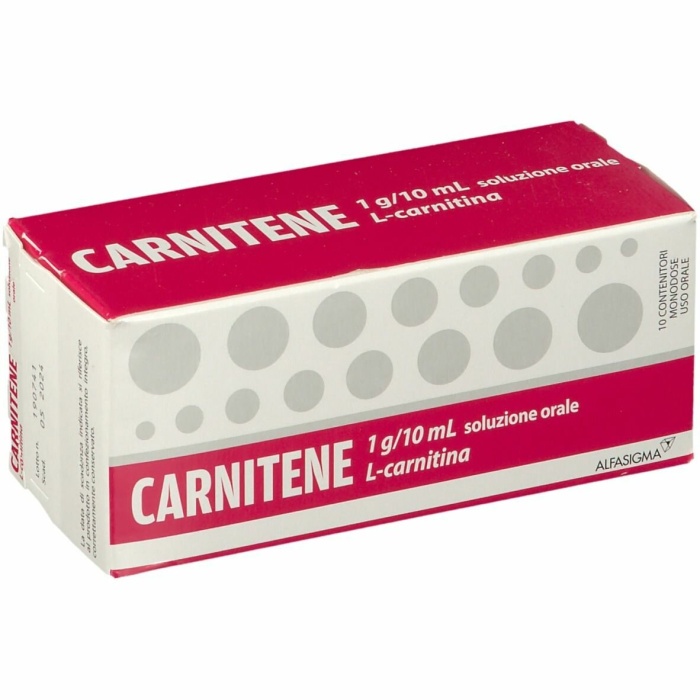
- Страна регистрации
- Форма выпускаOral solution, 1,5 G/5 ML
- Код АТХA16AA01
- Действующее вещество
- Отпускается по рецептуНет
- Производитель
- Информация на этой странице носит справочный характер и не является медицинской консультацией. Перед началом приема лекарства обязательно проконсультируйтесь с врачом.
- Аналоги KARNITENEФорма выпуска: Oral solution, 1 G/10 MLДействующее вещество: левокарнитинаОтпускается без рецептаФорма выпуска: Coated tablet, 500 MGДействующее вещество: левокарнитинаПроизводитель: ALFASIGMA S.P.A.Отпускается по рецептуФорма выпуска: Dispersible tablet, 200 MGДействующее вещество: Карглюмиковая кислотаПроизводитель: WAYMADE B.V.Отпускается по рецепту
Аналоги KARNITENE в других странах
Лекарства с тем же действующим веществом, доступные в других странах.
Аналог KARNITENE в Украина
Аналог KARNITENE в Испания
Врачи онлайн по KARNITENE
Обсудите применение KARNITENE и возможные следующие шаги — по оценке врача.









Получите рецепт на KARNITENE онлайн
Заполните форму за 2 минуты
Расскажите о симптомах, истории болезни и нужном препарате.
Выберите врача или мы назначим
Выберите специалиста или мы подберём ближайшего доступного врача.
Врач рассматривает ваш случай
Обычно в течение 30 минут. Может задать уточняющие вопросы в чате.
Получите в любой аптеке
Электронный рецепт отправляется на вашу почту — действителен по всей Польше.
Часто задаваемые вопросы
KARNITENE не требует рецепта в Италия. Вы можете уточнить у врача онлайн, подходит ли это лекарство для вашей ситуации.
Действующее вещество KARNITENE — левокарнитина. Эта информация помогает определить лекарства с тем же составом под другими торговыми названиями.
KARNITENE производится компанией ALFASIGMA S.P.A.. Упаковка и торговое название могут отличаться в зависимости от дистрибьютора.
Врачи, включая Семейные врачи, Психиатры, Дерматологи, Кардиологи, Эндокринологи, Гастроэнтерологи, Пульмонологи, Нефрологи, Ревматологи, Гематологи, Инфекционисты, Аллергологи, Гериатры, Педиатры, Онкологи, могут оценить целесообразность применения KARNITENE с учетом вашей ситуации и местных правил. Вы можете записаться на онлайн-консультацию, чтобы обсудить возможные варианты.
Польша имеет хорошо развитую систему здравоохранения в крупных городах, таких как Варшава, Краков, Вроцлав и Гданьск. Аптеки широко доступны и работают в соответствии с действующим законодательством, обеспечивая доступ к рецептурным препаратам.
Вы можете купить KARNITENE в Варшаве, Кракове, Вроцлаве или Гданьске в любой аптеке при наличии действующего рецепта.
Чтобы получить рецепт, вы можете воспользоваться Oladoctor:
Другие лекарства с тем же действующим веществом (левокарнитина) включают KARREFLOR, DROMOS, AKIDO KARLUMIKO WAYMADE. Они могут отличаться торговым названием или формой выпуска, но содержат одинаковый терапевтический компонент. Перед изменением лечения рекомендуется проконсультироваться с врачом.
