



CAPRELSA 100 mg Фильм-Coated Таблетки

Рассмотрение рецепта онлайн
Врач рассмотрит ваш случай и примет решение о назначении рецепта, если это медицински оправдано.

Поговорите с врачом об этом лекарстве
Обсудите симптомы и возможные дальнейшие шаги на онлайн-консультации.



Инструкция по применению KAPRELSA
Содержание инструкции
Caprelsa 100 mg film-coated tablets, 300 mg film-coated tablets
Vandetanib
In addition to this leaflet, you will be given the Patient Alert Card containing important
safety information that you must know before taking Caprelsa and during treatment
with this medicine.
Read this leaflet carefully before you start taking this medicine as it contains
important information for you.
- Keep this leaflet and the patient alert card. You may need to read it again.
- It is important that you keep the Alert Card with you during treatment.
- If you have any questions, ask your doctor or pharmacist.
- This medicine has been prescribed for you only. Do not pass it on to others even if they have the same symptoms as you, as it may be harmful.
- If you get any side effects, even those not listed in this leaflet, tell your doctor or pharmacist. See section 4.
Contents of this leaflet:
- 1. What Caprelsa is and what it is used for
- 2. What you need to know before you take Caprelsa
- 3. How to take Caprelsa
- 4. Possible side effects
- 5. How to store Caprelsa
- 6. Contents of the pack and other information
1. What is Caprelsa and what is it used for
Caprelsa is a treatment for adults and children aged 5 years and older with:
a type of medullary thyroid carcinoma called RET (Rearranged during
Transfection) gene mutant, and that cannot be surgically removed or has already spread to other parts of the
body.
Caprelsa works by slowing the growth of new blood vessels in the tumor (cancer). This interrupts the
supply of nutrients and oxygen to the tumor. Caprelsa may also act directly on cancer cells
killing them or slowing their growth.
2. What you need to know before taking Caprelsa
Do not take Caprelsa:
- If you are allergic to vandetanib or any of the other ingredients of this medicine (listed in section 6).
- If you have a heart problem from birth, called “long QT syndrome”. This can be detected by an electrocardiogram (ECG).
- If you are breastfeeding.
- If you are taking any of these medicines: arsenic, cisapride (used to treat heartburn), erythromycin intravenously and moxifloxacin (used to treat infections), toremifene (used to treat breast cancer), mizolastine (used to treat allergies), Class IA and III antiarrhythmics
(used to control heart rhythm).
Do not take Caprelsa if any of the above apply to you. If you are unsure, ask your doctor.
Warnings and precautions
Talk to your doctor or pharmacist before taking Caprelsa:
- If you are sensitive to the sun. Some people taking Caprelsa become more sensitive to the sun. This can cause sunburn. During treatment with Caprelsa, and to avoid sun exposure, you should always protect yourself before going out by using sunscreen and wearing protective clothing.
- If you have high blood pressure.
- If you have or have had an aneurysm (a bulge and weakening of a blood vessel wall) or a tear in a blood vessel wall.
- If you are going to have surgery. Your doctor may consider stopping treatment with Caprelsa if you are going to have major surgery, as Caprelsa can affect wound healing. Treatment with Caprelsa can be restarted when adequate wound healing has been established.
- If you have kidney problems.
Severe Skin Reactions (SCARs), including Stevens-Johnson syndrome (SJS)/toxic epidermal necrolysis (TEN), have been reported in association with vandetanib treatment. If you notice
any symptoms related to these severe skin reactions described in section 4, stop
taking Caprelsa and contact your doctor immediately.
Before starting treatment with Caprelsa, the status of the RET gene in the
tumor must be determined.
Blood and heart tests:
Your doctor or nurse must perform blood tests to check the levels of potassium, calcium,
magnesium and thyroid-stimulating hormone (TSH), as well as the electrical activity of the heart, by means of a
test called an electrocardiogram (ECG). You must undergo these tests:
- Before starting treatment with Caprelsa
- Regularly during treatment with Caprelsa
- 1, 3 and 6 weeks after starting treatment with Caprelsa
- 12 weeks after starting treatment with Caprelsa
- Subsequently every three months
- If your doctor or pharmacist changes the dose of Caprelsa
- If you start taking medicines that have an effect on the heart
- As recommended by your doctor or pharmacist
Children
Caprelsa should not be given to children under 5 years of age.
Other medicines and Caprelsa
Tell your doctor or pharmacist if you are taking, have recently taken or might take
any other medicines, including those available without a prescription and herbal medicines. This
is because Caprelsa can affect the activity of some medicines and some medicines can interfere
with the activity of Caprelsa.
Tell your doctor or pharmacist if you are taking any of the following medicines:
- itraconazole, ketoconazole, ritonavir, clarithromycin, rifampicin and moxifloxacin (medicines used to treat infections)
- carbamazepine and phenobarbital (used to control seizures)
- ondansetron (used to treat nausea and vomiting)
- cisapride (used to treat heartburn), pimozide (used to treat tics and verbal aggression) and halofantrine and lumefantrine (used to treat malaria)
- methadone (used to treat addiction), haloperidol, chlorpromazine, sulpiride, amisulpride and zuclopenthixol (used to treat mental illnesses)
- pentamidine (used to treat infections)
- vitamin K antagonists, and dabigatran often called ‘blood thinners’
- cyclosporine and tacrolimus (used to treat transplant rejection), digoxin (used to treat irregular heartbeat) and metformin (used to control blood sugar)
- proton pump inhibitors (used to treat heartburn). This information is also included in the Patient Alert Card, provided by your doctor. It is important that you keep this Alert Card and show it to your family or healthcare providers.
Pregnancy and breastfeeding
If you are pregnant, suspect you may be pregnant, are planning a pregnancy or are breastfeeding, ask your doctor for advice before taking this medicine, as Caprelsa may harm
the fetus. Your doctor will explain the benefits and risks of taking Caprelsa during
pregnancy.
- If you are of childbearing potential, during treatment with Caprelsa and for at least four months after the last dose of Caprelsa, you should use effective contraception.
For the safety of your baby, do not breastfeed during treatment with Caprelsa.
Driving and using machines
Be careful when driving and using machines. Be aware that Caprelsa can
cause fatigue, weakness or blurred vision.
3. How to take Caprelsa
Use in adults
Always take this medicine exactly as your doctor has told you. If you have any doubts, ask your
doctor or pharmacist.
- The recommended dose is 300 mg each day.
- Take Caprelsa every day, at about the same time.
- Caprelsa can be taken with or without food.
Use in children and adolescents
Your doctor will tell you how many Caprelsa tablets to give to your child. The amount of Caprelsa will depend
on the child's height and weight. The total daily dose in children should not exceed 300 mg.
Treatment can be given to the child either as a single dose once a day, or on alternate days, or according to a repeating 7-day schedule, as indicated in the dosage guide
that was given to you by your doctor. It is important that you keep the dosage guide and show it
to the people who take care of your child.
If you have difficulty swallowing the tablet
If you have difficulty swallowing the tablet, you can mix it in water as described below:
- Take half a glass of still (non-carbonated) water. Use only water - do not use other liquids.
- Put the tablet in the water.
- Stir the contents until the tablet has dispersed in the water. This may take about 10 minutes.
- Drink the liquid immediately.
To make sure that no medicine remains, refill the glass halfway with water and
drink the contents.
If you experience undesirable effects
If you experience any side effects, always inform your doctor. The doctor may reduce or increase the dose
of Caprelsa (for example two 100 mg tablets or one 100 mg tablet). They may also
prescribe other medicines to help control the side effects. The side effects of
Caprelsa are listed in section 4.
If you take more Caprelsa than you should
If you have taken more Caprelsa than you have been prescribed, inform your doctor immediately or
go to the nearest hospital.
If you forget to take Caprelsa
What to do if you forget to take a tablet depends on how much time is left until the next dose.
is due.
- If there are 12 hours or more until the next dose:Take the forgotten tablet as soon as you remember. Then take the next dose at the usual time.
- If there are less than 12 hours until the next dose:Skip the forgotten tablet. Then take the next tablet at the usual time.
Do not take a double dose (two tablets at the same time) to make up for forgetting to take a
tablet.
If you have any further questions on the use of this medicine, ask your doctor or pharmacist.
4. Possible side effects
Like all medicines, this medicine can cause side effects, although not everyone will experience them.
If any side effect occurs, your doctor may reduce the dose of Caprelsa. They may also prescribe you other
medicines to help manage the side effects.
Immediately inform your doctor if you notice any of the following side effects – you may need urgent
medical attention:
- Fainting, dizziness, or changes in heart rate. These could be signs of a change in the electrical activity of your heart. Such symptoms were observed in 8% of subjects who took Caprelsa for the treatment of medullary thyroid carcinoma. Your doctor may recommend using Caprelsa at a lower dose or stopping it. Caprelsa has been associated, infrequently, with life-threatening heart rhythm disturbances.
- Stop treatment with Caprelsa and contact your doctor immediately if you notice any of the following symptoms: flat, reddish patches on the trunk, resembling a target or circular, often with central blisters, skin peeling, mouth, throat, nose, genital, and eye ulcers. These severe skin rashes may be preceded by fever and flu-like symptoms (Stevens-Johnson syndrome and toxic epidermal necrolysis).
- Severe diarrhea.
- Severe shortness of breath or sudden worsening of shortness of breath, with possible cough or high temperature (fever). This could indicate inflammation of the lungs called “interstitial lung disease”. This reaction is considered uncommon (affects less than 1 in 100 patients), but can be life-threatening.
- Seizures, headache, confusion, or difficulty concentrating. These may be signs of a condition called RPLS (Reversible Posterior Leukoencephalopathy Syndrome). Generally, these symptoms disappear when treatment with Caprelsa is stopped. RPLS is considered an uncommon side effect (affects less than 1 in 100 patients).
Immediately inform your doctor if you notice any of the side effects listed above.
Other side effects include:
Very common (affect more than 1 in 10 people):
- Diarrhea. Your doctor may prescribe medication to control the diarrhea. If it worsens, inform your doctor immediately.
- Abdominal pain.
- Rash or acne.
- Depression.
- Fatigue.
- Feeling unwell (nausea).
- Stomach discomfort (dyspepsia).
- Nail diseases.
- Feeling sick (vomiting).
- Loss of appetite (anorexia).
- Weakness (asthenia).
- High blood pressure (arterial hypertension). Your doctor may prescribe medication to control blood pressure.
- Headache.
- Fatigue.
- Sleep disorders (insomnia).
- Inflammation of the nasal passages.
- Inflammation of the major airways of the lungs.
- Upper respiratory tract infections.
- Urinary tract infections.
- Numbness or tingling of the skin.
- Abnormal skin sensation.
- Dizziness.
- Pain.
- Swelling caused by excess fluid (edema).
- Kidney stones or calcium deposits in the urinary tract (nephrolithiasis).
- Blurred vision, including mild eye disturbances that can cause blurred vision (corneal opacity).
- Skin sensitivity to sunlight. During treatment with Caprelsa, you should always protect yourself before going out, using sunscreen and wearing appropriate clothing to avoid sun exposure.
Common (affect less than 1 in 10 people):
- Dehydration.
- Severe high blood pressure.
- Weight loss.
- Stroke or other conditions in which the brain does not receive enough blood.
- A type of rash that affects the hands and feet (hand-foot syndrome).
- Painful mouth (stomatitis).
- Dry mouth.
- Lung infection.
- Toxins in the blood as a complication of an infection.
- Flu.
- Inflammation of the urinary bladder.
- Inflammation of the sinuses.
- Inflammation of the throat (larynx).
- Inflammation of a follicle, especially a hair follicle.
- Pimples.
- Fungal infection.
- Kidney infection.
- Loss of fluids (dehydration).
- Anxiety.
- Tremor.
- Drowsiness.
- Fainting.
- Feeling unstable.
- Increased pressure inside the eye (glaucoma).
- Coughing up blood.
- Inflammation of lung tissue.
- Difficulty swallowing.
- Constipation.
- Inflammation of the stomach lining (gastritis).
- Gastrointestinal bleeding.
- Gallstones (cholelithiasis).
- Painful urination.
- Kidney failure.
- Frequent urination.
- Urgent need to urinate.
- Fever.
- Nosebleed (epistaxis).
- Dry eye.
- Eye irritation (conjunctivitis).
- Vision changes.
- Vision with halo.
- Perception of flashing lights (photopsia).
- Corneal disorder (keratopathy).
- Diarrhea (colitis).
- Hair loss (alopecia).
- Changes in taste (dysgeusia).
Uncommon (affect less than 1 in 100 people):
- Heart failure.
- Inflammation of the appendix (appendicitis).
- Bacterial infection.
- Inflammation of diverticula (small pouches that can form in the digestive tract).
- Bacterial skin infection.
- Abdominal wall abscess.
- Malnutrition.
- Involuntary muscle contraction (convulsions).
- Rapid alternation of muscle contraction and relaxation (clonus).
- Brain swelling.
- Opacity of the lens of the eye.
- Heart rate and rhythm disorders.
- Loss of heart function.
- Insufficient lung function.
- Pneumonia that occurs when foreign bodies are inhaled into the lungs.
- Intestinal obstruction.
- Perforation of the intestine.
- Inability to control bowel movements.
- Abnormal urine color.
- Lack of urine.
- Inability to heal properly.
- Inflammation of the pancreas (pancreatitis).
- Blistering of the skin (bullous dermatitis).
Not known (frequency cannot be estimated from available data)
- Dilation and weakening of a blood vessel wall or tearing of a blood vessel wall (aneurysms and arterial dissections).
- Flat, reddish patches on the trunk, resembling a target or circular, often with central blisters, skin peeling, mouth, throat, nose, genital, and eye ulcers that may be preceded by fever and flu-like symptoms. These severe skin rashes can be potentially life-threatening (Stevens-Johnson syndrome and toxic epidermal necrolysis).
- Skin reaction that causes red or reddish patches on the skin, which may appear as a target or "bull's-eye" with a dark red center surrounded by rings of light red color (erythema multiforme).
Tests performed by your doctor may reveal the following side effects:
- Protein or blood in the urine (detected through a urine test).
- Changes in heart rate (found on an ECG). Your doctor may stop treatment with Caprelsa or prescribe a lower dose.
- Liver or pancreas abnormalities (found through blood tests). These usually do not cause symptoms, but your doctor may decide to monitor them.
- Decreases in calcium levels in the blood. Your doctor may consider prescribing or changing thyroid hormone therapy.
- Decreased potassium levels in the blood.
- Increased calcium levels in the blood.
- Increased glucose levels in the blood.
- Decreased sodium levels in the blood.
- Decreased thyroid function.
- Increased levels of red blood cells in the blood. If any of these side effects worsen, or if you notice any other effect
pharmacist.
Reporting of side effects
If you get any side effects, talk to your doctor, pharmacist, or nurse. You can also report side effects
directly through the national reporting system detailed in Annex V.
By reporting side effects you can help provide more information on the safety of this medicine.
5. How to store Caprelsa
Keep this medicine out of the sight and reach of children.
Do not use this medicine after the expiry date which is stated on the blister and the packaging, after
the wording EXP. The expiry date refers to the last day of that month.
Do not store at a temperature above 30°C.
Do not dispose of any medicine in waste water or household waste. Ask your pharmacist how to
dispose of medicines you no longer use. This will help protect the environment.
6. Contents of the pack and other information
What Caprelsa contains
- The active substance is vandetanib. Each tablet contains 100 mg or 300 mg of vandetanib.
- The excipients are: dibasic calcium phosphate dihydrate, microcrystalline cellulose, crospovidone (Type A), povidone (K29-32), magnesium stearate, hypromellose, macrogol and titanium dioxide (E171).
Description of the appearance of Caprelsa and contents of the pack
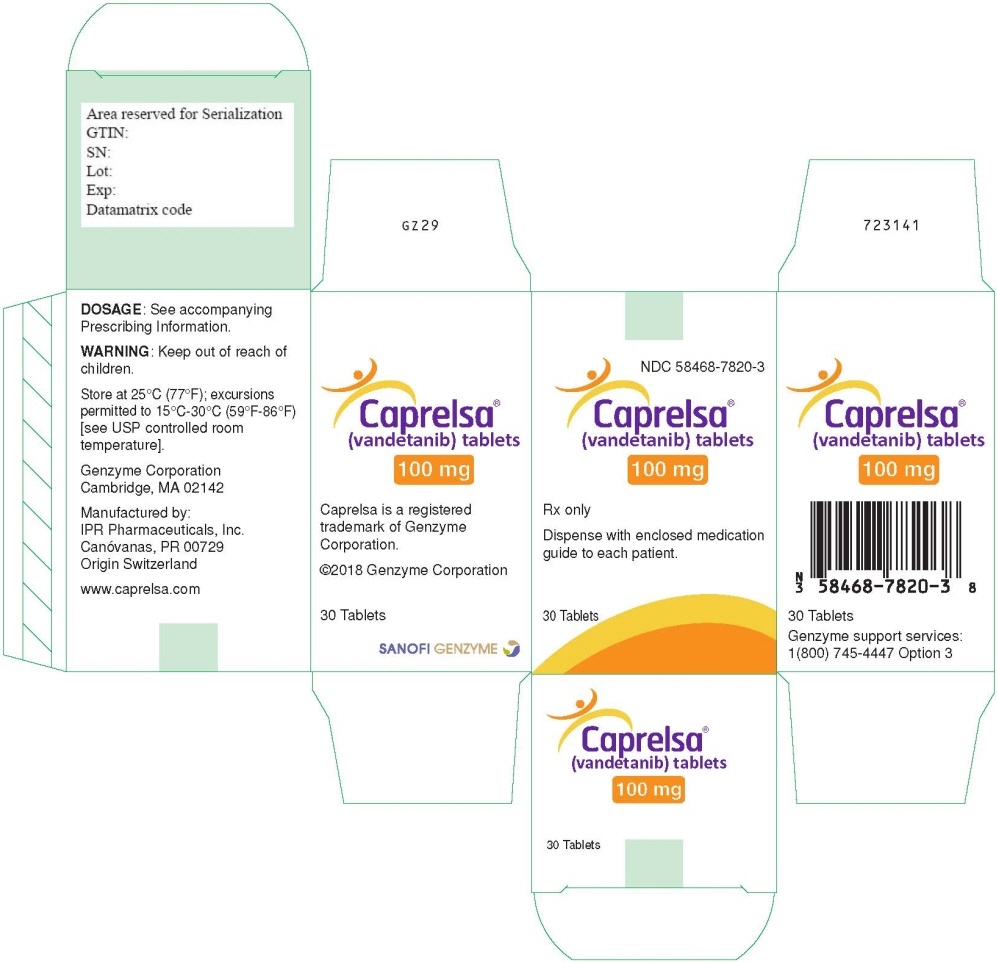
Caprelsa 100 mg is a white, round, film-coated tablet, with ‘Z100’ imprinted on one side.
Caprelsa 300 mg is a white, oval-shaped, film-coated tablet, with ‘Z300’ imprinted on
one side.
Caprelsa is available in blisters in packs of 30 tablets.
Marketing Authorisation Holder
Sanofi B.V.
Paasheuvelweg 25
1105 BP Amsterdam
Netherlands
Manufacturer
Genzyme Ireland Ltd, IDA Industrial Park, Old Kilmeaden Road, Waterford, Ireland.
Sanofi Winthrop Industrie, 30-36 avenue Gustave Eiffel, 37100 Tours, France
For further information on this medicinal product, contact the local representative of the marketing
authorisation holder:
België/Belgique/Belgien/
Luxembourg/Luxemburg
Sanofi Belgium
Tél/Tel: + 32 (0) 2 710 54 00
Magyarország
SANOFI-AVENTIS Zrt.
Tel: +36 1 505 0050
България
Swixx Biopharma EOOD
Тел.: +359 (0)2 4942 480
Malta
Sanofi S.r.l.
Tel: +39 02 3939 4275
Česká republika
sanofi-aventis, s.r.o.
Tel: +420 233 086 111
Nederland
Sanofi B.V.
Tel: +31 20 245 4000
Danmark
sanofi A/S
Tlf: +45 45 16 70 00
Norge
sanofi-aventis Norge AS
Tlf: + 47 67 10 71 00
Deutschland
Sanofi-Aventis Deutschland GmbH
Tel.: 0800 52 52 010
Tel. aus dem Ausland: +49 69 305 21 131
Österreich
sanofi-aventis GmbH
Tel: + 43 1 80 185 - 0
Eesti
Swixx Biopharma OÜ
Tel: +372 640 10 30
Polska
sanofi-aventis Sp. z o.o.
Tel.: +48 22 280 00 00
Ελλάδα
Sanofi-Aventis Μονοπρόσωπη AEBE
Τηλ: +30 210 900 1600
Portugal
Sanofi – Produtos Farmacêuticos, Lda.
Tel: +351 21 35 89 400
España
sanofi-aventis, S.A.
Tel: +34 93 485 94 00
România
Sanofi Romania SRL
Tel: +40 (0) 21 317 31 36
France
Sanofi Winthrop Industrie
Tél: 0 800 222 555
Appel depuis l’étranger: +33 1 57 63 23 23
Slovenija
Swixx Biopharma d.o.o.
Tel: +386 1 235 51 00
Hrvatska
Swixx Biopharma d.o.o.
Tel: +385 1 2078 500
Ireland
sanofi-aventis Ireland Ltd. T/A SANOFI
Tel: +353 (0) 1 403 56 00
Slovenská republika
Swixx Biopharma s.r.o.
Tel: +421 2 208 33 600
Ísland
Vistor hf.
Sími: +354 535 7000
Suomi/Finland
Sanofi Oy
Puh/Tel: + 358 (0) 201 200 300
Italia
Sanofi S.r.l.
Tel: 800 536 389
Κύπρος
C.A. Papaellinas Ltd.
Τηλ: +357 22 741741
Sverige
Sanofi AB
Tel: +46 (0)8 634 50 00
Latvija
Swixx Biopharma SIA
Tel: +371 6 616 47 50
United Kingdom (Northern Ireland)
sanofi-aventis Ireland Ltd. T/A SANOFI
Tel: +44 (0) 800 035 2525
Lietuva
Swixx Biopharma UAB
Tel: +370 5 236 91 40
Other sources of information
More detailed information on this medicinal product is available on the website of the European Medicines
Agency: http://www.ema.europa.eu

Не уверены, подходит ли вам это лекарство?
Обсудите симптомы и варианты лечения с врачом онлайн.

Уже начали прием и появились вопросы?
Обсудите свое состояние и дальнейшие шаги с врачом онлайн.
- Страна регистрации
- Форма выпускаFilm-coated tablet, 100MG
- Код АТХL01EX04
- Действующее вещество
- Отпускается по рецептуДа
- Производитель
- Информация на этой странице носит справочный характер и не является медицинской консультацией. Перед началом приема лекарства обязательно проконсультируйтесь с врачом.
- Аналоги KAPRELSAФорма выпуска: Hard capsule, 40 mgДействующее вещество: Other protein kinase inhibitorsПроизводитель: BRISTOL-MYERS SQUIBB PHARMA EEIGОтпускается по рецептуФорма выпуска: Film-coated tablet, 100 MGДействующее вещество: АвапритинибПроизводитель: BLUEPRINT MEDICINES (NETHERLANDS) BVОтпускается по рецептуФорма выпуска: Film-coated tablet, 20 MGДействующее вещество: КабозантинибПроизводитель: IPSEN PHARMAОтпускается по рецепту
Аналоги KAPRELSA в других странах
Лекарства с тем же действующим веществом, доступные в других странах.
Аналог KAPRELSA в Польша
Аналог KAPRELSA в Испания
Получите рецепт на KAPRELSA онлайн
Заполните форму за 2 минуты
Расскажите о симптомах, истории болезни и нужном препарате.
Выберите врача или мы назначим
Выберите специалиста или мы подберём ближайшего доступного врача.
Врач рассматривает ваш случай
Обычно в течение 30 минут. Может задать уточняющие вопросы в чате.
Получите в любой аптеке
Электронный рецепт отправляется на вашу почту — действителен по всей Польше.
Часто задаваемые вопросы
KAPRELSA требует рецепта в Италия. Вы можете уточнить у врача онлайн, подходит ли это лекарство для вашей ситуации.
Действующее вещество KAPRELSA — Вандетаниб. Эта информация помогает определить лекарства с тем же составом под другими торговыми названиями.
KAPRELSA производится компанией SANOFI B.V.. Упаковка и торговое название могут отличаться в зависимости от дистрибьютора.
Врачи, включая Семейные врачи, Психиатры, Дерматологи, Кардиологи, Эндокринологи, Гастроэнтерологи, Пульмонологи, Нефрологи, Ревматологи, Гематологи, Инфекционисты, Аллергологи, Гериатры, Педиатры, Онкологи, могут оценить целесообразность применения KAPRELSA с учетом вашей ситуации и местных правил. Вы можете записаться на онлайн-консультацию, чтобы обсудить возможные варианты.
Польша имеет хорошо развитую систему здравоохранения в крупных городах, таких как Варшава, Краков, Вроцлав и Гданьск. Аптеки широко доступны и работают в соответствии с действующим законодательством, обеспечивая доступ к рецептурным препаратам.
Вы можете купить KAPRELSA в Варшаве, Кракове, Вроцлаве или Гданьске в любой аптеке при наличии действующего рецепта.
Чтобы получить рецепт, вы можете воспользоваться Oladoctor:
Другие лекарства с тем же действующим веществом (Вандетаниб) включают AUGTYRO, AYVAKYT, KABOMETYX. Они могут отличаться торговым названием или формой выпуска, но содержат одинаковый терапевтический компонент. Перед изменением лечения рекомендуется проконсультироваться с врачом.
