



CALQUENCE 100 mg Hard Capsule

Рассмотрение рецепта онлайн
Врач рассмотрит ваш случай и примет решение о назначении рецепта, если это медицински оправдано.

Поговорите с врачом об этом лекарстве
Обсудите симптомы и возможные дальнейшие шаги на онлайн-консультации.



Инструкция по применению KALQUENKE
Содержание инструкции
Calquence 100 mg hard capsules
acalabrutinib
Read this leaflet carefully before you start taking this medicine because it contains important
information for you.
- Keep this leaflet. You may need to read it again.
- If you have any questions, ask your doctor, pharmacist or nurse.
- This medicine has been prescribed for you only. Do not pass it on to others, even if they have the same symptoms as you, as it may be harmful.
- If you get any side effects, even those not listed in this leaflet, tell your doctor, pharmacist or nurse. See section 4.
Contents of this leaflet:
- 1. What Calquence is and what it is used for
- 2. What you need to know before you take Calquence
- 3. How to take Calquence
- 4. Possible side effects
- 5. How to store Calquence
- 6. Contents of the pack and other information
1. What is Calquence and what is it used for
What is Calquence
- Calquence contains the active substance acalabrutinib.
- It belongs to a group of medicines called Bruton’s tyrosine kinase (BTK) inhibitors.
What is Calquence used for
Calquence is used to treat adults with chronic lymphocytic leukemia (CLL).
CLL is a cancer of the white blood cells, called B lymphocytes (or B cells). These cells are part of the
immune system (the body's defenses).
Calquence is used to treat adults with mantle cell lymphoma (MCL).
MCL is a type of blood cancer that affects the lymph nodes.
How Calquence works
Calquence works by blocking BTK, a protein found in the body that helps cancer cells grow and
survive. By blocking BTK, Calquence helps to kill and can reduce the
number of cancer cells, slowing the progression of the disease.
If you have any questions about how Calquence works or why this medicine has been prescribed for you,
ask your doctor, pharmacist or nurse.
2. What you need to know before you take Calquence
Do not take Calquence
- if you are allergic to acalabrutinib or any of the other ingredients of this medicine (listed in section 6).
If you are not sure, ask your doctor, pharmacist or nurse before taking Calquence.
Warnings and precautions
Talk to your doctor, pharmacist or nurse before taking Calquence, if:
- you have ever had unusual bruising or bleeding or if you are taking any medicine that increases the risk of bleeding (see section 4 “Possible side effects”)
- you have an infection (see section 4 “Possible side effects”)
- you have recently had or are going to have surgery. Your doctor may stop treatment with Calquence before and after a medical, surgical or dental procedure
- you have ever had hepatitis B (a liver infection), as Calquence may cause hepatitis B to become active again, so your doctor will look for signs of the infection returning (see section 4 “Possible side effects”)
- you have or have ever had an irregular heartbeat (see section 4 “Possible side effects”).
Talk to your doctor if you develop a new skin lesion or any change in the appearance of an area of the
skin as you are at high risk of developing skin cancer (see section 4). Use
sun protection and have regular skin checks.
Your doctor will check your blood count during treatment, if necessary.
Children and adolescents
This medicine should not be given to children and adolescents under 18 years of age, as
it has not been studied in this age group.
Other medicines and Calquence
Tell your doctor, pharmacist or nurse if you are taking, have recently taken or might
take any other medicines, especially if you are taking:
- antibiotics for bacterial infections - such as clarithromycin
- medicines for fungal infections - such as posaconazole, itraconazole or voriconazole
- ketoconazole - a medicine for Cushing's syndrome (a condition where the body produces too much cortisol)
- medicines for HIV infections - such as indinavir and ritonavir
- medicines for hepatitis C - such as telaprevir
- rifampicin - an antibiotic for bacterial infections (tuberculosis)
- ergotamine - a medicine for migraines
- conivaptan - a medicine for low sodium levels in the blood
- metformin - a medicine for high blood sugar levels
- cyclosporine - a medicine to prevent organ rejection
- medicines for seizures or epilepsy - such as carbamazepine and phenytoin
- pimozide - a medicine used for Tourette's syndrome (a condition that causes uncontrolled movements and excessive words and sounds)
- St. John's Wort (hypericum, Hypericum perforatumL.) - a herbal medicine for depression
- theophylline - a medicine used for wheezing, shortness of breath and tightness in the chest
- medicines to reduce stomach acid: or antacids - such as calcium carbonate. Take Calquence 2 hours before or 2 hours after taking these medicines.
- histamine receptor 2 blockers - such as ranitidine and famotidine. Take Calquence 2 hours before or 10 hours after taking these medicines.
- proton pump inhibitors - such as omeprazole. Avoid taking these medicines while taking Calquence.
- methotrexate - a medicine for diseases such as rheumatoid arthritis, psoriasis and ulcerative colitis, which are caused by the immune system not working properly.
- This medicine must be taken at least 6 hours before or after Calquence.
Medicines that increase the risk of bleeding
Calquence may make bleeding easier. Tell your doctor, pharmacist or nurse if you are taking
other medicines that increase the risk of bleeding:
- antiplatelet agents (medicines that work against blood clotting) such as acetylsalicylic acid and clopidogrel
- anticoagulants (blood thinners) such as warfarin or enoxaparin.
Pregnancy
If you are pregnant, or suspect you may be pregnant, ask your doctor for advice
before taking Calquence. This is because Calquence may have harmful effects on the unborn baby.
Breast-feeding
Do not breast-feed during treatment with Calquence and for 2 days after the last dose of
Calquence. It is not known whether Calquence passes into breast milk.
Driving and using machines
It is unlikely that Calquence will affect your ability to drive and use machines. However, if
you feel dizzy, weak or tired while taking Calquence, do not drive and
use machines.
Calquence contains sodium
This medicine contains less than 1 mmol (23 mg) of sodium per dose, that is to say essentially ‘sodium-free’.
3. How to take Calquence
Calquence will be prescribed exclusively by a doctor experienced in the use of anticancer medicines.
Take Calquence following the doctor's instructions exactly at all times. If you have any doubts
consult your doctor, pharmacist or nurse.
Depending on the type of tumor, Calquence may be administered in combination with other anticancer medicines.
How much to take
- The usual dose is one capsule (100 mg) twice a day. Take the doses approximately 12 hours apart.
How to take it
- Swallow the capsule whole with water at approximately the same time each day.
- Do not chew, dissolve or open the capsules as this may alter the rate at which the drug is absorbed by the body.
- You can take Calquence with food or between meals.
- You can check when you took your last Calquence capsule by looking at the blister pack. The images on the blister pack will help you take the dose at the right time: the sun for the morning dose and the moon for the evening dose.
If you take more Calquence than you should
If you have taken more Calquence than you should have, consult a doctor or go to the nearest hospital immediately
If you forget to take a dose
- If less than 3 hours have passed since you should have taken the missed dose, take it immediately and take the next dose at the usual time.
- If more than 3 hours have passed since the scheduled time for taking the dose, skip the missed dose. Take the next dose at the usual time.
- Do not take a double dose to make up for a missed dose.
If you have any further questions on the use of this medicine, ask your doctor, pharmacist or nurse.
4. Possible side effects
Like all medicines, this medicine can cause side effects, although not everyone will experience them.
Stop taking Calquence and contact your doctor or go immediately to the nearest emergency room if any of the following symptoms occur:
Very common serious side effects(may affect more than 1 in 10 people)
- Bleeding from various sites, including skin, intestines, and brain. Symptoms may include black stools or stools with blood, pink or brown urine, nosebleeds, bruising, unexpected bleeding, vomiting or coughing up blood, dizziness, weakness, confusion
- Infections. Signs may include fever, chills, feeling weak or confused, cough, shortness of breath [lung infection, a very common side effect(may affect more than 1 in 10 people) or aspergillosis, a not common side effect(may affect up to 1 in 100 people)].
Common serious side effects(may affect up to 1 in 10 people)
- fast heartbeat, skipped heartbeats, weak or irregular pulse, dizziness, feeling faint, chest discomfort or shortness of breath (signs of heart rhythm problems known as atrial fibrillation and atrial flutter).
- fever, chills, nausea, vomiting, confusion, shortness of breath, seizures, irregular heartbeat, cloudy or dark-colored urine, unusual fatigue, or muscle or joint pain. These may be symptoms of tumor lysis syndrome (TLS), a condition caused by the rapid breakdown of cancer cells.
Other side effects:
Very common(may affect more than 1 in 10 people):
- muscle or joint pain
- headache
- skin rash
- fatigue, weakness, or lack of energy
- stomach discomfort (nausea), vomiting, stomach pain, constipation (infrequent or hard stools), diarrhea (frequent or loose stools)
- decreased number of red blood cells, decreased number of neutrophils (a type of white blood cells), or decreased number of cells that help blood clot (platelets)
- high blood pressure
- dizziness
- headache, pressure in the area between eyes, nose, or cheeks (sinusitis)
- sore throat and runny nose (nasopharyngitis)
- upper respiratory tract infection
- urinary tract infection (pain or burning during urination)
- new cancers, including skin cancers, may develop during treatment with Calquence (see section 2 “What you need to know before you take Calquence”)
- herpes
Common(may affect up to 1 in 10 people):
- increased levels of liver enzymes (aspartate aminotransferase and alanine aminotransferase) in blood tests [when used in combination with certain medicines for the treatment of mantle cell lymphoma (MCL)].
- bronchitis
- fever, chills, weakness, confusion, feeling unwell, and yellowing of the skin or eyes (jaundice), these may be signs of hepatitis B reactivation (a liver infection).
- lung inflammation (pneumonia)
Not common side effects(may affect up to 1 in 100 people)
- memory loss, difficulty thinking, difficulty walking, or loss of vision - these may be symptoms of a serious brain infection (progressive multifocal leukoencephalopathy or PML).
- lymphocytosis (a higher than normal amount of lymphocytes, a type of white blood cells, in the blood).
Reporting of side effects
If you get any side effects, talk to your doctor or pharmacist. You can also report side effects directly through the national reporting system listed in Annex V. By reporting side effects you can help provide more information on the safety of this medicine.
5. How to store Calquence
Keep this medicine out of the sight and reach of children.
Do not use this medicine after the expiry date which is stated on the box and blister after
Expiry/EXP. The expiry date refers to the last day of that month.
This medicine does not require any particular storage conditions.
Do not dispose of any medicine in waste water or household waste. Ask your pharmacist how to
dispose of medicines you no longer use. This will help protect the environment.
6. Package Contents and Other Information
What Calquence contains
The active ingredient is acalabrutinib. Each hard capsule contains 100 mg of acalabrutinib.
The other ingredients are:
- capsule contents: microcrystalline cellulose, anhydrous colloidal silicon dioxide, partially pregelatinized corn starch, magnesium stearate (E470b) and sodium starch glycolate (see section 2 “Calquence contains sodium”)
- capsule shell: gelatin, titanium dioxide (E171), yellow iron oxide (E172) and indigotin (E132)
- printing ink: shellac, black iron oxide (E172), propylene glycol (E1520) and ammonium hydroxide.
Description of Calquence and package contents
Calquence is a 20 mm hard gelatin capsule with a yellow body and a blue closure cap, with
“ACA 100 mg” printed in black.
Calquence is supplied in aluminum blisters containing 6 or 8 hard capsules. Each pack contains
56 or 60 hard capsules.
Not all pack sizes may be marketed.
Marketing Authorisation Holder
AstraZeneca AB
SE-151 85 Södertälje
Sweden
Manufacturer
AstraZeneca AB
Gärtunavägen
SE-152 57 Södertälje
Sweden
For further information on this medicinal product, contact the local representative of the marketing
authorisation holder:
België/Belgique/Belgien
AstraZeneca S.A./N.V.
Tel: +32 2 370 48 11
Lietuva
UAB AstraZeneca Lietuva
Tel: +370 5 2660550
България
АстраЗенека България ЕООД
Тел: +359 24455000
Luxembourg/Luxemburg
AstraZeneca S.A./N.V.
Tél/Tel: +32 2 370 48 11
Česká republika
AstraZeneca Czech Republic s.r.o.
Tel: +420 222 807 111
Magyarország
AstraZeneca Kft.
Tel: +36 1 883 6500
Danmark
AstraZeneca A/S
Malta
Associated Drug Co. Ltd
Tlf: +45 43 66 64 62 Tel: +356 2277 8000
Deutschland
AstraZeneca GmbH
Tel: +49 40 809034100
Nederland
AstraZeneca BV
Tel: +31 85 808 9900
Eesti
AstraZeneca
Tel: +372 6549 600
Norge
AstraZeneca AS
Tlf: +47 21 00 64 00
Ελλάδα
AstraZeneca A.E.
Τηλ: +30 210 6871500
Österreich
AstraZeneca Österreich GmbH
Tel: +43 1 711 31 0
España
AstraZeneca Farmacéutica Spain, S.A.
Tel: +34 91 301 91 00
Polska
AstraZeneca Pharma Poland Sp. z o.o.
Tel: +48 22 245 73 00
France
AstraZeneca
Tél: +33 1 41 29 40 00
Portugal
AstraZeneca Produtos Farmacêuticos, Lda.
Tel: +351 21 434 61 00
Hrvatska
AstraZeneca d.o.o.
Tel: +385 1 4628 000
România
AstraZeneca Pharma SRL
Tel: +40 21 317 60 41
Ireland
AstraZeneca Pharmaceuticals (Ireland)
DAC
Tel: +353 1609 7100
Slovenija
AstraZeneca UK Limited
Tel: +386 1 51 35 600
Ísland
Vistor hf.
Sími: +354 535 7000
Slovenská republika
AstraZeneca AB, o.z.
Tel: +421 2 5737 7777
Italia
AstraZeneca S.p.A.
Tel: +39 02 00704500
Suomi/Finland
AstraZeneca Oy
Puh/Tel: +358 10 23 010
Κύπρος
Αλέκτωρ Φαρµακευτική Λτδ
Τηλ: +357 22490305
Sverige
AstraZeneca AB
Tel: +46 8 553 26 000
Latvija
SIA AstraZeneca Latvija
Tel: +371 67377100
Other sources of information
More detailed information on this medicinal product is available on the website of the European
Medicines Agency, http://www.ema.europa.eu/
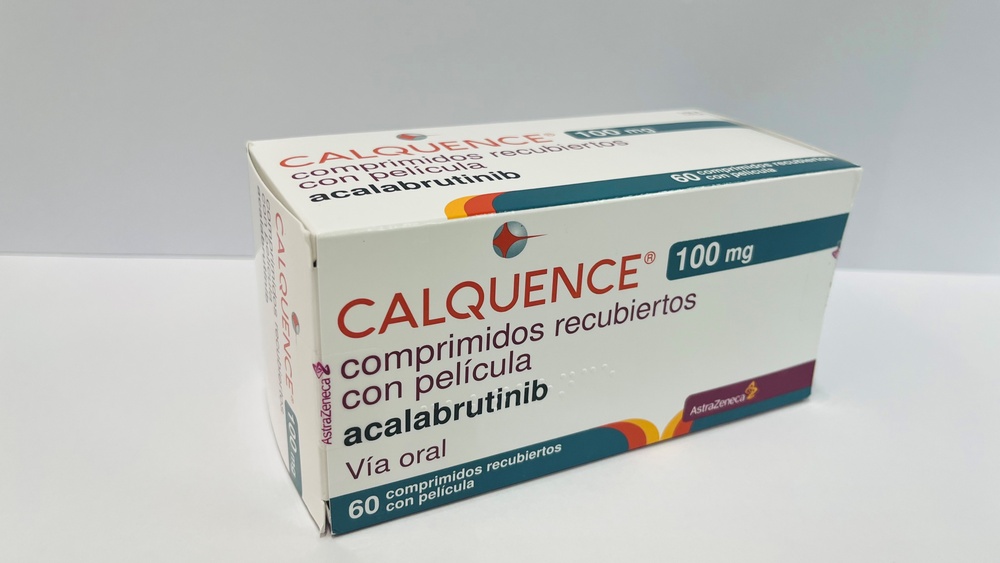
Calquence 100 mg film-coated tablets
acalabrutinib
Read this leaflet carefully before you start taking this medicine because it contains important
information for you.
- Keep this leaflet. You may need to read it again.
- If you have any questions, ask your doctor, pharmacist or nurse.
- This medicine has been prescribed for you only. Do not pass it on to others, even if their symptoms are the same as yours, as it could be harmful.
- If you get any side effects, even those not listed in this leaflet, tell your doctor, pharmacist or nurse. See section 4.
Contents of this leaflet:
- 1. What Calquence is and what it is used for
- 2. What you need to know before you take Calquence
- 3. How to take Calquence
- 4. Possible side effects
- 5. How to store Calquence
- 6. Contents of the pack and other information
1. What is Calquence and what is it used for
What is Calquence
- Calquence contains the active substance acalabrutinib.
- It belongs to a group of medicines called Bruton's tyrosine kinase (BTK) inhibitors.
What is Calquence used for
Calquence is used to treat adults with chronic lymphocytic leukemia (CLL).
CLL is a cancer of the white blood cells, called B lymphocytes (or B cells). These cells are part of the
immune system (the body's defenses).
Calquence is used to treat adults with mantle cell lymphoma (MCL).
MCL is a type of blood cancer that affects the lymph nodes.
How Calquence works
Calquence works by blocking BTK, a protein present in the body that helps cancer cells grow and
survive. By blocking BTK, Calquence helps to kill and can reduce the
number of cancer cells, slowing the progression of the disease.
If you have any questions about how Calquence works or why this medicine has been prescribed for you,
ask your doctor, pharmacist or nurse.
2. What you need to know before taking Calquence
Do not take Calquence
- if you are allergic to acalabrutinib or any of the other ingredients of this medicine (listed in section 6).
If you are not sure, ask your doctor, pharmacist or nurse before taking Calquence.
Warnings and precautions
Talk to your doctor, pharmacist or nurse before taking Calquence, if:
- you have ever had unusual bruising or bleeding or if you are taking any medicine that increases the risk of bleeding (see section 4 “Possible side effects”)
- you have an infection (see section 4 “Possible side effects”)
- you have recently had or are about to have surgery. Your doctor may stop treatment with Calquence before and after a medical, surgical or dental procedure
- you have ever had hepatitis B (a liver infection), as Calquence may cause hepatitis B to become active again, so your doctor will look for signs of the infection returning (see section 4 “Possible side effects”)
- you have or have ever had an irregular heartbeat (see section 4 “Possible side effects”).
Talk to your doctor if you develop a new skin lesion or any change in the appearance of an area of the
skin as you are at high risk of developing skin cancer (see section 4). Use
sun protection and have regular skin checks.
Your doctor will check your blood count during treatment, if necessary.
Children and adolescents
This medicine should not be given to children and adolescents under 18 years of age, as
it has not been studied in this age group.
Other medicines and Calquence
Tell your doctor, pharmacist or nurse if you are taking, have recently taken or might
take any other medicines, especially if you are taking:
- antibiotics for bacterial infections - such as clarithromycin
- medicines for fungal infections - such as posaconazole, itraconazole or voriconazole
- ketoconazole - a medicine for Cushing's syndrome (a condition where the body produces too much cortisol)
- medicines for HIV infections - such as indinavir and ritonavir
- medicines for hepatitis C - such as telaprevir
- rifampicin - an antibiotic for bacterial infections (tuberculosis)
- ergotamine - a medicine for migraines
- conivaptan - a medicine for low sodium levels in the blood
- metformin - a medicine for high blood sugar levels
- cyclosporine - a medicine to prevent organ rejection
- medicines for seizures (convulsions) or epilepsy - such as carbamazepine and phenytoin
- pimozide - a medicine used for Tourette's syndrome (a condition that causes uncontrolled movements and excessive words and sounds)
- St. John's Wort (hypericum, Hypericum perforatumL.) - a herbal medicine for depression
- theophylline - a medicine used for wheezing, shortness of breath and tightness in the chest
- methotrexate - a medicine for diseases such as rheumatoid arthritis, psoriasis and ulcerative colitis, which are caused by the immune system not working properly.
- this medicine must be taken at least 6 hours before or after Calquence.
It is possible to take medicines that reduce stomach acid such as antacids (calcium carbonate), histamine-2 receptor blockers (ranitidine and famotidine) and proton pump inhibitors (omeprazole) with
Calquence tablets.
Medicines that increase the risk of bleeding
Calquence may make bleeding easier. Tell your doctor, pharmacist or nurse if you are taking
other medicines that increase the risk of bleeding:
- antiplatelet agents (medicines that work against blood clotting) such as acetylsalicylic acid and clopidogrel
- anticoagulants (blood thinners) such as warfarin or enoxaparin.
Pregnancy
If you are pregnant, or suspect you may be pregnant, ask your doctor for advice
before taking Calquence. This is because Calquence may have harmful effects on the unborn baby.
Breast-feeding
Do not breast-feed during treatment with Calquence and for 2 days after the last dose of
Calquence. It is not known whether Calquence passes into breast milk.
Driving and using machines
It is unlikely that Calquence will affect your ability to drive and use machines. However, if
you experience dizziness, weakness or fatigue while taking Calquence, do not drive or
use machines.
Calquence contains sodium
This medicine contains less than 1 mmol (23 mg) of sodium per dose, that is to say essentially ‘sodium-free’.
3. How to take Calquence
Calquence will be prescribed exclusively by a doctor experienced in the use of anticancer medications. Take Calquence following the doctor's instructions exactly. If you have any doubts, consult your doctor, pharmacist, or nurse.
Depending on the type of tumor, Calquence may be administered in combination with other anticancer medications.
How much to take
- The usual dose is one tablet (100 mg) twice a day. Take the doses approximately 12 hours apart.
How to take it
- Swallow the tablet whole with water at approximately the same time each day.
- Do not chew, crush, dissolve, or split the tablets.
- You can take Calquence with food or between meals.
- You can check when you took your last Calquence tablet by looking at the blister pack. The images on the blister pack will help you take the dose at the right time: the sun for the morning dose and the moon for the evening dose.
If you take more Calquence than you should
If you have taken more Calquence than you should, consult a doctor or go to the nearest hospital immediately.
If you forget to take a dose
- If less than 3 hours have passed since you should have taken the missed dose, take it immediately and take the next dose at the usual time.
- If more than 3 hours have passed since the scheduled time for taking the dose, skip the missed dose. Take the next dose at the usual time.
- Do not take a double dose to make up for a missed dose.
If you have any further questions on the use of this medicine, ask your doctor, pharmacist or nurse.
4. Possible side effects
Like all medicines, this medicine can cause side effects, although not everybody gets them.
Stop taking Calquence and contact your doctor or go immediately to the nearest emergency
room if any of the following symptoms occur:
Very common serious side effects(may affect more than 1 in 10 people):
- Bleeding from several sites, including skin, intestines and brain. Symptoms may be black or bloody stools, pink or brown urine, nosebleeds, bruising, unexpected bleeding, vomiting or coughing up blood, dizziness, weakness, confusion
- Infections. Signs may include fever, chills, feeling weak or confused, cough, shortness of breath [lung infection, a very common side effect(may affect more than 1 in 10 people) or aspergillosis, a not common side effect(may affect up to 1 in 100)].
Common serious side effects(may affect up to 1 in 10 people):
- fast heartbeat, skipped beats, weak or irregular pulse, dizziness, feeling faint, chest discomfort or shortness of breath (signs of heart rhythm problems known as atrial fibrillation and atrial flutter).
- fever, chills, nausea, vomiting, confusion, shortness of breath, seizures, irregular heartbeat, cloudy or dark urine, unusual fatigue, or muscle or joint pain. These may be symptoms of tumor lysis syndrome (TLS), a condition caused by the rapid breakdown of cancer cells.
Other side effects:
Very common(may affect more than 1 in 10 people):
- muscle or joint pain
- headache
- skin rash
- fatigue, weakness or lack of energy
- stomach discomfort (nausea), vomiting, stomach pain, constipation (infrequent or hard stools), diarrhea (frequent or loose stools)
- decreased number of red blood cells, decreased number of neutrophils (a type of white blood cells) or decreased number of cells that help the blood clot (platelets)
- high blood pressure
- dizziness
- headache, pressure in the area between eyes, nose or cheeks (sinusitis)
- sore throat and runny nose (nasopharyngitis)
- upper respiratory tract infection
- urinary tract infection (pain or burning during urination)
- new cancers, including skin cancers, may occur during treatment with Calquence (see section 2 “What you need to know before you take Calquence”)
- herpes
Common(may affect up to 1 in 10 people):
- increased levels of liver enzymes (aspartate aminotransferase and alanine aminotransferase) in blood tests [when used in combination with certain medicines for the treatment of mantle cell lymphoma (MCL)].
- bronchitis
- fever, chills, weakness, confusion, feeling unwell and yellowing of the skin or eyes (jaundice) - these may be signs of hepatitis B reactivation (a liver infection)
- lung inflammation (pneumonia)
Not common side effects(may affect up to 1 in 100 people):
- memory loss, difficulty thinking, difficulty walking or loss of vision - these may be symptoms of a serious brain infection (progressive multifocal leukoencephalopathy or PML)
- lymphocytosis (a higher than normal amount of lymphocytes, a type of white blood cells, in the blood).
Reporting of side effects
If you get any side effects, talk to your
doctor. You can also report side effects directly through the national reporting system
listed in Annex V. By reporting side effects you can help provide more information on the safety of this medicine.
5. How to store Calquence
Keep this medicine out of the sight and reach of children.
Do not use this medicine after the expiry date which is stated on the box and on the blister after
Expiry/EXP. The expiry date refers to the last day of that month.
This medicine does not require any particular storage conditions.
Do not dispose of any medicine in waste water or household waste. Ask your pharmacist how to
dispose of medicines you no longer use. This will help protect the environment.
6. Contents of the pack and other information
What Calquence contains
The active ingredient is acalabrutinib. Each film-coated tablet contains 100 mg of acalabrutinib
(as acalabrutinib maleate).
The other ingredients are:
- Tablet core: mannitol (E421), microcrystalline cellulose (E460), low substitution hydroxypropylcellulose (E463) and sodium stearyl fumarate (see section 2 “Calquence contains sodium”).
- Tablet coating: hypromellose (E464), copovidone, titanium dioxide (E171), macrogol, medium chain triglycerides, yellow iron oxide (E172) and red iron oxide (E172).
Description of the appearance of Calquence and contents of the pack
Calquence is an orange-colored, 7.5 x 13 mm, oval, biconvex tablet, imprinted with "ACA
100" on one side and smooth on the other side.
Calquence is supplied in aluminum blisters containing 8 or 10 film-coated tablets. On each blister
there are sun/moon symbols to help you take the dose at the right time: the sun for the morning dose and
the moon for the evening dose. Both sun and moon blisters contain the same medicine.
Each pack contains 56 or 60 film-coated tablets.
Not all pack sizes may be marketed.
Marketing authorisation holder
AstraZeneca AB
SE-151 85 Södertälje
Sweden
Manufacturer
AstraZeneca AB
Gärtunavägen
SE-152 57 Södertälje
Sweden
For further information on this medicine, contact the local representative of the marketing authorisation
holder:
België/Belgique/Belgien
AstraZeneca S.A./N.V.
Tel: +32 2 370 48 11
Lietuva
UAB AstraZeneca Lietuva
Tel: +370 5 2660550
България
АстраЗенека България ЕООД
Тел: +359 24455000
Luxembourg/Luxemburg
AstraZeneca S.A./N.V.
Tél/Tel: +32 2 370 48 11
Česká republika
AstraZeneca Czech Republic s.r.o.
Tel: +420 222 807 111
Magyarország
AstraZeneca Kft.
Tel: +36 1 883 6500
Danmark
AstraZeneca A/S
Tlf: +45 43 66 64 62
Malta
Associated Drug Co. Ltd
Tel: +356 2277 8000
Deutschland
AstraZeneca GmbH
Nederland
AstraZeneca BV
Tel: +49 40 809034100 Tel: +31 85 808 9900
Eesti
AstraZeneca
Tel: +372 6549 600
Norge
AstraZeneca AS
Tlf: +47 21 00 64 00
Ελλάδα
AstraZeneca A.E.
Τηλ: +30 210 6871500
Österreich
AstraZeneca Österreich GmbH
Tel: +43 1 711 31 0
España
AstraZeneca Farmacéutica Spain, S.A.
Tel: +34 91 301 91 00
Polska
AstraZeneca Pharma Poland Sp. z o.o.
Tel: +48 22 245 73 00
France
AstraZeneca
Tél: +33 1 41 29 40 00
Portugal
AstraZeneca Produtos Farmacêuticos, Lda.
Tel: +351 21 434 61 00
Hrvatska
AstraZeneca d.o.o.
Tel: +385 1 4628 000
România
AstraZeneca Pharma SRL
Tel: +40 21 317 60 41
Ireland
AstraZeneca Pharmaceuticals (Ireland)
DAC
Tel: +353 1609 7100
Slovenija
AstraZeneca UK Limited
Tel: +386 1 51 35 600
Ísland
Vistor hf.
Sími: +354 535 7000
Slovenská republika
AstraZeneca AB, o.z.
Tel: +421 2 5737 7777
Italia
AstraZeneca S.p.A.
Tel: +39 02 00704500
Suomi/Finland
AstraZeneca Oy
Puh/Tel: +358 10 23 010
Κύπρος
Αλέκτωρ Φαρµακευτική Λτδ
Τηλ: +357 22490305
Sverige
AstraZeneca AB
Tel: +46 8 553 26 000
Latvija
SIA AstraZeneca Latvija
Tel: +371 67377100
Other sources of information
More detailed information on this medicine is available on the website of the European Medicines Agency, http://www.ema.europa.eu/

Не уверены, подходит ли вам это лекарство?
Обсудите симптомы и варианты лечения с врачом онлайн.

Уже начали прием и появились вопросы?
Обсудите свое состояние и дальнейшие шаги с врачом онлайн.
- Страна регистрации
- Форма выпускаHard capsule, 100 MG
- Код АТХL01EL02
- Действующее вещество
- Отпускается по рецептуДа
- Производитель
- Информация на этой странице носит справочный характер и не является медицинской консультацией. Перед началом приема лекарства обязательно проконсультируйтесь с врачом.
- Аналоги KALQUENKEФорма выпуска: Hard capsule, 80 mgДействующее вещество: ЗанубрутинибПроизводитель: BEONE MEDICINES IRELAND LIMITEDОтпускается по рецептуФорма выпуска: Hard capsule, 140 MGДействующее вещество: ИбрутинибПроизводитель: JANSSEN-CILAG INTERNATIONAL N.V.Отпускается по рецептуФорма выпуска: Film-coated tablet, 50 mgДействующее вещество: ПиртобрутинибПроизводитель: ELI LILLY NEDERLAND B.V.Отпускается по рецепту
Аналоги KALQUENKE в других странах
Лекарства с тем же действующим веществом, доступные в других странах.
Аналог KALQUENKE в Испания
Аналог KALQUENKE в Украина
Получите рецепт на KALQUENKE онлайн
Заполните форму за 2 минуты
Расскажите о симптомах, истории болезни и нужном препарате.
Выберите врача или мы назначим
Выберите специалиста или мы подберём ближайшего доступного врача.
Врач рассматривает ваш случай
Обычно в течение 30 минут. Может задать уточняющие вопросы в чате.
Получите в любой аптеке
Электронный рецепт отправляется на вашу почту — действителен по всей Польше.
Часто задаваемые вопросы
KALQUENKE требует рецепта в Италия. Вы можете уточнить у врача онлайн, подходит ли это лекарство для вашей ситуации.
Действующее вещество KALQUENKE — акалабрутиниб. Эта информация помогает определить лекарства с тем же составом под другими торговыми названиями.
KALQUENKE производится компанией ASTRAZENECA AB. Упаковка и торговое название могут отличаться в зависимости от дистрибьютора.
Врачи, включая Семейные врачи, Психиатры, Дерматологи, Кардиологи, Эндокринологи, Гастроэнтерологи, Пульмонологи, Нефрологи, Ревматологи, Гематологи, Инфекционисты, Аллергологи, Гериатры, Педиатры, Онкологи, могут оценить целесообразность применения KALQUENKE с учетом вашей ситуации и местных правил. Вы можете записаться на онлайн-консультацию, чтобы обсудить возможные варианты.
Польша имеет хорошо развитую систему здравоохранения в крупных городах, таких как Варшава, Краков, Вроцлав и Гданьск. Аптеки широко доступны и работают в соответствии с действующим законодательством, обеспечивая доступ к рецептурным препаратам.
Вы можете купить KALQUENKE в Варшаве, Кракове, Вроцлаве или Гданьске в любой аптеке при наличии действующего рецепта.
Чтобы получить рецепт, вы можете воспользоваться Oladoctor:
Другие лекарства с тем же действующим веществом (акалабрутиниб) включают BRUKINSA, IMBRUVIKA, JAYPIRKA. Они могут отличаться торговым названием или формой выпуска, но содержат одинаковый терапевтический компонент. Перед изменением лечения рекомендуется проконсультироваться с врачом.
