



BYDUREON 2 mg Порошок И Раствор Для Инъекционной Суспензии

Рассмотрение рецепта онлайн
Врач рассмотрит ваш случай и примет решение о назначении рецепта, если это медицински оправдано.

Поговорите с врачом об этом лекарстве
Обсудите симптомы и возможные дальнейшие шаги на онлайн-консультации.



Инструкция по применению BYDUREON
Содержание инструкции
- Bydureon 2 mg powder and solvent for prolonged-release injectable suspension
- What is Bydureon and what is it used for
- What you need to know before using Bydureon
- How to use Bydureon
- Possible side effects
- How to store Bydureon
- Package contents and other information
- What is Bydureon and what is it used for
- What you need to know before using Bydureon
- How to use Bydureon
- Possible side effects
- How to store Bydureon
- Contents of the pack and other information
- Bydureon 2 mg prolonged-release injectable suspension in a pre-filled pen
- What is Bydureon and what is it used for
- What you need to know before using Bydureon
- How to use Bydureon
- Possible side effects
- How to store Bydureon
- Package Contents and Other Information
- Initial preparation
- Connecting the components
- Mixing the medicine and filling the syringe.
- Injection of the medicine
- After I have mixed the medicine, how long can I wait before performing
- How do I know if the medicine is mixed well?
- What should I do if I have problems inserting the needle?
- What should I do if I have problems removing the needle cap?
- How do I know if the medicine is mixed properly?
- What should I do if I have trouble mixing the medicine?
- After I have mixed the medicine, how long can I wait before performing
- Come faccio a sapere se ho iniettato l’intera dose?
- Come elimino la penna di Bydureon?
- Where is the needle?
- How do I know if the medicine is completely mixed?
- Why must I keep the pen in a vertical position while removing the orange cap?
- Why must I inject the medicine immediately after mixing it?
- How do I know I have injected the complete dose of the medicine?
- Why must I store the pen horizontally in the refrigerator?
- How do I dispose of the Bydureon BCise pen?
- What to do if the device is malfunctioning and I cannot unlock it?
- Where to find more information about the Bydureon BCise pen
Bydureon 2 mg powder and solvent for prolonged-release injectable suspension
exenatide
Read this leaflet carefully before you start using this medicine as it contains important
information for you.
- Keep this leaflet. You may need to read it again.
- If you have any questions, ask your doctor, pharmacist or the nurse at the diabetes centre.
- This medicine has been prescribed for you only. Do not pass it on to others, even if their symptoms are the same as yours, as it could be harmful.
- If you get any side effects, even those not listed in this leaflet, tell your doctor, pharmacist or the nurse at the diabetes centre. See section 4.
Contents of this leaflet
- 1. What Bydureon is and what it is used for
- 2. What you need to know before you use Bydureon
- 3. How to use Bydureon
- 4. Possible side effects
- 5. How to store Bydureon
- 6. Contents of the pack and other information
1. What is Bydureon and what is it used for
Bydureon contains the active substance exenatide. It is an injectable medicine used to improve the
control of blood sugar levels (glycemia) in adults, adolescents and children aged 10 years and over with
type 2 diabetes mellitus.
This medicine is used together with the following diabetes medications: metformin, sulfonylureas,
thiazolidinediones (combination therapy with thiazolidinedione has only been studied in adult
patients), sodium-glucose cotransporter 2 inhibitors and/or long-acting insulin. Your doctor is
prescribing this medicine as an add-on medicine to control your blood sugar levels. Continue to follow
your diet and exercise program.
Diabetes occurs because the body does not produce enough insulin to control blood sugar levels or
cannot use insulin appropriately. This medicine helps the body to increase insulin production when
blood sugar levels are high.
2. What you need to know before using Bydureon
Do not use Bydureon:
- If you are allergic to exenatide or any of the other ingredients of this medicine listed in section 6.
Warnings and precautions
Talk to your doctor, pharmacist or nurse at the diabetes centre before using Bydureon regarding the following:
- If you are using this medicine in combination with a sulfonylurea, because a decrease in blood sugar levels (hypoglycemia) may occur. Check your blood glucose levels regularly. If you do not know whether any of the other medicines you are taking contain a sulfonylurea, ask your doctor, pharmacist or nurse at the diabetes centre.
- if you have type 1 diabetes or diabetic ketoacidosis, because this medicine should not be used.
- how to inject this medicine. This must be injected into the skin and must not be injected into a vein or a muscle.
- If you have a severe problem with gastric emptying (including gastroparesis) or digestion, because the use of this medicine is not recommended. The active ingredient contained in this medicine slows down gastric emptying, so food passes more slowly through the stomach.
- if you have had inflammation of the pancreas (pancreatitis) in the past (see section 4).
- if you are losing weight too quickly (more than 1.5 kg per week) inform your doctor because this can cause problems such as gallstones.
- if you have a serious kidney disease or are on dialysis because the use of this medicine is not recommended.
Bydureon is not insulin and therefore should not be used as a substitute for insulin.
Children and adolescents
Bydureon can be used in adolescents and children aged 10 years and over. There are no data available on the use of this medicine in children under 10 years of age.
Other medicines and Bydureon
Tell your doctor or pharmacist if you are taking, have recently taken or might take any other medicines, in particular:
- other medicines that are used to treat type 2 diabetes such as medicines that work like Bydureon (for example: liraglutide or other medicines containing exenatide) because the use of these medicines with Bydureon is not recommended.
- medicines to thin the blood (anticoagulants) e.g. warfarin, because you will require further monitoring to detect changes in the INR (index for measuring blood coagulation) in the early stages of treatment with this medicine.
- a medicine containing a sulfonylurea, as in combination with Bydureon, it may cause a decrease in blood sugar levels (hypoglycemia).
- if you are using insulin. Your doctor will tell you how to reduce your insulin dose and will recommend that you monitor your blood glucose more frequently to avoid the development of hyperglycemia (high blood sugar levels) and diabetic ketoacidosis (a complication of diabetes that occurs when the body is unable to break down glucose because there is not enough insulin).
Pregnancy and breastfeeding
It is not known whether this medicine is harmful to your baby, therefore you should not use it during pregnancy and for at least 3 months before a pregnancy.
It is not known whether exenatide passes into breast milk. You should not use this medicine during breastfeeding.
If you are pregnant, suspect you may be pregnant, are planning to become pregnant, or are breastfeeding, ask your doctor or pharmacist for advice before taking this medicine.
You must use contraception if you could potentially become pregnant during treatment with this medicine.
Driving and using machines
If you are using this medicine in combination with a sulfonylurea, a decrease in blood sugar levels (hypoglycemia) may occur. Hypoglycemia can reduce your ability to concentrate. Keep this possibility in mind in all situations where you might put yourself and others at risk (e.g. driving a vehicle or using machinery).
Important information about some of the ingredients of Bydureon
This medicine contains less than 1 mmol of sodium (23 mg) per dose, i.e. it is practically “sodium-free”.
3. How to use Bydureon
Use this medicine following the instructions of your doctor, pharmacist or
diabetes center nurse exactly. If you have any doubts, consult your doctor, pharmacist or the nurse at the
diabetes center.
You must inject this medicine once a week, at any time of the day,
regardless of meals.
You must inject this medicine under the skin (subcutaneous injection) of the stomach (abdomen), the
upper part of the leg (thigh) or the upper back of the arms. Do not inject into a vein or into
a muscle.
Each week you can use the same area of the body. Make sure to choose a different injection site
in this area.
Never administer insulin and Bydureon together in the same injection. If you need to
administer both at the same time, use two separate injections. You can give both
injections in the same area of the body (for example in the stomach area), but you must not give the
injections close to each other.
Check your blood glucose levels regularly, this is particularly important if you are
also taking a sulfonylurea.
To inject Bydureon, follow the “Instructions for Use found in the package”.
Your doctor or diabetes center nurse must teach you how to inject this medicine
before you use it for the first time.
Before starting, check that the liquid in the syringe is clear and free of particles. After
mixing, use the suspension only if the mixture appears from white to off-white and cloudy. If you see
dust particles on the walls or at the bottom of the vial, the medicine is NOT mixed well.
Shake the vial vigorously again until the medicine is well mixed.
You must inject this medicine immediately after mixing the powder and the solvent.
Use a new needle for each injection and dispose of it safely after each use as explained to you
by your doctor or diabetes center nurse.
If you use more Bydureon than you should
If you use more medicine than you should, consult your doctor first as you may need
medical treatment. Too high a dose of this medicine can cause nausea, vomiting, dizziness or
symptoms due to low blood sugar levels (see section 4).
If you forget to use Bydureon
You can choose the day you plan to always give the Bydureon injection.
If you forget a dose and there are still 3 or more days until your next dose, then administer the forgotten dose as soon as possible.
For the next injection you can return to your chosen day for injections.
If you forget a dose and there are only 1 or 2 days until the next dose, skip the forgotten dose
and administer the next injection as usual, on the scheduled day. You can also change the day
you had chosen to give the injection, provided you had your last dose within 3 or more days
before.
Do not give two Bydureon injections less than 3 days apart.
If you are not sure you have taken the entire dose of Bydureon
If you are not sure you have taken the entire dose, do not inject another dose of this medicine, but
take it next week as scheduled.
If you stop taking Bydureon
If you think you need to stop taking this medicine, consult your doctor first. If
you stop taking this medicine, this may alter your blood sugar levels.
If you have any questions about the use of this medicine, ask your doctor, pharmacist or
diabetes center nurse.
4. Possible side effects
Like all medicines, this medicine can cause side effects, although not everyone gets them.
persone li manifestino.
Serious allergic reactions(anaphylaxis) have been reported rarely (may affect up to 1
person out of 1000).
You should contact your doctor immediately if you experience symptoms such as:
- Swelling of the face, tongue or throat (angioedema)
- Hypersensitivity (skin rashes, itching and rapid swelling of the tissues of the neck, face, mouth or throat)
- Difficulty swallowing
- Itching (urticaria) and difficulty breathing
Cases of inflammation of the pancreas(pancreatitis) have been reported with uncommon frequency
(may affect up to 1 person out of 100) in patients treated with this medicine. Pancreatitis
can be a serious, potentially life-threatening condition.
- Tell your doctor if you have had pancreatitis, gallstones, alcoholism or very high levels of triglycerides. These conditions may increase the risk of developing pancreatitis for the first time or of having it again, whether you are using this medicine or not.
- STOP taking this medicine and contact your doctor immediately if you have severe and persistentstomach pain, with or without vomiting, as you may have an inflamed pancreas (pancreatitis).
Very common side effects(may affect more than 1 in 10 people):
- nausea (nausea is more common at the beginning of treatment with this medicine, but decreases over time in most patients)
- diarrhea
- hypoglycemia (low blood sugar) when administered concurrently with a medicine containing a sulfonylurea.
When this medicine is used together with a drug containing a sulfonylurea, episodes of decreased blood glucose levels (hypoglycemia, usually mild to moderate) may occur.
While using this medicine, a decrease in the dose of the
sulfonylurea may be necessary. Signs and symptoms due to low blood sugar may include headache,
drowsiness, weakness, dizziness, confusion, irritability, feeling hungry, rapid heartbeat,
sweating and nervousness. Your doctor should tell you how to treat a hypoglycemic condition.
Common side effects(may affect up to 1 in 10 people):
- hypoglycemia (low blood sugar) when administered with insulin
- dizziness
- headache
- vomiting
- loss of energy and strength
- fatigue (tiredness)
- constipation
- stomach pain
- bloating
- indigestion
- flatulence (intestinal gas)
- heartburn
- decreased appetite. This medicine may reduce your appetite, the amount of food you eat and your body weight. If you lose weight too quickly (more than 1.5 kg per week) tell your doctor as this can cause problems such as gallstones.
- injection site reactions
If you have a reaction at the injection site (redness, rash or itching) you
can ask your doctor for something to relieve the signs and symptoms. After the injection, you may see or
feel a small bump under the skin that should go away after 4-8 weeks. You
should not need to stop treatment.
Uncommon side effects
- decreased kidney function
- dehydration, sometimes with decreased kidney function
- intestinal obstruction (blockage of the intestine)
- belching
- strange taste in mouth increased sweating
- hair loss
- drowsiness
- a delay in stomach emptying
- inflamed gallbladder
- gallstones
Rare side effects
- nervousness
Not known(frequency cannot be estimated based on available data)
In addition, some other side effectshave been reported
- bleeding or bruising more easily than usual due to low platelet levels in the blood
- changes in INR (index for measuring blood coagulation) have been reported when used together with warfarin
- skin reactions at the exenatide injection site after injection. These include: pus-containing cavity (abscess) and areas of skin that are swollen or red and appear warm and painful (cellulitis).
Reporting of side effects
If you get any side effects, talk to your doctor, pharmacist or nurse at the diabetes center. You can also report side effects directly through the national reporting system listed in Annex V.
By reporting side effects you can help provide more information on the safety of
this medicine.
5. How to store Bydureon
Keep this medicine out of the sight and reach of children.
Do not use this medicine after the expiry date which is reported on the label and on the packaging
after EXP/Scad.. The expiry date refers to the last day of that month.
Store in a refrigerator (2°C – 8°C). Do not freeze.
Before use, the kit may be kept for up to 4 weeks at a temperature below 30°C.
Store in the original package to protect the medicine from light.
Discard the Bydureon kit if it has been frozen.
Do not dispose of any medicine in wastewater or household waste. Ask your pharmacist how
to eliminate medicines that you no longer use. This will help protect the environment.
6. Package contents and other information
What Bydureon contains
- The active ingredient is exenatide. Each vial contains 2 mg of exenatide.
- The other ingredients are:
- In the powder: poly (D,L-lactide-co-glycolide) and sucrose.
- In the solvent: sodium croscarmellose, sodium chloride, polysorbate 20, disodium phosphate monohydrate, disodium phosphate heptahydrate and water for injections.
Description of Bydureon and package contents
Powder and solvent for prolonged-release injectable suspension.
The powder is white to off-white and the solvent is a clear, colorless to light yellow to light brown solution.
Each single-dose kit of Bydureon contains a vial with 2 mg of exenatide powder, a prefilled syringe containing 0.65 ml of solvent, a vial adapter and two injection needles. One needle is a spare.
This medicine is available in packs of 4 single-dose kits and 3 x 4 single-dose kits. Not all pack sizes may be marketed.
Marketing authorisation holder
AstraZeneca AB
SE-151 85 Södertälje
Sweden
Manufacturer
AstraZeneca UK Limited
Silk Road Business Park,
Macclesfield, Cheshire, SK10 2NA
United Kingdom
Swords Laboratories T/A Lawrence Laboratories
Unit 12 Distribution Centre, Shannon Industrial Estate, Shannon, Co. Clare
Ireland
For further information on this medicine, contact the local representative of the marketing authorisation holder:
België/Belgique/Belgien
AstraZeneca S.A./N.V.
Tel: +32 2 370 48 11
Lietuva
UAB AstraZeneca Lietuva
Tel: +370 5 2660550
България
АстраЗенека България ЕООД
Тел.: +359 (2) 44 55 000
Luxembourg/Luxemburg
AstraZeneca S.A./N.V.
Tél/Tel: +32 2 370 48 11
Česká republika
AstraZeneca Czech Republic s.r.o.
Tel: +420 222 807 111
Magyarország
AstraZeneca Kft.
Tel.: +36 1 883 6500
Malta
Associated Drug Co. Ltd
Tel: +356 2277 8000
Danmark
AstraZeneca A/S
Tlf: +45 43 66 64 62
Nederland
AstraZeneca BV
Tel: +31 85 808 9900
Deutschland
AstraZeneca GmbH
Tel: +49 40 809034100
Eesti
AstraZeneca
Tel: +372 6549 600
Norge
AstraZeneca AS
Tlf: +47 21 00 64 00
Ελλάδα
AstraZeneca A.E.
Τηλ: +30 2 106871500
Österreich
AstraZeneca Österreich GmbH
Tel: +43 1 711 31 0
España
AstraZeneca Farmacéutica Spain, S.A.
Tel: +34 91 301 91 00
Polska
AstraZeneca Pharma Poland Sp. z o.o.
Tel.: +48 22 874 35 00
France
AstraZeneca
Tél: +33 1 41 29 40 00
Portugal
AstraZeneca Produtos Farmacêuticos, Lda.
Tel: +351 21 434 61 00
Hrvatska
AstraZeneca d.o.o.
Tel: +385 1 4628 000
România
AstraZeneca Pharma SRL
Tel: +40 21 317 60 41
Ireland
AstraZeneca Pharmaceuticals (Ireland) DAC
Tel: +353 1609 7100
Slovenija
AstraZeneca UK Limited
Tel: +386 1 51 35 600
Ísland
Vistor hf.
Sími: +354 535 7000
Slovenská republika
AstraZeneca AB, o.z.
Tel: +421 2 5737 7777
Italia
AstraZeneca S.p.A.
Tel: +39 02 00704500
Suomi/Finland
AstraZeneca Oy
Puh/Tel: +358 10 23 010
Sverige
AstraZeneca AB
Tel: +46 8 553 26 000
Κύπρος
Αλέκτωρ Φαρµακευτική Λτδ
Τηλ: +357 22490305
Latvija
SIA AstraZeneca Latvija
Tel: +371 67377100
United Kingdom (Northern Ireland)
AstraZeneca UK Ltd
Tel: +44 1582 836 836
Other sources of information
More detailed information on this medicine is available on the website of the European Medicines Agency: http://www.ema.europa.eu
Bydureon 2 mg powder and solvent for prolonged-release injectable suspension in prefilled pen
exenatide
Read all of this leaflet carefully before you start using this medicine because it contains important information for you.
- Keep this leaflet. You may need to read it again.
- If you have any questions, ask your doctor, pharmacist or the nurse at the diabetes centre.
- This medicine has been prescribed for you only. Do not pass it on to others, even if their symptoms are the same as yours, as it could be harmful.
- If you get any side effects, talk to your doctor, pharmacist or the nurse at the diabetes centre. See section 4.
Contents of this leaflet
- 1. What Bydureon is and what it is used for
- 2. What you need to know before you use Bydureon
- 3. How to use Bydureon
- 4. Possible side effects
- 5. How to store Bydureon
- 6. Contents of the pack and other information
1. What is Bydureon and what is it used for
Bydureon contains the active substance exenatide. It is an injectable medicine used to improve the
control of blood sugar levels (glycemia) in adults, adolescents and children aged 10 years and over with
type 2 diabetes mellitus.
This medicine is used together with the following diabetes medications: metformin, sulfonylureas,
thiazolidinediones (combination therapy with thiazolidinedione has only been studied in adult
patients), sodium-glucose cotransporter 2 inhibitors and/or long-acting insulin. Your doctor is
prescribing this medicine as an add-on medicine to control your blood sugar levels. Continue to follow
your diet and exercise program.
Diabetes occurs because the body does not produce enough insulin to control blood sugar levels or
cannot use insulin appropriately. This medicine helps the body to increase insulin production when blood
sugar levels are high.
2. What you need to know before using Bydureon
Do not use Bydureon:
- If you are allergic to exenatide or any of the other ingredients of this medicine listed in section 6.
Warnings and precautions
Talk to your doctor, pharmacist or nurse at the diabetes centre before using Bydureon regarding the
following:
- If you are using this medicine in combination with a sulfonylurea, because a reduction in blood sugar levels (hypoglycemia) may occur. Check your blood glucose levels regularly. If you do not know whether any of the other medicines you are taking contains a
sulfonylurea, ask your doctor, pharmacist or nurse at the diabetes centre.
sangue regolarmente. Qualora non sappia se uno degli altri farmaci che sta usando contiene una
sulfanilurea, chieda al medico, al farmacista o all’infermiere del centro antidiabetico.
- If you have type 1 diabetes or diabetic ketoacidosis, because this medicine should not be used.
- This medicine must be injected into the skin and must not be injected into a vein or muscle.
- If you have a severe problem with gastric emptying (including gastroparesis) or digestion, because the use of this medicine is not recommended. The active ingredient contained in this medicine slows down stomach emptying, so food passes more slowly through the stomach.
- If you have had inflammation of the pancreas (pancreatitis) in the past (see section 4).
- If you are losing weight too quickly (more than 1.5 kg per week), tell your doctor because this can cause problems such as gallstones.
- If you have a serious kidney disease or are on dialysis because the use of this medicine is not recommended.
Bydureon is not insulin and therefore should not be used as a substitute for insulin.
Children and adolescents
Bydureon can be used in adolescents and children aged 10 years and over. There are no
data available on the use of this medicine in children under 10 years of age.
Other medicines and Bydureon
Tell your doctor or pharmacist if you are taking, have recently taken or might take
any other medicines, in particular:
- other medicines that are used to treat type 2 diabetes such as medicines that work like Bydureon (e.g. liraglutide or other medicines containing exenatide) because the use of these medicines with Bydureon is not recommended.
- medicines to thin the blood (anticoagulants) e.g. warfarin, because you will require further monitoring to detect changes in the INR (index for measuring blood coagulation) in the early stages of treatment with this medicine.
- a medicine containing a sulfonylurea, as in combination with Bydureon, it may cause a reduction in blood sugar levels (hypoglycemia).
- if you are using insulin. Your doctor will tell you how to reduce your dose of insulin and will recommend that you monitor your blood glucose more frequently to avoid the onset of hyperglycemia (high blood sugar levels) and diabetic ketoacidosis (a complication of diabetes that occurs when the body is unable to break down glucose because there is not enough insulin).
Pregnancy and breastfeeding
It is not known whether this medicine is harmful to your baby, therefore you should not use it during
pregnancy and for at least 3 months before pregnancy.
It is not known whether exenatide passes into breast milk. You should not use this medicine during
breastfeeding.
If you are pregnant, suspect you are pregnant, are planning to become pregnant, or are breastfeeding with
breast milk, ask your doctor or pharmacist for advice before taking this medicine.
You must use contraception if you could potentially become pregnant during treatment with this
medicine.
Driving and using machines
If you are using this medicine in combination with a sulfonylurea, a reduction in blood
sugar levels (hypoglycemia) may occur. Hypoglycemia can reduce your ability to concentrate. Be
aware of this possibility in all situations where you could put yourself and others at risk
(e.g. driving a vehicle or using machinery).
Important information about some of the excipients in Bydureon
This medicine contains less than 1 mmol of sodium (23 mg) per dose, i.e. it is practically “sodium-free”.
3. How to use Bydureon
Use this medicine following the instructions of your doctor, pharmacist or
nurse at the diabetes centre exactly as they tell you. If you have any doubts, ask your doctor, pharmacist or nurse at the
diabetes centre.
You must inject this medicine once a week, at any time of the day,
regardless of meals.
You must inject this medicine under the skin (subcutaneous injection) of the stomach (abdomen), the
upper part of the leg (thigh) or the upper back of the arms. Do not inject into a vein or into
a muscle.
Every week you can use the same area of the body. Make sure you choose a different injection site
in this area.
Never administer insulin and Bydureon together in the same injection. If you need to
administer both at the same time, use two separate injections. You can give both
injections in the same area of the body (for example in the stomach area), but you should not give the
injections close to each other.
Check your blood glucose levels regularly, this is particularly important if you are
also taking a sulfonylurea.
To inject Bydureon follow the “Instructions for Use” that you find in the pack.
Your doctor or nurse must teach you how to inject this medicine before you use it for the first
time.
Take a pen from the refrigerator and leave it at room temperature for at least 15 minutes.
Before starting, check that the liquid in the pen is clear and free of particles. After the
mixing of the liquid with the powder, use the suspension only if the mixture appears from white to white
turbid. If you see powder particles on the walls of the pen, the medicine is NOT
mixed well. Tap firmly until the medicine is well mixed.
You must inject this medicine immediately after mixing the powder and the solvent.
Use a new pen for each injection and dispose of it safely, with the needle still attached, after
each use as explained by your doctor or nurse at the diabetes centre.
If you use more Bydureon than you should
If you use more medicine than you should, contact your doctor first as you may need
medical treatment. An overdose of this medicine can cause nausea, vomiting, dizziness or
symptoms due to low blood sugar (see section 4).
If you forget to use Bydureon
You can choose a day when you plan to always give the Bydureon injection.
If you forget a dose and there are still 3 or more days until your next dose, then give
the missed dose as soon as possible. For the next injection you can return to your chosen day for
injections. If you have forgotten a dose and there are still 1 or 2 days until your next dose,
skip the missed dose and give your next dose as usual, on the scheduled day. You can
also change the day you chose for the injection, provided that your last dose was
given 3 or more days ago.
Do not give two Bydureon injections less than three days apart.
If you are not sure you have taken the entire dose of Bydureon
If you are not sure you have taken your entire dose, do not inject another dose of this medicine, but take it the following week as planned.
If you stop using Bydureon
If you think you need to stop using this medicine, first consult your doctor. If
you stop using this medicine, this may alter your blood sugar levels.
If you have any questions about using this medicine, ask your doctor, pharmacist or
nurse at the diabetes centre.
4. Possible side effects
Like all medicines, this medicine can cause side effects, although not everybody gets them.
Serious allergic reactions(anaphylaxis) have been reported rarely (may affect up to 1 in 1,000 people).
You must immediately contact your doctor if you experience symptoms such as:
- Swelling of the face, tongue or throat (angioedema)
- Hypersensitivity (skin rashes, itching and rapid swelling of the tissues of the neck, face, mouth or throat)
- Difficulty swallowing
- Itching (urticaria) and difficulty breathing
Cases of inflammation of the pancreas(pancreatitis) have been reported with uncommon frequency
(may affect up to 1 in 100) in patients treated with this medicine. Pancreatitis can be a serious, potentially life-threatening condition.
- Tell your doctor if you have had pancreatitis, gallstones, alcoholism or very high levels of triglycerides. These conditions may increase the risk of developing pancreatitis for the first time or having it again, whether you are using this medicine or not.
- STOP taking this medicine and contact your doctor immediately if you have severe and persistentstomach pain, with or without vomiting, because you may have an inflamed pancreas (pancreatitis).
Very common side effects(may affect more than 1 in 10 people):
- nausea (nausea is more common at the beginning of treatment with this medicine, but decreases over time in most patients)
- diarrhea
- hypoglycemia (low blood sugar) when administered in combination with a medicine containing a sulfonylurea.When this medicine is used together with a drug containing a sulfonylurea, episodes of reduced blood glucose levels (hypoglycemia, generally mild to moderate) may occur. While using this medicine, a decrease in the dose of sulfonylurea may be necessary. The signs and symptoms due to low blood sugar levels may include headache, drowsiness, weakness, dizziness, confusion, irritability, feeling hungry, rapid heartbeat, sweating and nervousness. Your doctor should tell you how to treat a situation of hypoglycemia.
Common side effects(may affect up to 1 in 10 people):
- hypoglycemia (low blood sugar) when administered with insulin
- dizziness
- headache
- vomiting
- loss of energy and strength
- fatigue (tiredness)
- constipation
- stomach pain
- bloating
- indigestion
- flatulence (intestinal gas)
- heartburn
- decreased appetite. This medicine may reduce your appetite, the amount of food you eat and your body weight. If you lose weight too quickly (more than 1.5 kg per week) tell your doctor because this can cause problems such as gallstones.
- injection site reactions If you have a reaction at the injection site (redness, rash or itching) you can ask your doctor for something to relieve the signs and symptoms. After the injection, you may see or feel a small bump under the skin that should go away after 4-8 weeks. You should not need to stop treatment.
Uncommon side effects
- decreased kidney function
- dehydration, sometimes with decreased kidney function
- intestinal obstruction (blockage of the intestine)
- belching
- strange taste in the mouth
- increased sweating
- hair loss
- drowsiness
- a delay in stomach emptying
- inflamed gallbladder
- gallstones
Rare side effects
- nervousness
Not known(frequency cannot be estimated based on available data)
Also, some other side effectshave been reported
- bleeding or bruising more easily than normal due to low platelet levels in the blood
- changes in INR (index for measuring blood coagulation) have been reported when used together with warfarin
- skin reactions at the injection site after the injection of exenatide. These include: a cavity containing pus (abscess) and areas of skin that are swollen or red and look warm and painful (cellulitis).
Reporting of side effects
If you get any side effects, talk to your doctor, pharmacist or nurse at the diabetes center. You can also report side effects directly through the national reporting system listed in Annex V.
By reporting side effects, you can help provide more information on the safety of this medicine.
5. How to store Bydureon
Keep this medicine out of the sight and reach of children.
Do not use this medicine after the expiry date which is stated on the label and the packaging
after EXP / Scad.. The expiry date refers to the last day of that month.
Store in a refrigerator (2°C-8°C). Do not freeze.
Before use, the pen can be kept for up to 4 weeks at a temperature below 30 °C.
Store in the original package to protect the medicine from light.
Throw away the Bydureon pen if it has been frozen.
Do not dispose of any medicine in wastewater or household waste. Ask your pharmacist how
to eliminate medicines that you no longer use. This will help protect the environment.
6. Contents of the pack and other information
What Bydureon contains:
- The active substance is exenatide. Each pre-filled pen contains 2 mg of exenatide. After suspension, the released dose is 2 mg/0.65 ml.
- The other ingredients are:
- In the powder: poly (D,L-lactide-co-glycolide) and sucrose.
- In the solvent: sodium croscarmellose, sodium chloride, polysorbate 20, disodium phosphate monohydrate, disodium phosphate heptahydrate, water for injections and sodium hydroxide (for pH adjustment).
Description of the appearance of Bydureon and contents of the pack
This medicine is available as powder and solvent (liquid) for injectable suspension in a
pre-filled pen. The powder (2 mg) contained in one chamber is white or off-white and the solvent
(0.65 ml) present in the other chamber is a clear, colourless to light yellow to light brown
solution. Each single-dose pre-filled pen is supplied with a needle. Each pack also contains a spare
needle.
This medicine is available in a pack of 4 single-dose pre-filled pens and in a multiple pack containing 12 (3 packs of 4) single-dose pre-filled pens. Not all pack sizes may be marketed.
Marketing Authorisation Holder
AstraZeneca AB
SE-151 85 Södertälje
Sweden
Manufacturer
AstraZeneca AB
Gärtunavägen
SE-152 57 Södertälje
Sweden
AstraZeneca UK Limited
Silk Road Business Park,
Macclesfield, Cheshire, SK10 2NA
United Kingdom
Swords Laboratories T/A Lawrence Laboratories
Unit 12 Distribution Centre, Shannon Industrial Estate, Shannon, Co. Clare
Ireland
For further information on this medicine, contact the local representative of the Marketing Authorisation Holder:
België/Belgique/Belgien
AstraZeneca S.A./N.V.
Tel: +32 2 370 48 11
Lietuva
UAB AstraZeneca Lietuva
Tel: +370 5 2660550
България
АстраЗенека България ЕООД
Тел.: +359 (2) 44 55 000
Luxembourg/Luxemburg
AstraZeneca S.A./N.V.
Tél/Tel: +32 2 370 48 11
Česká republika
AstraZeneca Czech Republic s.r.o.
Tel: +420 222 807 111
Magyarország
AstraZeneca Kft.
Tel.: +36 1 883 6500
Danmark
AstraZeneca A/S
Tlf: +45 43 66 64 62
Malta
Associated Drug Co. Ltd
Tel: +356 2277 8000
Deutschland
AstraZeneca GmbH
Tel: +49 40 809034100
Nederland
AstraZeneca BV
Tel: +31 85 808 9900
Eesti
AstraZeneca
Tel: +372 6549 600
Norge
AstraZeneca AS
Tlf: +47 21 00 64 00
Ελλάδα
AstraZeneca A.E.
Τηλ: +30 2 106871500
Österreich
AstraZeneca Österreich GmbH
Tel: +43 1 711 31 0
España
AstraZeneca Farmacéutica Spain, S.A.
Tel: +34 91 301 91 00
Polska
AstraZeneca Pharma Poland Sp. z o.o.
Tel.: +48 22 245 73 00
France
AstraZeneca
Tél: +33 1 41 29 40 00
Portugal
AstraZeneca Produtos Farmacêuticos, Lda.
Tel: +351 21 434 61 00
Hrvatska
AstraZeneca d.o.o.
Tel: +385 1 4628 000
România
AstraZeneca Pharma SRL
Tel: +40 21 317 60 41
Ireland
AstraZeneca Pharmaceuticals (Ireland) DAC
Tel: +353 1609 7100
Slovenija
AstraZeneca UK Limited
Tel: +386 1 51 35 600
Ísland
Vistor hf.
Sími: +354 535 7000
Slovenská republika
AstraZeneca AB, o.z.
Tel: +421 2 5737 7777
Italia
AstraZeneca S.p.A.
Tel: +39 02 00704500
Suomi/Finland
AstraZeneca Oy
Puh/Tel: +358 10 23 010
Sverige
AstraZeneca AB
Tel: +46 8 553 26 000
Κύπρος
Αλέκτωρ Φαρµακευτική Λτδ
Τηλ: +357 22490305
Latvija
SIA AstraZeneca Latvija
Tel: +371 67377100
United Kingdom (Northern
Ireland)AstraZeneca UK Ltd
Tel: +44 1582 836 836
Other sources of information
More detailed information on this medicine is available on the website of the European Medicines Agency: http://www.ema.europa.eu
Bydureon 2 mg prolonged-release injectable suspension in a pre-filled pen
exenatide
Read this leaflet carefully before you start using this medicine as it contains important
information for you.
- Keep this leaflet. You may need to read it again.
- If you have any questions, ask your doctor, pharmacist or the nurse at the diabetes centre.
- This medicine has been prescribed for you only. Do not pass it on to others, even if they have the same symptoms as you, as it could be harmful.
- If you get any side effects, even those not listed in this leaflet, tell your doctor, pharmacist or the nurse at the diabetes centre. See section 4.
Contents of this leaflet
- 1. What Bydureon is and what it is used for
- 2. What you need to know before you use Bydureon
- 3. How to use Bydureon
- 4. Possible side effects
- 5. How to store Bydureon
- 6. Contents of the pack and other information
1. What is Bydureon and what is it used for
Bydureon contains the active substance exenatide. It is an injectable medicine used to improve the
control of blood sugar levels in adults, adolescents and children aged 10 years and over
with type 2 diabetes mellitus.
This medicine is used together with the following diabetes medications: metformin, sulfonylureas,
thiazolidinediones (combination therapy with thiazolidinedione has only been studied in adult
patients), sodium-glucose cotransporter 2 inhibitors and/or long-acting insulin. Your doctor is
prescribing this medicine as an additional medicine to control your blood sugar levels. Continue to
follow your diet and exercise program.
Diabetes occurs because the body does not produce enough insulin to control
blood sugar levels or cannot use insulin appropriately. This medicine
helps the body to increase insulin production when blood sugar levels are
high.
2. What you need to know before using Bydureon
Do not use Bydureon:
- If you are allergic to exenatide or any of the other ingredients of this medicine listed in section 6.
Warnings and precautions
Talk to your doctor, pharmacist or nurse at the diabetes centre before using Bydureon regarding the
following:
- If you are using this medicine in combination with a sulfonylurea, because a decrease in blood sugar levels (hypoglycemia) may occur. Check your blood glucose levels regularly. If you do not know whether any of the other medicines you are taking contain a sulfonylurea, ask your doctor, pharmacist or nurse at the diabetes centre.
- If you have type 1 diabetes or diabetic ketoacidosis, because this medicine should not be used.
- How to inject this medicine. This must be injected into the skin and must not be injected into a vein or muscle.
- If you have a serious problem with gastric emptying (including gastroparesis) or digestion, because the use of this medicine is not recommended. The active ingredient contained in this medicine slows down gastric emptying, so food passes more slowly through the stomach.
- If you have had inflammation of the pancreas (pancreatitis) in the past (see section 4).
- If you are losing weight too quickly (more than 1.5 kg per week) inform your doctor because this can cause problems such as gallstones.
- If you have a serious kidney disease or are on dialysis because the use of this medicine is not recommended.
Bydureon is not an insulin and therefore should not be used as a substitute for insulin.
Children and adolescents
Bydureon can be used in adolescents and children aged 10 years and over. Data on the use of this
medicine in children under 10 years of age are not available.
Other medicines and Bydureon
Tell your doctor or pharmacist if you are taking, have recently taken or might take any other
medicines, in particular:
- other medicines that are used to treat type 2 diabetes such as medicines that work like Bydureon (for example: liraglutide or other medicines containing exenatide) because the use of these medicines with Bydureon is not recommended.
- medicines to thin the blood (anticoagulants) e.g. warfarin, because you will require further monitoring to detect changes in the INR (index for measuring blood coagulation) in the early stages of treatment with this medicine.
- a medicine containing a sulfonylurea, as in combination with Bydureon, it may cause a decrease in blood sugar levels (hypoglycemia).
- if you are using insulin. Your doctor will tell you how to reduce your insulin dose and will recommend that you monitor your blood glucose more frequently to avoid the onset of hyperglycemia (high blood sugar levels) and diabetic ketoacidosis (a complication of diabetes that occurs when the body is unable to break down glucose because there is not enough insulin).
Pregnancy and breastfeeding
It is not known whether this medicine is harmful to your baby, therefore you should not use it during
pregnancy and for at least 3 months before a pregnancy.
It is not known whether exenatide passes into breast milk. You should not use this medicine during
breastfeeding.
If you are pregnant, suspect you may be pregnant, are planning to become pregnant, or are breastfeeding,
ask your doctor or pharmacist for advice before taking this medicine.
You should use contraception if you could potentially become pregnant during treatment with this
medicine.
Driving and using machines
If you are using this medicine in combination with a sulfonylurea, a decrease in blood sugar levels
(hypoglycemia) may occur. Hypoglycemia can reduce your ability to concentrate. Keep this possibility
in mind in all situations where you could put yourself and others at risk (e.g. driving a vehicle or
using machines).
3. How to use Bydureon
BCise is the name of the prefilled pen, used to inject Bydureon.
Use this medicine following exactly the instructions of your doctor, pharmacist or
nurse at the diabetes centre. If you have any doubts, consult your doctor, pharmacist or nurse at the
diabetes centre.
You must inject this medicine once a week, at any time of the day,
regardless of meals.
You must inject this medicine under the skin (subcutaneous injection) of the stomach (abdomen), the
upper part of the leg (thigh) or the upper back of the arms. Do not inject into a vein or
into the muscle.
Each week you can use the same area of the body. Make sure you choose a different injection site
in this area.
Check your blood glucose levels regularly, this is particularly important if you are
also taking a sulfonylurea.
To inject Bydureon BCise follow the “Instructions for Use” that you find in the package.
Your doctor or nurse at the diabetes centre must teach you how to inject this medicine
before you use it for the first time.
Take a pen out of the refrigerator and leave it in a horizontal position for at least 15 minutes. Mix the
suspension by shaking vigorously for at least 15 seconds. Use the suspension only if uniformly
mixed and if the mixture appears from white to off-white and cloudy. If you see white medicine
on the walls or at the bottom or the top of the pen window, the medicine is NOT mixed
well. Shake vigorously again until the medicine is well mixed.
You must inject this medicine immediately after mixing the suspension.
Use a new pen for each injection and dispose of it safely after each use as explained to you by your
doctor or nurse at the diabetes centre.
If you use more Bydureon than you should
If you use more medicine than you should, consult your doctor first as you may need
medical treatment. Too high a dose of this medicine can cause nausea, vomiting, dizziness or
symptoms due to low blood sugar (see section 4).
If you forget to use Bydureon
You can choose the day you plan to always have your Bydureon injection.
If you forget a dose and there are still 3 or more days until your next dose, it should
be administered as soon as possible. For the next injection you can return to your chosen day
for injections.
If you forget a dose and there is only 1 or 2 days until the next dose, skip the missed dose
and administer the next injection as usual, on the scheduled day. You can also change the day
you had chosen to have the injection provided that your last dose was administered within three
or more days before.
Do not have two Bydureon injections less than 3 days apart
If you are not sure you have taken the entire dose of Bydureon
If you are not sure you have taken your entire dose, do not inject another dose of this medicine, but
take it the following week as planned.
If you stop using Bydureon
If you think you need to stop using this medicine, consult your doctor first. If
you stop using this medicine, this may alter your blood sugar levels.
If you have any doubts about the use of this medicine, ask your doctor, pharmacist or
nurse at the diabetes centre.
4. Possible side effects
Like all medicines, this medicine can cause side effects, although not everyone gets them.
Serious allergic reactions(anaphylaxis) have been reported rarely (may affect up to 1 in 1000 people).
You should contact your doctor immediately if you experience symptoms such as:
- Swelling of the face, tongue or throat (angioedema)
- Hypersensitivity (skin rashes, itching and rapid swelling of the tissues of the neck, face, mouth or throat)
- Difficulty swallowing
- Itching (urticaria) and difficulty breathing
Cases of inflammation of the pancreas(pancreatitis) have been reported with uncommon frequency
(may affect up to 1 in 100) in patients treated with this medicine. Pancreatitis can be a serious, potentially life-threatening condition.
- Tell your doctor if you have had pancreatitis, gallstones, alcoholism or very high levels of triglycerides. These conditions may increase the risk of developing pancreatitis for the first time or of having it again, whether you are using this medicine or not.
- STOP taking this medicine and contact your doctor immediately if you have severe and persistentstomach pain, with or without vomiting, as you may have an inflamed pancreas (pancreatitis).
Very common side effects(may affect more than 1 in 10 people):
- hypoglycemia (low blood sugar levels) when used with a medicine containing a sulfonylurea
When this medicine is used together with a medicine containing a sulfonylurea, episodes of reduced blood sugar levels (hypoglycemia, usually mild to moderate) may occur.
While using this medicine, a decrease in the dose of the sulfonylurea may be necessary. The signs and symptoms due to low blood sugar levels may include headache, drowsiness, weakness, dizziness, confusion, irritability, feeling hungry, rapid heartbeat, sweating and nervousness. Your doctor should tell you how to treat a hypoglycemic episode.
Common side effects(may affect up to 1 in 10 people):
- hypoglycemia (low blood sugar levels) when administered with insulin
- headache
- dizziness
- nausea (nausea is more common at the beginning of treatment with this medicine, but decreases over time in most patients)
- diarrhea
- vomiting
- constipation
- indigestion
- heartburn
- bloating
- stomach pain
- itching or redness at the injection site
- fatigue (tiredness)
Uncommon side effects
- hypoglycemia (low blood sugar levels) when used with a medicine containing a sulfonylurea
- decreased appetite. This medicine may reduce your appetite, the amount of food you eat and your body weight. If you lose weight too quickly (more than 1.5 kg per week) tell your doctor as this can cause problems such as gallstones.
- dehydration
- strange taste in the mouth
- drowsiness
- flatulence (intestinal gas)
- belching
- intestinal obstruction (blockage of the intestine)
- urticaria
- increased sweating
- skin rash, itching
- hair loss
- decreased kidney function
- reaction at the injection site
- inflamed gallbladder
- gallstones
If you have a reaction at the injection site (redness, rash or itching) you can
ask your doctor for something to relieve the signs and symptoms. After the injection, you may see or
feel a small bump under the skin that should go away after 4-8 weeks. You should not need to stop treatment.
- loss of energy and strength
- a delay in stomach emptying
Rare side effects
- nervousness Not known(frequency cannot be estimated based on available data) In addition, some other side effectshave been reported
- bleeding or bruising more easily than usual due to low platelet levels in the blood
- skin reactions at the exenatide injection site after injection. These include: a cavity containing pus (abscess) and areas of skin that are swollen or red and look warm and painful (cellulitis).
- changes in INR (index for measuring blood coagulation) have been reported when used together with warfarin
Reporting of side effects
If you get any side effects, even those not listed in this leaflet, tell your
doctor, pharmacist or nurse at the diabetes center. You can also report side effects directly through the national reporting system listed in Annex V.
By reporting side effects you can help provide more information on the safety of
this medicine.
5. How to store Bydureon
Keep this medicine out of the sight and reach of children.
Do not use this medicine after the expiry date which is stated on the label and the packaging
after Exp.. The expiry date refers to the last day of that month.
The Bydureon BCise pen must be stored as follows:
- Store in a refrigerator (2°C - 8°C).
- Before use, the pen can be kept for up to 4 weeks at a temperature below 30°C.
- Store in the original packaging to protect the medicine from light.
- The pen must be stored in a horizontal position.
Do not dispose of any medicine in waste water or household waste. Ask your pharmacist how
to dispose of medicines you no longer use. This will help protect the environment.
6. Package Contents and Other Information
What the Bydureon BCise pen contains
- The active ingredient is exenatide. Each pre-filled pen contains 2 mg of exenatide.
- The other ingredients are: poly (D,L-lactide-co-glycolide), sucrose and medium chain triglycerides.
Description of the appearance of Bydureon and package contents
Prolonged-release injectable suspension in a pre-filled pen (BCise).
Suspension from white to opalescent white.
Each pre-filled pen delivers 2 mg of exenatide in a volume of 0.85 mL.
This medicine is available in packs of 4 pre-filled single-dose pens (BCise) and a
multipack containing 12 (3 packs of 4) pre-filled single-dose pens (BCise). Not all pack sizes may be marketed.
Marketing Authorisation Holder
AstraZeneca AB
SE-151 85 Södertälje
Sweden
Manufacturer
AstraZeneca AB
Gärtunavägen
SE-152 57 Södertälje
Sweden
AstraZeneca UK Limited
Silk Road Business Park,
Macclesfield, Cheshire, SK10 2NA
United Kingdom
For further information on this medicine, contact the local representative of the marketing authorisation holder:
België/Belgique/Belgien
AstraZeneca S.A./N.V.
Tel: +32 2 370 48 11
Lietuva
UAB AstraZeneca Lietuva
Tel: +370 5 2660550
България
АстраЗенека България ЕООД
Тел.: +359 (2) 44 55 000
Luxembourg/Luxemburg
AstraZeneca S.A./N.V.
Tél/Tel: +32 2 370 48 11
Česká republika
AstraZeneca Czech Republic s.r.o.
Tel: +420 222 807 111
Magyarország
AstraZeneca Kft.
Tel.: +36 1 883 6500
Danmark
AstraZeneca A/S
Tlf: +45 43 66 64 62
Malta
Associated Drug Co. Ltd
Tel: +356 2277 8000
Deutschland
AstraZeneca GmbH
Tel: +49 40 809034100
Nederland
AstraZeneca BV
Tel: +31 85 808 9900
Eesti
AstraZeneca
Tel: +372 6549 600
Norge
AstraZeneca AS
Tlf: +47 21 00 64 00
Ελλάδα
AstraZeneca A.E.
Τηλ: +30 2 106871500
Österreich
AstraZeneca Österreich GmbH
Tel: +43 1 711 31 0
España
AstraZeneca Farmacéutica Spain, S.A.
Tel: +34 91 301 91 00
Polska
AstraZeneca Pharma Poland Sp. z o.o.
Tel.: +48 22 874 35 00
France
AstraZeneca
Tél: +33 1 41 29 40 00
Portugal
AstraZeneca Produtos Farmacêuticos, Lda.
Tel: +351 21 434 61 00
Hrvatska
AstraZeneca d.o.o.
Tel: +385 1 4628 000
România
AstraZeneca Pharma SRL
Tel: +40 21 317 60 41
Ireland
AstraZeneca Pharmaceuticals (Ireland) DAC
Tel: +353 1609 7100
Slovenija
AstraZeneca UK Limited
Tel: +386 1 51 35 600
Ísland
Vistor hf.
Sími: +354 535 7000
Slovenská republika
AstraZeneca AB, o.z.
Tel: +421 2 5737 7777
Italia
AstraZeneca S.p.A.
Tel: +39 02 00704500
Suomi/Finland
AstraZeneca Oy
Puh/Tel: +358 10 23 010
Sverige
AstraZeneca AB
Tel: +46 8 553 26 000
Κύπρος
Αλέκτωρ Φαρµακευτική Λτδ
Τηλ: +357 22490305
Latvija
SIA AstraZeneca Latvija
Tel: +371 67377100
United Kingdom (Northern
Ireland)AstraZeneca UK Ltd
Tel: +44 1582 836 836
Other sources of information
More detailed information on this medicine is available on the website of the European Medicines Agency: http://www.ema.europa.eu
INSTRUCTIONS FOR USE
Detailed step-by-step guide
Bydureon 2 mg powder and solvent for prolonged-release injectable suspension
If you have any questions about using Bydureon
- See section Frequently Asked Questions
Helpful tips
- Take your time.
- Follow these instructions step by step.
- You will need enough time to complete all the steps without stopping.
- You will probably need less time if you are used to giving yourself injections.
IMPORTANT:
Read and follow each step of these instructions carefullyeach timeyou administer a dose
in the pack.
Component guide
- Single-dose kit
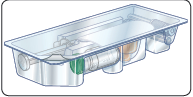
Lift here for a detailed description of the components
Keep the flap of this cover open so you can refer to it as you proceed through the steps.
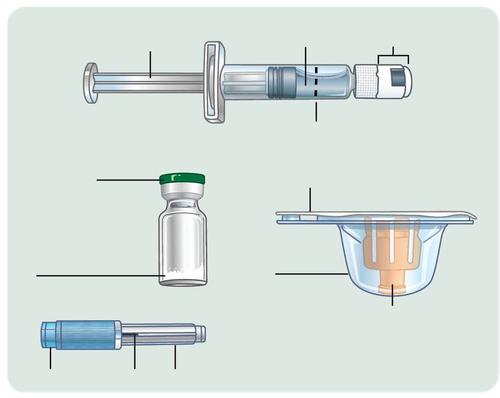
Component guide
Single-dose kit
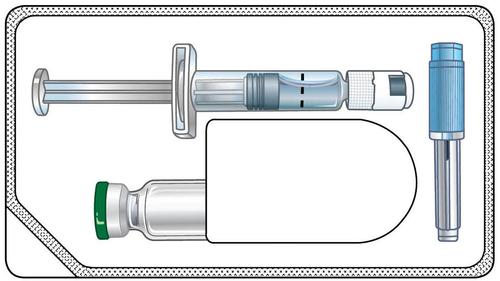
Package contents
To administer the correct dose, read each paragraph so you can perform each step in the
correct order.
This Guide is divided into the following sections:
1Initial preparation
2Connecting the components
3Mixing the medicine and filling the syringe
4Injecting the medicine
Frequently Asked Questions.
1. Initial preparation
1aTake one single-dose kit from the refrigerator.
Prepare to safely dispose of used needles and syringes.You must have what you need to
safely dispose of used needles and syringes.
1bWash your hands.
1c
To open, remove the cover.
Pull out the syringe. The liquid in the syringe should be clear and free of particles. It is okay if there
are air bubbles.
Place the needle, vial adapter packaging, vial, and syringe on a
flat, clean surface.
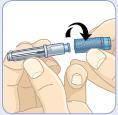
1d
Take the needle and remove the blue cap by twisting it.
Place the capped needle down. The needle is now ready. You will need it later.
There is a spare needle in case you need it.
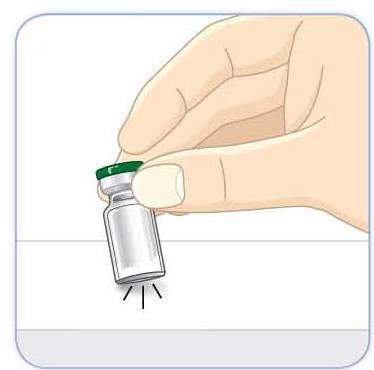
1e
Take the vial.
Tap the vial several times on a hard surface to loosen the powder.
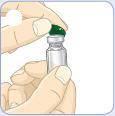
1f
Use your thumb to remove the green cap.
Place the vial down.
2. Connecting the components
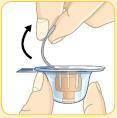
2a
Take the vial connector packaging and remove the paper cover.Do not touch the
orange connector inside.
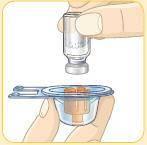
2b
Hold the vial connector packaging in one hand.
Hold the vial in the other hand.
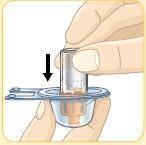
2c
Press the top of the vial firmly into the orange connector.
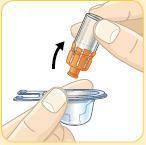
2d
Remove the vial with the orange connector from the packaging, which is now joined to the
vial.
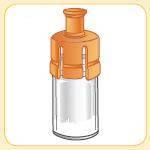
2e
This is how the vial should look now.
Set it aside for later use.
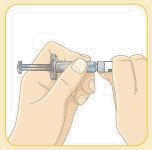
2f
Take the syringe.
With the other hand, hold the 2 grey parts on the white cap firmly.
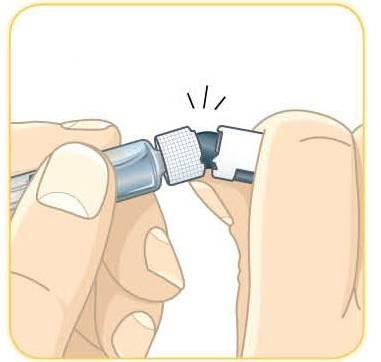
2g
Break the cap
Be careful not to press the plunger.
Break the cap in the same way you might break a stick.
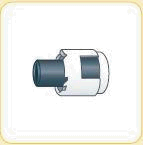
2h
This is how the broken cap looks.
You will not need the cap and can discard it.
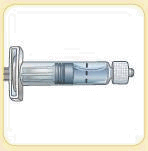
2i
This is how the syringe should look now.
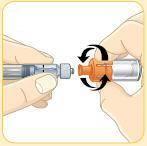
2j
Now take the vial with the attached orange connector.
Rotate the orange connector onto the end of the syringe until it is tightly secured.While
rotating, make sure to hold the orange connector. Do not overtighten. Be careful not to press the
plunger.
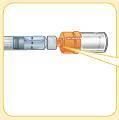
2k

This is how the components should look when connected.
3. Mixing the medicine and filling the syringe.
IMPORTANT:
In the following steps, you will mix the medicine and fill the syringe. Once you have mixed the medicine, you must inject it immediately. Do not store the mixed medicine to inject it later.
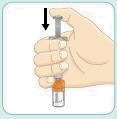
3a
Press the plunger of the syringe with your thumb until it stops and hold it pressed with your thumb.
You may feel as if the plunger is tending to move back a little.
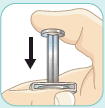
3b
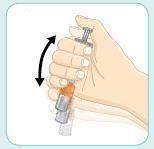
Continue to press the plunger with your thumb and shake vigorously. Continue shaking until the liquid and powder are well mixed.
Do not be afraid that the vial will detach. The orange connector will keep it connected to the syringe.
Shake vigorously as if you were shaking a bottle with an oil and vinegar salad dressing.
3c
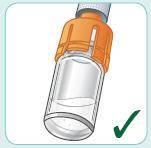
When the medicine is well mixed, it should appear cloudy.
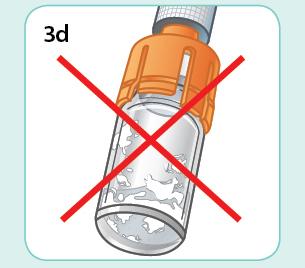
If you see powder residue adhering to the bottom or walls of the vial, the medicine is NOT well mixed.
Shake again vigorously until the medicine is well mixed.
While shaking, continue to hold the plunger pressed with your thumb.
3e
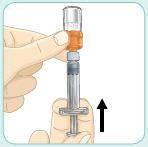
Now, hold the vial with the syringe pointing upwards. Continue to press the plunger with your thumb until it stops and hold it pressed.
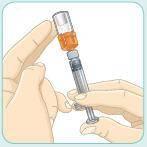
3f
Gently tap the vial with your other hand. Continue to press the plunger with your thumb to keep it stationary.
Tapping the vial helps the medicine to descend along the walls of the vial. It is okay if there are air bubbles.
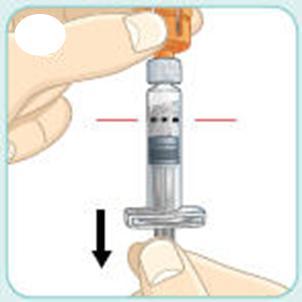
3g
Pull the plunger down past the black dashed line of the dose.
This causes the medicine to pass from the vial into the syringe. You may see air bubbles. This is normal.
A small amount of liquid may adhere to the walls of the vial. This is also normal.
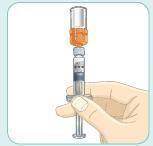
3h
With one hand, hold the plunger stationary so that it does not move.
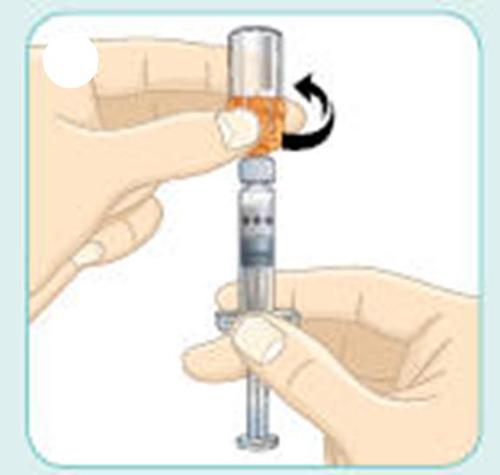
3i
With the other hand, rotate the orange connector to remove it.
After removing the connector, be careful not to press the plunger.
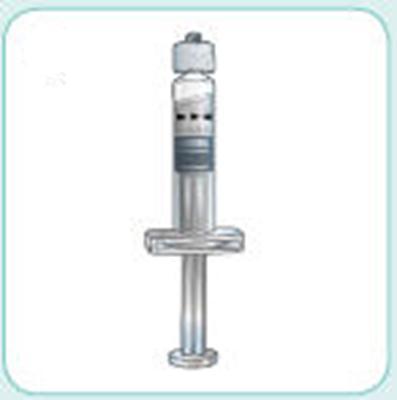
3j
This is how the syringe should look now.
4. Injection of the medicine
IMPORTANT:
Read the next steps scrupulously and observe the figures very carefully.
This will help you administer the correct dose of medicine.
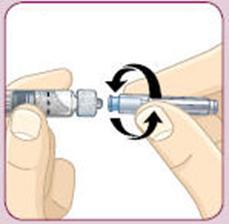
4a
Screw the needle onto the syringe until it is fixed.Do not remove the needle cap yet.
Be careful not to press the plunger.
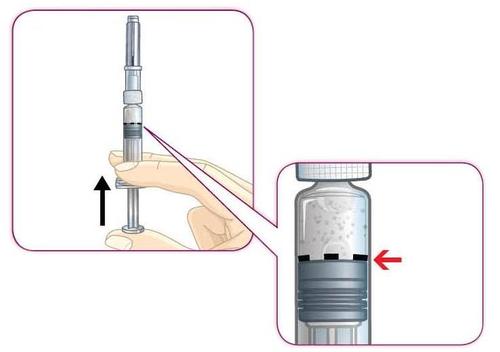
4b
Press slowly on the plunger so that the top of the plunger aligns with the
dashed black line of the dose.
Then, remove your thumb from the plunger.
It is important that you stop pressing at this point or you will waste medicine and not
administer the correct dose.
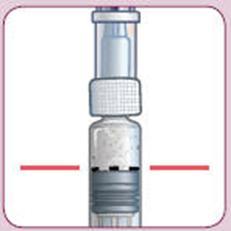
4c
To proceed to the next steps, the top of the plunger must be aligned with the
dashed black line of the dose.This will help you administer the correct dose of the medicine.
IMPORTANT:
It is normal to see some air bubbles in the mixture.
Air bubbles will not alter or affect your dose.
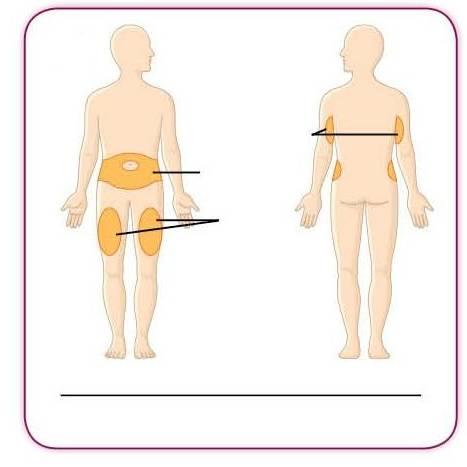
4d
You can inject each dose of the medicine into the area of the stomach (abdomen), in the thighs or in the
upper back of the arms.
Each week you can use the same area of the body. But make sure to choose a different injection site
in this area.
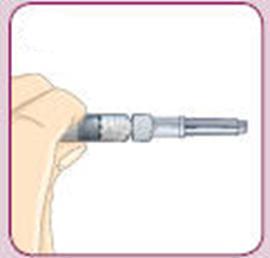
4e
Hold the syringe close to the dashed black line of the dose.
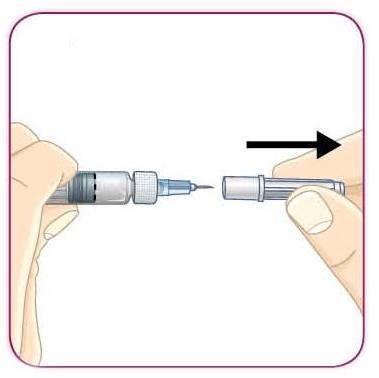
4f
Remove the needle cap
Do not rotate it.
Be careful not to press the plunger.
When you remove the cap, you may see 1 or 2 drops of liquid. This is normal.
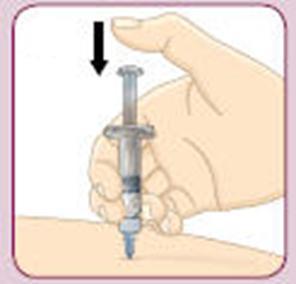
4g
Make sure to use the injection technique recommended by your doctor or the nurse at the diabetes
center.
Remember: you must administer the injection of Bydureonimmediately after mixing.
Insert the needle into the skin (subcutaneously). Inject the entire dose, press the plunger all the way down until it
stops.
Remove the needle.
complete dose.
4h. Dispose of the syringe with the needle still inserted as taught by your doctor or nurseat the
diabetes center.
DO NOT try to put the cap back on or reuse the needle.
You must not store any components. Each single-dose kit has everything you need for your
weekly dose of Bydureon.
Medicines should not be thrown into the drain and household waste. Ask your
pharmacist how to dispose of medicines you no longer use. This will help protect the environment.
When it is time for the next weekly dose, start again from
Step 1.
Frequently Asked Questions
If your question concerns:See question
number:
When to inject after mixing1
Mixing the medicine2
Air bubbles in the syringe3
Needle insertion4
Removing the cap from the needle5
Plunger not aligned with the dashed black line of
dosage
Being unable to press the plunger all the way down at the time
of injection.
7
Frequently Asked Questions
1. After I have mixed the medicine, how long can I wait before performing
the injection?
You should inject Bydureon immediately after mixing. If you do not inject Bydureon
immediately, the medicine will begin to form small floating residues in the syringe.
These floating residues may obstruct the needle while you are injecting (see
question 7).
2. How do I know if the medicine is mixed well?
When the medicine is mixed well, it should appear cloudy. There should be no powder residues
adhering to the bottom or walls of the vial. If you see powder residues, shake vigorously
continuing to press the plunger with your thumb. (This question relates to the steps shown from
step 3a to step 3d).
- 3. I am ready to perform the injection. What should I do if I see air bubbles in thesyringe?It is normal to have air bubbles in the syringe. Air bubbles will not modify or affect your dose. Bydureon is injected into the skin (subcutaneously). Air bubbles are not a problem for this type of injection.
4. What should I do if I have problems inserting the needle?
First, make sure you have removed the blue cap. Then, rotate the needle on the syringe until it is firmly tightened. To prevent medicine leakage, do not press the plunger while inserting the needle. For more information on injection techniques, talk to healthcare professionals. (This question relates to Phase 4a).
5. What should I do if I have problems removing the needle cap?
With one hand, hold the syringe near the dashed black line of dosage. With the other hand, hold the needle cap. Remove the needle cap. Do not rotate it. (This question relates to Phase 4f.)
- 6. I am at Phase 4c. What should I do if the top of the plunger has been pressed beyond thedashed black line of dosage?The dashed black line of dosage shows the correct dose. If the top of the plunger has been pressed beyond this line, you must continue from Phase 4d and administer the injection. Before administering the next injection after 1 week, carefully review the instructions from Phase 3a to Phase 4h.
- 7. When I administer the injection, what should I do if I cannot press the plunger completelyto the end?This means that the needle is blocked. Remove the needle and replace it with the spare needle provided in the kit. Then choose a different injection site and complete the injection.
To review how to:
- Remove the blue needle cap, see phase 1d
- Insert the needle, see phase 4a
- Remove the needle cap and administer the injection, see from phase 4e to phase 4g.
If you still cannot press the plunger completely to the end, remove the needle. Read the package leaflet (paragraph 3) about what to do if you are not sure you have received the full dose. To prevent needle blockage, always mix the medicine very well and inject it immediately after mixing.
Bydureon must be administered only once a week.
Note that you have administered Bydureon today and mark on your calendar when you need to administer the next injection.
How to obtain further information about Bydureon
- Talk to your doctor, pharmacist or nurse at the diabetes center.
INSTRUCTIONS FOR USE
Read the instructions carefully before use
Bydureon 2 mg powder and solvent for prolonged-release injectable suspension in pre-filled pen
How to use the Bydureon pre-filled pen
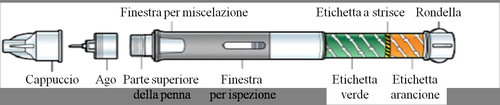
Before using the pen, it is recommended that you receive instructions on correct use from your doctor or nurse at the diabetes center. Unless a qualified person can help inject it, this medicine is not recommended for people who are blind or have poor eyesight.
Phase 1: Preparing the pen
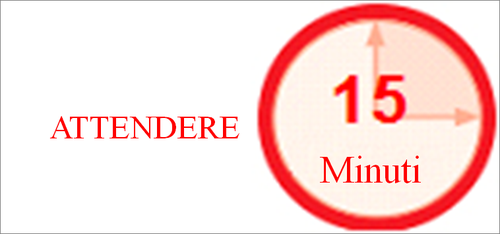
- A. Let the pen warm up.Take a pen from the refrigerator and let it stand at room temperature for at least 15 minutes. DO NOTuse a pen once the expiration date has passed.
Wash your hands while the pen is warming up.
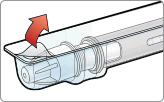
- B.Open the tray,
by pulling the tab located in the corner. Then remove the pen and the needle. DO NOTuse the pen or the needle if any components are broken or missing.
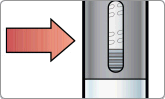
- C. Check the liquid,
inside the inspection window. It must be clear and free of particles. It is normal if you see air bubbles in the liquid.
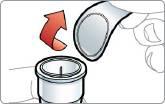
- D. Remove the paper tab,
from the needle cap.
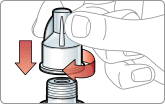
- E.Insert the needle into the pen,
pushing it and screwing it onto the top of the pen until it is tight. For now DO NOTremove the needle cap.
DO NOT proceed if the needle is not inserted

STOP
Phase 2: Mixing the medicine
- A. Mix the medicine.
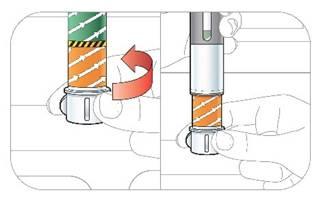
Holding the pen straight with the needle cap facing up, slowly turn the collar counterclockwise. STOPwhen you hear a click and the green label disappears.
CLICK!
- B. Tap the pen firmly to mix.
- Hold the pen by the end with the orange label and tap the pen firmly against the palm of your hand.
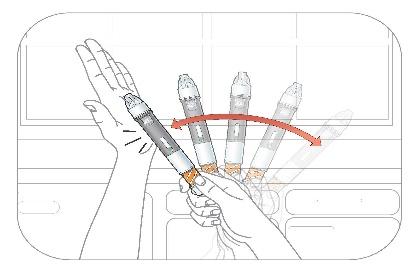
- WITHOUTturning the collar, ROTATEthe pen after a few taps.
- Tap the pre-filled pen firmly until you obtain a uniform cloudy suspension without clumps. 80 times or more
- You may need to tap 80 times or more.
- C. Check the suspension.Hold the pen upright to the light and check through both sides of the mixing window.The solution MUST NOTcontain CLUMPSand must be uniformly cloudy.
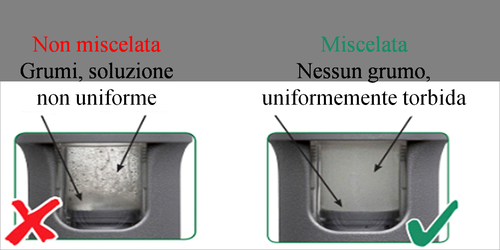
To obtain the full dose, the medicine must be mixed well.
If it is not mixed well, tap longer and harder.
DO NOT proceed with the injection unless the medicine is well mixed

STOP
To obtain the full dose, the medicine must be mixed well. If it is not mixed well, tap longer and harder. It is normal if you see air bubbles in the liquid, they will not cause any harm.
- D. Compare both sides of the mixing window with the images below,holding the pen against the page. Carefully observe the lower surface.If you do not seeclumps, you are ready for the injection.
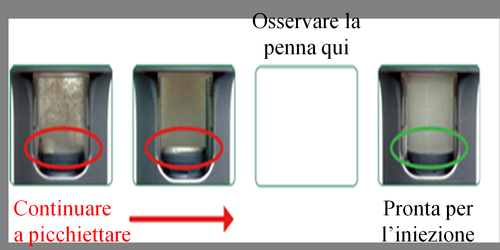
Phase 3: Injecting the medicine
IMPORTANT Once you have mixed the medicine, you must inject it immediately.
Do not store it for injection later.
- A. Choose the injection site,
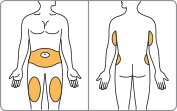
between abdomen, thigh or back of the arm. Each week you can use the same area of the body, but choose a different injection site in that area. Gently clean the areawith soap and water or an alcohol swab.
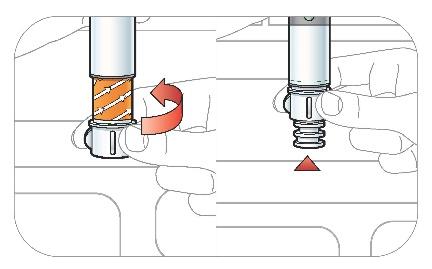
- B.Turn the collar to release the injection button.Holding the pen straight, turn the collar until the orange label disappears and the injection button is released. For now DO NOTpress the injection button.
- C. Remove the needle cap,
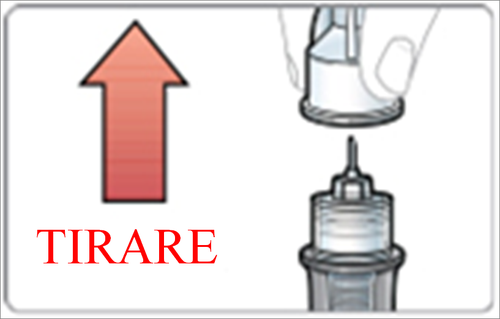
by pulling it. DO NOTrotate it. You may see some drops of liquid on the needle or in the cap.
- D. Inject the medicine,
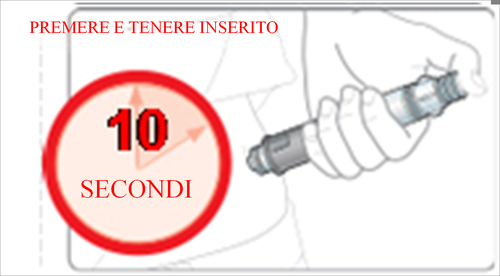
Insert the needle into the skin (subcutaneously). Press the injection button with your thumb until you hear a click. Keep the needle inserted
into the skin for 10 secondsto be sure to inject the entire dose.
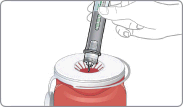
- E. Dispose of the pen correctly,
with the needle attached, by throwing it into a puncture-resistant container. DO NOTtry to put the cap back on or reuse the needle.
Frequently Asked Questions
1. How do I know if the medicine is mixed properly?
The medicine is mixed properly when the liquid appears cloudy from both sides of the window. You should not
see any clumps in the liquid. It may be helpful to hold the pen up to the light to see
inside the window. If you see clumps of any size, continue to tap the
pen firmly against the palm of your hand until the medicine is mixed.
2. What should I do if I have trouble mixing the medicine?
Before preparing the dose, remember to leave the pen out of the refrigerator for at least 15 minutes.
This will allow the pen to reach room temperature. It will be easier to mix the
medicine if the pen is at room temperature.
Make sure to hold the pen at the end with the rubber stopper and the orange label. This way
you will be able to hold the pen firmly and tap it more forcefully against your palm.
It may also be helpful to tap the mixing window, on both sides, against your palm. If
you see clumps, continue to tap.
3. After I have mixed the medicine, how long can I wait before performing
the injection?
You should inject the dose immediately after mixing. If you do not inject the dose immediately, small clumps of medicine may form in the pen and you may not inject the entire dose.
- 4.I am ready to perform the injection. What should I do if I see air bubblesin the pen?It is normal for there to be air bubbles in the pen. The medicine is injected into the skin (subcutaneously). Air bubbles will not cause you any harm or affect the dose with this type of injection.
- 5.When I try to perform the injection, what should I do if I cannot press the injection buttoncompletely down?Verify that you have completely screwed the needle onto the pen. Also, make sure you have turned the dial until it stops, check that the orange label has disappeared and the injection button appears. If you still cannot press the button, then the needle may be blocked. Remove the needle from the skin and replace it with the spare needle in the package. Review the procedure for inserting the needle. Then choose a different injection site and complete the injection. If you still cannot press the button completely down, remove the needle from the skin. Dispose of the pen with the needle still attached in a puncture-resistant container.
6. Come faccio a sapere se ho iniettato l’intera dose?
Per essere certo di iniettarsi la dose intera, prema il pulsante di iniezione con il pollice finché sente un
click. Dopo il click, continui a tenere l’ago inserito nella pelle per 10 secondi, un lasso di tempo
sufficiente per garantire che tutto il medicinale passi dalla penna sotto la pelle.
7. Come elimino la penna di Bydureon?
Dovrà disporre di un contenitore resistente alle punture che sia sufficientemente grande per contenere
l’intera penna con l’ago usato attaccato. Si accerti che il contenitore sia provvisto di un coperchio. Può
usare un contenitore per lo smaltimento dei materiali biologici, un altro contenitore di plastica dura o
un contenitore in metallo. Nella confezione non è incluso alcun contenitore.
Chieda al farmacista come eliminare in modo sicuro il contenitore con le penne e gli aghi usati. Non
getti il contenitore nei rifiuti domestici.
ISTRUZIONI PER L’UTILIZZATORE
Legga attentamente le istruzioni prima dell’uso
Bydureon 2 mg sospensione iniettabile a rilascio prolungato in penna preriempita
exenatide
Una volta a settimana
Solo per uso sottocutaneo
Penna preriempita monodose
BCise è il nome della penna preriempita usata per iniettare Bydureon.
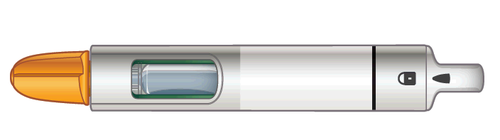
Prima di iniziare
La penna Bydureon BCise:
- È monodose, penna a dose fissa che inietta automaticamente il suo medicinale.
- La porti nella posizione bloccata prima di usarla. Non sblocchi la penna fino a quando non è pronta per l’iniezione.
- L’ago è nascosto. Non lo vede prima, durante o dopo l’uso della penna.
- Nonusi la penna se alcune parti le sembrano rotte o danneggiate.
- Lo conservi in frigorifero in orizzontale da 2°C a 8°C.
- La penna Bydureon BCise nondeve essere usata da persone cieche o che non possono vedere bene, a meno che possano essere aiutate da un altra persona in grado di usare questo device.
- Tenga la penna, e tutti gli altri medicinali fuori dalla portata dei bambini.
Prima dell’uso
Il suo dottore o il suo infermiere del centro antidiabetico deve insegnarle come iniettarsi questo
medicinale prima che lei lo usi per la prima volta.
Posizione di
blocco
Finestra
Cappuccio
arancione
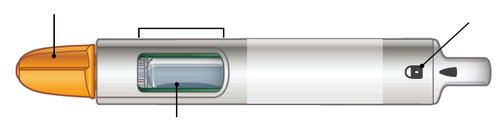
Medicinale
Figura A
Materiale necessario per la tua iniezione:
- penna Bydureon BCise • Tampone con alcool • Una superficie pulita e piatta • Contenitore resistente alla puntura (vedere le istruzioni per lo “smaltimento” alla fine di queste istruzioni)
Fase 1: Preparazione per l’iniezione
- A. Lasciare la penna a temperatura ambiente.Rimuova la penna dal frigorifero e la lasci riposare per 15 minuti. La penna Bydureon BCise può essere tenuta a temperatura ambiente fino a 4 settimane.
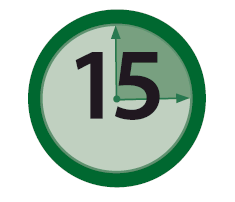
ASPETTARE
- B.Verificare la data di scadenza (denominataSCAD) stampata sull'etichetta della penna.Non utilizzare la penna oltre la data di scadenza. Figura B
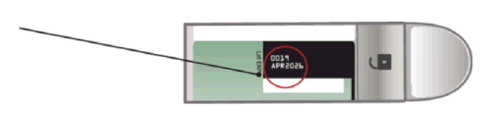
Figura C
- C. Lavare le mani
- D. Scegliere il sito d’iniezioneNello stomaco, nella coscia o nella parte alta posteriore del braccio, vedere figura D. Ogni settimana può usare la stessa area del corpo, ma scelga un sito di iniezione diverso in quell'area del corpo. Pulire l'area con un tampone imbevuto di alcol.
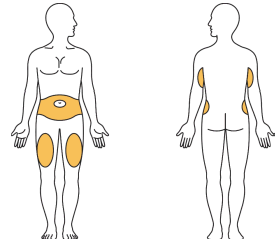
DavantiDietro
Figura D
Fase 2: Miscelare il medicinale
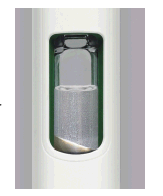
- A. Guardare nella finestraPuò vedere del medicinale bianco lungo i lati, in basso o in alto. Questo significa che il medicinale non è stato miscelato in modo uniforme. Guardare
Figura E
- B. Agitare la penna con forza,con un movimento su e giù, finché il medicinale non è miscelato uniformemente e non si vede medicinale bianco lungo i lati, in basso o in alto. Agitare per almeno 15 secondi.
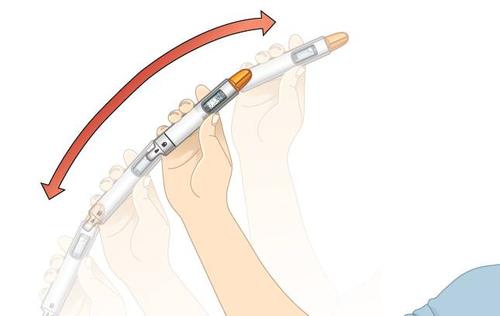
Agitare con
forza
Figura F
- C. Controllare la miscelaTenere la penna in controluce e guardare attraverso entrambi i lati e la parte inferiore della finestra. Se il medicinale non è ben miscelato, ripetere il passaggio 2 e ricontrollare.
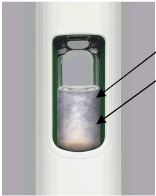
NON miscelato bene
Miscela irregolare
Medicinale bianco in basso, in alto o
sui lati

Figura G
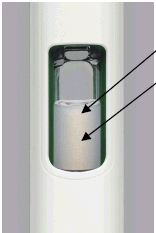
Miscelato bene
Miscela regolare
Torbido
Va bene se si vedono bolle

Figura H

Nonproseguire con la fase successiva finché il medicinale non è ben miscelato. Per ottenere una dose
completa, il medicinale deve essere miscelato bene e avere un aspetto torbido.
Se non è stato miscelato bene, continuare ad agitare con forza.
Fase 3: Preparare la Penna
Importante:Dopo che il farmaco è stato completamente miscelato, è necessario completare
immediatamentei passaggi di preparazione e iniettare per somministrare la dose completa. Non
conservare per usarlo successivamente.
Sbloccare la penna solo quando si è pronti per l'iniezione.
Sbloccare la penna
Tenere la penna in posizione verticale con il cappuccio arancione rivolto verso il soffitto. Ruota la
manopola dalla posizione di Blocco alla posizione di Sblocco fino a quando non sente un clic.
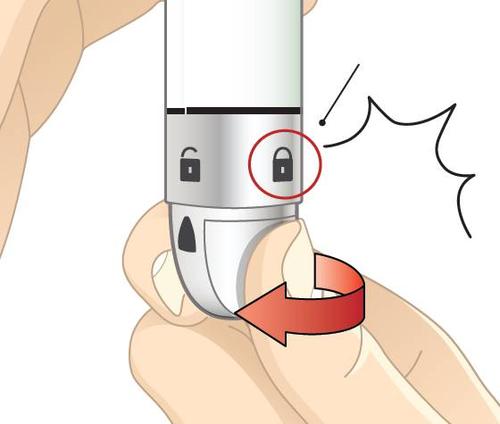
Blocco
Click
Figura I
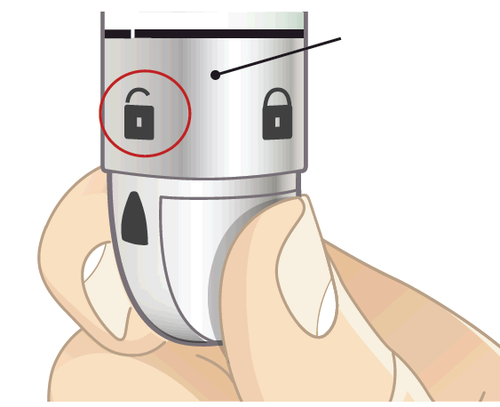
Sblocco
Figura J
- B. Tenendo sempre la penna verso l'alto, svitare saldamente il cappuccio arancione.
- Potrebbe essere necessario ruotare il cappuccio alcune volte prima che si allenti (se si sente clic si sta ruotando nella direzione sbagliata).
- Continuare a tenere la penna in posizione verticale per evitare che il medicinale fuoriesca accidentalmente.
- Si aprirà una protezione verde dopo che il cappuccio è stato rimosso. La protezione verde nasconde l'ago. È normale vedere alcune gocce di liquido all'interno del tappo. Nonrichiudere la penna. Gettare via il cappuccio.
Tenere verso l’alto& ruotare saldamente
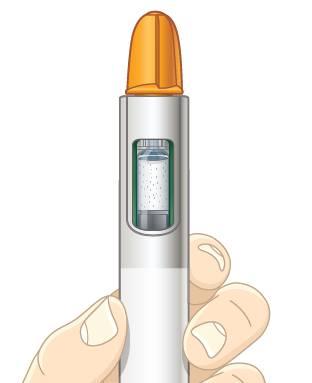
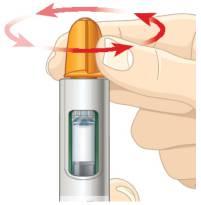
Figura KFigura L
Cappuccio rimossoProtezione verde a comparsa
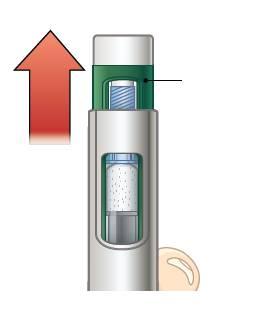
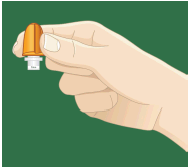
Ago
nascosto
Figura MFigura N
STEP 4: Iniettare la dose
- A. Iniettaree attendere:
- Premere la penna contro la pelle. Sentirà un “click” quando l’iniezione inizia.
- Tenere la penna contro la pelle per 15 secondi. Questo per assicurarsi di iniettare la dose completa.
INIETTARE E ATTENDERE
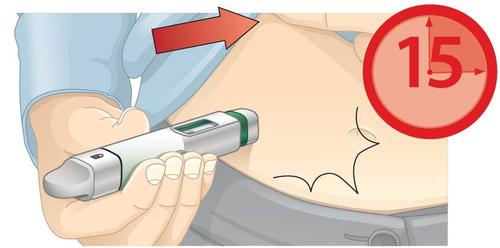
Click
Figura O
- B.Assicurarsi di aver iniettato la dose completaDopo aver ricevuto l'iniezione, vedrà una barra arancione nella finestra. Dopo aver sollevato la penna dalla pelle, la protezione verde si sposterà indietro per bloccare l'ago. Veda le Domande e risposte frequenti su cosa fare se non vede la barra arancione nella finestra dopo l'iniezione.
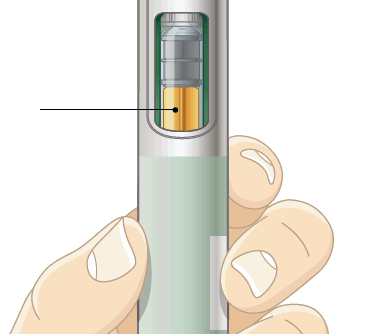
Barra
arancione
Figura P
- C. Smaltimento
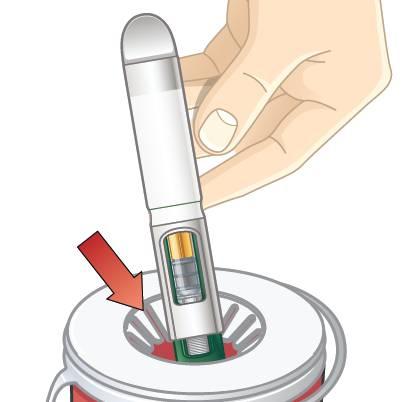
Smaltire correttamente la penna dopo l’uso
come indicato dal medico, farmacista o infermiere
del centro antidiabetico.
Avrà bisogno di un contenitore resistente alle
perforazioni che:
- sia largo abbastanza da contenere tutta la penna,
- abbia un coperchio
- non abbia perdite
- sia correttamente etichettato per l’indicazione di rifiuti pericolosi all’interno del contenitore. È possibile utilizzare un contenitore per i rifiuti a rischio biologico, un altro contenitore di plastica resistente o un contenitore di metallo. Figura Q
Domande e risposte frequenti
1. Where is the needle?
The needle is attached to the pen and covered by the orange cap. When you unscrew the orange cap, the green protector keeps the needle covered until injection. For further information, see Figure N Step 3B in the User Instructions.
2. How do I know if the medicine is completely mixed?
After shaking the pen, look through both sides of the window. You should not see any white medicine at the bottom, at the top, or along the sides. If you see white medicine, it is not mixed. To mix, shake the pen vigorously until the white medicine is no longer at the bottom, at the top, or along the sides. The medicine should appear uniform (see the images in Figure G and Figure H, Step 2C).
3. Why must I keep the pen in a vertical position while removing the orange cap?
Orange?
Keeping the pen with the orange cap facing upwards prevents the medicine from leaking out. It is normal to see some drops of medicine inside the orange cap after unscrewing it.
4. Why must I inject the medicine immediately after mixing it?
If you do not inject the medicine immediately after mixing, the medicine may separate and you may not inject the full dose. It is possible to remix the medicine if the pen is in the locked position. However, after unlocking it, you must immediately complete the preparation steps and inject to obtain the full dose. It cannot be stored for later use.
5. How do I know I have injected the complete dose of the medicine?
To be sure to inject the complete dose, hold the pen against the skin.
You will feel the needle enter the skin. Keep the needle against the skin for 15 seconds. This will allow
sufficient time for the medicine to pass from the pen to the underlying part of the skin. After
removing the needle, look for the orange bar in the window indicating that the dose has been
delivered. If the orange bar does not appear, contact the local representative of the marketing authorization holder
(list of contacts per country).
6. Why must I store the pen horizontally in the refrigerator?
Pens stored vertically (with the needle pointing up or down) are more difficult
to mix. The medicine may still be completely mixed but will require greater
shaking and more time.
7. How do I dispose of the Bydureon BCise pen?
Do notthrow the pen in household waste. You will need a puncture-resistant
container that is large enough to hold the entire pen. Make sure the container
has a lid. You can use a sharps container, another durable plastic container, or a metal
container. The container is not included in the
package. Do not recycle the container with used pens. Ask your pharmacist how to dispose of it
safely. Do not throw the container in household waste.
8. What to do if the device is malfunctioning and I cannot unlock it?
Review the User Instructions for Phase 3 to be sure of the order of operations to be performed, then contact the local representative of the marketing authorisation holder to avoid attempting to force unlock it or using other accessories.
- 9. What to do if the device is malfunctioning and I cannot remove the orange cap?Review the User Instructions for Phase 3 to be sure of the order of operations to be performed, also verify that the knob is completely in the unlock position, then contact the local representative of the marketing authorisation holder.
or attempting to remove the cap by force.
10. Where to find more information about the Bydureon BCise pen
- Talk to your doctor, pharmacist or nurse at the diabetes center.
How to store the Bydureon BCise pen:
- Store in a refrigerator horizontally between 2°C and 8°C.
- If necessary, each pen can be stored at room temperature not exceeding 30 °C for a maximum of 4 weeks.
- Store in the original packaging to protect from light until you are ready to prepare and use your dose.
- Do not use after the expiry date. The expiry date is on the label after Expiry.
- Keep the pen clean and away from contamination.

Не уверены, подходит ли вам это лекарство?
Обсудите симптомы и варианты лечения с врачом онлайн.

Уже начали прием и появились вопросы?
Обсудите свое состояние и дальнейшие шаги с врачом онлайн.
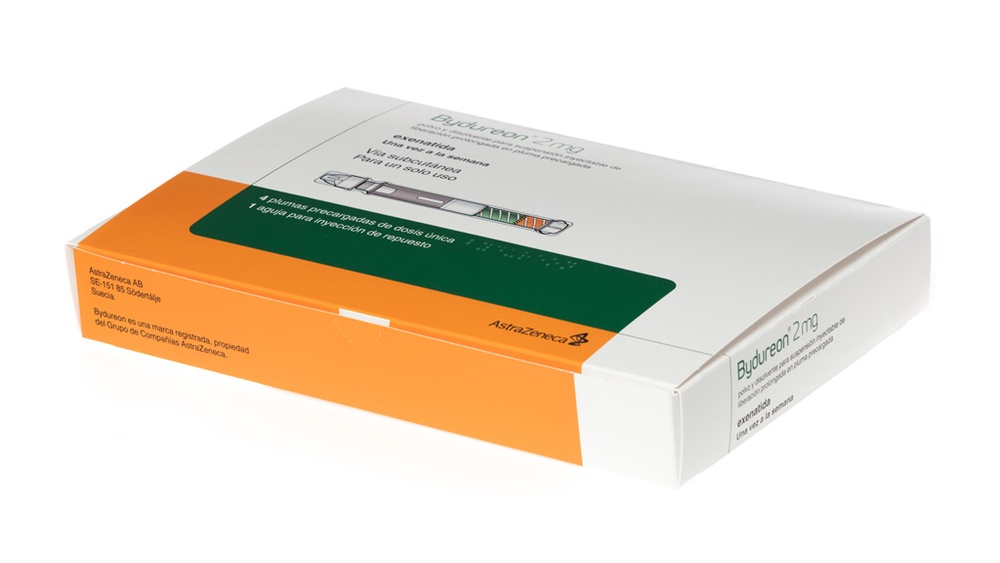
- Страна регистрации
- Форма выпускаPowder and solvent for injectable suspension, 2 MG
- Код АТХA10BJ01
- Действующее вещество
- Отпускается по рецептуНет
- Производитель
- Информация на этой странице носит справочный характер и не является медицинской консультацией. Перед началом приема лекарства обязательно проконсультируйтесь с врачом.
- Аналоги BYDUREONФорма выпуска: Injectable solution, 5 MICROGRAMSДействующее вещество: exenatideПроизводитель: ASTRAZENECA ABОтпускается по рецептуФорма выпуска: Pre-filled pen injectable solution, 6 MG/MLДействующее вещество: ЛираглютидПроизводитель: SUN PHARMACEUTICAL INDUSTRIES (EUROPE) B.V.Отпускается по рецептуФорма выпуска: Pre-filled pen injectable solution, 6 MG/MLДействующее вещество: ЛираглютидПроизводитель: CIPLA EUROPE NVОтпускается по рецепту
Аналоги BYDUREON в других странах
Лекарства с тем же действующим веществом, доступные в других странах.
Аналог BYDUREON в Испания
Врачи онлайн по BYDUREON
Обсудите применение BYDUREON и возможные следующие шаги — по оценке врача.


Получите рецепт на BYDUREON онлайн
Заполните форму за 2 минуты
Расскажите о симптомах, истории болезни и нужном препарате.
Выберите врача или мы назначим
Выберите специалиста или мы подберём ближайшего доступного врача.
Врач рассматривает ваш случай
Обычно в течение 30 минут. Может задать уточняющие вопросы в чате.
Получите в любой аптеке
Электронный рецепт отправляется на вашу почту — действителен по всей Польше.
Часто задаваемые вопросы
BYDUREON не требует рецепта в Италия. Вы можете уточнить у врача онлайн, подходит ли это лекарство для вашей ситуации.
Действующее вещество BYDUREON — exenatide. Эта информация помогает определить лекарства с тем же составом под другими торговыми названиями.
BYDUREON производится компанией ASTRAZENECA AB. Упаковка и торговое название могут отличаться в зависимости от дистрибьютора.
Врачи, включая Семейные врачи, Психиатры, Дерматологи, Кардиологи, Эндокринологи, Гастроэнтерологи, Пульмонологи, Нефрологи, Ревматологи, Гематологи, Инфекционисты, Аллергологи, Гериатры, Педиатры, Онкологи, могут оценить целесообразность применения BYDUREON с учетом вашей ситуации и местных правил. Вы можете записаться на онлайн-консультацию, чтобы обсудить возможные варианты.
Польша имеет хорошо развитую систему здравоохранения в крупных городах, таких как Варшава, Краков, Вроцлав и Гданьск. Аптеки широко доступны и работают в соответствии с действующим законодательством, обеспечивая доступ к рецептурным препаратам.
Вы можете купить BYDUREON в Варшаве, Кракове, Вроцлаве или Гданьске в любой аптеке при наличии действующего рецепта.
Чтобы получить рецепт, вы можете воспользоваться Oladoctor:
Другие лекарства с тем же действующим веществом (exenatide) включают BYETTA, DIAVIK, LIRATIGT. Они могут отличаться торговым названием или формой выпуска, но содержат одинаковый терапевтический компонент. Перед изменением лечения рекомендуется проконсультироваться с врачом.
