



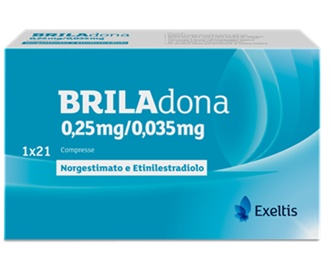
BRILADONA 0.25 MG/0.035 MG Coated tablet

Рассмотрение рецепта онлайн
Врач рассмотрит ваш случай и примет решение о назначении рецепта, если это медицински оправдано.

Поговорите с врачом об этом лекарстве
Обсудите симптомы и возможные дальнейшие шаги на онлайн-консультации.



Инструкция по применению BRILADONA
Содержание инструкции
Briladona 0.25mg/0.035 mg tablets
Norgestimate / Ethinylestradiol
Generic medicine
Important things to know about combined hormonal contraceptives (CHCs):
- They are one of the most reliable reversible methods of contraception, if used correctly.
- They slightly increase the risk of blood clots forming in veins and arteries, especially during the first year of use or when restarting a combined hormonal contraceptive after a break of 4 or more weeks.
- Pay attention and see a doctor if you think you have symptoms of a blood clot (see section 2 “Blood clots”)
Read this leaflet carefully before taking this medicine as it contains important information for you.
- Keep this leaflet. You may need to read it again.
- If you have any questions, ask your doctor or pharmacist.
- This medicine has been prescribed for you only. Do not pass it on to others, even if their symptoms are the same as yours, as it could be harmful.
- If you get any side effects, even those not listed in this leaflet, tell your doctor, pharmacist or nurse. See section 4.
Contents of this leaflet
- 1. What Briladonais and what it is used for
- 2. What you need to know before you take Briladona
- 3. How to take Briladona
- 4. Possible side effects
- 5. How to store Briladona
- 6. Contents of the pack and other information
1. What is BRILADONA and what is it used for
Briladona is a combined hormonal oral contraceptive (“the Pill”). Take it to prevent
pregnancy.
This contraceptive contains two types of female sex hormones, estrogen and progestin. These hormones
prevent the ovaries from producing an egg each month, so you cannot become pregnant. In addition, Briladona thickens the
fluid (mucus) in the cervix, making it more difficult for sperm to enter the uterus.
Briladona must be taken as directed to prevent pregnancy.
2. Cosa deve sapere prima di prendere Briladona
Note generali
Before starting to use Briladona, read the information on blood clots in paragraph 2.
It is particularly important that you read the symptoms of a blood clot (see paragraph 2 “Blood clots”).
Before starting to use Briladona, your doctor will ask you some questions about your personal medical history and that of your close relatives. The doctor will also measure your blood pressure, and, based on your personal situation, may also perform other tests.
This leaflet describes several situations in which you must stop using Briladona, or where the reliability of Briladona may be reduced. In such situations, you should not have sexual intercourse or you should use additional non-hormonal contraceptive precautions, such as using a condom or another barrier method. Do not use methods like the rhythm or basal temperature methods. These methods may be unreliable because Briladona alters the monthly changes in body temperature and cervical mucus.
Briladona, like other hormonal contraceptives, does not protect against infections from HIV (AIDS) and other sexually transmitted diseases.
Do not use Briladona
Do not use Briladona if you have any of the conditions listed below. If you have any of the conditions listed below, consult your doctor. The doctor will discuss with you other methods of birth control that may be more suitable for your case.
- if you have (or have ever had) a blood clot in a vessel of the legs (deep vein thrombosis, DVT), lungs (pulmonary embolism, PE) or other organs;
- if you know you have a disorderaffecting blood coagulation, such as protein C deficiency, protein S deficiency, antithrombin-III deficiency, Factor V Leiden or antiphospholipid antibodies;
- if you are going to have surgery or if you will be bedriddenfor a long period (see paragraph “Blood clots”);
- if you have, or have ever had, a heart attack or stroke;
- if you have (or have ever had) angina pectoris (a condition that causes severe chest pain and may be a first sign of a heart attack) or a transient ischemic attack (TIA - symptoms of a temporary stroke)
- if you have one of the following diseases that may increase the risk of blood clots forming in the arteries: severe diabeteswith damage to blood vessels or very high blood pressureor very high levels of fats(cholesterol or triglycerides) in the bloodor a known disease called hyperhomocysteinemia
- if you have (or have ever had) a type of migraine called “migraine with aura”
- if you have heart valve disorders that have caused complications
- if you have (or have ever had) a liver diseaseand liver function has not yet returned to normal
- if you have (or have ever had) a liver tumor
- if you have (or have ever had) or suspect you have breast canceror a tumor of the genital organs
- if you have any unexplained vaginal bleeding
- if you had jaundice during a pregnancy caused by the bile duct or if you have had jaundice previously during the use of the pill
- if you have an abnormal thickening of the uterine lining.
- if you are allergicto norgestimate or ethinylestradiol, or to any of the other ingredients of this medicine (listed in paragraph 6).
- if you have (or have ever had) pancreatitis (inflammation of the pancreas) associated with severe hypertriglyceridemia,
- if you have hepatitis C and are taking medications containing ombitasvir/paritaprevir/ritonavir and dasabuvir (see also the paragraph “Other medicines and Briladona”).
When to be particularly careful with Briladona
When should you contact a doctor?
Contact a doctor urgently
- if you notice possible signs of a blood clot that may indicate you have a blood clot in the leg (deep vein thrombosis), a blood clot in the lung (pulmonary embolism), a heart attack or a stroke (see the following section "Blood clots").
For a description of the symptoms of these serious side effects, go to the paragraph “How to recognize a blood clot”.
Tell your doctor if any of the following conditions apply to you.
If this condition appears or worsens while you are using Briladona, you should tell your doctor.
- if you have Crohn’s disease or ulcerative colitis (chronic inflammatory bowel disease);
- if you have systemic lupus erythematosus (SLE, a disease that affects the body's defense system);
- if you have hemolytic uremic syndrome (HUS, a blood clotting disorder that causes kidney failure);
- if you have sickle cell anemia (an inherited red blood cell disease);
- if you have high levels of fats in the blood (hypertriglyceridemia) or a family history of this condition. Hypertriglyceridemia has been associated with an increased risk of developing pancreatitis (inflammation of the pancreas);
- if you are going to have surgery or if you will be bedridden for a long period (see paragraph 2 “Blood clots”);
- if you have just given birth, your risk of developing blood clots is higher. Ask your doctor how long after giving birth you can start taking Briladona;
- if you have inflammation of the veins located under the skin (superficial thrombophlebitis);
- if you have varicose veins.
- if you have otosclerosis (hearing loss)
- if you have or have ever had chloasma (a discoloration of the skin, especially on the face or neck, known as "pregnancy spots"). If so, avoid direct sunlight or ultraviolet light.
- if you have a blistering rash during pregnancy (herpes gestationis) that appears for the first time during pregnancy
- if you have (or have ever had) gallstones or inflammation of the gallbladder
- if you have a blood disease called porphyria
- if you have a nervous system disease that causes sudden movements of the body (Sydenham's chorea)
- if a close relative of yours has or has ever had breast cancer
- if you have depression. Some women using hormonal contraceptives including Briladona have reported depression or depressed mood. Depression can be severe and sometimes can lead to suicidal thoughts. If you experience mood changes and depressive symptoms, consult your doctor as soon as possible for further medical advice.
- if you have a liver disease
BLOOD CLOTS
The use of a combined hormonal contraceptive like Briladona causes an increased risk of developing a blood clot compared to not using it. In rare cases, a blood clot can block blood vessels and cause serious problems.
Blood clots can develop
- in the veins (a condition called “venous thrombosis”, “venous thromboembolism” or VTE)
- in the arteries (a condition called “arterial thrombosis”, “arterial thromboembolism” or ATE). Healing from blood clots is not always complete. Rarely, serious long-term effects can occur or, very rarely, these effects can be fatal.
It is important to remember that the overall risk of a harmful blood clot associated with Briladona is low.
HOW TO RECOGNIZE A BLOOD CLOT
Contact a doctor immediately if you notice any of the following signs or symptoms.
Do you have any of these signs?
What you probably suffer from?
Swelling in one leg or along a vein in the leg or foot, especially if accompanied by:
- pain or sensitivity in the leg that can only be felt when standing or walking
- increased warmth in the affected leg
- change in skin color of the leg, such as paleness, redness or bluish discoloration Deep vein thrombosis
- shortness of breath or sudden unexplained rapid breathing;
- sudden cough with possible blood production;
- sharp chest pain that may increase when breathing deeply;
- severe dizziness or lightheadedness;
- rapid or irregular heartbeat;
- severe stomach pain; Pulmonary embolism
| If you are unsure, inform your doctor as some of these symptoms such as cough or shortness of breath can be mistaken for a milder condition such as a respiratory infection (e.g. a “common cold”). | c o |
Symptoms that occur more frequently in one eye:
| a m Retinal vein thrombosis (blood clot in the eye) |
r
| Heart attack |
e d
| Stroke |
a t
| Blood clots blocking other blood vessels |
BLOOD CLOTS IN A VEIN
What can happen if a blood clot forms in a vein?
- The use of combined hormonal contraceptives has been linked to an increased risk of blood clots in the veins (venous thrombosis). However, these side effects are rare. In most cases, they occur in the first year of use of a combined hormonal contraceptive.
- If a blood clot forms in a vein in the leg or foot, it can cause deep vein thrombosis (DVT).
- If a blood clot moves from the leg and lodges in the lung, it can cause a pulmonary embolism.
- Very rarely, the clot can form in another organ such as the eye (retinal vein thrombosis).
When is the risk of developing a blood clot in a vein highest?
The risk of developing a blood clot in a vein is highest during the first year you take a combined hormonal contraceptive for the first time. The risk may also be higher if you restart a combined hormonal contraceptive (the same medicine or a different medicine) after a break of 4 or more weeks.
After the first year, the risk decreases but is still slightly higher than if you were not using a combined hormonal contraceptive.
When you stop taking Briladona, the risk of developing a blood clot returns to normal levels within a few weeks.
What is the risk of developing a blood clot?
The risk depends on your natural risk of VTE and the type of combined hormonal contraceptive you are taking.
The overall risk of developing a blood clot in the leg or lung (DVT or PE) with Briladona is low.
- In 10,000 women who do not use any combined hormonal contraceptive and are not pregnant, about 2 will develop a blood clot in a year.
- In 10,000 women who use a combined hormonal contraceptive containing levonorgestrel, norethisterone or norgestimate like Briladona, about 5-7 will develop a blood clot in a year.
- The risk of a blood clot forming depends on your medical history (see below “Factors that increase the risk of developing a blood clot”).
| a | Risk of developing a blood clot in a year |
| i Women who do not use a hormonal pill/patch/ring l combined and are not pregnant | About 2 women out of 10,000 |
| a Women who use a combined hormonal contraceptive pill containing levonorgestrel, norethisterone or norgestimate | About 5-7 women out of 10,000 |
| t Women who use Briladona | About 5-7 women out of 10,000 |
Factors that increase the risk of developing a blood clot in a vein
The risk of developing a blood clot with Briladona is low but some conditions cause an increase.
Your risk is higher:
- if you are strongly overweight (body mass index or BMI greater than 30kg/m²);
- if a close relative of yours has had a blood clot in a leg, in the lung or in another organ at a young age (for example under about 50 years). In this case you may have an inherited blood clotting disorder;
- if you have to undergo surgery or if you have to stay in bed for a long period due to an injury or illness or if you have a leg in a cast. It may be necessary to stop taking Briladona a few weeks before the operation or during the period when you are less mobile. If you need to stop taking Briladona, ask your doctor when you can start taking it again.
- as you get older (especially over 35 years);
- if you have given birth less than a few weeks ago
The risk of developing a blood clot increases when you have more than one of these conditions.
Air travel (lasting more than 4 hours) can temporarily increase the risk of a
blood clot forming, especially if you have some of the other risk factors listed.
It is important that you inform your doctor if any of these conditions apply to you, even if you are not
sure. The doctor may decide to stop you from taking Briladona.
If any of the above conditions change while you are using Briladona, for example if a close relative
develops thrombosis for no known reason or if you gain a lot of weight, contact your doctor.
BLOOD CLOTS IN AN ARTERY
What can happen if a blood clot forms in an artery?
Like blood clots in a vein, clots in an artery can cause serious problems. For example,
they can cause a heart attack or a stroke.
Factors that increase the risk of developing a blood clot in an artery
It is important to note that the risk of heart attack or stroke associated with the use of Briladona is very low
but can increase:
- as you get older (over 35 years);
- if you smoke.When using a combined hormonal contraceptive like Briladona it is advisable that you quit smoking. If you cannot quit smoking and if you are over 35 years old, your doctor may advise you to use a different type of contraceptive;
- if you are overweight;
- if you have high blood pressure;
- if a close relative of yours has had a heart attack or stroke at a young age (under about 50 years). In this case you may also be at high risk of heart attack or stroke;
- if you, or a close relative, have high levels of fats in the blood (cholesterol or triglycerides);
- if you suffer from migraine, especially migraine with aura;
- if you have heart problems (valve defect, a heart rhythm disorder called atrial fibrillation)
- if you have diabetes.
If you have more than one of these conditions or if one of them is particularly severe, the risk of developing a
blood clot may be even higher.
If any of the above conditions change while you are using Briladona, for example if you start smoking,
if a close relative develops thrombosis for no known reason or if you gain a lot of weight, contact your
doctor.
Briladona and cancer
Breast cancer has been observed with a slightly higher frequency in women who use the pill
but it is not known whether this is caused by the treatment. For example, it is possible that more tumors are
detected in women who take combined pills because they have more frequent medical examinations.
The occurrence of breast tumors gradually decreases after stopping combined hormonal contraceptives.
It is important that you check your breasts regularly and must see your doctor if you feel any lump.
In rare cases, benign liver tumors have been reported, and in even rarer cases malignant liver tumors, in
women who use the pill. Contact your doctor if you have unusually severe abdominal pain.
Bleeding between periods
During the first few months of taking Briladona you may have unexpected bleeding (bleeding
outside the pill-free week). If this bleeding lasts more than a few months, or if it starts after
a few months, your doctor will need to investigate the cause.
What to do if you do not have bleeding during the withdrawal days
If you have taken all the tablets correctly, you have not had severe vomiting or diarrhea and you have not taken any other medicines,
it is highly unlikely that you are pregnant.
If the expected bleeding does not occur for two consecutive times, it is possible that you are pregnant. Seek
medical attention immediately. Do not start the next blister until you are sure you are not pregnant.
Other medicines and Briladona
Tell your doctor or pharmacist if you are taking, have recently taken or might take any
other medicines. Also tell your doctor or dentist, who prescribes other medicines (or the pharmacist), that you are
taking Briladona. They can tell you if you need to use additional contraceptive precautions (for
example condoms) and if so, for how long, or if you need to change the use of other medicines.
Some medicines
- can affect the levels of Briladona in the blood
- can make it less effective in preventing pregnancy
- can cause unexpected bleeding.
These include
- medicines used to treat or epilepsy (for example primidone, phenytoin, barbiturates, carbamazepine, oxcarbazepine,) or tuberculosis (for example rifampicin) or HIV and hepatitis C virus infections (so-called protease inhibitors and non-nucleoside reverse transcriptase inhibitors such as ritonavir, nevirapine, efavirenz); or fungal infections (e.g. griseofulvin); or arthritis, osteoarthritis (etoricoxib) or medicines used for the treatment of pulmonary arterial hypertension (bosentan); or the herbal remedy St John's wort
Briladona can affect the effectiveness of other medicines, for example
- medicines containing ciclosporin
- the antiepileptic lamotrigine (this may lead to an increased frequency of seizures)
- theophylline (used to treat breathing problems)
- tizanidine (used to treat pain and/or muscle cramps).
Do not use Briladona if you have hepatitis C and are taking medicines containing ombitasvir /paritaprevir /ritonavir and
dasabuvir, as this may cause increases in blood test results on liver function (increased ALT transaminases).
Your doctor will prescribe you another type of contraceptive before starting treatment with these medicines.
Taking Briladona can be restarted about 2 weeks after completion of this
treatment. See the paragraph “Do not use Briladona”.
Laboratory tests
If you are going to have a blood test, tell your doctor or the people working in the laboratory that you are taking
the pill, because oral contraceptives can affect the results of some tests.
Briladona with food and drink
Briladona can be taken with or without food, if necessary with a small amount of water.
Pregnancy, breastfeeding and fertility
Pregnancy.
You should not take Briladona if you are pregnant. If you become pregnant while using Briladona you should immediately
stop taking it and consult your doctor. If you want to become pregnant, you can stop taking
Briladona at any time .
Ask your doctor or pharmacist for advice before taking any medicine.
Breastfeeding
The use of Briladona is generally not recommended when a woman is breastfeeding. If you want to take the pill
while breastfeeding, you should consult your doctor.
Ask your doctor or pharmacist for advice before taking any medicine.
Driving and using machines
No effects of Briladona on driving or using machines are known.
Briladona contains lactose
If you have been diagnosed with intolerance to certain sugars, contact your doctor before taking Briladona.
3. How to take Briladona
How to take it
Take this medicine always exactly as your doctor or pharmacist has told you. If you have doubts,
consult your doctor or pharmacist.
Preparation of the blister
To help you keep track, there are 7 stickers each with 7 days of the week for each Briladona blister.
Choose the week sticker that starts on the first day you take the tablets, for example, if you start
on a Wednesday, use the week sticker that starts with "WED".
Stick the sticker in the upper left corner of the package, in the "Start" position. There will thus be a day
indicated above each tablet and you will be able to see if you have taken the pill. The arrows show the order in which you must
take the pills.
Take one tablet a day for 21 consecutive days, the tablets can be taken with or without food,
if necessary with a small amount of water. Start a new blister after an interval of 7 days without
tablets; during this interval, a withdrawal bleed (a menstruation) usually occurs.
The withdrawal bleed, which is similar to a menstruation, will start two or three days after you have taken the last
tablet and may not be finished before the start of the new blister.
If you use Briladona in this way, you will be protected from pregnancy even during the 7 days when you do not take any
tablets.
When you can start with the first blister
- If you have not used a hormonal contraceptive in the previous month.Start taking Briladona on the first day of your cycle (i.e. the first day of your menstruation). If you start taking Briladona on the first day of your menstruation, contraceptive protection starts immediately. You can also start between the second and fifth day of your cycle, but in this case you must use additional protective measures (for example a condom) for the first 7 days.
- Switching from another combined hormonal contraceptive, from a vaginal ring or from a patchYou can start Briladona preferably the day after the last active tablet (the last tablet containing active ingredients) of your previous pill, but at the latest the day after the end of the tablet-free days of the previous pill (or the day after the last placebo tablet, the last tablet without active ingredient of the previous pill). When switching from a combined contraceptive ring or patch, follow your doctor's advice.
- Switching from a progestin-only method (progestin-only pill, injection, implant ora progestin-releasing intrauterine device - IUD).You can switch on any day from the progestin-only pill (from an implant or IUD on the day of its removal, from an injectable when the next injection would have been due) but in all these cases you must use additional protective measures (for example a condom) for the first 7 days of taking the tablet.
- After an abortion, spontaneous or inducedFollow your doctor's advice.
- After having a babyYou can start Briladona between 21 and 28 days after childbirth. If you start taking it later than day 28, use a barrier contraceptive method (for example, a condom) during the first seven days of taking Briladona. If, after having a baby, you have had sexual intercourse before starting to take Briladona (or restarting it), make sure you are not pregnant or wait until your next menstrual cycle.
- If you are breastfeeding and want to start taking Briladona (or restarting it) after having ababyRead the paragraph relating to “Breast-feeding”.
Ask your doctor what to do if you are not sure when to start.
If you take more Briladona than you should
There are no reports of serious adverse effects due to taking too many Briladona tablets. If you take
several tablets at the same time, you may have symptoms such as nausea or vomiting. Young girls
may have vaginal bleeding.
If you have taken too many Briladona tablets or discover that a child has taken some, ask for advice from
your doctor or pharmacist.
If you forget to take Briladona
- If you are less than 12 hourslate in taking a tablet, contraceptive protection is not reduced. Take the forgotten tablet as soon as possible and then continue taking the tablets at the usual time.
- If you are more than 12 hourslate in taking a tablet, the contraceptive effect may be reduced. The more tablets you have forgotten, the greater the risk of pregnancy.
The risk of incomplete protection from pregnancy is greater if you forget to take a tablet at the beginning
or at the end of the blister. Therefore, you must follow the following rules (see also the diagram later):
- If you have forgotten more than one tablet in this blisterContact your doctor
- If you have forgotten a tablet between days 1-7 (first row)Take the forgotten tablet as soon as you remember, even if this means taking two tablets at the same time. Continue taking the tablets at the usual time and use additional precautionsfor the next 7 days, for example a condom. If you have had intercourse in the week before you forgot to take the tablet, you should be aware that there is a risk of pregnancy. In this case contact your doctor.
- If you have forgotten a tablet between days 8-14 (second row)Take the forgotten tablet as soon as you remember, even if this means taking two tablets at the same time. Continue taking the tablets at the usual time. The contraceptive effect is not reduced and you do not need to take further precautions.
- If you have forgotten a tablet between days 15-21 (third row)You can choose between two possibilities:
- 1. Take the forgotten tablet as soon as you remember, even if this means taking two tablets at the same time. Continue taking the tablets at the usual time. Instead of starting the tablet-free interval, start the next blister. You are more likely to have a menstrual period at the end of the second blister, but you may have some light bleeding or spotting during the taking of the tablets in the second blister.
- 2. You can also stop taking the tablets in the blister and start the 7-day tablet-free interval immediately (note the day you forgot thetablet). If you want to start a new blister on the day you usually start, shorten the tablet-free interval to less than 7 days.
If you follow one of these two recommendations, you will continue to have contraceptive protection.
- If you have forgotten any of the tablets in a blister, and you do not have a bleed during the first tablet-free interval, it is possible that you are pregnant. You should consult your doctor before starting the next blister.
More than 1 tablet
forgotten in 1
blister
Ask your doctor
Yes
Did you have intercourse in the week
before, before forgetting?
No
Take the forgotten tablet
Use a barrier method (condom) for the 7
following days, and finish the blister
Only 1 tablet
forgotten
(taken more than 12 hours late)
Take the forgotten tablet
Finish the blister
Take the forgotten tablet and
End the blister
Instead of the tablet-free week
Start the next blister
or
Immediately stop the blister
Start the tablet-free week (no more than 7
days, including the forgotten tablet)
Then, start the next blister
What to do in case of severe vomiting or diarrhea
If you vomit within 3-4 hours of taking a tablet or if you have severe diarrhea, there is a risk that the active ingredients
present in the pill have not been fully absorbed by the body. The situation is almost the same as
when you forget a tablet. After vomiting or diarrhea, you must take another tablet from a reserve blister as soon as possible. If possible, take it within 12 hours of the usual time you take the pill. If this is not
possible or if 12 hours have passed, you must follow the advice given in the section "If you forget to take
Briladona”.
How to delay your period: what you need to know
Although it is not recommended, you can postpone your period by going straight to a new blister of
Briladona and finishing it instead of having the tablet-free interval. You may have some light bleeding
or spotting while taking the tablets from this second blister. After the usual 7-day tablet-free interval, startthe next blister.
You can ask your doctor for advice before deciding to delay your period.
How to change the first day of your period: what you need to know
If you take the tablets following the instructions, your period will start during the tablet-free
interval. If you want to change this day, reduce the number of tablet-free days ( but never increase it – 7 is the maximum!
). For example, if the tablet-free interval usually starts on Friday, and you want to change
it to Tuesday (3 days earlier), you must start a new blister 3 days earlier than usual. If you reduce
the tablet-free interval a lot (for example, 3 days or less) you may not have any bleeding
during those days. You may then have some light bleeding or spotting.
If you are not sure how to proceed, consult your doctor.
If you stop taking Briladona
You can stop taking Briladona whenever you want. If you do not want to become pregnant, ask your
doctor about other reliable methods of contraception. If you want to become pregnant, stop taking Briladona
and wait for your next period before planning a pregnancy. You will be able to calculate the expected date of
delivery more easily.
If you have any doubts about the use of this medicine, consult your doctor or pharmacist.
4. Possible side effects
Like all medicines, this medicine can cause side effects, although not everyone gets them.
If you experience any side effect, especially if severe or persistent, or if you notice any change in your health that you think could be due to Briladona, inform your doctor.
A higher risk of developing blood clots in the veins (venous thromboembolism (VTE)) or blood clots in the arteries (arterial thromboembolism (ATE)) is present in all women who take combined hormonal contraceptives.
For more detailed information on the different risks associated with taking combined hormonal contraceptives, see section 2 “What you need to know before taking Briladona”.
Below is a list of side effects that have been associated with the use of Briladona.
Very common(may affect more than 1 in 10 people):
- Headache(if severe, unusual or long-lasting, consult a doctor as soon as possible)
- Stomach problemssuch as nausea, vomiting and diarrhoea
- Bleeding and spottingbetween periodsfor the first few months (although this usually stops when the body adjusts to Briladona, see section 4.3). Bleeding between periods should not last long
- Painful or unusual periods.
Common(may affect up to 1 in 10 women):
- Urinary tract infections(pain when urinating)
- Vaginal infections such as thrush
- Depression, mood changes; feeling of nervousness
- Migraine(see a doctor as soon as possible if this is your first migraine or is worse than usual)
- Acne, rash
- Breast pain
- Chest pain
- Muscle spasms; painin the legs, armsand back
- No period
- Weight gain.
- Feeling of weakness
- Stomach acheand bloating; constipation,flatulence
- Swollen hands, ankles or feet
- Difficulty sleeping(insomnia)
- Hypersensitivity (anaphylactic reaction)
Uncommon(may affect up to 1 in 100 women):
- • Breast problems, such as breast enlargement; nipple discharge
- • Abnormal cellsof the cervix (identified by a smear test)
- • Feeling of anxietyor weakness; feeling of tinglingor numbness
- • Changes in skin color
- • Skin problemssuch as rednessand itchingor discoloration
- • Thinning hair(alopecia), excess hair growth
- • Changes in appetite, possible weight changes, weight loss
- • Change in sexual desire
- • Dry eyes
- • Changes in vision
- • Palpitations(feeling of heartbeat)
- • Hot flushes
- • Muscle pain
- • Vaginal dryness
- • Ovarian cysts(can cause abdominal pain and swelling, changes in periods).
- • High blood pressure
- • Shortness of breath or difficulty breathing(subjective feeling of respiratory discomfort)
Rare(may affect up to 1 in 1,000 women):
- Breast lumps
- Feelingdizzy
- Faster heartbeat
- Pancreatitis(inflammation of the pancreas, causing severe abdominal and back pain)
- Increased sweating
- Sensitivity to light.
- Hepatitis(inflammation of the liver, causing severe abdominal and back pain)
- Vaginal discharge (change in vaginal fluid)
Frequency not known:
- Reduced amount of breast milk (if breastfeeding)
- Contact lensesmay be uncomfortable
- Red, swollen and painfullegs
- Changes in fat levelsin the blood (seen from blood tests)
- Night sweats.
- Liver adenomas (usually hormone-induced benign liver tumors)
- Breast cancer
- Benign breast tumors
- Focal nodular hyperplasia (benign tumor)
- Fibroadenoma of the breast
- Stroke
- Abnormal violent and involuntary contraction or series of muscle contractions (convulsions)
- Heart attack
- Angioedema (swelling in the deep layers of the skin)
The following serious adverse reactions have been reported slightly more frequently in women using contraceptive pills
(see section 2: What you need to know before taking Briladona?)
- increased blood pressure
- liver tumors or breast carcinoma
- liver function disorders
- dangerous blood clots in a vein or an artery, for example: o in a leg or foot (DVT) o in a lung (PE) o heart attack o stroke o mini-stroke o temporary symptoms similar to those of a stroke, known as a transient ischemic attack (TIA) o blood clots in the liver, stomach/intestine, kidneys or eye.
The possibility of developing a blood clot may be higher if you have any other condition
that increases this risk (see section 2 for more information on conditions that increase the risk
of blood clots and the symptoms of a blood clot).
The following conditions may occur or worsen with combined oral contraceptives: Crohn's disease,
ulcerative colitis, epilepsy, uterine fibroids porphyria (a metabolic disorder that causes abdominal pain and mental disorders),
systemic lupus erythematosus (a condition in which the body attacks and damages its own organs and tissues),
herpes in advanced pregnancy, Sydenham's chorea (rapid involuntary movements or jerky movements), hemolytic uremic
syndrome (a condition that occurs after diarrhea caused by E.coli), liver problems that
present with jaundice, gallbladder disorders or formation of gallstones.
In women with hereditary exogenous angioedema (sudden onset of skin, mucous membrane, internal organs or brain swelling),
the estrogens present in contraceptive pills may induce or
worsen the symptoms of angioedema.
Reporting of side effects
If you get any side effects, even those not listed in this leaflet, tell your doctor or
pharmacist. You can also report side effects directly through the national reporting system at www.agenziafarmaco.gov.it/content/come-segnalare-una-sospetta-reazione-avversa .
By reporting side effects you can help provide more information on the safety of this
medicine.
5. How to store Briladona
Keep this medicine out of the sight and reach of children.
Do not store at a temperature above 30ºC
Keep the blister in the outer packaging to protect the medicine from light.
Do not use this medicine after the expiry date which is stated on the box and on the blister after “EXP”.
The expiry date refers to the last day of that month.
Do not dispose of any medicine in wastewater or household waste. Ask your pharmacist how to dispose of medicines you no longer use. This will help protect the environment.
6. Contents of the pack and other information
What Briladona contains
The active ingredients are 250 micrograms of norgestimate and 35 micrograms of ethinylestradiol.
Briladona also contains other ingredients: corn starch, lactose, magnesium stearate and indigo carmine (E132)
Description of the appearance of Briladona and contents of the pack
Each film-coated tablet is blue, round and biconvex, with a diameter of 6 (5.9-6.1) mm and a thickness of
2.5 (1.5 – 3.5) mm.
Briladona is available in blisters containing 21 tablets.
The packs contain 1 or 3 blisters, each blister with 21 tablets.
Not all pack sizes may be marketed.
Marketing Authorisation Holder and Manufacturer
Marketing Authorisation Holder
Exeltis Healthcare S.L.
Av. Miralcampo 7 - Poligono Ind. Miralcampo
19200 Azuqueca de Henares – Guadalajara
Spain
Manufacturer
CYNDEA PHARMA S.L.
Poligono Industrial Emiliano Revilla
Sanz. Avenida de Agreda, Olvega
42110 Soria, Spain
This medicinal product is authorised in the Member States of the European Economic Area with the following
denominations:
Spain:
France
Poland:
Denmark:
Netherlands:
Italy:
Liberelle 0.25 mg/0.035 mg film-coated tablets EFG
Liberelle 0.035mg/0.25 mg, comprimé
Liberelle
Liberelle
Liberelle 0.25mg/0.035 mg tablets
Briladona

Не уверены, подходит ли вам это лекарство?
Обсудите симптомы и варианты лечения с врачом онлайн.

Уже начали прием и появились вопросы?
Обсудите свое состояние и дальнейшие шаги с врачом онлайн.
- Страна регистрации
- Форма выпускаCoated tablet, 0.25 MG/0.035 MG
- Код АТХG03AA11
- Действующее вещество
- Отпускается по рецептуДа
- Производитель
- Информация на этой странице носит справочный характер и не является медицинской консультацией. Перед началом приема лекарства обязательно проконсультируйтесь с врачом.
- Аналоги BRILADONAФорма выпуска: Coated tablet, 0.250 MG/0.035 MGДействующее вещество: norgestimate and ethinylestradiolПроизводитель: ITALFARMACO S.P.A.Отпускается по рецептуФорма выпуска: Film-coated tablet, 60 MCG + 15 MCGДействующее вещество: gestodene and ethinylestradiolПроизводитель: BAYER S.P.A.Отпускается по рецептуФорма выпуска: Film-coated tablet, 2 MG+0,03 MGДействующее вещество: chlormadinone and ethinylestradiolПроизводитель: GEDEON RICHTER PLCОтпускается по рецепту
Аналоги BRILADONA в других странах
Лекарства с тем же действующим веществом, доступные в других странах.
Аналог BRILADONA в Польша
Аналог BRILADONA в Испания
Врачи онлайн по BRILADONA
Обсудите применение BRILADONA и возможные следующие шаги — по оценке врача.
Получите рецепт на BRILADONA онлайн
Заполните форму за 2 минуты
Расскажите о симптомах, истории болезни и нужном препарате.
Выберите врача или мы назначим
Выберите специалиста или мы подберём ближайшего доступного врача.
Врач рассматривает ваш случай
Обычно в течение 30 минут. Может задать уточняющие вопросы в чате.
Получите в любой аптеке
Электронный рецепт отправляется на вашу почту — действителен по всей Польше.
Часто задаваемые вопросы
BRILADONA требует рецепта в Италия. Вы можете уточнить у врача онлайн, подходит ли это лекарство для вашей ситуации.
Действующее вещество BRILADONA — norgestimate and ethinylestradiol. Эта информация помогает определить лекарства с тем же составом под другими торговыми названиями.
BRILADONA производится компанией EXELTIS HEALTHCARE S.L.. Упаковка и торговое название могут отличаться в зависимости от дистрибьютора.
Врачи, включая Семейные врачи, Психиатры, Дерматологи, Кардиологи, Эндокринологи, Гастроэнтерологи, Пульмонологи, Нефрологи, Ревматологи, Гематологи, Инфекционисты, Аллергологи, Гериатры, Педиатры, Онкологи, могут оценить целесообразность применения BRILADONA с учетом вашей ситуации и местных правил. Вы можете записаться на онлайн-консультацию, чтобы обсудить возможные варианты.
Польша имеет хорошо развитую систему здравоохранения в крупных городах, таких как Варшава, Краков, Вроцлав и Гданьск. Аптеки широко доступны и работают в соответствии с действующим законодательством, обеспечивая доступ к рецептурным препаратам.
Вы можете купить BRILADONA в Варшаве, Кракове, Вроцлаве или Гданьске в любой аптеке при наличии действующего рецепта.
Чтобы получить рецепт, вы можете воспользоваться Oladoctor:
Другие лекарства с тем же действующим веществом (norgestimate and ethinylestradiol) включают EFFIMIA, ARIANNA, BELARA. Они могут отличаться торговым названием или формой выпуска, но содержат одинаковый терапевтический компонент. Перед изменением лечения рекомендуется проконсультироваться с врачом.
