



BREYANZI 1.1-70 x 10^6 клеток/мл Инфузионная утечка

Рассмотрение рецепта онлайн
Врач рассмотрит ваш случай и примет решение о назначении рецепта, если это медицински оправдано.

Поговорите с врачом об этом лекарстве
Обсудите симптомы и возможные дальнейшие шаги на онлайн-консультации.



Инструкция по применению BREYANTSI
Содержание инструкции
Breyanzi 1.1-70 × 10 cells/mL / 1.1-70 × 10 cells/mL dispersion for infusion
lisocabtagene maraleucel (viable T cells expressing a chimeric antigen receptor [CAR])
Medicinal product subject to additional monitoring. This will allow the rapid identification of
new safety information. You can contribute by reporting any adverse effects
experienced during the use of this medicine. See the end of section 4 for
information on how to report adverse effects.
Read this leaflet carefully before you receive this medicine as it contains
important information for you.
- Keep this leaflet. You may need to read it again.
- Your doctor will give you a patient card. Read it carefully and follow the instructions contained therein.
- Always show the patient card to the doctor or nurse during visits or if you go to hospital.
- If you have any questions, ask your doctor or nurse.
- If you experience any side effects, including those not listed in this leaflet, tell your doctor or nurse. See section 4.
Contents of this leaflet
- 1. What Breyanzi is and what it is used for
- 2. What you need to know before you receive Breyanzi
- 3. How Breyanzi is administered
- 4. Possible side effects
- 5. How to store Breyanzi
- 6. Contents of the pack and other information
1. What is Breyanzi and what is it used for
What is Breyanzi
Breyanzi contains the active substance lisocabtagene maraleucel, a type of treatment called “genetically modified cell therapy”.
Breyanzi is made from your white blood cells. The procedure involves taking a sample of your blood, from which white blood cells are extracted and sent to a laboratory where they can be modified to produce Breyanzi.
What is Breyanzi used for
Breyanzi is used for the treatment of adults with a type of blood cancer called lymphoma,
which affects the lymphatic tissues and causes uncontrolled growth of white blood cells. Breyanzi is used in cases of:
- diffuse large B-cell lymphoma
- high-grade B-cell lymphoma
- large B-cell mediastinal primitive lymphoma
- follicular lymphoma
How Breyanzi works
- The cells contained in Breyanzi have been genetically modified to recognize lymphoma cells present in your body.
- When these cells are reintroduced into the bloodstream, they are able to recognize and attack lymphoma cells.
2. Cosa deve sapere prima di ricevere Breyanzi
Breyanzi non le deve essere somministrato:
- se è allergico ad uno qualsiasi dei componenti di questo medicinale (elencati al paragrafo 6). Se pensa di poter essere allergico, chieda consiglio al medico;
- se non può ricevere un trattamento chiamato chemioterapia linfodepletiva, che riduce il numero di globuli bianchi nel sangue (vedere anche paragrafo 3 “Come viene somministrato Breyanzi”).
Avvertenze e precauzioni
Prima che le venga somministrato Breyanzi, deve informare il medico se:
- soffre di problemi al cuore o ai polmoni
- soffre di pressione sanguigna bassa
- ha un’infezione o altre malattie infiammatorie. L’infezione sarà trattata prima che le venga somministrato Breyanzi
- è stato sottoposto a un trapianto di cellule staminali provenienti da un’altra persona negli ultimi 4 mesi - le cellule trapiantate possono attaccare l’organismo (“malattia del trapianto contro l’ospite”), causando sintomi come eruzione cutanea, nausea, vomito, diarrea e sangue nelle feci
- nota che i sintomi del suo tumore stanno peggiorando. Questi sintomi includono febbre, sensazione di debolezza, sudorazione notturna, improvvisa perdita di peso
- ha contratto un’infezione da epatite B o C o da virus dell’immunodeficienza umana (HIV)
- ha ricevuto una vaccinazione nelle ultime 6 settimane o ha in programma di riceverne una nei prossimi mesi. Per maggiori informazioni, consultare di seguito il paragrafo “ Vaccini vivi”.
Se rientra in una qualsiasi delle condizioni sopra descritte (oppure se ha dubbi), si rivolga al medico
prima di ricevere Breyanzi.
I pazienti trattati con Breyanzi possono sviluppare nuovi tipi di cancro. Sono stati segnalati casi di
pazienti che, dopo il trattamento con Breyanzi e medicinali simili, hanno sviluppato un cancro che ha
avuto origine in un tipo di globuli bianchi denominati cellule T. Si rivolga al medico nel caso in cui
manifesti nuovo gonfiore delle ghiandole (linfonodi) o alterazioni della pelle, come nuovi noduli o
eruzioni.
Esami e controlli
Prima che le venga somministrato Breyanzi, il medico provvederà a:
- sottoporla a un controllo di polmoni, cuore e pressione sanguigna
- individuare segni di infezione; eventuali infezioni saranno trattate prima che riceva Breyanzi
- individuare segni della “malattia da trapianto contro l’ospite”, che può svilupparsi dopo un trapianto di cellule staminali provenienti da un’altra persona
- effettuare un controllo del sangue per rilevare i livelli di acido urico e la quantità di cellule tumorali presenti nel sangue. Ciò mostrerà se è probabile che sviluppi una malattia chiamata “sindrome da lisi tumorale”. Potrebbero esserle somministrati dei medicinali per prevenire questa malattia
- verificare se il tumore sta peggiorando
- verificare se presenta un’infezione da epatite B e C, e da HIV.
Dopo aver ricevuto Breyanzi
- Se manifesterà alcuni effetti indesiderati gravi, dovrà informare immediatamente il medico o l’infermiere perché potrebbe dover ricevere un trattamento. Vedere paragrafo 4 sotto “Effetti indesiderati gravi”.
- Il medico controllerà regolarmente la sua conta ematica in quanto il numero di cellule del sangue potrebbe diminuire.
- Rimanga nei pressi del centro di trattamento presso il quale ha ricevuto Breyanzi per almeno 4 settimane. Vedere paragrafi 3 e 4.
- Non doni sangue, organi, tessuti o cellule per trapianto.
Le verrà chiesto di iscriversi a un registro per almeno 15 anni per consentire di comprendere meglio
gli effetti a lungo termine di Breyanzi.
Bambini e adolescenti
Breyanzi non deve essere somministrato a bambini e adolescenti al di sotto dei 18 anni di età.
Altri medicinali e Breyanzi
Informi il medico o l’infermiere se sta assumendo, ha recentemente assunto o potrebbe assumere
qualsiasi altro medicinale, inclusi quelli che non necessitano di prescrizione.
Consulti il paragrafo 3 per informazioni sui medicinali che le verranno somministrati prima di ricevere
Breyanzi.
Medicinali che influiscono sul sistema immunitario
Prima che le venga somministrato Breyanzi, informi il medico o l’infermiere se sta assumendo
medicinali che indeboliscono il sistema immunitario, come:
- corticosteroidi.
Questo perché tali medicinali possono ridurre l’effetto di Breyanzi.
Altri medicinali per trattare i tumori
Alcuni medicinali antitumorali potrebbero ridurre l’effetto di Breyanzi. Il medico valuterà se lei
dovesse aver bisogno di altri trattamenti antitumorali.
Vaccini vivi
Non deve ricevere determinati vaccini noti come vaccini vivi:
- nelle 6 settimane prima di sottoporsi al breve ciclo di chemioterapia (chiamata chemioterapia linfodepletiva) per preparare l’organismo a ricevere Breyanzi
- durante il trattamento con Breyanzi
- dopo il trattamento mentre il suo sistema immunitario è in fase di recupero.
Si rivolga al medico se ha bisogno di eventuali vaccinazioni.
Gravidanza e allattamento
Se è in corso una gravidanza, se sospetta o sta pianificando una gravidanza o se sta allattando con latte
materno chieda consiglio al medico prima di ricevere questo medicinale o sottoporsi alla
chemioterapia linfodepletiva. Gli effetti di Breyanzi nelle donne in gravidanza o in fase di allattamento
non sono noti e tale medicinale potrebbe nuocere al feto o al neonato allattato con latte materno.
- Se è in gravidanza o pensa di esserlo dopo il trattamento con Breyanzi, consulti immediatamente il medico.
- Le sarà fornito un test di gravidanza prima dell’inizio del trattamento. Breyanzi deve essere somministrato solo se i risultati mostrano che non è in gravidanza.
Parli della necessità di misure contraccettive con il medico.
Parli della gravidanza con il medico se ha ricevuto Breyanzi.
Guida di veicoli e utilizzo di macchinari
Eviti di guidare veicoli, usare macchinari o intraprendere attività che richiedono attenzione per almeno
8 settimane dopo il trattamento. Breyanzi può provocare sonnolenza, attenzione ridotta e causare
confusione o attacchi (crisi convulsive).
Breyanzi contiene sodio, potassio e dimetilsolfossido (DMSO)
Questo medicinale contiene fino a 12,5 mg di sodio (componente principale del sale da cucina) per
flaconcino. Questo equivale allo 0,6% dell’assunzione massima giornaliera raccomandata con la dieta
di un adulto. Possono essere somministrati fino a 8 flaconcini di questo medicinale per dose, per un
totale di 100 mg di sodio o il 5% della dose giornaliera massima di sodio raccomandata per un adulto.
Questo medicinale contiene fino a 0,2 mmol (o 6,5 mg) di potassio per dose. Il medico prenderà in
considerazione questo contenuto di potassio se i suoi reni non funzionano correttamente o se sta
seguendo una dieta a basso contenuto di potassio.
Questo medicinale contiene anche DMSO, che può causare gravi reazioni di ipersensibilità.
3. How Breyanzi is administered
Patient card
- Your doctor will give you a patient card. Read it carefully and follow the instructions contained therein.
- Always show the patient card to the doctor or nurse during visits or if you go to hospital.
Blood collection to produce Breyanzi from your white blood cells
Breyanzi is produced from your own white blood cells.
- Your doctor will take a blood sample by inserting a small tube (catheter) into a vein. Some of the white blood cells will be separated from the blood and the remaining blood will be returned to the body. This procedure is called “leukapheresis” and may take 3 to 6 hours. It may be necessary to repeat this procedure.
- The separated white blood cells will be sent to produce Breyanzi.
Other medicines that will be administered to you before Breyanzi
- A few days before receiving Breyanzi, you will undergo a short course of chemotherapy. This is to remove existing white blood cells.
- Shortly before receiving Breyanzi, you will be given paracetamol and an antihistamine. This is to reduce the risk of infusion reactions and fever.
How Breyanzi is administered
- The doctor will check that Breyanzi has been prepared from your own blood by verifying that the patient identification data on the medicine's label matches your information.
- Breyanzi is administered by infusion (intravenous drip) through a small tube inserted into a vein.
- You will receive infusions of CD8-positive cells, immediately followed by infusions of CD4-positive cells. The infusion time will vary, but will generally be less than 15 minutes for each of the two types of cells.
After Breyanzi administration
- Remain near the treatment center where you received Breyanzi for at least 4 weeks.
- During the first week after treatment, you will need to return to the treatment center 2 or 3 times to allow the doctor to check if the treatment is working and to assist you if you experience any side effects. See paragraphs 2 and 4.
If you miss an appointment
Call your doctor or the treatment center as soon as possible to schedule another appointment.
4. Possible side effects
Like all medicines, this medicine can cause side effects, although not everyone will experience them.
Serious side effects
Tell your doctor immediately if, after receiving Breyanzi, you experience any of the following
side effects:
- fever, chills or shaking, feeling tired, fast or irregular heartbeat, feeling dizzy and shortness of breath - these may be signs of a serious problem called “cytokine release syndrome”
- confusion, decreased alertness (reduced level of consciousness), difficulty speaking or slowed speech, chills (shaking), feeling anxious, dizziness and headache - these may be symptoms of a condition called immune effector cell-associated neurotoxicity syndrome (ICANS) or signs of problems with the nervous system
- feeling of warmth, fever, chills or shaking - these may be signs of infection. Infections can be caused by:
- low levels of white blood cells, which help fight infections, or
- low levels of antibodies called “immunoglobulins”
- blurred vision, loss of vision or double vision, difficulty speaking, weakness or clumsiness in an arm or leg, change in the way you walk or problems with balance, changes in personality, changes in thinking, memory and orientation leading to confusion. These could all be symptoms of a serious and potentially life-threatening brain condition known as progressive multifocal leukoencephalopathy (PML). These symptoms may appear several months after the end of treatment and usually develop slowly and gradually over weeks or months. It is important that your family members or caregivers are also aware of these symptoms, as they may notice symptoms that you do not.
- feeling extremely tired, weak and short of breath - these may be signs of low red blood cell levels (anemia)
- increased ease of bleeding or bruising - these may be signs of low levels of blood cells called “platelets”.
Tell your doctor immediately if you experience any of the above side effects after
receiving Breyanzi, as you may need urgent medical treatment.
Other possible side effects
Very common: may affect more than 1 in 10 people
- difficulty sleeping
- low blood pressure, including signs such as dizziness, fainting or changes in vision
- cough
- feeling unwell or generally unwell
- diarrhea or constipation
- stomach pain
- swelling of the ankles, arms, legs and face
- skin rash.
Common: may affect up to 1 in 10 people
- difficulty with balance or walking
- high blood pressure, which may include signs such as severe headache, sweating or difficulty sleeping
- changes in vision
- changes in taste
- numbness and tingling in the feet or hands
- blood clots or problems with blood clotting
- bleeding in the intestine
- less frequent urination
- infusion reactions - such as dizziness, fever and shortness of breath
- low levels of phosphate in the blood
- low levels of oxygen in the blood.
Uncommon: may affect up to 1 in 100 people
- a new type of cancer that originates in a type of white blood cells called T cells (secondary malignant neoplasm originating from T cells)
- rapid breakdown of cancer cells leading to the release of toxic waste products into the bloodstream - a sign may be dark urine with symptoms such as nausea or pain on one side of the stomach
- severe inflammatory disease - symptoms may include fever, rash, enlargement of the liver, spleen and lymph nodes
- weakness of the heart, causing shortness of breath and swelling of the ankles
- fluid around the lungs
- stroke or mini-stroke
- seizures or convulsions
- weakness of the facial muscles, vocal cords or weakness throughout the body
- swelling of the brain.
Reporting of side effects
If you get any side effect, talk to your doctor or nurse. You can also report side effects directly
through the national reporting system listed in Annex V. By reporting side effects you can help
provide more information on the safety of this medicine.
5. How to store Breyanzi
Keep this medicine out of the sight and reach of children.
Do not use this medicine after the expiry date which is stated on the boxes and on the vial label after “Exp./EXP”.
Store frozen in liquid nitrogen vapours (≤ -130 °C).
6. Contents of the pack and other information
What Breyanzi contains
- The active substance is lisocabtagene maraleucel. Each 4.6 mL vial contains a dispersion of vital T cells expressing the CAR receptor (CD8-positive cell component or CD4-positive cell component) with a concentration between 1.1 × 10 and 70 × 10 vital T cells expressing the CAR receptor/mL for each cell component. There may be up to 4 vials of each cell component, CD8-positive or CD4-positive, depending on the concentration of cryopreserved medicinal product.
- The other ingredients (excipients) are CryoStor CS10 (contains dimethyl sulfoxide or DMSO), sodium chloride, sodium gluconate, sodium acetate trihydrate, potassium chloride, magnesium chloride, human albumin, N-acetyl-DL-tryptophan, caprylic acid, water for injections. See section 2, “Breyanzi contains sodium, potassium and dimethyl sulfoxide (DMSO)”.
This medicine contains human genetically modified blood cells.
Description of the appearance of Breyanzi and contents of the pack
Breyanzi is a cell dispersion for infusion. It is supplied in vials containing a dispersion
from slightly opaque to opaque, from colourless to yellow or yellowish-brown. Each vial contains
4.6 mL of cell dispersion of the CD8-positive or CD4-positive cell component.
Marketing authorisation holder
Bristol-Myers Squibb Pharma EEIG
Plaza 254
Blanchardstown Corporate Park 2
Dublin 15, D15 T867
Ireland
Manufacturer
Celgene Distribution B.V.
Orteliuslaan 1000
3528 BD Utrecht
Netherlands
BMS Netherlands Operations B.V.
Francois Aragostraat 2
2342 DK Oegstgeest
Netherlands
For further information on this medicine, contact the local representative of the marketing
authorisation holder:
Belgique/België/Belgien
N.V. Bristol-Myers Squibb Belgium S.A.
Tél/Tel: + 32 2 352 76 11
[email protected]
Lietuva
Swixx Biopharma UAB
Tel: + 370 52 369140
[email protected]
България
Swixx Biopharma EOOD
Тел.: + 359 2 4942 480
[email protected]
Luxembourg/Luxemburg
N.V. Bristol-Myers Squibb Belgium S.A.
Tél/Tel: + 32 2 352 76 11
[email protected]
Česká republika
Bristol-Myers Squibb spol. s r.o.
Tel: + 420 221 016 111
[email protected]
Magyarország
Bristol-Myers Squibb Kft.
Tel.: + 36 1 301 9797
[email protected]
Danmark
Bristol-Myers Squibb Denmark
Tlf: + 45 45 93 05 06
[email protected]
Malta
A.M. Mangion Ltd
Tel: + 356 23976333
[email protected]
Deutschland
Bristol-Myers Squibb GmbH & Co. KGaA
Tel: 0800 0752002 (+ 49 89 121 42 350)
[email protected]
Nederland
Bristol-Myers Squibb B.V.
Tel: + 31 (0)30 300 2222
[email protected]
Eesti
Swixx Biopharma OÜ
Tel: + 372 640 1030
[email protected]
Norge
Bristol-Myers Squibb Norway AS
Tlf: + 47 67 55 53 50
[email protected]
Ελλάδα
Bristol-Myers Squibb A.E.
Τηλ: + 30 210 6074300
[email protected]
Österreich
Bristol-Myers Squibb GesmbH
Tel: + 43 1 60 14 30
[email protected]
España
Bristol-Myers Squibb, S.A.
Tel: + 34 91 456 53 00
[email protected]
Polska
Bristol-Myers Squibb Polska Sp. z o.o.
Tel.: + 48 22 2606400
[email protected]
France
Bristol-Myers Squibb SAS
Tél: + 33 (0)1 58 83 84 96
[email protected]
Portugal
Bristol-Myers Squibb Farmacêutica Portuguesa,
S.A.
Tel: + 351 21 440 70 00
[email protected]
Hrvatska
Swixx Biopharma d.o.o.
Tel: + 385 1 2078 500
[email protected]
România
Bristol-Myers Squibb Marketing Services S.R.L.
Tel: + 40 (0)21 272 16 19
[email protected]
Ireland
Bristol-Myers Squibb Pharmaceuticals uc
Tel: 1 800 749 749 (+ 353 (0)1 483 3625)
[email protected]
Slovenija
Swixx Biopharma d.o.o.
Tel: + 386 1 2355 100
[email protected]
Ísland
Vistor hf.
Sími: + 354 535 7000
[email protected]
[email protected]
Slovenská republika
Swixx Biopharma s.r.o.
Tel: + 421 2 20833 600
[email protected]
Italia
Bristol-Myers Squibb S.r.l.
Tel: + 39 06 50 39 61
[email protected]
Suomi/Finland
Oy Bristol-Myers Squibb (Finland) Ab
Puh/Tel: + 358 9 251 21 230
[email protected]
Κύπρος
Bristol-Myers Squibb A.E.
Τηλ: 800 92666 (+ 30 210 6074300)
[email protected]
Sverige
Bristol-Myers Squibb Aktiebolag
Tel: + 46 8 704 71 00
[email protected]
Latvija
Swixx Biopharma SIA
Tel: + 371 66164750
[email protected]
Altre fonti d’informazioni
More detailed information on this medicine is available on the website of the European Medicines
Agency, https://www.ema.europa.eu .
------------------------------------------------------------------------------------------------------------------------
The following information is intended exclusively for healthcare professionals:
Precautions to be taken before handling or administering the
medicinal product
Breyanzi must be transported within the treatment centre in closed, hermetically sealed and
leak-proof containers.
This medicine contains human blood cells. Healthcare professionals handling Breyanzi
must take appropriate precautions (wear gloves, protective clothing and eye protection)
to avoid potential transmission of infectious diseases.
Preparation before administration
Beforeunfreezing the vials
- Confirm that the patient’s identity matches the patient identification data reported on the shipping container.
- Breyanzi consists of vital T cells expressing the CAR receptor formulated as separate CD8+ and CD4+ cell components; a separate infusion release certificate (RfIC) is provided for each cell component. Read the RfIC (attached inside the shipping container) to find information on the number of syringes needed and the volume of CD8+ and CD4+ cell components to be administered (syringe labels are provided with the RfIC).
- Confirm the infusion time in advance and adjust the start time for unfreezing Breyanzi so that it is available for infusion when the patient is ready.
Note:once the vials of vital T cells expressing the CAR receptor (CD8+ and CD4+ cell
components) have been removed from frozen storage, the unfreezing must be completed and the cells
administered within 2 hours.
Unfreezing the vials
- Confirm that the patient’s identity matches the patient identification data reported on the outer box and the infusion release certificate (RfIC).
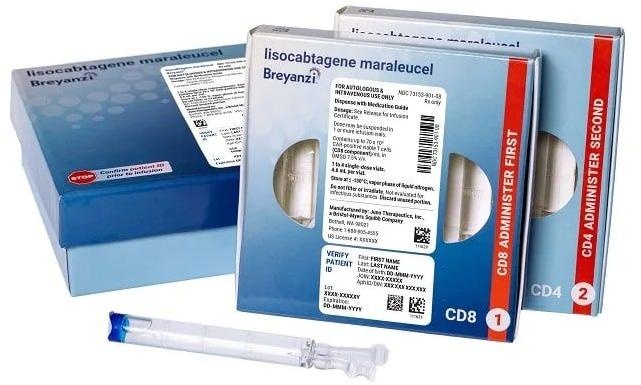
- Remove the box with the CD8+ cell component and the box with the CD4+ cell component from the outer box.
- Open each inner box and visually inspect the vial(s) for any damage. If the vials are damaged, contact the company.
- Carefully remove the vials from the boxes, place them on a protective barrier pad and unfreeze at room temperature. All vials must be unfrozen simultaneously. Make sure to keep the CD8+ andCD4+ cell components separate.
Dose preparation
- Depending on the concentration of vital T cells expressing the CAR receptor for each component, more than one vial of each of the CD8+ and CD4+ cell components may be needed to complete a dose. A separate syringe must be prepared for each vial of the CD8+ or CD4+ cell component received.
Note: the volume to be withdrawn and infused may vary for each component.
- Each 5 mL vial contains a total withdrawable volume of 4.6 mL of T cells with CD8+ or CD4+ cell component. The RfI certificate for each component states the volume (mL) of cells to be withdrawn into each syringe. Use the smallest possible luer-lock tip syringe (1 mL to 5 mL) to withdraw the specified volume from each vial. Do not use a 5 mL syringe for volumes less than 3 mL.
- Prepare the syringe(s) of the CD8+ cell component first.Make sure the patient identification data on the syringe label for the CD8+ cell component matches the data on the vial label for the CD8+ cell component. Apply the syringe labels for the CD8+ cell component to the syringe(s) before withdrawing the required volume into the syringe(s).
- Repeat the process for the CD4+ cell component.
Note:it is important to verify that the volume withdrawn of each cell component
corresponds to the volume specified in the respective infusion release certificate (RfIC).
Withdrawing the required volume of cells from each vial into a separate syringe must be
performed according to the following instructions:
- 1. Hold the unfrozen vial(s) upright and gently invert the vial(s) to mix the cell product. If clumps are present, continue to invert the vial(s) until the clumps have dispersed and the cells appear uniformly resuspended.
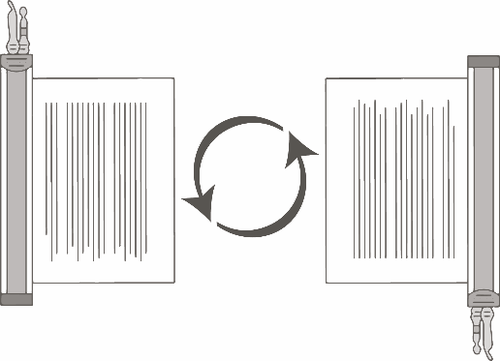
Vial in upright position Vial in inverted position
upright inverted
- 2. Visually inspect the unfrozen vial(s) for damage or leaks. Do not use if the vial is damaged or if the clumps do not disperse; contact the company. The liquid in the vials should be from slightly opaque to opaque, from colourless to yellow or yellowish-brown.
- 3. Remove the aluminium foil cover (if present) from the bottom of the vial and wipe the septum with an alcohol swab. Allow to air dry before proceeding.
NOTE:the absence of the aluminium foil cover does not affect the sterility of
the vial.
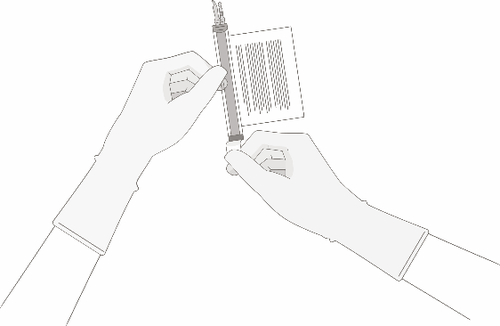
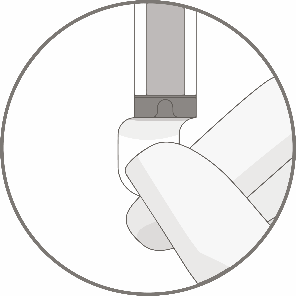
- 4. Holding the vial(s) upright, cut the seal on the tubing at the top of the vial, just above the filter, to open the vent on the vial.
NOTE:be careful to choose the correct tubing, namely the one with the filter. Cut
ONLY the tubing equipped with a filter.
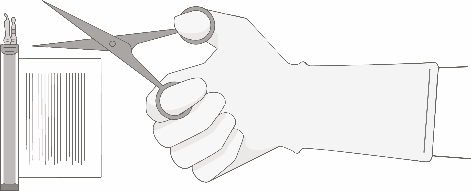
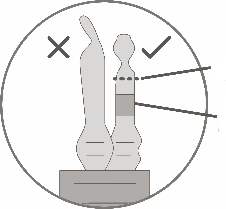
Cut here
Filter
- 5. Take a 20 gauge needle, 2.5-3.8 cm, keeping the needle tip opening away from the access septum for withdrawal.
- a. Insert the needle into the septum at an angle of 45°-60° to puncture the withdrawal access septum.
- b. Gradually increase the needle angle as the needle penetrates the vial.
a b
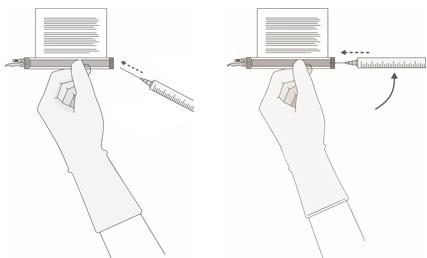
- 6. WITHOUT aspirating air into the syringe, slowly withdraw the target volume (specified in the infusion release certificate [RfIC]).
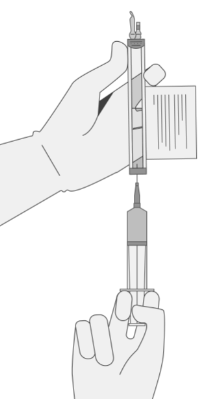
- 7. Before proceeding, carefully inspect the syringe for any signs of debris. If debris is present, contact the company.
- 8. Verify that the volume of the CD8+/CD4+ cell component corresponds to the volume specified in the infusion release certificate (RfIC) for the component of interest.
Once the volume has been verified, place the vial and syringe in a horizontal position and
remove the syringe/needle from the vial.
Carefully detach the needle from the syringe and place the cap on the syringe.
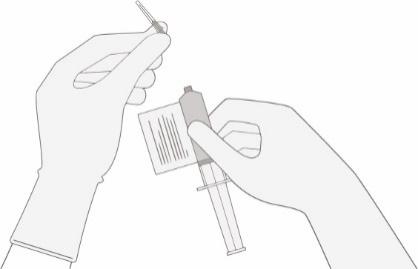
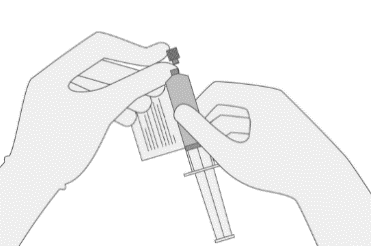
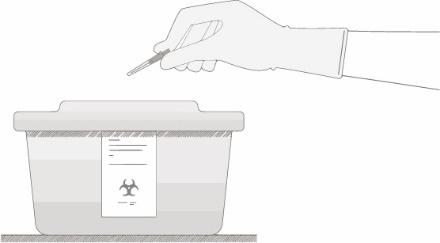
- 9. Continue to hold the vial in a horizontal position and return it to the box to prevent leakage from the vial.
- 10. Dispose of any unused portions of Breyanzi.
Administration
- DO NOTuse a leukodepletion filter.
- Ensure that tocilizumab and emergency supplies are available before and during the recovery period. In the rare event that tocilizumab is unavailable due to a shortage reported on the European Medicines Agency’s list of shortage medicines, ensure that appropriate alternative measures to tocilizumab are available on site to treat CRS.
- Confirm that the patient’s identity matches the patient identification data reported on the syringe label provided on the respective infusion release certificate (RfIC).
- After withdrawing the Breyanzi components into the syringes, proceed with administration as promptly as possible. The total time between removal of Breyanzi from frozen storage and administration to the patient must not exceed 2 hours.
- Use a 9 mg/mL (0.9%) sodium chloride intravenous injection solution to flush all infusion lines before and after administering each CD8+ or CD4+ cell component.
- Administer the CD8+ cell component first. The entire volume of the CD8+ cell component is administered intravenously at an infusion rate of approximately 0.5 mL/minute, using the port or Y-connector (“piggyback”) closest to the patient.
- If more than one syringe is required to obtain a complete dose of the CD8+ cell component, administer the volume contained in each syringe consecutively without any time elapsing between administration of the contents of the syringes (unless there is a clinical reason to suspend administration, such as an infusion reaction). After administering the CD8+ cell component, flush the line with a 9 mg/mL (0.9%) sodium chloride injection solution.
- Administer the CD4+ cell component immediately after completing the administration of the CD8+ cell component, following the same steps and infusion rate illustrated for the CD8+ cell component. After administering the CD4+ cell component, flush the line with a 9 mg/mL (0.9%) sodium chloride injection solution, using a sufficient amount of liquid to clean the line and IV catheter along its entire length. The infusion time will vary and will generally be less than 15 minutes for each component.
Measures to be taken in case of accidental exposure
In case of accidental exposure, follow local guidelines for handling human-derived material. Work surfaces and materials that have potentially come into contact with
Breyanzi must be decontaminated with an appropriate disinfectant.
Precautions to be taken for the disposal of Breyanzi
Unused medicine and all materials that have come into contact with Breyanzi (solid and
liquid waste) must be handled and disposed of as potentially infectious waste in accordance with
local guidelines for handling human-derived material.
APPENDIX IV
SCIENTIFIC CONCLUSIONS AND JUSTIFICATION FOR VARIATION OF THE TERMS
OF THE MARKETING AUTHORISATION(S)
Scientific conclusions
In light of the assessment of the Pharmacovigilance and Risk Assessment Committee
( Pharmacovigilance and Risk Assessment Committee, PRAC) of the Periodic Safety Update Report(s) ( Periodic Safety Update Report, PSUR) for lisocabtagene
maraleucel/lisocabtagene maraleucel, the PRAC’s scientific conclusions are as follows:
In light of the available data on viral reactivation, in particular progressive multifocal leukoencephalopathy (PML), from clinical trials, literature and spontaneous reports, and in light of a plausible mechanism of action, the PRAC considers that a causal relationship between lisocabtagene maraleucel and viral reactivation, in particular progressive multifocal leukoencephalopathy (PML), represents at least a reasonable possibility. The PRAC concluded that the product information containing lisocabtagene maraleucel should be amended accordingly.
Having examined the PRAC recommendation, the Committee for Human Medicinal Products
( Committee for Human Medicinal Products, CHMP) agrees with the overall conclusions and
the justification for the recommendation.
Justification for variation of the terms of the marketing authorisation(s)
Based on the scientific conclusions on lisocabtagene maraleucel/lisocabtagene maraleucel the
CHMP considers that the benefit-risk ratio of the medicinal product(s) containing lisocabtagene
maraleucel/lisocabtagene maraleucel remains unchanged save for the proposed changes to the product information.
The CHMP recommends the variations to the terms of the marketing authorisation(s)

Не уверены, подходит ли вам это лекарство?
Обсудите симптомы и варианты лечения с врачом онлайн.

Уже начали прием и появились вопросы?
Обсудите свое состояние и дальнейшие шаги с врачом онлайн.
- Страна регистрации
- Форма выпускаInfusion leak, 1.1-70 x 10^6 cells/mL
- Отпускается по рецептуДа
- Производитель
- Информация на этой странице носит справочный характер и не является медицинской консультацией. Перед началом приема лекарства обязательно проконсультируйтесь с врачом.
- Аналоги BREYANTSIФорма выпуска: Infusion leak, 260 - 500 X 10^6Действующее вещество: Идекабтаген виклеуцелПроизводитель: BRISTOL-MYERS SQUIBB PHARMA EEIGОтпускается по рецептуФорма выпуска: Concentrate for infusion solution, 25 MG / MLДействующее вещество: БевацизумабПроизводитель: BIOSIMILAR COLLABORATIONS IRELAND LIMITEDОтпускается по рецептуФорма выпуска: Powder for injectable suspension, 5 MG/MLДействующее вещество: ПаклитакселПроизводитель: BRISTOL-MYERS SQUIBB PHARMA EEIGОтпускается без рецепта
Врачи онлайн по BREYANTSI
Обсудите применение BREYANTSI и возможные следующие шаги — по оценке врача.









Получите рецепт на BREYANTSI онлайн
Заполните форму за 2 минуты
Расскажите о симптомах, истории болезни и нужном препарате.
Выберите врача или мы назначим
Выберите специалиста или мы подберём ближайшего доступного врача.
Врач рассматривает ваш случай
Обычно в течение 30 минут. Может задать уточняющие вопросы в чате.
Получите в любой аптеке
Электронный рецепт отправляется на вашу почту — действителен по всей Польше.
Часто задаваемые вопросы
BREYANTSI требует рецепта в Италия. Вы можете уточнить у врача онлайн, подходит ли это лекарство для вашей ситуации.
BREYANTSI производится компанией BRISTOL-MYERS SQUIBB PHARMA EEIG. Упаковка и торговое название могут отличаться в зависимости от дистрибьютора.
Врачи, включая Семейные врачи, Психиатры, Дерматологи, Кардиологи, Эндокринологи, Гастроэнтерологи, Пульмонологи, Нефрологи, Ревматологи, Гематологи, Инфекционисты, Аллергологи, Гериатры, Педиатры, Онкологи, могут оценить целесообразность применения BREYANTSI с учетом вашей ситуации и местных правил. Вы можете записаться на онлайн-консультацию, чтобы обсудить возможные варианты.
Польша имеет хорошо развитую систему здравоохранения в крупных городах, таких как Варшава, Краков, Вроцлав и Гданьск. Аптеки широко доступны и работают в соответствии с действующим законодательством, обеспечивая доступ к рецептурным препаратам.
Вы можете купить BREYANTSI в Варшаве, Кракове, Вроцлаве или Гданьске в любой аптеке при наличии действующего рецепта.
Чтобы получить рецепт, вы можете воспользоваться Oladoctor:
Другие лекарства с тем же действующим веществом () включают ABEKMA, ABEVMY, ABRAXANE. Они могут отличаться торговым названием или формой выпуска, но содержат одинаковый терапевтический компонент. Перед изменением лечения рекомендуется проконсультироваться с врачом.
