



BREVA 15 mg/3 mg Аэрозоль

Рассмотрение рецепта онлайн
Врач рассмотрит ваш случай и примет решение о назначении рецепта, если это медицински оправдано.

Поговорите с врачом об этом лекарстве
Обсудите симптомы и возможные дальнейшие шаги на онлайн-консультации.



Инструкция по применению BREVA
Содержание инструкции
Breva 0.375% + 0.075%
solution for nebulization
Salbutamol and ipratropium bromide
Read this leaflet carefully before using this medicine as it contains important
information for you.
- Keep this leaflet. You may need to read it again.
- If you have any questions, ask your doctor or pharmacist.
- This medicine has been prescribed for you only. Do not pass it on to others, even if they have the same symptoms as you, as it may be harmful.
- If any side effects occur, including those not listed in this leaflet, tell your doctor or pharmacist. See section 4.
Contents of this leaflet:
- 1. What Breva is and what it is used for
- 2. What you need to know before you use Breva
- 3. How to use Breva
- 4. Possible side effects
- 5. How to store Breva
- 6. Contents of the pack and other information
1. What is Breva and what is it for
Breva is a medicine consisting of an association of two active substances for the therapy of obstructive (narrowing) diseases of the bronchi: salbutamol (beta-agonist) and ipratropium bromide (anticholinergic).
Breva is indicated for the treatment of bronchospasm (contraction of the bronchial muscles) in adult patients with chronic obstructive pulmonary disease (a disease that makes it difficult to empty the air from the lungs).
2. What you need to know before using Breva
Do not use Breva
- if you are allergic to salbutamol and/or ipratropium bromide or to any of the other ingredients of this medicine (listed in section 6);
- if you are allergic to atropine or active substances similar to atropine;
- if you suffer from severe heart disease;
- if you suffer from an eye disease called glaucoma;
- if you suffer from prostatic hypertrophy (enlargement of the prostate);
- if you suffer from urinary retention (difficulty of the bladder to empty urine);
- if you suffer from intestinal obstruction (stopping of the passage of contents in the intestine).
Warnings and precautions
Consult your doctor or pharmacist before using Breva, if:
- you have an obstruction of the vessels that carry blood to the heart (coronary artery disease);
- you have an irregular heartbeat;
- you have high blood pressure (hypertension);
- you suffer from a thyroid disease caused by its increased activity (hyperthyroidism);
- you are affected by pheochromocytoma, a tumor that produces chemicals that cause an increase in pressure and an acceleration of the heartbeat;
- you suffer from diabetes (a disease characterized by high levels of glucose in the blood due to reduced production of insulin by the pancreas);
- you suffer from cystic fibrosis. Treatment with Breva may predispose you to gastrointestinal disorders. Contact your doctor if you experience chest pain, severe difficulty breathing with increased wheezing or shortness of breath, visual disturbances such as eye pain, blurred vision, colored images, pupil dilation, or if you perceive a worsening of your condition if:
- you suffer from ischemic heart disease (a heart condition that occurs following a reduction in blood flow due to a narrowing of the coronary arteries),
- you have a tachyarrhythmia (irregular and accelerated heartbeat),
- you have severe heart failure (the heart's inability to pump the adequate amount of blood necessary for the body's needs). Therapy with Breva may determine a decrease in potassium in the blood (hypokalemia), even severe, therefore your doctor will prescribe you periodic checks.
A condition known as lactic acidosis has been reported in association with high doses
therapeutic of salbutamol, mainly in patients treated for acute bronchospasm (see
paragraphs 3 and 4). Increased plasma lactate levels can lead to shortness of breath and
hyperventilation, even if your wheezing improves. If you think the medicine is no longer
effective and that it is necessary to use the nebulizer more than your doctor has
recommended, consult your doctor immediately.
During treatment, immediate hypersensitivity reactions may occur with the appearance in rare
cases of urticaria, angioedema, paradoxical bronchospasm (sudden involuntary contraction of the
bronchi and difficulty breathing) and anaphylaxis.
Be careful not to spray the solution into your eyes, especially if you are at risk of glaucoma
(an eye condition caused by increased intraocular pressure); when ipratropium
bromide (one of the active ingredients of Breva) has come into contact with the eye, isolated cases of
eye complications (such as mydriasis, blurred vision, visual halos or colored images,
increased eye pressure, closed-angle glaucoma, eye pain) have been reported.
Children and adolescents
Breva is not indicated in children and adolescents (under 18 years of age).
For those who play sports
The use of the medicine without therapeutic need constitutes doping and may still
result in positive doping tests.
Other medicines and Breva
Tell your doctor or pharmacist if you are taking, have recently taken or may take
any other medicine, including those available without a prescription.
Tell your doctor if you are taking:
- beta-blockers, such as propranolol (medicines used for heart disease and to lower blood pressure);
- xanthine derivatives, for example theophylline and aminophylline, (medicines that relax the bronchial muscles);
- corticosteroids (medicines used for the treatment of inflammatory states);
- diuretics (medicines that lower blood pressure);
- antidepressants (tricyclic antidepressants and monoamine oxidase inhibitors);
- anticholinergic medicines;
- digoxin - medicine used for the treatment of heart failure;
- if you are going to undergo surgery. Some anesthetics may affect the effects of Breva. If you are going to undergo surgery, inform your doctor, dentist or anesthesiologist that you are being treated with Breva.
Pregnancy and breastfeeding
If you are pregnant, suspect you are pregnant or are planning a pregnancy, or if you are breastfeeding with
breast milk, ask your doctor or pharmacist for advice before using this medicine.
The doctor will prescribe Breva only if absolutely necessary.
Driving and operating machinery
During treatment, dizziness, visual focus disturbances may occur,
pupil dilation (mydriasis), blurred vision. If this happens, avoid driving or operating
machinery.
Breva contains methyl parahydroxybenzoate, ethyl parahydroxybenzoate and butyl
parahydroxybenzoate.
May cause allergic reactions (even delayed) and exceptionally, bronchospasm
(narrowing of the bronchi and difficulty breathing).
3. How to use Breva
Use this medicine following exactly the instructions of your doctor or pharmacist. If you
have any doubts, consult your doctor or pharmacist.
Dosage
The recommended dose is 5 drops diluted in 2 ml of sterile physiological solution in the nebulizer
2-3 times a day.
The maximum daily dose is 15 drops.
Do not exceed the recommended maximum dose.
Use in children and adolescents
Breva is not indicated in children and adolescents (under 18 years of age).
Method of administration
Dilute with sterile physiological solution in the nebulizer.
Duration of treatment
The duration of nebulization is 10-15 minutes.
The maximum dose and the duration of therapy are established by the doctor based on your
clinical condition.
Instructions for use
To open the bottle, simultaneously apply pressure on the dropper cap ring and
a twist in an anti-clockwise direction. To close the bottle, screw the ring clockwise.
If you take more Breva than you should
In case of ingestion/taking an excessive dose of Breva, contact your doctor or the nearest
hospital.
In case of overdose, tremors, increased heart rate, increased breathing rate (tachypnea) and metabolic acidosis (alteration of blood acidity) may occur.
If you forget to take Breva
Do not take a double dose to make up for a missed dose.
If you stop taking Breva
Do not stop using this medicine without consulting your doctor.
If you have any doubts about the use of this medicine, ask your doctor or pharmacist.
4. Possible side effects
Like all medicines, this medicine can cause side effects, although not everybody gets them.
Conditions you should pay attention to
- Onset of chest pain
- Severe breathing difficulties
- Eye pain with blurred vision, pupil dilation Immediately contact your doctor if you experience any of these symptoms and stop therapy.
Rare side effects(may affect up to 1 in 1,000 people)
- headache,
- tension,
- peripheral vasodilation (red and warm skin) at high doses,
- dizziness (sensation of movement or rotation),
- drowsiness, muscle tremors, agitation, psychomotor hyperactivity,
- dry mouth, nausea, irritation of the mouth and throat, intestinal motility disorders (diarrhea, constipation and vomiting), stomatitis,
- hypersensitivity, anaphylaxis and angioedema,
- accommodation disorders of vision (blurred vision), pupil dilation (mydriasis), eye pain, dilation of superficial ocular vessels (conjunctival hyperemia), glaucoma, increased eye pressure. Very rare side effects(may affect up to 1 in 10,000 people)
- cardiac arrhythmias (irregular heartbeat) including atrial fibrillation, supraventricular tachycardia and extrasystole,
- myocardial ischemia (reduced oxygenation of the heart),
- angina (chest pain). Side effects with unknown frequency (frequency cannot be estimated based on available data):
- irritability,
- hypokalemia (reduced potassium in the blood),
- paradoxical bronchospasm (constriction of the bronchi) and hyperventilation (increased number of breaths immediately after inhalation),
- cough, dysphonia, throat irritation, dry throat,
- increased systolic blood pressure/decreased diastolic blood pressure,
- asthenia,
- urticaria, pruritus, excessive sweating (hyperhidrosis),
- muscle pain, cramps, muscle weakness,
- urinary retention,
- a condition known as lactic acidosis which can cause stomach pain, hyperventilation, shortness of breath despite your wheezing improving, cold feet and hands, irregular heartbeat or thirst.
Reporting of side effects
If you get any side effects, talk to your doctor or pharmacist. You can also report side effects directly
through the national reporting system at:
https://www.aifa.gov.it/content/segnalazioni-reazioni-avverse. By reporting side effects you can help
provide more information on the safety of this medicine.
5. How to store Breva
Keep this medicine out of the sight and reach of children.
Do not use this medicine after the expiry date which is stated on the pack. The expiry date refers to the last day of that month. The expiry date refers to the product in
intact packaging, correctly stored .
Store at a temperature not exceeding 25°C.
Use within 3 months of first opening the bottle. After this period, discard any remaining contents.
Do not dispose of any medicine in wastewater or household waste. Ask your pharmacist how to
dispose of medicines you no longer use. This will help protect the environment.
6. Contents of the pack and other information
What Breva contains
The active ingredients are: salbutamol and ipratropium bromide. 100 ml of solution contains:
salbutamol sulfate equivalent to 375 mg of salbutamol and ipratropium bromide monohydrate
equivalent to 75 mg of ipratropium bromide.
The other ingredients are: ethyl parahydroxybenzoate, methyl parahydroxybenzoate, butyl para-
hydroxybenzoate, sodium chloride, 1N sulfuric acid, purified water.
Description of the appearance of Breva and contents of the pack
Solution for nebulisation in 15 ml polyethylene bottle with dropper.
The solution is clear, colourless or slightly straw-coloured.
Marketing Authorisation Holder
NEOPHARMED GENTILI S.p.A – Via San Giuseppe Cottolengo 15 – 20143 Milan
Manufacturer
Valeas S.p.A. - Chemical and Pharmaceutical Industry - Via Vallisneri, 10 - 20133 Milan
Lachifarma S.r.l. - Salento Chemical Pharmaceutical Laboratory S.S. 16 – Industrial Area 73010
Zollino (LE)
Breva 15 mg + 3 mg
metered aerosol
Salbutamol and ipratropium bromide
Read this leaflet carefully before you start to use this medicine as it contains important
information for you.
- Keep this leaflet. You may need to read it again.
- If you have any questions, ask your doctor or pharmacist.
- This medicine has been prescribed for you only. Do not pass it on to others, even if their symptoms are the same as yours, as it could be harmful.
- If you get any side effects, even those not listed in this leaflet, tell your doctor or pharmacist. See section 4.
Contents of this leaflet:
- 1. What Breva is and what it is used for
- 2. What you need to know before you use Breva
- 3. How to use Breva
- 4. Possible side effects
- 5. How to store Breva
- 6. Contents of the pack and other information
1. What is Breva and what is it for
Breva is a medicine consisting of a combination of two active ingredients for the therapy of obstructive (narrowing) diseases of the bronchi: salbutamol (beta-agonist) and ipratropium bromide (anticholinergic).
Breva is indicated for the treatment of bronchospasm (contraction of the bronchial muscles) in adult patients with chronic obstructive pulmonary disease (a disease that makes it difficult to empty the air from the lungs).
2. What you need to know before using Breva
Do not use Breva
- if you are allergic to salbutamol and/or ipratropium bromide or to any of the other ingredients of this medicine (listed in section 6);
- if you are allergic to atropine or to active substances similar to atropine;
- if you suffer from severe heart disease;
- if you suffer from an eye disease called glaucoma;
- if you suffer from prostatic hypertrophy (enlargement of the prostate);
- if you suffer from urinary retention (difficulty of the bladder emptying urine);
- if you suffer from intestinal obstruction (stopping of the transit of contents in the intestine).
Warnings and precautions
Consult your doctor or pharmacist before using Breva, if:
- you have an obstruction of the vessels that carry blood to the heart (coronary artery disease);
- you have an irregular heartbeat;
- you have high blood pressure (hypertension);
- you suffer from a thyroid disease caused by its increased activity (hyperthyroidism);
- you are affected by pheochromocytoma, a tumor that produces chemicals that cause an increase in pressure and an acceleration of the heartbeat;
- you suffer from diabetes (a disease characterized by high levels of glucose in the blood due to reduced production of insulin by the pancreas);
- you suffer from cystic fibrosis. Treatment with Breva may predispose you more to gastrointestinal disorders. Contact your doctor if you experience chest pain, severe difficulty breathing with increased wheezing or shortness of breath, visual disturbances such as eye pain, blurred vision, colored images, pupil dilation or if you perceive a worsening of your condition in case you:
- suffer from ischemic heart disease (a heart condition that occurs following a reduction in blood flow due to narrowing of the coronary arteries),
- have a tachyarrhythmia (irregular and accelerated heartbeat),
- have severe heart failure (inability of the heart to pump the adequate amount of blood necessary for the needs of the body) Therapy with Breva may determine a decrease in potassium in the blood (hypokalemia), even severe, therefore the doctor will prescribe you periodic checks.
A condition known as lactic acidosis has been reported in association with high doses
therapeutic of salbutamol, mainly in patients treated for acute bronchospasm (see
paragraphs 3 and 4). Increased plasma lactate levels can lead to shortness of breath and
hyperventilation, even if your wheezing improves. If you think the medicine is no longer
effective and that you need to use the nebulizer more than your doctor has
recommended, contact your doctor immediately.
Immediate hypersensitivity reactions with the appearance in rare
cases of urticaria, angioedema, paradoxical bronchospasm (sudden involuntary contraction of the
bronchi and difficulty breathing) and anaphylaxis can occur during treatment.
Be careful not to spray the solution into your eyes, especially if you are at risk of glaucoma
(an eye condition caused by increased intraocular pressure); when ipratropium
bromide (one of the active ingredients of Breva) has come into contact with the eye, cases have been reported
isolated complications (such as mydriasis, blurred vision, visual halos or colored images,
increased eye pressure, angle-closure glaucoma, eye pain).
Children and adolescents
Breva is not indicated in children and adolescents (under 18 years of age).
For those who play sports
The use of the medicine without therapeutic necessity constitutes doping and may still
result in positive doping tests.
Other medicines and Breva
Tell your doctor or pharmacist if you are taking, have recently taken or may take
any other medicines, including those available without a prescription.
Tell your doctor if you are taking:
- beta-blockers, such as propranolol (medicines used for heart disease and to lower blood pressure);
- xanthine derivatives, for example theophylline and aminophylline (medicines that relax the bronchial muscles);
- corticosteroids (medicines used for the treatment of inflammatory states);
- diuretics (medicines that lower blood pressure);
- antidepressants (tricyclic antidepressants and monoamine oxidase inhibitors);
- anticholinergic medicines;
- digoxin - a medicine used for the treatment of heart failure;
- if you are going to undergo surgery. Some anesthetics may affect the effects of Breva. If you are going to undergo surgery, inform your doctor, dentist or anesthesiologist that you are being treated with Breva.
Pregnancy and breastfeeding
If you are pregnant, suspect you may be pregnant, are planning to become pregnant, or are breastfeeding with
breast milk, ask your doctor or pharmacist for advice before using this medicine.
The doctor will prescribe Breva only if absolutely necessary.
Driving and operating machinery
During treatment, dizziness, disturbances in image focusing, may occur
pupil dilation (mydriasis), blurred vision. If this occurs, avoid driving or operating
machinery.
3. How to use Breva
Use this medicine following exactly the instructions of your doctor or pharmacist. If you
have any doubts, consult your doctor or pharmacist.
Dosage
The recommended dose is 2 sprays, 3-6 times a day
Duration of treatment
The maximum dose and the duration of therapy are established by the doctor based on your clinical
condition.
Use in children and adolescents
Breva is not indicated in children and adolescents (under 18 years of age).
Instructions for use
Shake very well before use.
- 1. Remove the cap from the mouthpiece. (fig.1)
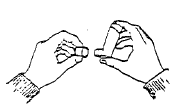
fig.1
- 2. Hold the inhaler with your thumb and index finger and, without pressing the canister, shake vigorously. (fig.2)
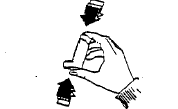
fig.2
- 3. Seal the mouthpiece between your lips. (fig.3)
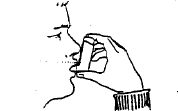
fig.3
- 4. Exhale deeply, blowing directly into the mouthpiece. (fig.4)
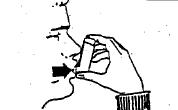
- 5. Then take a slow, deep breath while simultaneously pressing, and only once, with your index finger on the bottom of the canister so as to coincide the delivery of the medicine with the beginning of the inhalation itself. (fig.5)
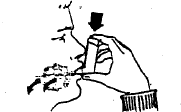
fig.5
- 6. Hold your breath for as long as possible, remove the mouthpiece from your lips and exhale slowly.
- 7. For the next inhalation of the medicine, wait at least one minute and follow the procedures described in points 2, 3, 4, 5 and 6.
- 8. Replace the cap on the mouthpiece. (fig.8)
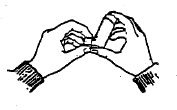
fig.8
Keep the mouthpiece and valve always clean.
For cleaning, remove the canister from the inhaler, wash the mouthpiece with warm water, dry and replace
the canister in the clean mouthpiece.
Always protect the device from dust and keep it away from heat sources. Do not throw
the device into the fire, even if empty.
If you take more Breva than you should
In case of ingestion/taking an excessive dose of Breva, contact your doctor or the nearest
hospital.
In case of overdose, tremors, increased heart rate
increased number of breaths (tachypnea) and metabolic acidosis (alteration of blood acidity) may occur.
If you forget to take Breva
Do not take a double dose to make up for a missed dose.
If you stop taking Breva
Do not stop using this medicine without consulting your doctor.
If you have any doubts about the use of this medicine, ask your doctor or pharmacist.
4. Possible side effects
Like all medicines, this medicine can cause side effects, although not everybody gets them.
Conditions you should pay attention to
- Onset of chest pain
- Severe breathing difficulties
- Eye pain with blurred vision, dilated pupil Immediately contact your doctor if you experience any of these symptoms and stop therapy.
Rare side effects(may affect up to 1 in 1,000 people)
- headache,
- tension,
- peripheral vasodilation (red and warm skin) for high dosages.
- dizziness (feeling of movement or rotation),
- drowsiness, muscle tremors, agitation, psychomotor hyperactivity,
- dry mouth, nausea, irritation of the mouth and throat, intestinal motility disorders (diarrhea, constipation and vomiting), stomatitis,
- hypersensitivity, anaphylaxis and angioedema,
- accommodation disorders of vision (blurred vision), pupil dilation (mydriasis), eye pain, dilation of superficial ocular vessels (conjunctival hyperemia), glaucoma, increased eye pressure Very rare side effects(may affect up to 1 in 10,000 people)
- cardiac arrhythmias (irregular heartbeat) including atrial fibrillation, supraventricular tachycardia and extrasystoles,
- myocardial ischemia (reduced oxygenation of the heart),
- angina (chest pain). Side effects Not known: known (frequency cannot be established based on available data)
- irritability,
- hypokalemia (decreased potassium in the blood),
- paradoxical bronchospasm (constriction of the bronchi) and hyperventilation (increased number of respiratory acts immediately after inhalation),
- cough, dysphonia, throat irritation, dry throat,
- increased systolic blood pressure/decreased diastolic blood pressure
- asthenia,
- urticaria, pruritus, excessive sweating (hyperhidrosis),
- muscle pain, cramps, muscle weakness,
- urinary retention,
- a condition known as lactic acidosis which can cause stomach pain, hyperventilation, shortness of breath despite your wheezing improving, cold feet and hands, irregular heartbeat or thirst.
Reporting of side effects
If you get any side effects, talk to your doctor or pharmacist. You can also report side effects directly through
the national reporting system at: https://www.aifa.gov.it/content/segnalazioni-
reazioni-avverse. By reporting side effects you can help provide more information
about the safety of this medicine.
5. How to store Breva
Keep this medicine out of the sight and reach of children.
Do not use this medicine after the expiry date which is stated on the packaging. The expiry date refers to the last day of that month. The expiry date refers to the product in
intact packaging, correctly stored.
Store at a temperature not exceeding 25°C.
Do not dispose of any medicine in wastewater or household waste. Ask your pharmacist how to
dispose of medicines you no longer use. This will help protect the environment.
6. Contents of the pack and other information
What Breva contains
The active ingredients are: salbutamol and ipratropium bromide. One pressurized inhaler
contains 15 mg of salbutamol and 3 mg of ipratropium bromide. Each spray delivers 75 µg of
salbutamol and 15 µg of ipratropium bromide.
The other ingredients are: oleic acid, trichlorofluoromethane, dichlorodifluoromethane.
Description of the appearance of Breva and contents of the pack
Pressurized inhaler in an aluminum canister for 200 sprays, with a metering valve and an inhaler mouthpiece.
Marketing authorization holder and manufacturer
NEOPHARMED GENTILI S.p.A – Via San Giuseppe Cottolengo 15 – 20143 Milano

Не уверены, подходит ли вам это лекарство?
Обсудите симптомы и варианты лечения с врачом онлайн.

Уже начали прием и появились вопросы?
Обсудите свое состояние и дальнейшие шаги с врачом онлайн.

- Страна регистрации
- Форма выпускаAerosol, 15 MG + 3 MG
- Код АТХR03AL02
- Действующее вещество
- Отпускается по рецептуДа
- Производитель
- Информация на этой странице носит справочный характер и не является медицинской консультацией. Перед началом приема лекарства обязательно проконсультируйтесь с врачом.
- Аналоги BREVAФорма выпуска: Solution for nebulization, 0.375% + 0.075%Действующее вещество: salbutamol and ipratropium bromideПроизводитель: I.B.N. SAVIO S.R.LОтпускается по рецептуФорма выпуска: Solution for nebulization, 0.375% + 0.075%Действующее вещество: salbutamol and ipratropium bromideПроизводитель: NEOPHARMED GENTILI S.P.A.Отпускается по рецептуФорма выпуска: Solution for nebulization, 0.375% + 0.075%Действующее вещество: salbutamol and ipratropium bromideПроизводитель: KONPHARMA S.R.L.Отпускается по рецепту
Аналоги BREVA в других странах
Лекарства с тем же действующим веществом, доступные в других странах.
Аналог BREVA в Испания
Аналог BREVA в Польша
Аналог BREVA в Украина
Врачи онлайн по BREVA
Обсудите применение BREVA и возможные следующие шаги — по оценке врача.









Получите рецепт на BREVA онлайн
Заполните форму за 2 минуты
Расскажите о симптомах, истории болезни и нужном препарате.
Выберите врача или мы назначим
Выберите специалиста или мы подберём ближайшего доступного врача.
Врач рассматривает ваш случай
Обычно в течение 30 минут. Может задать уточняющие вопросы в чате.
Получите в любой аптеке
Электронный рецепт отправляется на вашу почту — действителен по всей Польше.
Часто задаваемые вопросы
BREVA требует рецепта в Италия. Вы можете уточнить у врача онлайн, подходит ли это лекарство для вашей ситуации.
Действующее вещество BREVA — salbutamol and ipratropium bromide. Эта информация помогает определить лекарства с тем же составом под другими торговыми названиями.
BREVA производится компанией NEOPHARMED GENTILI S.P.A.. Упаковка и торговое название могут отличаться в зависимости от дистрибьютора.
Врачи, включая Семейные врачи, Психиатры, Дерматологи, Кардиологи, Эндокринологи, Гастроэнтерологи, Пульмонологи, Нефрологи, Ревматологи, Гематологи, Инфекционисты, Аллергологи, Гериатры, Педиатры, Онкологи, могут оценить целесообразность применения BREVA с учетом вашей ситуации и местных правил. Вы можете записаться на онлайн-консультацию, чтобы обсудить возможные варианты.
Польша имеет хорошо развитую систему здравоохранения в крупных городах, таких как Варшава, Краков, Вроцлав и Гданьск. Аптеки широко доступны и работают в соответствии с действующим законодательством, обеспечивая доступ к рецептурным препаратам.
Вы можете купить BREVA в Варшаве, Кракове, Вроцлаве или Гданьске в любой аптеке при наличии действующего рецепта.
Чтобы получить рецепт, вы можете воспользоваться Oladoctor:
Другие лекарства с тем же действующим веществом (salbutamol and ipratropium bromide) включают ALMEIDA, BIWIND, INASAL. Они могут отличаться торговым названием или формой выпуска, но содержат одинаковый терапевтический компонент. Перед изменением лечения рекомендуется проконсультироваться с врачом.
