



AWIQLI 700 U/ml Преднаполненный инъекционный пенал

Рассмотрение рецепта онлайн
Врач рассмотрит ваш случай и примет решение о назначении рецепта, если это медицински оправдано.

Поговорите с врачом об этом лекарстве
Обсудите симптомы и возможные дальнейшие шаги на онлайн-консультации.



Инструкция по применению AWIQLI
Содержание инструкции
Awiqli 700 units/mL injectable solution in prefilled pen
insulin icodec
Medicinal product subject to additional monitoring. This will allow the rapid identification of
new safety information. You can contribute by reporting any adverse effects
experienced during the use of this medicine. See the end of section 4 for
information on how to report adverse effects.
Read this leaflet carefully before using this medicine as it contains important
information for you.
- Keep this leaflet. You may need to read it again.
- If you have any questions, ask your doctor, pharmacist or nurse.
- This medicine has been prescribed for you only. Do not pass it on to others, even if they have the same symptoms as you, as it may be harmful.
- If you get any side effects, even those not listed in this leaflet, tell your doctor, pharmacist or nurse. See section 4.
Contents of this leaflet
- 1. What Awiqli is and what it is used for
- 2. What you need to know before you use Awiqli
- 3. How to use Awiqli
- 4. Possible side effects
- 5. How to store Awiqli
- 6. Contents of the pack and other information
1. What is Awiqli and what is it used for
Awiqli contains 'insulin icodec' used to treat diabetes in adults. It is a type of insulin
called "long-acting basal insulin".
Diabetes is a disease in which the body does not produce enough insulin (a hormone that controls the
amount of sugar in the blood in the body). The active ingredient of Awiqli, insulin icodec, is a
substitute insulin that acts in the same way as naturally produced insulin but for a longer period of time. This means that it produces a long and constant hypoglycemic action. Therefore, it must be
injected only once a week.
2. What you need to know before using Awiqli
Do not use Awiqli
- if you are allergic to insulin icodec or to any of the other ingredients of this medicine (listed in section 6).
Warnings and precautions
Talk to your doctor, pharmacist or nurse before using Awiqli.
Important things to know before using Awiqli:
- Hypoglycemia (low blood glucose levels) can occur if the dose of Awiqli is too high or if you skip a meal or do intense and unplanned exercise. Other factors that can increase the risk of hypoglycemia include changing the injection site, illnesses (such as vomiting, diarrhea and fever), alcohol consumption and use of other medicines. The symptoms of hypoglycemia usually appear suddenly (see the information
loss of consciousness and/or convulsions and can lead to temporary or
permanent impairment of brain function or even death. If you experience hypoglycemia, follow the
blood sugar.
- If you have type 1 diabetes, the risk of hypoglycemia may be higher
- Hyperglycemia (high blood glucose levels) can occur if the dose of Awiqli is insufficient and/or if treatment is interrupted or if you have an associated illness, particularly an infection. The symptoms of hyperglycemia usually develop gradually over hours
Untreated hyperglycemia can lead to diabetic ketoacidosis (a serious complication of
diabetes with high levels of ketones in the blood). If you experience hyperglycemia, follow the instructions
blood sugar.
- Switching from other insulin medicines: your doctor may need to adjust the insulin dose if you switch from basal insulin once or twice a day to Awiqli once a week. It is important to always check that you are injecting the correct dose, especially for the first and second Awiqli injections, as your doctor may prescribe a higher dose for the first injection followed by a lower dose. Always follow your doctor's recommendations on how much medicine you should take. See section 3.
- If you are taking pioglitazone with Awiqli, contact your doctor if you experience signs or symptoms of congestive heart failure (when the heart does not pump blood as it should) such as shortness of breath, fatigue, fluid retention, weight gain and swelling of the ankles.
- Eye problems: rapid improvement in blood glucose control can lead to temporary worsening of diabetic retinopathy (an eye condition that can cause vision loss and blindness in people with diabetes). If you experience eye problems, see your doctor.
- Make sure you use the right type of insulin: always check the label on the insulin pen before each injection to avoid accidental confusion with other insulin medicines. If you are blind or have vision problems, make sure you get help from another person who has good vision and is trained to use the prefilled pen.
Skin changes at the injection site
The injection site should be changed regularly to help prevent changes in the fatty tissue
under the skin. These changes include thickening or thinning of the skin or
subcutaneous nodules.
This medicine may not work properly if you inject it into an area with nodules,
into a thinned area or into a thickened area (see section 3, ‘How to use Awiqli’). See your
doctor, pharmacist or nurse if you notice any skin changes at the injection site and if you are currently injecting in these affected areas before
starting to inject in another area. Your doctor, pharmacist or nurse may ask you to
check your blood glucose more carefully and adjust the dose of Awiqli or other antidiabetic
medicines, if necessary.
Anti-insulin antibodies
Treatment with Awiqli may induce the body to produce antibodies against insulin (molecules that
can affect insulin treatment). Very rarely, this may require a change in the dose of insulin.
Children and adolescents
Do not give this medicine to children and adolescents under the age of 0 to 18 years. This
is because there is no experience with the use of Awiqli in children or adolescents.
Other medicines and Awiqli
Tell your doctor, pharmacist or nurse if you are taking, have recently taken or might
take any other medicines. Some medicines affect blood sugar levels,
this may mean that the dose of Awiqli needs to be changed.
The most common medicines that may affect treatment with Awiqli are listed below.
You may need a lower dose/your blood sugar level may
drop (hypoglycemia),if you use:
- other medicines for diabetes (by mouth or injections)
- sulfonamides, for infections
- anabolic steroids, such as testosterone
- beta-blockers, for high blood pressure. These may make it difficult to recognize the warning signs of a blood sugar level that is too low (see ‘Warning signs of a blood sugar level that is too low’
warning signs of a blood sugar level that is too low’)
- acetylsalicylic acid (and other salicylates), for mild pain and fever
- monoamine oxidase inhibitors (MAOIs), for depression
- angiotensin-converting enzyme (ACE) inhibitors, for some heart conditions or high blood pressure.
You may need a higher dose/your blood sugar level may
rise (hyperglycemia),if you use:
- danazol, for endometriosis
- oral contraceptives (birth control pills)
- thyroid hormones, for thyroid problems
- growth hormone, for growth hormone deficiency
- glucocorticoids, such as cortisone, for inflammation
- sympathomimetics, such as epinephrine (adrenaline), salbutamol, terbutaline, for asthma
- thiazides, for high blood pressure or excessive fluid retention.
Octreotide and lanreotide(for a rare disease involving an excess of growth hormone) may increase or decrease blood sugar levels.
Pioglitazone(an oral antidiabetic medicine for type 2 diabetes).
Some patients with long-term type 2 diabetes and heart problems or previous stroke
treated with pioglitazone and insulin have developed heart failure.
- Tell your doctor immediately if you experience signs of heart failure such as shortness of breath, fatigue, fluid retention, weight gain and swelling of the ankles.
If you fall into any of the above conditions (or if you are unsure), see your doctor, pharmacist or nurse before injecting Awiqli, as the dose adjustment of a weekly insulin
in relation to the interaction with other medicines may be different.
Awiqli with alcohol
If you drink alcohol, the dose of Awiqli you need may change. Your blood sugar level may increase or decrease. This means you need to check your blood sugar level more often than usual when drinking alcohol.
Pregnancy and breastfeeding
It is not known whether or how Awiqli may affect the fetus. Therefore, if you are a woman of childbearing potential who is
trying to become pregnant, you should stop treatment with this medicine. If you become pregnant
while using this medicine, contact your doctor for assistance.
It is not known whether this medicine is excreted in breast milk and a risk to the
baby cannot be excluded. Therefore, Awiqli should not be used during breastfeeding and you should decide whether to
stop treatment with this medicine or to avoid breastfeeding.
Driving and using machines
Awiqli has no or negligible effects on the ability to drive and use machines, but it changes
blood sugar levels. A blood sugar level that is too low (hypoglycemia) or too
high (hyperglycemia) can affect your ability to drive or use tools or machines. If your blood sugar level is too low or too high, your ability to concentrate or react
may be impaired. This could endanger yourself or others. Ask your doctor or nurse if:
- your blood sugar level often becomes too low
- you have difficulty recognizing the signs of a blood sugar level that is too low.
Important information about some ingredients of Awiqli
This medicine contains less than 1 mmol (23 mg) of sodium per dose, i.e. it is essentially “sodium-free”.
3. How to use Awiqli
Awiqli is given once a week.
Use this medicine exactly as your doctor has told you. If you are unsure, ask your
doctor, pharmacist or nurse.
Awiqli is a long-acting insulin. It can be used with short-acting or
rapid-acting insulins.
In type 2 diabetes:
- Awiqli can be used together with tablets or injections for diabetes, including short-acting or rapid-acting insulins. In type 1 diabetes:
- Awiqli must always be used together with short-acting or rapid-acting insulins.
- If you have recently been diagnosed with type 1 diabetes (you are not already on insulin treatment), Awiqli is not suitable for you.
If you are blind or have poor vision and cannot read the dose counter on the pen, do not
use this pen without help. Ask someone with good vision and who is trained in
using the prefilled pen to help you.
What the pens contain
The prefilled pen can deliver a dose of 10 to 700 units in one injection, in increments
of 10 units.
- Awiqli 700 units/mL (1 mL) contains 700 units
- Awiqli 700 units/mL (1.5 mL) contains 1,050 units
- Awiqli 700 units/mL (3 mL) contains 2,100 units
The dose counter on the prefilled pen shows the number of insulin units to inject. For
this reason, do not recalculate the dose. The 700 units/mL prefilled pen can deliver a dose
of 10–700 units in one injection, in increments of 10 units.
When to use Awiqli
Awiqli is a basal insulin to be used once a week.
- The injection of Awiqli should be given on the same day each week.
- You can take the medicine at any time of the day.
How much to inject
Your doctor will decide with you:
- how much Awiqli you will need each week
- when to check your blood sugar level
- when you need a higher or lower dose, as your doctor may adjust the dose based on your blood sugar level
- if the treatment needs to be changed when you use other medicines.
Dose when switching from a’ basal insulin taken once or twice a day
The weekly dose of Awiqli depends on your current basal insulin dose. Your doctor will prescribe a
dose that covers your weekly basal insulin requirement.
- For the first injection only, you may need to take an increased dose of Awiqli. This dose is only for the first injection; you should not use that dose for the second and subsequent injections. Ask your doctor about the amount to take for the first injection.
- The Awiqli dose should be based on blood glucose measurements. Your doctor will decide with you the amount of Awiqli you will receive each week.
- Constant blood glucose monitoring is recommended during the switch and in the following weeks.
Use in the elderly (65 years and older)
Awiqli can be used in the elderly.
If you have kidney or liver problems
If you have kidney or liver problems, you may need to check your blood sugar level more frequently.
Before the Awiqli injection
Before using Awiqli for the first time, read the instructions for use provided with this package.
Check the name and label on the pen to make sure it is Awiqli 700 units/mL.
How to inject
- Inject Awiqli under the skin (subcutaneous injection). Do not inject it into a vein or muscle.
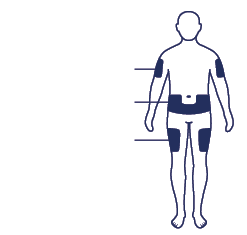
- The best areas to inject are the front of the thighs, the upper arms, or the abdomen.
- Change the injection site each time. This is to reduce the risk of developing nodules and skin indentations (see section 2).
- Always use a new needle for each injection. This reduces the risk of contamination, infection, and blocked needles, which could lead to inaccurate doses. Dispose of the needles carefully after each use.
- Do not use a syringe to remove solution from the pen, to avoid dosing errors and potential overdose.
Do not use Awiqli
- in insulin infusion pumps
- if the pen is damaged or has not been stored correctly (see section 5)
- if there are visible particles - the solution must be clear and colorless.
If you use more Awiqli than you should
If you use too much of this medicine, your blood sugar level may
drop too low (hypoglycemia). See the instructions in the information provided in the
(hypoglycemia).
If you forget to use Awiqli
If you are a patient with type 1 diabetes
- Inject it as soon as you remember. You should then inject Awiqli once a week after injecting the forgotten dose. This day will become your new weekly injection day for Awiqli. Then continue to inject once a week.
- If you want to return to the original day of injections, you can do so in agreement with your doctor by extending the time interval between subsequent doses.
- If you are unsure when to take the medicine, ask your doctor or pharmacist.
If you are a patient with type 2 diabetes
- If 3 days or less have passed since you should have injected Awiqli, inject it as soon as you remember. Then inject the next dose on your usual injection day.
- If more than 3 days have passed since the last time you should have injected Awiqli, inject it as soon as you remember. You must inject the next dose of Awiqli one week after injecting the forgotten dose. If you want to return to the original day of injections, you can do so in agreement with your doctor by extending the time interval between subsequent doses.
- Then continue to inject once a week.
- If you are unsure when to take the medicine, ask your doctor or pharmacist.
If you stop using Awiqli
Do not stop treatment with Awiqli without talking to your doctor. If you stop using
this medicine, a very high blood sugar level (hyperglycemia) and
ketoacidosis (a condition characterized by too much acid in the blood) may develop. See the advice provided
in the information provided in the box at the end of this leaflet - Blood sugar too high
(hyperglycemia).
4. Possible side effects
Like all medicines, this medicine can cause side effects, although not everybody gets them.
Hypoglycemia (low blood sugar):very common (may affect more than
1 in 10 people).
- It can become very serious.
- If your blood sugar gets too low, you may lose consciousness.
- Severe hypoglycemia can cause damage to the brain and be life-threatening. If you experience signs of low blood sugar, act immediately to raise it. See the advice in the section “Low blood sugar (hypoglycemia)” below.
Hypersensitivity reactions:uncommon (may affect up to 1 in 100)
The signs of a severe allergic reaction are:
- feeling unwell (dizziness)
- difficulty breathing
- fast heartbeat or feeling faint
- nausea and vomiting
- local reactions such as rash, swelling or itching that spread to other parts of the body
- sweating and loss of consciousness.
If you experience a severe allergic reaction to Awiqli, stop using this medicine and seek
immediate medical attention. A severe allergic reaction can be life-threatening if
swelling of the throat blocks your airways.
Skin changes at the injection site:rare (may affect up to 1 in 1,000)
- If you inject this medicine too often into the same place, the skin may become thinner (lipoatrophy) or thicker (lipohypertrophy).
- Lumps under the skin can also be caused by a build-up of a protein called amyloid (cutaneous amyloidosis) if you inject insulin into the same place often. The frequency with which this occurs is not known.
- This medicine may not work as well if you inject it into an area with lumps, an area that is thinned, or an area that is thickened.
- Change the injection site with each injection to prevent these skin changes.
Other side effects include:
Common (may affect up to 1 in 10 people)
- Skin problems at the injection site such as bruising, bleeding, pain or discomfort, redness, swelling, itching.
- Peripheral edema (swelling, especially of the ankles and feet due to fluid retention).
Reporting of side effects
If you get any side effects, talk to your doctor, pharmacist or nurse. You can also report side effects
directly through the national reporting system listed in Annex V. By reporting side effects you can
help to provide more information on the safety of this
medicine.
5. How to store Awiqli
Keep this medicine out of the sight and reach of children.
Do not use this medicine after the expiry date which is stated on the pen label and on the
pack after “Exp.”. The expiry date refers to the last day of that month.
Before opening
Store in a refrigerator (2 °C – 8 °C).
Do not freeze. Keep away from refrigerating elements.
Keep the cap on the pen to protect it from light.
After first opening or if carried as a spare
You can carry with you as a spare the pre-filled Awiqli (FlexTouch) pen and keep it at room
temperature (below 30 °C) or in a refrigerator (from 2 °C to 8 °C) for a maximum of 12 weeks.
When not in use, store the pen with the cap on to protect the medicine from light.
Do not dispose of any medicine in waste water or household waste. Ask your pharmacist how to
dispose of medicines you no longer use. This will help protect the environment.
6. Content of the pack and other information
What Awiqli contains
- The active ingredient is insulin icodec. Each mL of the solution contains 700 units of insulin icodec. Each pre-filled pen contains 700, 1,050 or 2,100 units of insulin icodec respectively in 1, 1.5 or 3 mL of solution.
- The other ingredients are glycerol, metacresol, phenol, zinc acetate, sodium chloride, hydrochloric acid, sodium hydroxide (for pH adjustment) and water for injections (see section 2).
Description of Awiqli and content of the pack
Awiqli is presented as a clear and colourless injectable solution contained in a pre-filled pen.
The outer packaging is green with the dosage “700 units/mL” indicated in a yellow box. The pen body is green while the pen label is dark green with a yellow box
highlighting the dosage of the formulation.
Packs
- Pack of 1 pre-filled pen of 1 mL (without needles).
- Pack of 1 pre-filled pen of 1 mL (with 9 or 14 NovoFine Plus single-use needles).
- Pack of 1 pre-filled pen of 1.5 mL (without needles).
- Pack of 1 pre-filled pen of 1.5 mL (with 13 or 14 NovoFine Plus single-use needles).
- Multipack of 2 pre-filled pens of 1.5 mL (with 26 or 28 NovoFine Plus single-use needles).
- Pack of 1 pre-filled pen of 3 mL (without needles).
- Pack of 2 pre-filled pens of 3 mL (without needles).
- Pack of 1 pre-filled pen of 3 mL (with 13 or 14 NovoFine Plus single-use needles).
- Multipack of 2 pre-filled pens of 3 mL (with 26 or 28 NovoFine Plus single-use needles).
Not all pack sizes may be marketed.
Marketing Authorisation Holder and Manufacturer
Novo Nordisk A/S
Novo Alle 1
DK-2880 Bagsvaerd
Denmark
More detailed information on this medicine is available on the website of the European Medicines
Agency: http://www.ema.europa.eu
HYPERGLYCEMIA AND HYPOGLYCEMIA
General effects of diabetes treatment
Blood sugar too low (hypoglycemia)
This can happen if:
- you drink alcohol
- you use too much insulin
- you do more physical activity than usual
- you eat too little or skip a meal.
Early warning signs of blood sugar being too low, which can occur
suddenly:
- headache
- fast heartbeat
- feeling unwell or strong hunger
- cold sweat or cold and pale skin
- temporary vision disturbances
- trembling or nervousness or anxiety
- unusual tiredness, weakness and sleepiness
- slurred speech, feeling confused, difficulty concentrating.
What to do if your blood sugar is too low:
- eat glucose tablets or a sugary snack, such as sweets, biscuits, fruit juice (always carry glucose tablets or a sugary snack with you to use if needed).
- Measure your blood sugar if possible and rest. You may need to measure your blood sugar more than once. This is because with basal insulins like Awiqli, the rise in blood sugar may be delayed.
- Wait until the signs of low blood sugar have disappeared or your blood sugar has stabilised, then continue with your insulin as usual.
- If you have type 1 diabetes and experience multiple episodes of hypoglycemia, you should consult your doctor.
What others should do if you faint
Tell everyone you spend time with that you have diabetes and what the
consequences of low blood sugar could be, including the risk of fainting.
Explain to them that, if you should faint, they must:
- turn you onto your side
- seek immediate medical help
- do notgive you food or drink as this could cause you to choke.
You may recover more quickly from fainting with the administration of glucagon, which
can only be given by someone who knows how to use it.
- If you are given glucagon, you will need sugar or a sweet snack as soon as you regain consciousness.
- If you do not respond to glucagon, you will need to be taken to hospital.
If severe hypoglycemia is not treated in time, it can cause brain damage, which can
be short- or long-lasting. It can even cause death.
Contact your doctor if:
- your blood sugar has become so low that you have fainted
- you have used glucagon
- you have recently had multiple episodes of low blood sugar. You may need to adjust your insulin dose or injection times, diet or exercise.
Blood sugar too high (hyperglycemia)
This can happen if:
- you drink alcohol
- you get an infection or have a fever
- you have not used enough insulin
- you eat more or do less physical activity than usual
- you continue to use less insulin than you need
- you forget to use your insulin or stop using it without consulting your doctor.
Early warning signs of blood sugar being too high, which usually develop
gradually:
- thirst
- dry and flushed skin
- loss of appetite
- feeling sleepy or tired
- increased frequency of urination
- dry mouth or fruity-smelling breath (acetone)
- feeling unwell or sick (nausea or vomiting). These can be signs of a very serious condition called diabetic ketoacidosis. This is a build-up of acid in the blood because the body is metabolising fat instead of sugar. If left untreated, it could lead to diabetic coma and eventually death.
What to do if your blood sugar is too high:
- measure your blood sugar.
- check for ketones in your urine or blood. seek immediate medical help.
Instructions for use
Before you start using the needle and Awiqli pen, always read these instructions
carefully and ask your doctor, nurse or pharmacist how to inject Awiqli correctly.
The Awiqli pen is a single-use pre-filled pen containing insulin icodec 700 units/mL. You can
inject from 10 to 700 units in a single weekly injection.
Always start by checking the pen label to make sure it contains
Awiqli 700 units/mL.
The pen is designed for use with NovoFine Plus, NovoFine or NovoTwist single-use needles
up to 8 mm in length.

Once a week
Awiqli pen
Note:the pen may be a different size than shown in the figure. These instructions
apply to all Awiqli pens.
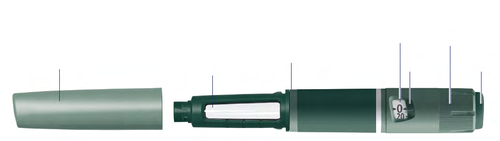
Information about needles
Always use a new needle for each injection. Check the flow as described in ‘Point 2’
and use a new needle for each injection.Always remove the needle after each use.
NovoFine Plus needle (example)
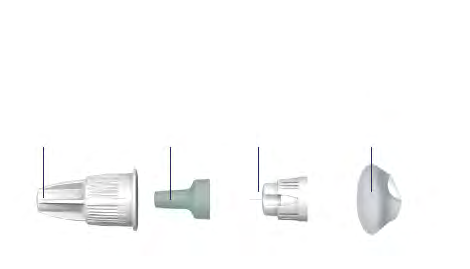
Point 1 Prepare the pen with a new needle
- Check the name and dosage on the pen labelto make sure the pen contains insulin icodec 700 units/mL.
- Remove the cap from the pen. See Figure A.
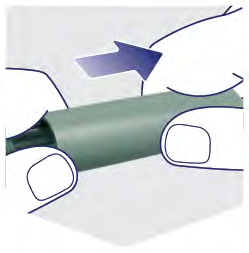
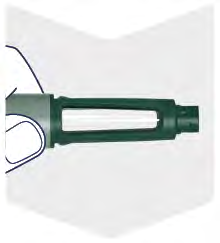
- Always check that the insulin in the pen is clear andcolourless.
- Look through the pen window. If the insulin appears cloudy or contains particles, do not use the pen. See Figure B.
- Always use a new needle for each injection.
- Check the protective seal and outer cap of the needle for any damage that could affect sterility. Throw the needle away and use a new one.
- Take a new needle and remove the protective seal.
- Do not attach a new needle to the pen until you are readyto give the injection.See Figure C.
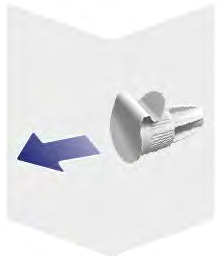
C
- Push the needle straight onto the pen. Rotate it until it is firmlyattached.See Figure D.
- The needle is covered by two caps: you must remove both of them.If you forget to remove both caps, you will not inject Awiqli.
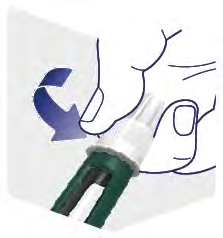
- Pull off the outer cap of the needle and keep it for later. You will need it after the injection to safely remove the needle from the pen. See Figure E.
- Pull off the inner cap of the needle and throw it away.See Figure F.
- A drop of Awiqli may appear on the tip of the needle. This is normal, but you should still check the flow of Awiqli before each injection. See ‘ Point 2’.
- Never use a bent or damaged needle.
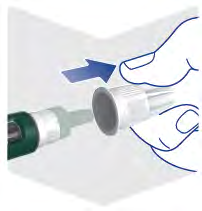
E
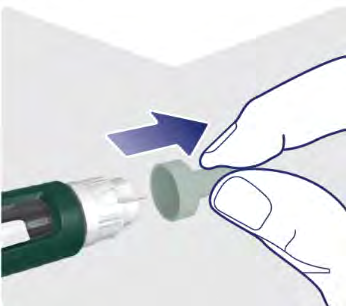
Point 2 Check the flow before each injection.
- Always check the flow before each injection.This helps to ensure that the entire dose of Awiqli is delivered.
- Rotate the dose selector clockwise until you see the first mark (10 units) on the dose counter. See Figure G.
- Make sure the mark is aligned with the dose indicator. See Figure H.
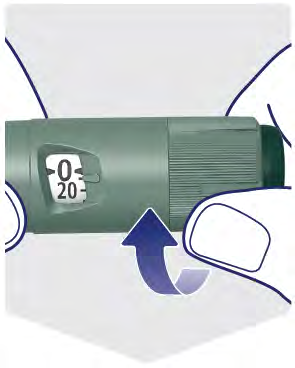
G
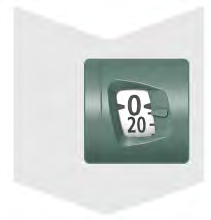
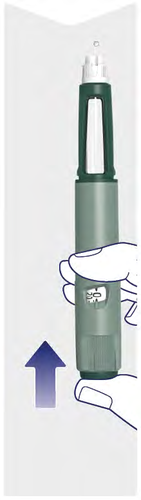
- Hold the pen with the needle pointing upwards.
- Press and hold the injection button untilthe dose counter shows.It should align with the dose indicator.
- A drop of Awiqli should appear on the tip of the needle. This drop indicates that the pen is ready for use. See Figure I.
- If no drop appears, check the flow again.This should only be done a total of six times.
- If no drop still appears,the needle may be blocked. Change the needle as described in ‘ Point 5’ and ‘Point 1’.
- Then check the flow again.
- Do not use the penif no drop of Awiqli still appears.
I
Point 3 Set the dose
- Verify that the dose indicator is set to . See Figure J.
- Rotate the dose selector to select the number of units needed for the injection as indicated by your doctor or nurse. The dose counter shows the dose measured in units.
- Make sure you select the intended dose.
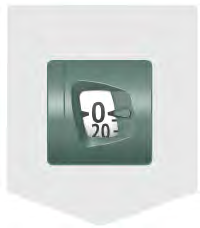
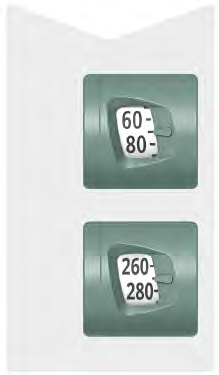
- The units shown on the dose counter will guide you to your dose. The dose can be increased by 10 unitsat a time.
- You will feel a “click” each time you rotate the dose selector. Do not set the dose by counting the audible clicks.
- If you select the wrong dose, you can correct it by rotating the dose selector forwards or backwards.
- When the dose is aligned with the dose indicator, it has been selected. Make sure you select the intended dose.
- The images show examples of how to choose the dose correctly. See Figure K.
- If the dose counter stops before you reach the prescribed dose, see the section ‘Do you have enough Awiqli?’at the bottom of these instructions.
Choose the injection site
- Choose an injection site on the abdomen (stay at least 5 cm away from the navel), on the upper thighs or arms.
- You can inject into the same area of the body each week, but make sure it is not in the same spot used for the last injection.
Step 4 Inject the dose
- Insert the needle completely into the skin. See Figure L.
- Make sure you can see the dose counter. Do not cover thedose counter and do not touch it with your fingers,otherwise the injection may be blocked.
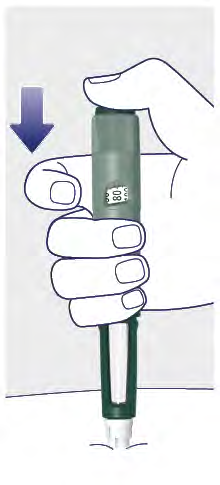
- Press and hold the injection button untilthe dose counter shows.
- Continue to press the injection button with the needle insertedinto the skin and count slowly to 6.This should align with the dose indicator. See Figure M. When the dose counter returns to you may hear a click.
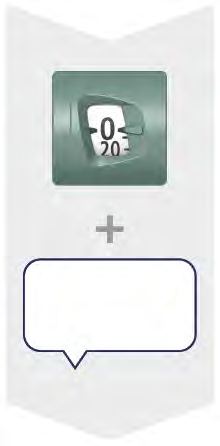
Count
slowly
1-2-3-4-5-6
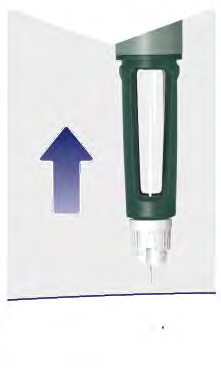
- Remove the needle from the skin, then release the injection button. See Figure N.
- If the needle is removed prematurely, a stream of Awiqli may leak from the needle tip, and the entire dose will not have been administered.
- If blood appears at the injection site, press lightly on the area for a few minutes to stop the bleeding.
- After the injection, you may see a drop of Awiqli on the needle tip. This is normal and has no effect on the dose.
N
Step 5 After the injection
- Gently insert the needle tip into the outer needle cap resting on a flat surface, without touching the needle or the cap itself. See Figure O.
- When the needle is covered, press the outer cap completely with caution.
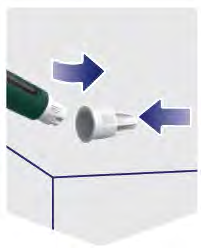
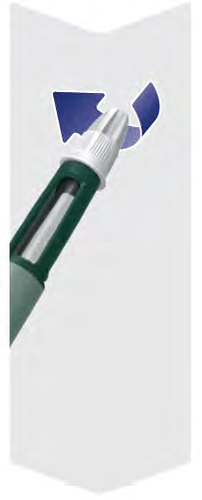
- Unscrew the needle and dispose of it carefully according to your doctor's, nurse's, pharmacist's or local authorities' instructions. See Figure P.
- Never try to reattach the inner needle cap. You could prick yourself with the needle.
- Always remove and dispose of the needle immediately aftereach injectionto avoid contamination, infection, clogged needles and inaccurate dosages.
- Never store the pen with the needle inserted.
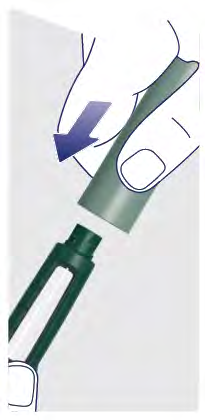
- Replace the capon the pen after each use to protect Awiqli from light. See Figure Q.
- When the pen is empty, dispose of it without the needle attached as instructed by your doctor, nurse, pharmacist or local authorities.
household waste.
Do you have enough Awiqli left?
- If the dose counter stops before it reaches your dose, there is no longer enough Awiqli for a full dose. The number shown on the dose counter is the number of units remaining in the pen.
- If you need more Awiqli than is left in the pen,you can split the dose between two pens. In this case, make sure you calculate correctly. If in doubt, discard the used pen and administer the entire dose with a new pen.
- If you split the dose incorrectly, you will inject adose that is too low or too high of Awiqli, and this can lead to ablood sugar level that is too high or too low.
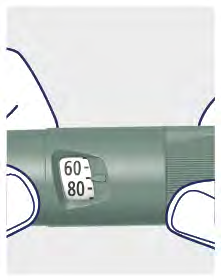
Important information
- Needles are for single use only. Never reuse needles.This reduces the risk of contamination, infection, insulin leakage, needle blockage, and incorrect dosage.
- Treat the pen with care.Incorrect or improper use can cause incorrect dosages, which can lead to a blood sugar level that is too high or too low.
- Anyone assisting the patient must be extremely carefulwhen handling theneedlesto prevent injury and infection from punctures.
- Do not use this pen without help if you have vision problems and cannot follow theseinstructions.Get help from a person with good vision who is trained to use the Awiqli pen.
- Always keep the pen and needles out of sight and reach of others,especially children.
- Inject Awiqli once a week.
- Use Awiqli as prescribed. If you do not use Awiqlias prescribed, you may develop ablood sugar level that is too high or too low.
- If you are using more than one type of injectable medication, it is very important to check the name andconcentrationon the pen label before use.
- Never sharethe pen and needles with other people.
Pen maintenance
- Do not freeze Awiqli. Do not use Awiqli if it has been frozen. Discard the pen.
- Do not drop the pen or bump it against hard surfaces.
- Avoid exposing Awiqli to direct sunlight.
- Keep Awiqli away from heat sources, microwaves and light.
- Do not try to repair or disassemble the pen.
- Do not expose the pen to dust, dirt or liquids.
- Do not wash, immerse in liquid or lubricate the pen. If necessary, it can be cleaned with a mild detergent on a damp cloth.
pen.

Не уверены, подходит ли вам это лекарство?
Обсудите симптомы и варианты лечения с врачом онлайн.

Уже начали прием и появились вопросы?
Обсудите свое состояние и дальнейшие шаги с врачом онлайн.
- Страна регистрации
- Форма выпускаPre-filled pen injectable solution, 700 U/ml
- Код АТХA10AE07
- Действующее вещество
- Отпускается по рецептуДа
- Производитель
- Информация на этой странице носит справочный характер и не является медицинской консультацией. Перед началом приема лекарства обязательно проконсультируйтесь с врачом.
- Аналоги AWIQLIФорма выпуска: Injectable solution, 100 UNITS/MLДействующее вещество: инсулин гларгинПроизводитель: ELI LILLY NEDERLAND B.V.Отпускается по рецептуФорма выпуска: Injectable solution, 100 IU/MLДействующее вещество: инсулин гларгинПроизводитель: SANOFI-AVENTIS DEUTSCHLAND GMBHОтпускается по рецептуФорма выпуска: Injectable solution, 100 U/MLДействующее вещество: инсулин детемирПроизводитель: NOVO NORDISK A/SОтпускается по рецепту
Аналоги AWIQLI в других странах
Лекарства с тем же действующим веществом, доступные в других странах.
Аналог AWIQLI в Испания
Врачи онлайн по AWIQLI
Обсудите применение AWIQLI и возможные следующие шаги — по оценке врача.









Получите рецепт на AWIQLI онлайн
Заполните форму за 2 минуты
Расскажите о симптомах, истории болезни и нужном препарате.
Выберите врача или мы назначим
Выберите специалиста или мы подберём ближайшего доступного врача.
Врач рассматривает ваш случай
Обычно в течение 30 минут. Может задать уточняющие вопросы в чате.
Получите в любой аптеке
Электронный рецепт отправляется на вашу почту — действителен по всей Польше.
Часто задаваемые вопросы
AWIQLI требует рецепта в Италия. Вы можете уточнить у врача онлайн, подходит ли это лекарство для вашей ситуации.
Действующее вещество AWIQLI — insulin icodec. Эта информация помогает определить лекарства с тем же составом под другими торговыми названиями.
AWIQLI производится компанией NOVO NORDISK A/S. Упаковка и торговое название могут отличаться в зависимости от дистрибьютора.
Врачи, включая Семейные врачи, Психиатры, Дерматологи, Кардиологи, Эндокринологи, Гастроэнтерологи, Пульмонологи, Нефрологи, Ревматологи, Гематологи, Инфекционисты, Аллергологи, Гериатры, Педиатры, Онкологи, могут оценить целесообразность применения AWIQLI с учетом вашей ситуации и местных правил. Вы можете записаться на онлайн-консультацию, чтобы обсудить возможные варианты.
Польша имеет хорошо развитую систему здравоохранения в крупных городах, таких как Варшава, Краков, Вроцлав и Гданьск. Аптеки широко доступны и работают в соответствии с действующим законодательством, обеспечивая доступ к рецептурным препаратам.
Вы можете купить AWIQLI в Варшаве, Кракове, Вроцлаве или Гданьске в любой аптеке при наличии действующего рецепта.
Чтобы получить рецепт, вы можете воспользоваться Oladoctor:
Другие лекарства с тем же действующим веществом (insulin icodec) включают ABASALAR, LANTUS, LEVEMIR. Они могут отличаться торговым названием или формой выпуска, но содержат одинаковый терапевтический компонент. Перед изменением лечения рекомендуется проконсультироваться с врачом.
