



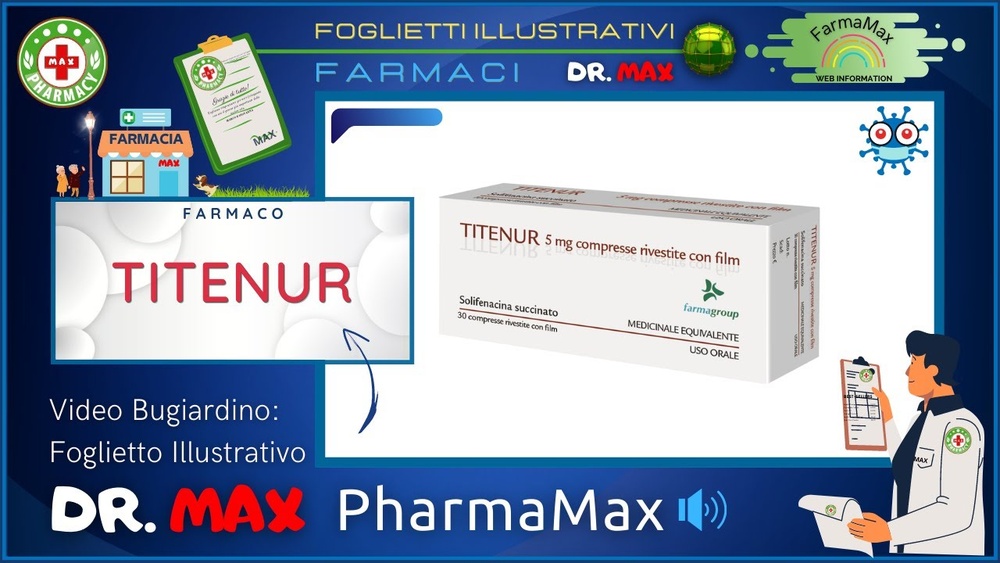
TITENUR 5 mg Film-Coated Tablets

Запит на рецепт онлайн
Лікар розгляне ваш випадок і визначить, чи є рецепт медично доцільним.

Поговоріть з лікарем про ці ліки
Обговоріть симптоми та можливі подальші кроки під час короткої онлайн-консультації.



Інструкція із застосування TITENUR
Зміст інструкції
Titenur 5 mg film-coated tablets, 10 mg film-coated tablets
solifenacin succinate
Generic medicine
Read this leaflet carefully before you start taking this medicine as it contains
important information for you.
- Keep this leaflet. You may need to read it again.
- If you have any questions, ask your doctor or pharmacist.
- This medicine has been prescribed for you only. Do not pass it on to others, even if their symptoms are the same as yours, as it could be harmful.
- If you get any side effects, even those not listed in this leaflet, tell your doctor or pharmacist. See section 4. Contents of this leaflet:
- 1. What Titenur is and what it is used for
- 2. What you need to know before you take Titenur
- 3. How to take Titenur
- 4. Possible side effects
- 5. How to store Titenur
- 6. Contents of the pack and other information
1. What is Titenur and what is it used for
The active ingredient of Titenur belongs to the class of anticholinergics.
These medications are used to reduce the activity of an overactive bladder. This allows it
to wait longer before going to the bathroom and increases the amount of urine that can be
contained within your bladder. Titenur is used to treat the symptoms of a condition
called overactive bladder. These symptoms include: a strong and sudden urge to
urinate without preceding signals, the need to urinate frequently, or wetting yourself because you
cannot reach the bathroom in time.
2. What you need to know before using Titenur
Do not take Titenur
- if you have an impairment of urination or complete emptying of the bladder (urinary retention)
- if you have a serious problem with your stomach or intestines (including toxic megacolon, a complication associated with ulcerative colitis)
- if you suffer from a muscle disease called myasthenia gravis, which causes extreme weakness of some muscles
- if you suffer from increased pressure in the eye with gradual loss of vision (glaucoma)
- if you are allergic to solifenacin or any of the other ingredients of this medicine (listed in section 6)
- if you are undergoing renal dialysis
- if you have a severe liver disease
- if you suffer from a severe kidney disease or a moderate liver disease and are also being treated with medicines that can reduce the elimination of Titenur from the
Page 1of 6
body (for example, ketoconazole). Your doctor or pharmacist will inform you about this.
Before starting treatment with Titenur, tell your doctor if you have or have ever had
any of the conditions listed above.
Warnings and precautions
Talk to your doctor or pharmacist before taking Titenur
- If you have problems emptying your bladder (bladder obstruction) or have difficulty urinating (e.g. reduced urine flow). The risk of accumulating urine in the bladder (urinary retention) is very high.
- If you experience obstructions of the digestive system (constipation).
- If you are at risk of reduced gastrointestinal motility (gastric and intestinal movements). Your doctor will inform you about this possibility.
- If you suffer from a severe kidney disease.
- If you have a moderately severe liver disease.
- If you have a tear in the stomach (hiatal hernia) or heartburn.
- If you have a disease of the nervous system (autonomic neuropathy).
Children and adolescents
Titenur should not be used in children and adolescents under 18 years of age.
Tell your doctor if you have or have ever had any of the conditions listed above
before starting treatment with Titenur.
Before starting treatment with Titenur, your doctor will make sure that there are no other causes
leading to the need to urinate frequently (e.g. heart failure
(insufficient ability of the heart to pump) or kidney disease). If you have a urinary tract
infection, your doctor will prescribe you an antibiotic (a treatment against specific bacterial
infections).
Other medicines and Titenur
Tell your doctor or pharmacist if you are taking, have recently taken or might
take any other medicines.
It is particularly important to tell your doctor if you are taking:
- Other cholinergic medicines, the effectiveness and side effects of both medicines may increase.
- Cholinergics that may reduce the effect of Titenur
- Medicines, such as metoclopramide and cisapride, that stimulate the motility of the digestive system. Titenur may reduce their effects.
- Medicines, such as ketoconazole, ritonavir, nelfinavir, itraconazole, verapamil and diltiazem that reduce the rate of elimination of Titenur from the body.
- Medicines such as rifampicin, phenytoin and carbamazepine, which increase the rate of elimination of Titenur from the body.
- Medicines, such as bisphosphonates, that can cause or worsen inflammation of the esophagus (esophagitis).
Titenur with food and drink
Titenur can be taken as needed, with or without food.
Pregnancy and breastfeeding
You should not use Titenur if you are pregnant unless it is strictly
necessary.
Do not use Titenur if you are breastfeeding as solifenacin may be excreted in breast milk.
Page 2of 6
If you suspect or are planning a pregnancy, ask your doctor or pharmacist for advice
before taking this medicine.
Driving and using machines
Titenur can cause blurred vision and sometimes drowsiness or fatigue. If you
experience any of these side effects, do not drive vehicles or use machines.
Titenur contains lactose.If your doctor has diagnosed you with lactose intolerance
contact him before taking this medicine.
3. How to take Titenur
Instructions for appropriate use
Take this medicine following exactly the instructions of your doctor. If you have any doubts,
consult your doctor or pharmacist.
You must swallow the tablet whole with a little liquid. You can take it with or without food, as
you prefer. Do not crush the tablets.
The recommended dose is 5 mg per day, unless your doctor tells you to take 10 mg per
day.
The 10 mg tablet can be divided into two equal doses.
If you take more Titenur than you should
If you take more Titenur than you should or if a child has accidentally taken Titenur,
consult your doctor or pharmacist immediately.
Symptoms of overdose may include: headache, dry mouth, dizziness, drowsiness
and blurred vision, perception of non-existent objects (hallucinations), overexcitation, seizures
(convulsions), difficulty breathing, increased heart rate
(tachycardia), urine retention in the bladder (urinary retention) and dilated pupils
(mydriasis).
If you forget to take Titenur
If you forget to take a dose at the usual time, take it as soon as you remember, unless
it is time to take the next dose. Never take more than one dose per day. If
you have any doubts, always consult your doctor or pharmacist.
If you stop taking Titenur
If you stop taking Titenur, the symptoms of overactive bladder may
reappear or worsen. Always consult your doctor if you are considering stopping the treatment.
If you have any further questions on the use of this medicine, ask your doctor or pharmacist.
4. Possible side effects
Like all medicines, this medicine can cause side effects, although not everybody gets them.
If you experience an allergic reaction or a severe skin reaction (e.g. formation of blisters
or peeling of the skin), you should inform your doctor or pharmacist immediately.
In some patients treated with solifenacin, angioedema has been reported
(allergic reaction consisting of swelling of the tissue just below the
skin surface) with airway obstruction (difficulty breathing). If
angioedema occurs, treatment with Titenur must be immediately discontinued
and appropriate therapy and/or measures must be instituted.
Page 3of 6
Titenur can cause the following side effects:
Very common (may affect more than 1 in 10 people)
- Dry mouth Common (may affect up to 1 in 10 people)
- Blurred vision
- Constipation, nausea, indigestion with symptoms such as abdominal fullness, abdominal pain, belching, nausea and heartburn (dyspepsia), discomfort in the stomach
Uncommon (may affect up to 1 in 100 people)
- Urinary tract infections, bladder infection
- Drowsiness,
- Altered taste perception (dysgeusia) Dry eyes (irritated)
- Dry nose
- Reflux disease (gastroesophageal reflux), dry throat
- Dry skin
- Difficulty urinating
- Fatigue, fluid retention in the lower legs (edema)
Rare (may affect up to 1 in 1,000 people)
- Accumulation of a large amount of hardened stool in the colon (fecal impaction)
- Increased amount of urine in the bladder caused by the inability to empty the bladder (urinary retention)
- Dizziness, headache
- Vomiting
- Itching, rash
Very rare (may affect up to 1 in 10,000 people)
- Hallucinations, confusion
- Allergic rash
Not known (frequency cannot be estimated from the available data)
- Decreased appetite, high levels of potassium in the blood that can cause an abnormal heart rhythm
- Increased eye pressure
- Changes in the electrical activity of the heart (ECG), irregular heartbeat, palpitations, fast heartbeat (Torsades de Pointes)
- Voice disorders
- Liver disease
- Muscle weakness
- Kidney disease
Reporting of side effects
If you get any side effects, talk to your doctor or pharmacist or nurse. This includes any possible side effects not listed in this leaflet. You can also report side effects directly through the national reporting system at
https://www.aifa.gov.it/content/segnalazioni-reazioni-avverse. By reporting side effects you can help provide more information on the safety of this
medicine.
Page 4of 6
5. How to store Titenur
Keep this medicine out of sight and reach of children.
Do not use Titenur after the expiry date which is stated on the pack after Exp. The expiry date refers to the last day of the month.
This medicine does not require any particular storage conditions.
If the medicine loses colour or shows signs of deterioration, you should ask your pharmacist for advice.
Do not dispose of any medicine in wastewater or household waste. Ask your pharmacist how to dispose of medicines you no longer use. This will help protect the environment.
6. Package Contents and Other Information
What Titenur Contains
- The active ingredient is solifenacin succinate. Titenur 5 mg: each film-coated tablet of Titenur contains 5 mg of solifenacin succinate equivalent to 3.8 mg of solifenacin - Titenur 10 mg: each film-coated tablet of Titenur contains 10 mg of solifenacin succinate equivalent to 7.5 mg of solifenacin.
- The other ingredients are:
Tablet core
Lactose monohydrate
Corn starch
Starch (corn), (partially) pregelatinized
Magnesium stearate
Water for injections
Coating
5 mg
Hypromellose 5cp
Titanium dioxide (E171)
Macrogol 8000
Talc
Yellow iron oxide (E172)
Water for injections
10 mg
Hypromellose 5cp
Titanium dioxide (E171)
Macrogol 8000
Talc
Red iron oxide (E172)
Yellow iron oxide (E172)
Water for injections
Description of the Appearance of Titenur and Package Contents
Page 5of 6
Titenur 5 mg: film-coated tablets of light yellow color, round, biconvex, with a
diameter of 5.8 mm.
Titenur 10 mg: film-coated tablets of light pink color, round, biconvex, with
a score line on one side and flat on the other side, with a diameter of 7.9 mm. The
tablet can be divided into two equal halves.
The tablets of Titenur are supplied in blisters of 10, 20 or 30 tablets.
Not all pack sizes may be marketed.
Marketing Authorisation Holder
FARMA GROUP S.r.l.
Via Strampelli, 18
63074 San Benedetto del Tronto (AP)
Manufacturer
Genepharm S.A.
18 km Marathon Avenue
153 51 Pallini Attiki
Greece
This medicinal product is authorised in the Member States of the European Economic Area
with the following denominations:
Portugal: Uriken
Italy: Titenur
Page 6of 6

Не впевнені, чи підходить вам цей лікарський засіб?
Обговоріть симптоми та можливі варіанти лікування з лікарем онлайн.

Виникли питання під час прийому ліків?
Обговоріть свої симптоми та лікування з лікарем онлайн.
- Країна реєстрації
- Лікарська формаFilm-coated tablet, 5 MG
- Код АТХG04BD08
- Діюча речовина
- Потрібен рецептТак
- Виробник
- Ця інформація надана лише для ознайомлення і не є медичною порадою. Рішення щодо лікування завжди приймає лікар.
- Альтернативи до TITENURЛікарська форма: Film-coated tablet, 5 MGДіюча речовина: солифенацинВиробник: LAMPUGNANI FARMACEUTICI SPAПотрібен рецептЛікарська форма: Orodispersible tablet, 5 MGДіюча речовина: солифенацинПотрібен рецептЛікарська форма: Film-coated tablet, 5 MGДіюча речовина: солифенацинВиробник: ARISTO PHARMA GMBHПотрібен рецепт
Аналоги TITENUR в інших країнах
Препарати з тією самою діючою речовиною, доступні в інших країнах.
Аналог TITENUR у Іспанія
Аналог TITENUR у Польща
Аналог TITENUR у Україна
Лікарі онлайн щодо TITENUR
Застосування, безпека та можливість призначення рецепта — за результатами медичної оцінки.


Отримайте рецепт на TITENUR онлайн
Заповніть форму за 2 хвилини
Розкажіть про симптоми, історію хвороби та потрібний препарат.
Оберіть лікаря або ми призначимо
Оберіть спеціаліста або ми підберемо найближчого доступного лікаря.
Лікар розглядає ваш випадок
Зазвичай протягом 30 хвилин. Може ставити уточнювальні запитання в чаті.
Отримайте в будь-якій аптеці
Електронний рецепт надсилається на вашу пошту — дійсний по всій Польщі.
Часті запитання
TITENUR потребує рецепта в Італія. Ви можете обговорити з лікарем онлайн, чи підходить цей лікарський засіб для вашої ситуації.
Діюча речовина у TITENUR — солифенацин. Це допомагає визначити препарати з тим самим складом, але під іншими торговими назвами.
TITENUR виробляється компанією FARMA GROUP S.R.L.. Назва бренду та упаковка можуть відрізнятися залежно від дистрибʼютора.
Лікарі, зокрема Сімейні лікарі, Психіатри, Дерматологи, Кардіологи, Ендокринологи, Гастроентерологи, Пульмонологи, Нефрологи, Ревматологи, Гематологи, Інфекціоністи, Алергологи, Геріатри, Педіатри, Онкологи, можуть оцінити доцільність застосування TITENUR з урахуванням вашого стану та місцевих правил. Ви можете записатися на онлайн-консультацію, щоб обговорити симптоми та можливі подальші кроки.
Польща має добре розвинену систему охорони здоров'я у великих містах, таких як Варшава, Краків, Вроцлав і Гданськ. Аптеки широко доступні та працюють відповідно до чинного законодавства, забезпечуючи доступ до рецептурних препаратів.
Ви можете придбати TITENUR у Варшаві, Кракові, Вроцлаві або Гданську в будь-якій аптеці за наявності дійсного рецепта.
Щоб отримати рецепт, ви можете скористатися Oladoctor:
Інші препарати з тією самою діючою речовиною (солифенацин) включають INKOVES, ORODAX, SOLIFENAKINA ARISTO. Вони можуть відрізнятися торговою назвою або формою випуску, але містять той самий терапевтичний компонент. Перед зміною або початком прийому нового препарату варто проконсультуватися з лікарем.
