



SCENESSE 16 mg Implant

Ocena recepty online
Lekarz przeanalizuje Twój przypadek i zdecyduje, czy wystawienie recepty jest medycznie uzasadnione.

Porozmawiaj z lekarzem o tym leku
Omów swoje objawy i opcje leczenia podczas szybkiej konsultacji online.



Jak stosować SENESSE
Treść ulotki
SCENESSE 16 mg implant
afamelanotide
Medicinal product subject to additional monitoring. This will allow the rapid identification of
new safety information. You can contribute by reporting any adverse effects
experienced during the use of this medicine. See the end of section 4 for
information on how to report adverse effects.
Read this leaflet carefully before using this medicine as it contains important
information for you.
- Keep this leaflet. You may need to read it again.
- If you have any questions, ask your doctor.
- If you experience any side effects, including those not listed in this leaflet, tell your doctor. See section 4.
Contents of this leaflet:
- 1. What SCENESSE is and what it is used for
- 2. What you need to know before you receive SCENESSE
- 3. How SCENESSE is used
- 4. Possible side effects
- 5. How to store SCENESSE
- 6. Contents of the pack and other information
1. What is SCENESSE and what is it used for
SCENESSE contains the active substance afamelanotide (as acetate). Afamelanotide is a synthetic form of a hormone present in the body, called alpha-melanocyte stimulating hormone (α-MSH). Afamelanotide acts similarly to the natural hormone, stimulating skin cells to produce eumelanin, a type of brown-black melanin pigment present in the body. Afamelanotide is used to increase tolerance to sunlight in adults with a confirmed diagnosis of erythropoietic protoporphyria (EPP). EPP is a disease in which patients have increased sensitivity to sunlight, which can cause toxic effects, such as pain and burning. By increasing the amount of eumelanin, SCENESSE may help delay the onset of pain due to the skin's photosensitivity (sensitivity to sunlight).
2. What you need to know before you receive SCENESSE
Do not use SCENESSE
- if you are allergic to afamelanotide or any of the other ingredients of this medicine (listed in section 6)
- if you have a severe liver disease
- if you have liver problems
- if you have kidney problems.
Warnings and precautions
Talk to your doctor before you receive SCENESSE if you have or have had in the past:
- heart problems or severe breathing problems;
- gastrointestinal problems;
- diabetes;
- Cushing's disease (a hormonal disorder in which the body produces an excessive amount of the hormone cortisol);
- Addison's disease (an adrenal gland disorder that causes a lack of certain hormones);
- Peutz-Jeghers syndrome (a disorder that causes intestinal blockage and in which brown freckles may appear on the hands, soles of the feet, and surface of the lips);
- epilepsy (or have been told you are at risk of seizures);
- anemia (low number of red blood cells in the blood);
- melanoma (an aggressive type of skin cancer), including melanoma in situ, e.g., lentigo maligna; or if you have certain hereditary diseases that increase the risk of developing melanoma;
- skin cancer of the type basal cell carcinoma or squamous cell carcinoma (including carcinoma in situ, e.g., Bowen's disease), Merkel cell carcinoma or other malignant or pre-malignant skin problems.
Talk to your doctor before you receive SCENESSE if you are over 70 years of age.
If you have had any of these diseases in the past, your doctor may need to monitor you more
closely during treatment.
Sun protection
Do not change the sun protection measures you normally take to manage erythropoietic
protoporphyria and according to your skin phototype (sensitivity to UV). Keep in mind that increased
exposure to UV light contributes to the development of skin cancer.
Skin monitoring
As this medicine increases eumelanin, the skin darkens in most patients treated. This is an expected response to this medicine and the darkening slowly fades, unless another implant is used.
The doctor will need to check the skin (whole body) periodically to detect changes in moles (e.g.
darkening) or other skin abnormalities. It is recommended to perform checks every 6 months.
Tell your doctor if you notice new abnormalities or changes in existing abnormalities on the skin. Make
an appointment with a porphyria specialist promptly if pigmented lesions, such as moles,
grow or if other lesions appear that spread, do not heal, are exudative, resemble
plaques, resemble warts or are ulcerated. You may need to consult a dermatologist.
Children and adolescents
This medicine should not be given to children and adolescents under 18 years of age,
because it has not been studied in this age group.
Other medicines and SCENESSE
Tell your doctor if you are taking, have recently taken or might take any other
medicines.
Tell your doctor if you are taking anticoagulants, used to prevent blood clots. These may include warfarin, acetylsalicylic acid (a substance present
in many medicines used to relieve pain and lower fever or to prevent blood clotting) and a group of medicines called non-steroidal anti-inflammatory drugs (NSAIDs), used
for the treatment of common disorders, such as arthritis, headache, mild fever, rheumatism and sore
throat. This is because patients taking these medicines may experience an increase in
the appearance of bruising or bleeding at the implant site.
Pregnancy and breastfeeding
If you are pregnant, suspect you are pregnant or are planning a pregnancy, or if you are breastfeeding with
breast milk, you should not use SCENESSE because the effects on the unborn or breastfeeding infant are
unknown.
Women of childbearing potential should use adequate contraception, such as oral contraceptives,
diaphragm plus spermicide, intrauterine device (also known as a coil) during treatment and
for three months after the last SCENESSE implant.
Driving and using machines
There is a risk of feeling sleepy or tired when using this medicine, especially
within 72 hours of insertion. If you experience these symptoms, do not drive vehicles and do not use tools or
machinery. If you suffer from persistent drowsiness, consult your doctor.
3. How SCENESSE is used
The implant will be inserted by a doctor who has received adequate training on the insertion procedure. The doctor will decide with you the most suitable time and location for the implant insertion.
One implant is inserted every 2 months during the spring and summer months. Three implants per year are recommended, depending on the duration of the effect required. However, the number of 4 implants per year should not be exceeded.
The implant is inserted by injection under the skin, using a catheter and a needle (subcutaneous use). Before inserting this medicine, the doctor may decide to apply a local anesthetic to numb the area where the implant will be inserted. The implant is inserted directly
under the skin folds on the waist or abdomen, in an area known as the iliac crest.
At the end of the insertion procedure, you may be able to feel the implant under the skin.
Over time, the implant will be absorbed by the body; this happens within 50-60 days after
implantation.
If you experience discomfort or have any doubts, consult your doctor. If necessary, the implant can be removed
with a simple surgical procedure.
If you have any questions about the use of this medicine, ask your doctor or pharmacist.
4. Possible side effects
Like all medicines, this medicine can cause side effects, although not everyone will experience them.
The following side effects have been reported:
Very common(may affect more than 1 in 10 people):
- nausea (feeling unwell);
- headache
Common(may affect up to 1 in 10 people):
- influenza, upper respiratory tract infection (cold)
- general skin changes, including darkening of freckles and moles;
- rash with small blisters, tingling, rash, red rash, itchy rash
- dizziness, drowsiness and migraine (severe headache);
- hot flushes, redness, feeling of heat and redness of the skin;
- abdominal pain (stomach), toothache, diarrhea and vomiting;
- pain in arms and legs, muscle and bone pain or weakness, back pain;
- fatigue, pain, fever, reactions at the implantation site, including pain, bruising, swelling, bleeding, itching and change in color of the overlying skin, flu-like illness, cough, nasal congestion, inflamed nose and throat.
Uncommon(may affect up to 1 in 100 people):
- urinary tract infection, hair follicle infection, infection of the stomach and intestines;
- hypersensitivity;
- decrease or increase in appetite;
- depressed mood including depression, inability to sleep, poor sleep quality;
- fainting, feeling of fainting, weakness, inability to relax legs, balance disorders;
- dry eyes, eye pain, red eyes, difficulty focusing objects, sensitivity of eyes to light, ringing in the ears;
- palpitations, bruising, bleeding, high blood pressure;
- blocked sinuses;
- inflammation of the stomach and intestines, heartburn, irritable bowel syndrome, intestinal gas, swelling of the lips, reduced sense of touch in the mouth, gum pain;
- acne, eczema, red-colored swelling on the skin, dry skin, change in hair color, excessive sweating, nail pigmentation, discoloration of the lips, skin exfoliation, burning sensation of the skin, change in skin color including loss of color, oily skin, hives;
- joint stiffness, stiffness of muscles and bones, sudden muscle contraction, muscle pain;
- breast tenderness, irregular menstruation, painful menstruation;
- chills, feeling of heat, hangover, malaise, swelling of legs or hands;
- abnormalities in liver function tests, reduced iron binding, increased sugar level, reduced iron level in the blood, blood in urine;
- falls and injuries;
- device expulsion.
Rare(may affect up to 1 in 1,000 people):
- fungal infection
- reduction in white blood cells
- increased cholesterol
- confusion, headache following trauma, taste abnormalities;
- swelling of the eyelids;
- fast heart rate;
- irregular bowel movements, inflammation of the lips, change in color of the gums, lips and tongue;
- red or brown nodules on the skin (called “lichen planus”), vitiligo;
- heavy and prolonged menstruation, vaginal secretions, decreased sexual drive;
- weight gain;
- wound complications, nausea after implant insertion.
Reporting of side effects
If you get any side effects, talk to your doctor or pharmacist. This includes any possible side effects not listed in this leaflet. You can also report side effects directly through the national reporting system
listed in Annex V. By reporting side effects you can help provide more information on the safety of this medicine.
5. How SCENESSE is stored
Keep this medicine out of the sight and reach of children.
This medicine must not be used after the expiry date which is reported on the vial and
on the outer packaging. The doctor will check the expiry date before using the implant.
Store in a refrigerator (2 C – 8 C).
Do not dispose of any medicine in wastewater or household waste. Ask your pharmacist how to
dispose of medicines you no longer use. This will help protect the environment.
6. Contents of the pack and other information
What SCENESSE contains
The active ingredient is afamelanotide. One implant contains 16 mg of afamelanotide (as acetate).
The other component is poly(DL-lactide-co-glycolide).
Description of the appearance of SCENESSE and contents of the pack
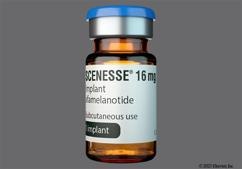
The implant is a solid rod, ranging in colour from white to off-white, approximately 1.7 cm in length and
1.5 mm in diameter, contained in a sealed amber glass vial with a rubber stopper coated
in PTFE.
Pack size of one vial containing one implant.
Marketing Authorisation Holder
CLINUVEL EUROPE LIMITED
10 Earlsfort Terrace
Dublin 2
D02 T380
Ireland
Tel: +353 1513 4932
[email protected]
Manufacturer
CLINUVEL EUROPE LIMITED
Alexandra House
The Sweepstakes
Ballsbridge
Dublin 4
D04 C7H2
Ireland
An authorisation has been granted for this medicinal product in “exceptional circumstances”. This means that
due to the rarity of the disease, for scientific and ethical reasons complete information on this medicinal
product could not be obtained.
The European Medicines Agency will annually review any new information on this
Other sources of information
Detailed information on this medicinal product is available on the European Medicines Agency website:
http://www.ema.europa.eu. Links to other websites on rare diseases and related therapeutic treatments are also
provided.
---------------------------------------------------------------------------------------------------------------------------
The following information is intended for healthcare professionals only:
Method of administration
SCENESSE is inserted subcutaneously under aseptic conditions, as described below.
Insertion must be performed by a physician experienced and accredited by the marketing authorisation
holder for implant insertion.
Instructions for use
- Remove the packaged implant from the refrigerator and allow the medicine to warm to room temperature.
- Have the patient sit in a comfortable position or lie down with the upper body slightly raised.
- Disinfect the skin over the iliac crest.
- Anaesthetise the insertion area, if deemed necessary and after consulting the patient.
- Select a 14-gauge (inner diameter 1.6 mm) catheter with a needle.
- Mark 1.5 to 2 cm on the catheter shaft using surgical ink.
- Holding the catheter at the base using a sterile technique, grasp and hold the patient’s skin at or above the iliac crest with two fingers.
- With the bevel of the needle facing upwards, insert the catheter laterally for 1.5-2 cm into the subcutaneous layer, at an angle of 30-45 degrees to the skin surface, in one smooth, continuous motion.
- Once the catheter is positioned, aseptically remove the implant from the vial.
- Remove the needle from within the catheter using a sterile technique.
- Transfer the implant to the end of the catheter.
- Using a suitable device (such as a mandrel) gently push the implant along the entire length of the catheter lumen.
- Apply some pressure with a finger to the insertion area during removal of the mandrel and catheter.
- Confirm implant insertion by palpating the skin and subcutaneous tissue at or above the iliac crest until the implant is located. Always verify the presence of the implant; if in doubt, check if the implant remained in the catheter. If the implant has not been inserted during the steps of the procedure described above, discard the implant and insert a new one. Do not insert a new implant unless the failure of the first insertion has been unequivocally confirmed.
- Apply a small compressive dressing to the injection site.
- Observe the patient for 30 minutes to check for the development of an allergic or hypersensitivity reaction (immediate type).
The implant can be surgically removed if necessary.

Nie jesteś pewien, czy ten lek jest odpowiedni dla ciebie?
Omów swoje objawy i leczenie z lekarzem online.

Zacząłeś przyjmować lek i masz pytania?
Omów swoje objawy i leczenie z lekarzem online.
- Kraj rejestracji
- Postać farmaceutycznaImplant, 16 MG
- Kod ATCD02BB02
- Substancja czynna
- Wymaga receptyTak
- Producent
- Te treści mają charakter wyłącznie informacyjny i nie zastępują konsultacji lekarskiej.
Odpowiedniki SENESSE w innych krajach
Leki z tą samą substancją czynną dostępne w innych krajach.
Odpowiednik SENESSE w Hiszpania
Lekarze online w sprawie SENESSE
Omów stosowanie SENESSE, bezpieczeństwo i ocenę zasadności recepty zgodnie z obowiązującymi przepisami.


Uzyskaj receptę na SENESSE online
Wypełnij 2-minutowy formularz
Opisz swoje objawy, historię choroby i lek, o który prosisz.
Wybierz lekarza lub pozwól nam przydzielić
Wybierz specjalistę lub dopasujemy Cię do najbliższego dostępnego lekarza.
Lekarz analizuje Twój przypadek
Zazwyczaj w ciągu 30 minut. Może zadawać dodatkowe pytania przez czat.
Odbierz w dowolnej aptece
Recepta elektroniczna wysłana na Twój e-mail — ważna w całej Polsce.
Często zadawane pytania
SENESSE wymaga recepty w Włochy. Możesz skonsultować się z lekarzem online, aby sprawdzić, czy ten lek może być odpowiedni w Twojej sytuacji.
Substancją czynną w SENESSE jest afamelanotide. Informacja ta pomaga rozpoznać leki o tym samym składzie, ale pod różnymi nazwami handlowymi.
SENESSE jest produkowany przez CLINUVEL EUROPE LIMITED. Nazwy handlowe i opakowania mogą się różnić w zależności od dystrybutora.
Lekarze, tacy jak Lekarze rodzinni, Psychiatrzy, Dermatolodzy, Kardiolodzy, Endokrynolodzy, Gastroenterolodzy, Pulmonolodzy, Nefrolodzy, Reumatolodzy, Hematolodzy, Zakaźnicy, Alergolodzy, Geriatrzy, Pediatrzy, Onkolodzy, mogą ocenić, czy stosowanie SENESSE jest odpowiednie w Twoim przypadku, w zależności od sytuacji klinicznej i lokalnych przepisów. Możesz umówić konsultację online, aby omówić objawy i możliwe dalsze kroki.
Polska posiada dobrze rozwiniętą infrastrukturę ochrony zdrowia w dużych miastach, takich jak Warszawa, Kraków, Wrocław i Gdańsk. Apteki są łatwo dostępne i działają zgodnie z obowiązującymi przepisami, zapewniając dostęp do leków na receptę.
Możesz kupić SENESSE w Warszawie, Krakowie, Wrocławiu lub Gdańsku w każdej aptece, posiadając ważną receptę.
Aby uzyskać receptę, możesz skorzystać z Oladoctor:
