



ONUREG 200 mg Tabletki Powlekane

Ocena recepty online
Lekarz przeanalizuje Twój przypadek i zdecyduje, czy wystawienie recepty jest medycznie uzasadnione.

Porozmawiaj z lekarzem o tym leku
Omów swoje objawy i opcje leczenia podczas szybkiej konsultacji online.



Jak stosować ONUREG
Treść ulotki
Onureg 200 mg film-coated tablets, 300 mg film-coated tablets
azacitidine
Read this leaflet carefully before you start taking this medicine as it contains
important information for you.
- Keep this leaflet. You may need to read it again.
- If you have any questions, ask your doctor, pharmacist or nurse.
- This medicine has been prescribed for you only. Do not pass it on to others, even if they have the same symptoms as you, as it may be harmful.
- If you get any side effects, even those not listed in this leaflet, tell your doctor, pharmacist or nurse. See section 4.
Contents of this leaflet
- 1. What Onureg is and what it is used for
- 2. What you need to know before you take Onureg
- 3. How to take Onureg
- 4. Possible side effects
- 5. How to store Onureg
- 6. Contents of the pack and other information
1. What is Onureg and what is it used for
What is Onureg
Onureg is an antineoplastic medicine that belongs to a group of medicines called antimetabolites.
Onureg contains the active substance azacitidine.
What is Onureg used for
Onureg is used to treat adults with acute myeloid leukemia (AML). This is a form
of cancer that affects the bone marrow and can cause problems with the normal production of blood
cells.
Onureg is used to keep the disease under control (remission, when the disease is less severe
or inactive).
How Onureg works
Onureg works by preventing cancer cells from growing. Azacitidine, the active substance contained
in Onureg, works by altering the way the cell activates and deactivates genes. It also reduces the
production of new genetic material (RNA and DNA). These effects are thought to block the
growth of cancer cells in the presence of leukemia.
Ask your doctor or nurse if you have any questions about how Onureg works or
why it has been prescribed for you.
2. What you need to know before you take Onureg
Do not take Onureg
- if you are allergic to azacitidine or any of the other ingredients of this medicine (listed in section 6)
- if you are breastfeeding.
Warnings and precautions
Blood tests
Before and during treatment with Onureg, you will undergo blood tests to check if you have a
sufficient number of blood cells and if your liver and kidneys are functioning normally. Your doctor
will determine how often to perform the blood tests.
Immediately inform your doctor, pharmacist or nurse if you experience any of the following
symptoms during treatment with Onureg:
- bruising or bleeding - which may be due to a low number of blood cells called platelets;
- fever - which may be due to an infection caused by a reduced number of white blood cells, which can be life-threatening;
- diarrhea, vomiting or nausea (feeling unwell).
The doctor may need to adjust the dose, suspend treatment or permanently discontinue
treatment with Onureg. The doctor may prescribe other medicines to manage these symptoms.
Children and adolescents
Onureg is not recommended in children and adolescents under 18 years of age.
Other medicines and Onureg
Tell your doctor if you are taking, have recently taken or might take any other
medicines. This is because Onureg can affect the way other medicines work. Other
medicines can, in turn, affect the way Onureg works.
Pregnancy, contraception and breastfeeding
If you are pregnant, suspect you are pregnant or are planning a pregnancy, or if you are breastfeeding
ask your doctor for advice before taking this medicine. While receiving
treatment with Onureg, men must not father a child.
Pregnancy
Do not use Onureg during pregnancy, as it may be harmful to the baby. Inform
your doctor immediately if you should become pregnant during treatment with Onureg.
Contraception
If you are a woman of childbearing potential you must use effective contraception during treatment
with Onureg and for 6 months after stopping treatment with Onureg. Men must use
effective contraception while taking Onureg and for 3 months after stopping
treatment with Onureg.
Your doctor will discuss with you the most suitable method of contraception to use.
Breastfeeding
Do not breastfeed while taking Onureg as it may be harmful to the baby.
Fertility
Onureg may affect your ability to have children. Ask your doctor for advice before using it.
Driving and operating machines or tools
You may feel tired, weak or have difficulty concentrating. If this happens or if
you experience other side effects, do not drive and do not use tools or machinery.
Onureg contains lactose
Onureg contains lactose. If your doctor has told you that you have an intolerance to some sugars, contact
them before taking this medicine.
Onureg contains sodium
This medicine contains less than 1 mmol of sodium (23 mg) per tablet, i.e. essentially
“sodium-free”.
3. How to take Onureg
Take this medicine following exactly the instructions of your doctor. If you have any doubts, consult your doctor.
How much Onureg to take
- The recommended dose is 300 mg, to be taken orally once a day.
- The doctor may reduce the dose to 200 mg once a day.
Onureg is administered in treatment cycles of 28 days.
- You must take Onureg every day for the first 14 days of each 28-day cycle.
- You will then observe a 14-day treatment suspension period for the remainder of the cycle.
Your doctor will tell you which dose of Onureg to take. The doctor may decide to:
- extend the treatment period beyond 14 days in each treatment cycle
- reduce the dose or temporarily interrupt treatment
- reduce the duration of treatment to 7 days. Always take Onureg according to your doctor's prescription.
Your doctor will prescribe a medicine that helps to reduce nausea (feeling unwell) and vomiting.
Take the medicine 30 minutes before each Onureg tablet, during the first and second treatment cycles.
The doctor will tell you if you need to take it for a longer period, if necessary.
Taking this medicine
- Take Onureg once a day, every day at the same time.
- Swallow the tablets whole with a glass of water.
- To ensure you take the correct dose, do not break, crush, dissolve or chew the tablets.
- You can take the medicine with food or between meals. If you vomit after taking a tablet, do not take another one on the same day. Instead, wait until the next day and take the next scheduled dose. Do not take two doses on the same day.
If the powder from a broken tablet touches your skin, wash the skin immediately and thoroughly with
water and soap. If the powder gets into your eyes, nose or mouth, rinse the affected area well
with water.
If you take more Onureg than you should
If you take more tablets than you should, contact your doctor or go to hospital immediately. If
If you forget to take Onureg
If you forget to take Onureg at the usual time, take the usual dose as soon as you remember it
on the same day and take the next dose at the usual time the next day. Do not take a double dose to
make up for a forgotten tablet or its expulsion in case of vomiting.
If you stop taking Onureg
Do not stop taking Onureg unless your doctor tells you to.
If you have any doubts about the use of this medicine, ask your doctor.
4. Possible side effects
Like all medicines, this medicine can cause side effects, although not everybody gets them.
Serious side effects
Tell your doctor, pharmacist or nurse immediatelyif you get any of the following symptoms during treatment with Onureg:
- bruising or bleeding - which may be due to a low number of blood cells called platelets;
- fever - which may be due to an infection caused by a reduced number of white blood cells, which can be life-threatening;
- diarrhoea, vomiting or nausea (feeling sick).
Other side effects include:
Very common side effects(may affect more than 1 in 10 people):
- constipation
- abdominal pain
- infection of the nose, sinuses and throat
- lung infection
- feeling tired or weak
- loss of appetite
- pain affecting different parts of the body and which can be sharp to dull
- stiff joints
- back pain.
Common side effects(may affect up to 1 in 10 people):
- flu
- urinary tract infection
- hay fever
- anxiety
- weight loss.
Reporting of side effects
If you get any side effects, talk to your doctor. You can also report side effects directly through the national reporting system listed in Annex V. By reporting side effects you can help provide more information on the safety of this medicine.
5. How to store Onureg
Keep this medicine out of the sight and reach of children.
Do not use this medicine after the expiry date which is stated on the blister and the pack after
Scad/EXP. The expiry date refers to the last day of that month.
This medicine does not require any particular storage conditions.
Do not dispose of any medicine in waste water or household waste. Ask your pharmacist how to
dispose of medicines you no longer use. This will help protect the environment.
6. Contents of the pack and other information
What Onureg contains
- The active ingredient is azacitidine. Each film-coated tablet contains 200 mg or 300 mg of azacitidine.
- The other ingredients are sodium croscarmellose (E468), magnesium stearate (E572), mannitol (E421) and silicified microcrystalline cellulose (E460, E551).
- The coating of the 200 mg tablets - Opadry II pink - contains: hypromellose (E464), titanium dioxide (E171), lactose monohydrate, polyethylene glycol/macrogol (E1521), triacetin (E1518) and red iron oxide (E172). See section 2 “Onureg contains sodium”.
- The coating of the 300 mg tablets - Opadry II brown - contains: hypromellose (E464), titanium dioxide (E171), lactose monohydrate, polyethylene glycol/macrogol (E1521), triacetin (E1518), red iron oxide (E172), yellow iron oxide (E172), and black iron oxide (E172). See section 2 “Onureg contains sodium”.
Description of the appearance of Onureg and contents of the pack
Onureg 200 mg film-coated tablets are oval-shaped, pink tablets with
“200” imprinted on one side and “ONU” on the other side.
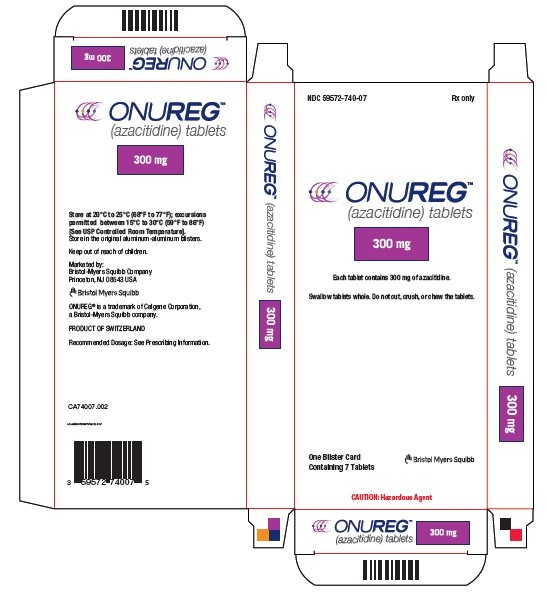
Onureg 300 mg film-coated tablets are oval-shaped, brown tablets with
“300” imprinted on one side and “ONU” on the other side.
The film-coated tablets are packaged in aluminium foil blisters.
Each pack contains 7 or 14 film-coated tablets. Not all pack sizes
may be marketed.
Marketing authorisation holder
Bristol-Myers Squibb Pharma EEIG
Plaza 254
Blanchardstown Corporate Park 2
Dublin 15, D15 T867
Ireland
Manufacturer
Celgene Distribution B.V.
Orteliuslaan 1000
3528 BD Utrecht
Netherlands
Other sources of information
More detailed information on this medicine is available on the website of the European
Medicines Agency, http://www.ema.europa.eu .

Nie jesteś pewien, czy ten lek jest odpowiedni dla ciebie?
Omów swoje objawy i leczenie z lekarzem online.

Zacząłeś przyjmować lek i masz pytania?
Omów swoje objawy i leczenie z lekarzem online.
- Kraj rejestracji
- Postać farmaceutycznaFilm-coated tablet, 200 MG
- Kod ATCL01BC07
- Substancja czynna
- Wymaga receptyTak
- Producent
- Te treści mają charakter wyłącznie informacyjny i nie zastępują konsultacji lekarskiej.
- Zamienniki ONUREGPostać farmaceutyczna: Powder for injectable suspension, 25 MG/MLSubstancja czynna: azacitidineProducent: ACCORD HEALTHCARE, S.L.U.Bez receptyPostać farmaceutyczna: Powder for injectable suspension, 25 MG/MLSubstancja czynna: azacitidineProducent: BETAPHARM ARZNEIMITTEL GMBHBez receptyPostać farmaceutyczna: Powder for injectable suspension, 25 mg/mlSubstancja czynna: azacitidineProducent: FRESENIUS KABI DEUTSCHLAND GMBHBez recepty
Odpowiedniki ONUREG w innych krajach
Leki z tą samą substancją czynną dostępne w innych krajach.
Odpowiednik ONUREG w Hiszpania
Odpowiednik ONUREG w Polska
Odpowiednik ONUREG w Ukraina
Uzyskaj receptę na ONUREG online
Wypełnij 2-minutowy formularz
Opisz swoje objawy, historię choroby i lek, o który prosisz.
Wybierz lekarza lub pozwól nam przydzielić
Wybierz specjalistę lub dopasujemy Cię do najbliższego dostępnego lekarza.
Lekarz analizuje Twój przypadek
Zazwyczaj w ciągu 30 minut. Może zadawać dodatkowe pytania przez czat.
Odbierz w dowolnej aptece
Recepta elektroniczna wysłana na Twój e-mail — ważna w całej Polsce.
Często zadawane pytania
ONUREG wymaga recepty w Włochy. Możesz skonsultować się z lekarzem online, aby sprawdzić, czy ten lek może być odpowiedni w Twojej sytuacji.
Substancją czynną w ONUREG jest azacitidine. Informacja ta pomaga rozpoznać leki o tym samym składzie, ale pod różnymi nazwami handlowymi.
ONUREG jest produkowany przez BRISTOL-MYERS SQUIBB PHARMA EEIG. Nazwy handlowe i opakowania mogą się różnić w zależności od dystrybutora.
Lekarze, tacy jak Lekarze rodzinni, Psychiatrzy, Dermatolodzy, Kardiolodzy, Endokrynolodzy, Gastroenterolodzy, Pulmonolodzy, Nefrolodzy, Reumatolodzy, Hematolodzy, Zakaźnicy, Alergolodzy, Geriatrzy, Pediatrzy, Onkolodzy, mogą ocenić, czy stosowanie ONUREG jest odpowiednie w Twoim przypadku, w zależności od sytuacji klinicznej i lokalnych przepisów. Możesz umówić konsultację online, aby omówić objawy i możliwe dalsze kroki.
Polska posiada dobrze rozwiniętą infrastrukturę ochrony zdrowia w dużych miastach, takich jak Warszawa, Kraków, Wrocław i Gdańsk. Apteki są łatwo dostępne i działają zgodnie z obowiązującymi przepisami, zapewniając dostęp do leków na receptę.
Możesz kupić ONUREG w Warszawie, Krakowie, Wrocławiu lub Gdańsku w każdej aptece, posiadając ważną receptę.
Aby uzyskać receptę, możesz skorzystać z Oladoctor:
Inne leki zawierające tę samą substancję czynną (azacitidine) to m.in. ATSAKITIDINA AKKORD, ATSAKITIDINA BETAPARM, ATSAKITIDINA KABI. Mogą one różnić się nazwą handlową lub postacią, ale zawierają ten sam składnik terapeutyczny. Przed zmianą lub rozpoczęciem nowego leku skonsultuj się z lekarzem.
