



NEXOBRID 2 Гель

Рассмотрение рецепта онлайн
Врач рассмотрит ваш случай и примет решение о назначении рецепта, если это медицински оправдано.

Поговорите с врачом об этом лекарстве
Обсудите симптомы и возможные дальнейшие шаги на онлайн-консультации.



Инструкция по применению NEXOBRID
Содержание инструкции
NexoBrid 2 g powder and gel for gel
concentrate of proteolytic enzymes enriched with bromelain
Read this leaflet carefully before using this medicine as it contains important
information for you.
- Keep this leaflet. You may need to read it again.
- If you have any questions, ask your doctor.
- If you or the child experiences any side effects, including those not listed in this leaflet, contact your doctor. See section 4.
Contents of this leaflet:
- 1. What NexoBrid is and what it is used for
- 2. What you need to know before NexoBrid is used
- 3. How to use NexoBrid
- 4. Possible side effects
- 5. How to store NexoBrid
- 6. Contents of the pack and other information
1. What is NexoBrid and what is it used for
What is NexoBrid
NexoBrid contains a mixture of enzymes, called “concentrated proteolytic enzymes enriched with
bromelain”, which is derived from an extract of the pineapple stem.
What is NexoBrid used for
NexoBrid is used in adults, adolescents and children of all ages to remove
burned tissue from deep or partially deep skin burns.
The use of NexoBrid may reduce the need for, or extent of, surgical removal of burned tissue and/or skin grafting.
2. What you need to know before NexoBrid is used
NexoBrid must not be used:
- if you or the child are allergic to bromelain
- if you or the child are allergic to pineapple
- if you or the child are allergic to papaya/papain
- if you or the child are allergic to any of the other ingredients of the powder or gel (listed in section 6).
Warnings and precautions
Talk to your doctor or nurse before using NexoBrid if:
- you or the child have a heart condition;
- you or the child have diabetes;
- you or the child have an active stomach ulcer (peptic ulcer);
- you or the child have a vascular disease (with vascular occlusion);
- you or the child have dilated veins in the area near the burn;
- you or the child have implants, pacemakers or vascular shunts;
- you or the child have bleeding problems or you or the child are taking medicines to thin the blood;
- your wound(s) or that of the child have come into contact with chemicals or other hazardous substances;
- you or the child have a lung disease;
- your lungs or those of the child have been, or could have been, damaged by inhalation of smoke;
- you or the child are allergic to latex, bee stings or olive pollen. In this case, you or the child may develop allergic reactions to NexoBrid. Allergic reactions can cause, for example, difficulty breathing, skin swelling, hives, other skin reactions, skin redness, low blood pressure, rapid heartbeat and abdominal discomfort or a combination of these effects. If you or the child notice the appearance of any of these signs or symptoms, inform your doctor or healthcare professional immediately. Allergic reactions can be serious and require medical treatment. If it comes into contact with the skin, wash NexoBrid off with water. This reduces the likelihood of an allergic reaction to NexoBrid.
The use of NexoBrid to remove burned tissue may cause fever, inflammation or infection
of the wound and possibly generalized infection. You or the child may be subject to
regular checks to verify these conditions and may receive medicines to prevent or
treat infections.
NexoBrid may reduce the blood's ability to clot, increasing the risk of
bleeding. NexoBrid should be used with caution if you or the child are being treated with
medicines that reduce the blood's ability to clot (called anticoagulants), or in case of
a general tendency to bleed, stomach ulcer, blood poisoning or other conditions
that could cause bleeding. After treatment with NexoBrid, the doctor may
check blood clotting levels.
Direct contact of NexoBrid with the eyes must be avoided. If NexoBrid comes into contact with
the eyes, wash them with plenty of water for at least 15 minutes.
To prevent wound healing problems, the burn wound treated will be covered as
quickly as possible with temporary or permanent skin substitutes or with dressings.
NexoBrid must not be used on chemical burns, electrical burns, foot burns in
diabetic patients and patients with obstructive vascular disease, on contaminated wounds and wounds in which
NexoBrid may come into contact with foreign materials (e.g. implants, pacemakers and shunts) or
large vessels, eyes or other important parts of the body. NexoBrid should be used with caution in areas
with varicose veins (dilated and tortuous veins), to prevent the risk of bleeding from these veins.
Other medicines and NexoBrid
Tell your doctor if you or the child are taking, have recently taken or may take
any other medicine.
The doctor will pay attention and monitor any signs of reduced blood clotting or
bleeding when prescribing other medicines that affect clotting, as
NexoBrid can reduce blood clotting.
NexoBrid may:
- increase the effects of some medicines that are inactivated by liver enzymes called CYP2C8 and CYP2C9. This happens because NexoBrid can be absorbed from the burn wound into the bloodstream. These medicines include:
- amiodarone (used to treat some forms of irregular heartbeat),
- amodiaquine and chloroquine (used to treat malaria and some forms of inflammation),
- fluvastatin (used to treat high cholesterol),
- pioglitazone, repaglinide, tolbutamide and glipizide (used to treat diabetes),
- paclitaxel (used to treat cancer),
- torasemide (used to increase urine flow),
- ibuprofen (used to treat fever, pain and some forms of inflammation),
- losartan (used to treat high blood pressure),
- celecoxib (used to treat some forms of inflammation),
- warfarin (used to reduce blood clotting) and
- phenytoin (used to treat epilepsy)
- intensify your or the child's reaction to the anticancer medicines fluorouracil and vincristine
- cause an undesirable drop in blood pressure when you or the child are being treated with medicines called ACE inhibitors, used to treat high blood pressure and other conditions
- increase drowsiness when used together with medicines that cause drowsiness. These medicines include, for example, sleeping pills, so-called tranquilizers, some painkillers and antidepressants
- silver sulfadiazine or povidone-iodine on the wound may reduce the effectiveness of the medicine.
If you are not sure whether you or the child are taking any of the medicines mentioned above, consult your doctor
before NexoBrid is used.
Pregnancy and breastfeeding
The use of NexoBrid during pregnancy is not recommended.
As a precaution, do not breastfeed for at least 4 days after applying NexoBrid.
If you are pregnant, breastfeeding, or suspect or are planning a
pregnancy, talk to your doctor or pharmacist before using this medicine.
3. How to use NexoBrid
NexoBrid must be used exclusively by specialists in burn centers. It will be prepared
directly before use and applied by a doctor or another healthcare professional.
2 g of NexoBrid powder mixed with 20 g of gel should be applied with a thickness of
1.5-3 mm to a burn area equal to 1 percent of the body surface area of an adult patient.
The gel should be left in place for 4 hours and then removed. A subsequent second
application is not recommended.
- NexoBrid must not be applied to more than 15% of the total body surface area in adults and children/adolescents aged between 4 and 18 years.
- This medicine must not be applied to more than 10% of the total body surface area in children aged between 0 and 3 years.
in the section intended for medical or healthcare professionals.
Before being applied to a burn wound, NexoBrid powder is mixed into a gel and must
be used within 15 minutes of mixing.
- NexoBrid will be applied to a clean, debrided, and moist wound area.
- Other medicines (such as silver sulfadiazine or povidone-iodine) will be removed from the wound area before the application of NexoBrid.
- Before the application of NexoBrid, a gauze pad soaked in antibacterial solution will be applied for 2 hours.
- At least 15 minutes before the application of NexoBrid, and before removal, you or the child will be given appropriate medications to prevent and treat pain.
- After the removal of NexoBrid and dead tissue from the wound, a gauze pad soaked in antibacterial solution will be applied for another 2 hours.
- The vial containing the powder, the gel bottle, and the gel prepared after mixing are for single use only.
If you use too much NexoBrid
If too much NexoBrid gel is applied to a burn wound, the excess gel can be removed.
If you have any doubts about the use of this medicine, ask your doctor.
4. Possible side effects
Like all medicines, this medicine can cause side effects, although not everybody gets them.
If you or the child should notice the appearance of any of these signs or
symptoms, inform your doctor or healthcare professional immediately.
Allergic reactions to NexoBrid can occur and cause, for example, difficulty in
breathing, swelling of the skin, hives, skin redness, low blood pressure,
rapid heart rate and nausea/vomiting/stomach cramps or a combination of these effects.
Very common(affects more than 1 in 10 people)
- Fever
Common(affects less than 1 in 10 people)
- Pain in the area of the treated burn wound (even if medicines are used to prevent or reduce the pain caused by the removal of the burned tissue)
- Burn wound infection, including skin infection around the wound (cellulitis)
- Wound complications, including increased wound depth, wound opening, drying and cracking of the wound, inadequate healing of skin grafts
- Rash or redness in the area around the burn wound
- Non-serious allergic reactions, such as rash
- Rapid heartbeat
- Itching in the area of the burn wound. Itching in the area of the burn wound is very common as part of the normal burn healing process
Uncommon
- Bruising in the area of the wound
Frequency not known(the frequency cannot be estimated from the available data)
- Serious allergic reactions including anaphylaxis
Reporting of side effects
If you or the child experiences any side effects, including those not listed in this
leaflet, tell your doctor or nurse. You can also report side effects
directly through the national reporting system in Appendix V.
By reporting side effects you can help provide more information on the safety of
this medicine.
5. How to store NexoBrid
Keep this medicine out of the sight and reach of children.
Do not use NexoBrid after the expiry date which is stated on the label of the vial, bottle and
carton after “Exp.”. The expiry date refers to the last day of that month.
Store and transport in a refrigerator at 2 °C – 8 °C.
NexoBrid must be stored in an upright position to keep the gel at the bottom of the vial and
in the original packaging to protect the medicine from light.
Do not freeze.
NexoBrid must be used within 15 minutes of mixing the powder with the gel.
Do not dispose of any medicine in wastewater or household waste. Ask your pharmacist how to
dispose of medicines you no longer use. This will help protect the environment.
6. Contents of the pack and other information
What NexoBrid contains
- The active substance (in the vial powder) is a concentrate of proteolytic enzymes enriched with bromelain: one vial contains 2 g, corresponding, after mixing, to 0.09 g of concentrate of proteolytic enzymes enriched with bromelain.
- The other ingredients are: for the powder: ammonium sulfate and acetic acid and for the gel: carbomer 980, disodium phosphate anhydrous, sodium hydroxide and water for injections.
Description of the appearance of NexoBrid and contents of the pack
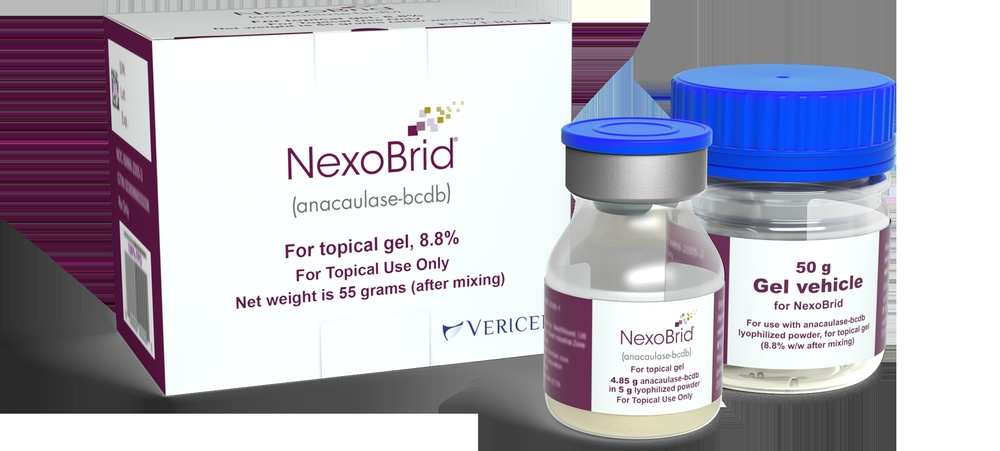
This medicinal product is supplied in the form of powder and gel for gel (powder in a vial (2 g) and gel in
a bottle (20 g)), pack size of 1 (one pack comprises one vial of powder and 1 bottle of
gel).
The colour of the powder varies from ivory white to light brown and the gel is transparent and colourless.
For further information on this medicinal product, contact the marketing authorisation holder.
Marketing Authorisation Holder
MediWound Germany GmbH
Hans-Sachs-Strasse 100
65428 Rüsselsheim
Germany
e-mail: [email protected]
Manufacturer
Diapharm GmbH & Co. KG
Am Mittelhafen 56 48155 Münster
Germany
Other sources of information
More detailed information on this medicinal product is available on the website of the European
Medicines Agency: http://www.ema.europa.eu . Furthermore, links to other websites on rare diseases
and related therapeutic treatments are provided.
---------------------------------------------------------------------------------------------------------------------------
The following information is intended exclusively for healthcare professionals:
Preparation and administration
From a microbiological point of view and as the enzymatic activity of the product decreases
progressively after mixing, the reconstituted product must be used
immediately after preparation (within 15 minutes).
NexoBrid must be applied to a moist, clean, eschar-free wound area (from which blisters have been
removed).
Medicinal products applied topically (such as silver sulfadiazine or povidone-iodine) to the wound,
must be removed and the wound must be cleaned before the application of NexoBrid.
Patient and wound area preparation
- In each session, a total wound area of no more than 15% of the TBSA may be treated with NexoBrid in adults and children/adolescents aged > 3 years; in children aged between 0 and 3 years, an area of no more than 10% of the TBSA may be treated.
- Enzymatic debridement is a painful procedure that requires adequate analgesia and/or anaesthesia.
- At least 15 minutes before the application of NexoBrid, preventive pain treatment should be started based on common practices for large dressing changes.
- Thoroughly clean the wound and remove the superficial layer of keratin or blisters from its area, as keratin isolates the eschar from direct contact with NexoBrid and prevents its removal.
- Apply a gauze soaked in antibacterial solution for 2 hours.
- Remove all topical antibacterial medicinal products before applying NexoBrid. Remaining antibacterial medicinal products may limit the activity of NexoBrid, reducing its efficacy.
- Surround the area from which the eschar is to be removed with an adhesive barrier formed by a sterile paraffin-based ointment, applying it a few centimetres outside the area to be treated (using a dispenser). The paraffin layer must not come into contact with the area to be treated to avoid covering the eschar, isolating it from direct contact with NexoBrid. To prevent irritation of the abraded skin through inadvertent contact with NexoBrid, and to prevent bleeding, acute lesions such as lacerations or escharotic incisions may be protected with a layer of sterile greasy ointment (e.g. with petrolatum gauze). The medicinal product must be used with caution in areas with varicose veins, to prevent erosion of the vessel wall and the risk of bleeding.
- Spray a sterile isotonic solution of sodium chloride 9 mg/mL (0.9%) onto the burn wound. The wound must be kept moist during the application procedure.
Preparation of NexoBrid gel (mixing the powder with the gel)
- NexoBrid powder and the gel are sterile. Use an aseptic technique when mixing NexoBrid powder with the gel. The powder must not be inhaled. Gloves, protective clothing, safety glasses and a surgical mask must be worn.
- Open the vial containing NexoBrid powder by carefully tearing off the aluminium closure cap and removing the rubber stopper.
- When opening the gel bottle, verify that the tamper-evident ring is detached from the bottle cap. If the tamper-evident ring has already been separated from the cap before opening, discard the gel bottle and use a new one.
- Transfer NexoBrid powder into the corresponding gel bottle.
- Thoroughly mix NexoBrid powder and the gel until a uniform mixture is obtained, ranging in colour from light brown to brown. To achieve this, NexoBrid powder and the gel usually need to be mixed for 1-2 minutes.
- Prepare the NexoBrid gel near the patient’s bed.
Application of NexoBrid
- Moisten the area to be treated by applying sterile physiological solution to the area outlined by an adhesive barrier made with greasy ointment.
- Within 15 minutes of mixing, NexoBrid must be applied topically to the burn wound, to a thickness of 1.5-3 millimetres.
- The wound must then be covered with a sterile occlusive film dressing that adheres to the sterile adhesive barrier applied according to the previous instructions (see Patient and wound area preparation). The NexoBrid gel must fill the entire occlusive dressing under which there must be no air. Gently pressing the occlusive dressing at the point of contact with the adhesive barrier ensures adhesion between the occlusive film and the barrier so that NexoBrid is fully included in the area to be treated.
- The dressed wound must be covered with a soft, thick, non-constricting dressing, held in place by a bandage.
- The dressing must remain in place for 4 hours.
Removal of NexoBrid
- Removal of NexoBrid is a painful procedure that requires adequate analgesia and/or anaesthesia. Appropriate preventive analgesic medicinal products should be administered at least 15 minutes before the application of NexoBrid.
- After 4 hours of treatment with NexoBrid, remove the occlusive dressing using aseptic techniques.
- The adhesive barrier must be removed using a sterile instrument with rounded edges (e.g., a tongue depressor).
- Remove the dissolved eschar from the wound, removing it with a sterile instrument with rounded edges.
- Thoroughly clean the wound first with a dry, sterile, large-sized gauze or cloth, then with a sterile gauze or cloth soaked in a sterile isotonic solution of sodium chloride 9 mg/mL (0.9%). Rub the treated area until a pink surface with punctate bleeding or whitish tissue appears. Rubbing does not remove the eschar adhering to areas where it has not dissolved.
- Apply a gauze soaked in antibacterial solution for another 2 hours.
Wound care after debridement
- Immediately cover the debrided area with skin substitutes or temporary or permanent dressings, to prevent drying and/or the formation of pseudo-eschar and/or infections.
- Before applying a permanent skin covering or temporary skin substitute to a recently enzymatically debrided area, a wet-dry dressing should be applied.
- Before applying grafts or primary dressings, clean and renew the debrided bed, e.g. by brushing or scraping, to allow adhesion of the dressing.
- Wounds with areas of deep and full-thickness burns should be auto-grafted as quickly as possible after debridement with NexoBrid. Consideration should also be given to placing permanent skin coverings (e.g. an autograft) on deep partial-thickness wounds immediately after debridement with NexoBrid.
Recommendations for safe handling
Each vial, gel or reconstituted gel of NexoBrid must be used for a single patient.
Cases of occupational exposure to bromelain resulting in
sensitisation have been reported. Sensitisation may have occurred due to inhalation of
bromelain powder. Allergic reactions to bromelain include anaphylactic and other immediate-type
reactions with manifestations such as bronchospasm, angioedema, urticaria and mucosal and
gastrointestinal reactions. When mixing NexoBrid powder with the gel, appropriate precautions for
handling must be taken, wearing gloves, protective clothing, safety glasses and a surgical mask. The
powder must not be inhaled.
Avoid accidental exposure to the eyes. In case of eye exposure, rinse them with
plenty of water for at least 15 minutes. In case of skin exposure, wash NexoBrid off with water.
Disposal
Unused medicinal product and waste material derived from such medicinal product must be disposed of in
accordance with local regulations.
NexoBrid 5 g powder and gel
concentrated proteolytic enzymes enriched with bromelain
Read this leaflet carefully before using this medicine as it contains important
information for you.
- Keep this leaflet. You may need to read it again.
- If you have any questions, ask your doctor.
- If you or your child experiences any side effects, including those not listed in this leaflet, tell your doctor. See section 4.
Contents of this leaflet:
- 1. What NexoBrid is and what it is used for
- 2. What you need to know before NexoBrid is used
- 3. How to use NexoBrid
- 4. Possible side effects
- 5. How to store NexoBrid
- 6. Contents of the pack and other information
1. What is NexoBrid and what is it used for
What is NexoBrid
NexoBrid contains a mixture of enzymes, called “concentrated proteolytic enzymes enriched with
bromelain”, which is derived from an extract of the pineapple stem.
What is NexoBrid used for
NexoBrid is used in adults, adolescents and children of all ages to remove
burned tissue from deep or partially deep skin burns.
The use of NexoBrid may reduce the need for, or extent of, surgical removal of burned tissue and/or skin grafting.
2. What you need to know before NexoBrid is used
NexoBrid must not be used:
- if you or the child are allergic to bromelain
- if you or the child are allergic to pineapple
- if you or the child are allergic to papaya/papain
- if you or the child are allergic to any of the other ingredients of the powder or gel (listed in section 6).
Warnings and precautions
Talk to your doctor or nurse before using NexoBrid if:
- you or the child have a heart condition;
- you or the child have diabetes;
- you or the child have an active stomach ulcer (peptic ulcer);
- you or the child have a vascular disease (with vascular occlusion);
- you or the child have dilated veins in the area near the burn;
- you or the child have implants, pacemakers or vascular shunts;
- you or the child have bleeding problems or you or the child are taking medicines to thin the blood;
- your wound(s) or that of the child have come into contact with chemicals or other hazardous substances;
- you or the child have a lung disease;
- your lungs or those of the child have been, or could have been, damaged by inhalation of smoke;
- you or the child are allergic to latex, bee stings or olive pollen. In this case, you or the child may develop allergic reactions to NexoBrid. Allergic reactions can cause, for example, difficulty breathing, skin swelling, hives, other skin reactions, skin redness, low blood pressure, rapid heart rate and abdominal discomfort or a combination of these effects. If you or the child notice the appearance of any of these signs or symptoms, inform your doctor or healthcare professional immediately. Allergic reactions can be severe and require medical treatment. If it comes into contact with the skin, wash NexoBrid away with water. This reduces the likelihood of an allergic reaction to NexoBrid.
The use of NexoBrid to remove burned tissue may cause fever, inflammation or infection
of the wound and possibly generalized infection. You or the child may undergo
regular checks to verify these conditions and may receive medicines to prevent or
treat infections.
NexoBrid may reduce the blood's ability to clot, increasing the risk of
bleeding. NexoBrid should be used with caution if you or the child are being treated with
medicines that reduce the blood's ability to clot (called anticoagulants), or in case of
a general tendency to bleed, stomach ulcer, blood poisoning or other conditions
that could cause bleeding. After treatment with NexoBrid, the doctor may
check blood clotting levels.
Direct contact of NexoBrid with the eyes must be avoided. If NexoBrid comes into contact with
the eyes, wash them with plenty of water for at least 15 minutes.
To prevent wound healing problems, the treated burn wound will be covered as
quickly as possible with temporary or permanent skin substitutes or with dressings.
NexoBrid must not be used on chemical burns, electrical burns, foot burns in
diabetic patients and patients with obstructive vascular disease, on contaminated wounds and wounds in which
NexoBrid may come into contact with foreign materials (e.g. implants, pacemakers and shunts) or
large vessels, eyes or other important parts of the body. NexoBrid should be used with caution in areas
with varicose veins (dilated and tortuous veins), to prevent the risk of bleeding from these veins.
Other medicines and NexoBrid
Tell your doctor if you or the child are taking, have recently taken or may take
any other medicine.
The doctor will pay attention and monitor for any signs of reduced blood clotting or
bleeding when prescribing other medicines that affect clotting, as
NexoBrid can reduce blood clotting.
NexoBrid may:
- increase the effects of some medicines that are inactivated by liver enzymes called CYP2C8 and CYP2C9. This happens because NexoBrid can be absorbed from the burn wound into the bloodstream. These medicines include:
- amiodarone (used to treat some forms of irregular heartbeat),
- amodiaquine and chloroquine (used to treat malaria and some forms of inflammation),
- fluvastatin (used to treat high cholesterol),
- pioglitazone, repaglinide, tolbutamide and glipizide (used to treat diabetes),
- paclitaxel (used to treat cancer),
- torasemide (used to increase urine flow),
- ibuprofen (used to treat fever, pain and some forms of inflammation),
- losartan (used to treat high blood pressure),
- celecoxib (used to treat some forms of inflammation),
- warfarin (used to reduce blood clotting) and
- phenytoin (used to treat epilepsy)
- intensify your or the child's reaction to the anticancer medicines fluorouracil and vincristine
- cause an undesirable drop in blood pressure when you or the child are being treated with medicines called ACE inhibitors, used to treat high blood pressure and other conditions
- increase drowsiness when used together with medicines that cause drowsiness. These medicines include, for example, sleeping pills, so-called tranquilizers, some painkillers and antidepressants
- silver sulfadiazine or povidone-iodine on the wound may reduce the effectiveness of the medicine.
If you are not sure if you or the child are taking any of the medicines mentioned above, consult your doctor
before NexoBrid is used.
Pregnancy and breastfeeding
The use of NexoBrid during pregnancy is not recommended.
As a precaution, do not breastfeed for at least 4 days after applying NexoBrid.
If you are pregnant, breastfeeding, or suspect or are planning a
pregnancy, talk to your doctor or pharmacist before using this medicine.
3. How to use NexoBrid
NexoBrid must be used exclusively by specialists in burn centers. It will be prepared
directly before use and applied by a doctor or another healthcare professional.
5 g of NexoBrid powder mixed with 50 g of gel should be applied to a thickness of 1.5-3 mm
to a burned area equal to 2.5 percent of the body surface area of an adult patient.
The gel should be left in place for 4 hours and then removed. A subsequent second
application is not recommended.
- NexoBrid should not be applied to more than 15% of the total body surface area in adults and children/adolescents aged between 4 and 18 years.
- This medicine should not be applied to more than 10% of the total body surface area in children aged between 0 and 3 years.
in the section intended for medical or healthcare professionals.
Before being applied to a burn wound, NexoBrid powder is mixed into a gel and must
be used within 15 minutes of mixing.
- NexoBrid will be applied to a clean, debrided, and moist wound area.
- Other medicines (such as silver sulfadiazine or povidone-iodine) will be removed from the wound area before the application of NexoBrid.
- Before the application of NexoBrid, a gauze pad soaked in antibacterial solution will be applied for 2 hours.
- At least 15 minutes before the application of NexoBrid, and before removal, appropriate medications will be given to you or the child to prevent and treat pain.
- After the removal of NexoBrid and dead tissue from the wound, a gauze pad soaked in antibacterial solution will be applied for another 2 hours.
- The vial containing the powder, the gel bottle, and the gel prepared after mixing are for single use only.
If you use too much NexoBrid
If too much NexoBrid gel is applied to a burn wound, excess gel can be removed.
If you have any questions about the use of this medicine, ask your doctor.
4. Possible side effects
Like all medicines, this medicine can cause side effects, although not everybody gets them.
If you or the child notice any of these signs or symptoms, tell your doctor or healthcare professional immediately.
Allergic reactions to NexoBrid can occur and cause, for example, difficulty in
breathing, swelling of the skin, hives, redness of the skin, low blood pressure,
rapid heart rate and nausea/vomiting/stomach cramps or a combination of these effects.
Very common(affects more than 1 in 10 people)
- Fever
Common(affects less than 1 in 10 people)
- Pain in the treated burn wound area (even if medicines are used to prevent or reduce the pain caused by the removal of the burned tissue)
- Burn wound infection, including skin infection around the wound (cellulitis)
- Wound complications, including increased wound depth, wound opening, drying and cracking of the wound, inadequate healing of skin grafts
- Rash or redness in the area around the burn wound
- Non-serious allergic reactions, such as rash
- Rapid heartbeat
- Itching in the burn wound area. Itching in the burn wound area is very common as part of the normal burn healing process
Uncommon
- Bruising in the wound area
Frequency not known(the frequency cannot be estimated from the available data)
- Serious allergic reactions including anaphylaxis
Reporting of side effects
If you or the child gets any side effect, talk to your doctor or nurse. You can also report side effects
directly through the national reporting system in Appendix V.
By reporting side effects you can help provide more information on the safety of
this medicine.
5. How to store NexoBrid
Keep this medicine out of the sight and reach of children.
Do not use NexoBrid after the expiry date stated on the label of the vial, bottle and
carton after “Exp.”. The expiry date refers to the last day of that month.
Store and transport in a refrigerator at 2 °C – 8 °C.
NexoBrid must be stored in an upright position to keep the gel at the bottom of the vial and
in the original packaging to protect the medicine from light.
Do not freeze.
NexoBrid must be used within 15 minutes of mixing the powder with the gel.
Do not dispose of any medicine in wastewater or household waste. Ask your pharmacist how to
dispose of medicines you no longer use. This will help protect the environment.
6. Contents of the pack and other information
What NexoBrid contains
- The active substance (in the vial powder) is a concentrate of proteolytic enzymes enriched with bromelain: one vial contains 5 g, corresponding, after mixing, to 0.09 g of concentrate of proteolytic enzymes enriched with bromelain.
- The other ingredients are: for the powder: ammonium sulfate and acetic acid and for the gel: carbomer 980, disodium phosphate anhydrous, sodium hydroxide and water for injections.
Description of the appearance of NexoBrid and contents of the pack
NexoBrid is supplied as powder and gel for gel (powder in a vial (5 g) and gel in a
bottle (50 g)), pack size of 1 (one pack comprises one vial of powder and 1 bottle of
gel).
The colour of the powder varies from ivory white to light brown and the gel is transparent and colourless.
For further information on this medicinal product, contact the marketing authorisation holder.
Marketing Authorisation Holder
MediWound Germany GmbH
Hans-Sachs-Strasse 100
65428 Rüsselsheim
Germany
e-mail: [email protected]
Manufacturer
Diapharm GmbH & Co. KG
Am Mittelhafen 56 48155 Münster
Germany
Other sources of information
More detailed information on this medicinal product is available on the website of the European
Medicines Agency: http://www.ema.europa.eu. Furthermore, links to other websites on rare diseases
and related therapeutic treatments are provided.
---------------------------------------------------------------------------------------------------------------------------
The following information is intended exclusively for healthcare professionals:
Preparation and administration
From a microbiological point of view and since the enzymatic activity of the product decreases
progressively following mixing, the reconstituted product must be used
immediately after preparation (within 15 minutes).
NexoBrid must be applied to a moist, clean, keratin-free wound area (from which blisters have been
removed).
Medicinal products applied topically (such as silver sulfadiazine or povidone-iodine) to the wound,
must be removed and the wound must be cleaned before applying NexoBrid.
Patient and wound area preparation
- In each session, a total wound area of no more than 15% of the TBSA can be treated with NexoBrid in adults and children/adolescents aged > 3 years; in children aged between 0 and 3 years, an area of no more than 10% of the TBSA can be treated.
- Enzymatic debridement is a painful procedure that requires adequate analgesia and/or anaesthesia.
- At least 15 minutes before applying NexoBrid, preventive pain treatment should be started based on common practices for large dressing changes.
- Thoroughly clean the wound and remove the superficial layer of keratin or blisters from its area, as keratin isolates the eschar from direct contact with NexoBrid and prevents its removal.
- Apply a gauze soaked in antibacterial solution for 2 hours.
- Remove all topical antibacterial medicinal products before applying NexoBrid. Remaining antibacterial medicinal products may limit the activity of NexoBrid, reducing its efficacy.
- Surround the area from which the eschar is to be removed with an adhesive barrier formed by a sterile paraffin-based ointment, applying it a few centimetres outside the area to be treated (using a dispenser). The paraffin layer must not come into contact with the area to be treated to avoid covering the eschar, isolating it from direct contact with NexoBrid. To prevent irritation of the abraded skin through inadvertent contact with NexoBrid, and to prevent bleeding, acute lesions such as lacerations or escharotic incisions may be protected with a layer of sterile fatty ointment (e.g. with petrolatum gauze). The medicinal product must be used with caution in areas with varicose veins, to prevent erosion of the vessel wall and the risk of bleeding.
- Spray a sterile isotonic solution of sodium chloride 9 mg/mL (0.9%) onto the burn wound. The wound must be kept moist during the application procedure.
Preparation of NexoBrid gel (mixing the powder with the gel)
- NexoBrid powder and the gel are sterile. Use an aseptic technique when mixing NexoBrid powder with the gel. The powder must not be inhaled. Gloves, protective clothing, safety glasses and a surgical mask must be worn.
- Open the vial containing NexoBrid powder by carefully tearing off the aluminium closure cap and removing the rubber stopper.
- When opening the gel bottle, verify that the tamper-evident ring detaches from the bottle cap. If the tamper-evident ring has already been separated from the cap before opening, discard the gel bottle and use another new one.
- Transfer NexoBrid powder into the corresponding gel bottle.
- Thoroughly mix NexoBrid powder and the gel until a uniform mixture is obtained, ranging in colour from light brown to brown. To achieve this, NexoBrid powder and the gel usually need to be mixed for 1-2 minutes.
- Prepare the NexoBrid gel near the patient’s bed.
Application of NexoBrid
- Moisten the area to be treated by applying sterile physiological solution to the area delineated by an adhesive barrier made with fatty ointment.
- Within 15 minutes of mixing, NexoBrid must be applied topically to the burn wound, in a thickness of 1.5-3 millimetres.
- The wound must then be covered with a sterile occlusive film dressing that adheres to the sterile adhesive barrier applied according to the previous instructions (see Patient and wound area preparation). The NexoBrid gel must fill the entire occlusive dressing under which there must be no air. Gently pressing the occlusive dressing at the point of contact with the adhesive barrier ensures adhesion between the occlusive film and the barrier so that NexoBrid is totally included in the area to be treated.
- The medicated wound must be covered with a soft, thick, non-restrictive dressing, held in place by a bandage.
- The dressing must remain in place for 4 hours.
Removal of NexoBrid
- Removal of NexoBrid is a painful procedure that requires adequate analgesia and/or anaesthesia. Appropriate preventive analgesic medicinal products must be administered at least 15 minutes before applying NexoBrid.
- After 4 hours of treatment with NexoBrid, remove the occlusive dressing using aseptic techniques.
- The adhesive barrier must be removed using a sterile instrument with rounded edges (e.g., a tongue depressor).
- Remove the dissolved eschar from the wound, removing it with a sterile instrument with rounded edges.
- Thoroughly clean the wound first with a dry, sterile, large-size gauze or cloth, then with a sterile gauze or cloth soaked in a sterile isotonic solution of sodium chloride 9 mg/mL (0.9%). Rub the treated area until a pink surface with pinpoint bleeding or whitish tissue appears. Rubbing does not remove the eschar adhering to areas where it has not dissolved.
- Apply a gauze soaked in antibacterial solution for another 2 hours.
Wound care after debridement
- Immediately cover the debrided area with skin substitutes or temporary or permanent dressings, to prevent drying and/or the formation of pressure ulcers and/or infections.
- Before applying a permanent skin covering or a temporary skin substitute to a recently enzymatically debrided area, a wet-dry dressing should be applied.
- Before applying grafts or primary dressings, clean and renew the debrided bed, e.g. by brushing or scraping, to allow adhesion of the dressing.
- Wounds with areas with deep and full-thickness burns should be auto-grafted as quickly as possible after debridement with NexoBrid. Placement of permanent skin coverings (e.g. an autograft) on deep partial-thickness wounds immediately after debridement with NexoBrid should also be considered.
Recommendations for safe handling
Each vial, gel or reconstituted gel of NexoBrid must be used for a single patient.
Cases of occupational exposure to bromelain with subsequent
sensitization have been reported. Sensitization may have occurred due to inhalation of
bromelain powder. Allergic reactions to bromelain include anaphylactic and other immediate-type reactions with manifestations such as bronchospasm, angioedema, urticaria and mucosal and
gastrointestinal reactions. When mixing NexoBrid powder with the gel, appropriate precautions for handling must be taken, wearing gloves, protective clothing, safety glasses and a surgical mask. The powder must not be inhaled.
Avoid accidental exposure to the eyes. In case of eye exposure, rinse them with
plenty of water for at least 15 minutes. In case of skin exposure, wash NexoBrid off with water.
Disposal
Unused medicinal product and waste derived from such medicinal product must be disposed of in accordance with
current local regulations.

Не уверены, подходит ли вам это лекарство?
Обсудите симптомы и варианты лечения с врачом онлайн.

Уже начали прием и появились вопросы?
Обсудите свое состояние и дальнейшие шаги с врачом онлайн.
- Страна регистрации
- Форма выпускаGel, 2 G
- Код АТХD03BA03
- Действующее вещество
- Отпускается по рецептуДа
- Производитель
- Информация на этой странице носит справочный характер и не является медицинской консультацией. Перед началом приема лекарства обязательно проконсультируйтесь с врачом.
- Аналоги NEXOBRIDФорма выпуска: Ointment, 1% + 60 IUДействующее вещество: collagenase, combinationsПроизводитель: SMITH & NEPHEW GMBHОтпускается по рецептуФорма выпуска: Cream, 30 GДействующее вещество: collagenase, combinationsПроизводитель: SMITH AND NEPHEW S.R.L.Отпускается без рецептаФорма выпуска: Cream, 0.2%Действующее вещество: Гиалуроновая кислотаПроизводитель: FIDIA FARMACEUTICI S.P.A.Отпускается без рецепта
Аналоги NEXOBRID в других странах
Лекарства с тем же действующим веществом, доступные в других странах.
Аналог NEXOBRID в Испания
Аналог NEXOBRID в Польша
Врачи онлайн по NEXOBRID
Обсудите применение NEXOBRID и возможные следующие шаги — по оценке врача.









Получите рецепт на NEXOBRID онлайн
Заполните форму за 2 минуты
Расскажите о симптомах, истории болезни и нужном препарате.
Выберите врача или мы назначим
Выберите специалиста или мы подберём ближайшего доступного врача.
Врач рассматривает ваш случай
Обычно в течение 30 минут. Может задать уточняющие вопросы в чате.
Получите в любой аптеке
Электронный рецепт отправляется на вашу почту — действителен по всей Польше.
Часто задаваемые вопросы
NEXOBRID требует рецепта в Италия. Вы можете уточнить у врача онлайн, подходит ли это лекарство для вашей ситуации.
Действующее вещество NEXOBRID — bromelains. Эта информация помогает определить лекарства с тем же составом под другими торговыми названиями.
NEXOBRID производится компанией MEDIWOUND GERMANY GMBH. Упаковка и торговое название могут отличаться в зависимости от дистрибьютора.
Врачи, включая Семейные врачи, Психиатры, Дерматологи, Кардиологи, Эндокринологи, Гастроэнтерологи, Пульмонологи, Нефрологи, Ревматологи, Гематологи, Инфекционисты, Аллергологи, Гериатры, Педиатры, Онкологи, могут оценить целесообразность применения NEXOBRID с учетом вашей ситуации и местных правил. Вы можете записаться на онлайн-консультацию, чтобы обсудить возможные варианты.
Польша имеет хорошо развитую систему здравоохранения в крупных городах, таких как Варшава, Краков, Вроцлав и Гданьск. Аптеки широко доступны и работают в соответствии с действующим законодательством, обеспечивая доступ к рецептурным препаратам.
Вы можете купить NEXOBRID в Варшаве, Кракове, Вроцлаве или Гданьске в любой аптеке при наличии действующего рецепта.
Чтобы получить рецепт, вы можете воспользоваться Oladoctor:
Другие лекарства с тем же действующим веществом (bromelains) включают IRUXOL, NORUXOL, KONNETTIVINA. Они могут отличаться торговым названием или формой выпуска, но содержат одинаковый терапевтический компонент. Перед изменением лечения рекомендуется проконсультироваться с врачом.
