



LUXTURNA 5 X 10^12 Инъекционный раствор

Рассмотрение рецепта онлайн
Врач рассмотрит ваш случай и примет решение о назначении рецепта, если это медицински оправдано.

Поговорите с врачом об этом лекарстве
Обсудите симптомы и возможные дальнейшие шаги на онлайн-консультации.



Инструкция по применению LUXTURNA
Содержание инструкции
Luxturna 5 × 10 vector genomes/mL concentrate and solvent for injectable solution
voretigene neparvovec
Medicinal product subject to additional monitoring. This will allow the rapid identification of
new safety information. You can contribute by reporting any adverse effects
experienced during the use of this medicine. See the end of section 4 for
information on how to report adverse effects.
Read this leaflet carefully before you are given this medicine because
it contains important information for you.
- Keep this leaflet. You may need to read it again.
- If you have any questions, ask your doctor or nurse.
- If any side effects occur, including those not listed in this leaflet, tell your doctor or nurse. See section 4.
Contents of this leaflet
- 1. What Luxturna is and what it is used for
- 2. What you need to know before you are given Luxturna
- 3. How Luxturna is administered
- 4. Possible side effects
- 5. How to store Luxturna
- 6. Contents of the pack and other information
1. What is Luxturna and what is it used for
Luxturna is a gene therapy product that contains the active substance voretigene neparvovec.
Luxturna is used for the treatment of adults and children with vision loss due to hereditary retinal
dystrophy caused by mutations in the RPE65gene. These mutations prevent the production of
a protein necessary for vision and therefore lead to vision loss and subsequent blindness.
The active substance contained in Luxturna, voretigene neparvovec, is a modified virus that contains
a working copy of the RPE65gene. After injection, it releases this gene into the cells of the retina,
the back layer of the eye that detects light. This allows the retina to produce the proteins
necessary for vision. The virus used to deliver the gene does not cause disease in humans.
Luxturna will only be given to you if genetic tests show that your vision loss is caused by the
mutation of the RPE65gene.
2. What you need to know before you are given Luxturna
You must not be given Luxturna
- if you are allergic to voretigene neparvovec or any of the other ingredients of this medicine (listed in section 6)
- if you have an eye infection
- if you have eye inflammation
If any of the above conditions apply to you, or if you are not sure, please speak to your doctor before receiving Luxturna.
Warnings and precautions
Before receiving treatment with Luxturna:
- Tell your doctor if you have signs of an eye infection or eye inflammation, such as redness of the eye, sensitivity to light, eye swelling or eye pain.
- Tell your doctor if you have an active infection of any kind. Your doctor may delay treatment until the infection has gone away, as this medicine may make it more difficult to clear up an infection. See also section 3.
After receiving Luxturna:
- Contact your doctor immediately if your eye or eyes become red, painful, sensitive to light, if you see flashes or floaters, or if you notice worsening or blurred vision.
- You should avoid air travel or other travel to high altitudes until advised by your doctor. During treatment with this medicine, your doctor introduces a gas bubble into your eye, which is slowly absorbed by the body. Until the bubble is completely absorbed, air travel or other travel to high altitudes may cause the bubble to expand and cause eye damage, including vision loss. Please speak to your doctor before travelling.
- You should avoid swimming due to an increased risk of eye infection. Please speak to your doctor before going swimming after receiving treatment with Luxturna.
- You should avoid strenuous physical activity due to an increased risk of eye injury. Please speak to your doctor before starting strenuous physical activity after receiving Luxturna.
- You may experience temporary visual disturbances, such as sensitivity to light and blurred vision. Tell your doctor about any visual disturbances that occur. Your doctor may be able to help reduce any discomfort caused by these temporary disturbances.
- The active ingredient of Luxturna may be temporarily excreted through tears. You and anyone assisting you should place used dressings and waste material with tears and nasal secretions in sealed bags before disposal. You should follow these precautions for 14 days.
- You may not be able to donate blood, organs, tissues and cells for transplantation after treatment with Luxturna.
Children and adolescents
Luxturna has not been studied in children under four years of age. Data are limited.
Other medicines and Luxturna
Tell your doctor if you are taking, have recently taken or might take any other medicines.
Pregnancy, breastfeeding and fertility
If you are pregnant, suspect you may be pregnant, are planning to become pregnant or are breastfeeding, ask your doctor or pharmacist for advice before you are given Luxturna.
The effects of this medicine on pregnancy and the developing baby are not known. As a precaution, you should not receive Luxturna while you are pregnant.
Luxturna has not been studied in women who are breastfeeding. It is not known whether it passes into breast milk. Tell your doctor if you are breastfeeding or plan to breastfeed. Your doctor will help you decide whether to stop breastfeeding or not receive Luxturna, taking into account the benefit of breastfeeding for your baby and the benefit of Luxturna for you.
Driving and operating machinery
After treatment with Luxturna you may experience temporary visual disturbances. Do not drive or operate heavy machinery until your vision has recovered. Talk to your doctor before resuming these activities.
Luxturna contains sodium
This medicine contains less than 1 mmol of sodium (23 mg) per dose, i.e. essentially ‘sodium-free’.
3. How Luxturna is administered
Luxturna will be administered to you in the operating room by surgeons experienced in ocular surgery.
Luxturna is administered under anesthesia. The doctor will talk to you about the anesthesia and how it will be
administered.
The doctor will perform eye surgery to remove the clear gel inside
the eye, and then inject Luxturna directly under the retina, the thin light-sensitive layer in the
back of the eye. The procedure will be repeated in the other eye at least 6 days later. After
each procedure, you will need to remain under postoperative observation for a few hours to monitor your
recovery and to observe any side effects due to the surgery or anesthesia.
Before you begin treatment with Luxturna, the doctor may ask you to take a medication that
will suppress your immune system (the body's natural defenses) so that it does not
neutralize Luxturna when it is given to you. It is important to take this medicine according to the
instructions provided. Do not stop taking the medicine without first talking to your doctor.
If you are given more Luxturna than you should
Because this medicine was given to you by a doctor, it is unlikely that you will be given too much. If
this happens, the doctor will treat the symptoms as needed. Inform the doctor or nurse if you experience
visual problems.
If you have any doubts about the use of this medicine, ask your doctor or nurse.
4. Possible side effects
Like all medicines, this medicine can cause side effects, although not everybody gets them.
The following side effects may occur with Luxturna:
Common (may affect up to 1 in 10 people)
- Deposits under the retina
Not known (frequency cannot be estimated from available data)
- Atrophy of the (chorio)retina
The following side effects may occur with the injection procedure:
Very common (may affect more than 1 in 10 people)
- Redness of the eyes
- Cataract (clouding of the lens)
- Increased pressure inside the eye
Common (may affect up to 1 in 10 people)
- Tear in the retina
- Eye pain
- Eye swelling
- Retinal detachment
- Bleeding in the back of the eye
- Pain or increased eye discomfort
- Blurred central vision due to a hole in the center of the retina
- Thinning of the surface of the eye (dellen)
- Eye irritation
- Eye inflammation
- Foreign body sensation in the eye
- Eye discomfort
- Abnormalities in the back of the eye
- Nausea (feeling sick), vomiting, abdominal (stomach) pain, lip pain
- Change in the electrical activity of the heart
- Headache, dizziness
- Skin rash, facial swelling
- Anxiety
- Problems associated with placing a tube for breathing into the trachea
- Surgical wound rupture
Not known (frequency cannot be estimated from available data)
- Clouding in the jelly-like substance inside the eye (vitreous opacities)
- Atrophy of the (chorio)retina
Damage to the eye tissues can be accompanied by bleeding and swelling and an
increased risk of infection. In the days following surgery, vision is reduced and usually
improves; inform your doctor if your vision does not return.
Reporting of side effects
If you get any side effects, talk to your doctor or nurse. This includes any side effects not listed in this leaflet. You can also report side effects directly through the national reporting system listed in Annex V. By reporting side effects you can help provide more information on the safety of this medicine.
5. How to store Luxturna
Luxturna will be stored by healthcare professionals at their healthcare facility.
The concentrate and the solvent must be stored and transported frozen at ≤-65 ºC. Once
thawed, the medicine must not be refrozen and must be left at room
temperature (below 25 °C).
Do not use this medicine after the expiry date which is reported on the label and on the packaging
after EXP and Scad, respectively.
6. Contents of the pack and other information
What Luxturna contains
- The active substance is voretigene neparvovec. Each mL of concentrate contains 5 × 10 vector genomes ( vector genomes, vg). The concentrate (0.5 mL draw volume in a 2 mL single-dose vial) requires a 1:10 dilution before administration.
- Each dose of diluted solution contains 1.5 × 10 vector genomes of voretigene neparvovec in a deliverable volume of 0.3 mL.
- The other components of the concentrate are sodium chloride (see “Luxturna contains sodium” in section 2 of this leaflet), monobasic sodium dihydrogen phosphate (for pH adjustment), dibasic disodium hydrogen phosphate (for pH adjustment), poloxamer 188 and water for injections.
- The solvent contains sodium chloride (see the end of section 2), monobasic sodium dihydrogen phosphate (for pH adjustment), dibasic disodium hydrogen phosphate (for pH adjustment), poloxamer 188 and water for injections.
This medicine contains genetically modified organisms.
Description of Luxturna and contents of the pack
Luxturna is a clear, colorless concentrate for solution for subretinal injection, supplied in a
transparent plastic vial. The solvent is a clear, colorless liquid supplied in a
transparent plastic vial.
Each aluminum pack contains a container enclosing 1 vial of 0.5 mL of
concentrate and 2 vials of solvent (each containing 1.7 mL).
Marketing Authorisation Holder
Novartis Europharm Limited
Vista Building
Elm Park, Merrion Road
Dublin 4
Ireland
Manufacturer
Novartis Pharma GmbH
Roonstrasse 25
90429 Nuremberg
Germany
For further information on this medicine, contact the local representative of the marketing
authorisation holder:
België/Belgique/Belgien
Novartis Pharma N.V.
Tél/Tel: +32 2 246 16 11
Lietuva
SIA Novartis Baltics Lietuvos filialas
Tel: +370 5 269 16 50
България
Novartis Bulgaria EOOD
Тел: +359 2 489 98 28
Luxembourg/Luxemburg
Novartis Pharma N.V.
Tél/Tel: +32 2 246 16 11
Česká republika
Novartis s.r.o.
Tel: +420 225 775 111
Magyarország
Novartis Hungária Kft.
Tel.: +36 1 457 65 00
Danmark
Novartis Healthcare A/S
Tlf: +45 39 16 84 00
Malta
Novartis Pharma Services Inc.
Tel: +356 2122 2872
Deutschland
Novartis Pharma GmbH
Tel: +49 911 273 0
Nederland
Novartis Pharma B.V.
Tel: +31 88 04 52 111
Eesti
SIA Novartis Baltics Eesti filiaal
Tel: +372 66 30 810
Norge
Novartis Norge AS
Tlf: +47 23 05 20 00
Ελλάδα
Novartis (Hellas) A.E.B.E.
Τηλ: +30 210 281 17 12
Österreich
Novartis Pharma GmbH
Tel: +43 1 86 6570
España
Novartis Farmacéutica, S.A.
Tel: +34 93 306 42 00
Polska
Novartis Poland Sp. z o.o.
Tel.: +48 22 375 4888
France
Novartis Pharma S.A.S.
Tél: +33 1 55 47 66 00
Portugal
Novartis Farma - Produtos Farmacêuticos, S.A.
Tel: +351 21 000 8600
Hrvatska
Novartis Hrvatska d.o.o.
Tel. +385 1 6274 220
România
Novartis Pharma Services Romania SRL
Tel: +40 21 31299 01
Ireland
Novartis Ireland Limited
Tel: +353 1 260 12 55
Slovenija
Novartis Pharma Services Inc.
Tel: +386 1 300 75 50
Ísland
Vistor hf.
Sími: +354 535 7000
Slovenská republika
Novartis Slovakia s.r.o.
Tel: +421 2 5542 5439
Italia
Novartis Farma S.p.A.
Tel: +39 02 96 54 1
Suomi/Finland
Novartis Finland Oy
Puh/Tel: +358 (0)10 6133 200
Κύπρος
Novartis Pharma Services Inc.
Τηλ: +357 22 690 690
Sverige
Novartis Sverige AB
Tel: +46 8 732 32 00
Latvija
SIA Novartis Baltics
Tel: +371 67 887 070
United Kingdom (Northern Ireland)
Novartis Ireland Limited
Tel: +44 1276 698370
Other sources of information
This leaflet is available as an audio file and in large print from the website:
http://www.voretigeneneparvovec.support
More detailed information on this medicine is available on the website of the European Medicines
Agency, http://www.ema.europa.eu .
------------------------------------------------------------------------------------------------------------------------
The following information is intended exclusively for healthcare professionals:
Precautions to be taken before handling or administering the
medicine
This medicine contains genetically modified organisms. During handling or
administration of voretigene neparvovec, personal protective equipment (including lab coats, safety
glasses and gloves) must be worn.
Intraocular pressure must be monitored before and after administration of the medicine and
managed appropriately.
After administration, patients must be instructed to report any symptom indicative of endophthalmitis or
retinal detachment without delay and must be managed appropriately.
Preparation before administration
Each pack contains 1 vial of concentrate and 2 vials of single-use solvent.
Luxturna must be visually inspected before administration. If particulate matter, turbidity or
discoloration is observed, the single-dose vial must not be used.
Preparation of Luxturna must be performed within 4 hours of the start of the
administration procedure, in accordance with the following recommendations performed under aseptic
conditions.
Thaw one single-dose vial of concentrate and two vials of solvent at room temperature.
Once all 3 vials (1 vial of concentrate and 2 vials of diluent) have been thawed, dilution must begin.
Gently invert the vials five times to mix the contents.
Inspect for any visible particles or abnormalities. Any abnormalities or visible particulate matter must be
reported to the marketing authorisation holder and the product must not be used.
Transfer 2.7 mL of the solvent drawn from the two thawed vials and deliver it into a sterile
10 mL glass vial using a 3 mL syringe.
For dilution, aspirate 0.3 mL of thawed concentrate into a 1 mL syringe and add it to the
10 mL sterile vial containing the solvent. Gently invert the vial at least
five times for proper mixing. Inspect for any visible particulate matter. The diluted solution should be from
clear to slightly opalescent. Label the
10 mL glass vial containing the diluted concentrate as follows: "Luxturna diluted".
Do not prepare syringes if the vial is damaged or if visible particulate matter is observed. Prepare
syringes for injection by drawing 0.8 mL of diluted solution into a sterile 1 mL syringe.
Repeat the same procedure to prepare a backupsyringe. Syringes filled with the product
must then be transferred to the operating room in a designated transport container.
Measures to be taken in case of accidental exposure
Accidental exposure must be avoided. Local biosafety guidelines must be followed for the preparation,
administration and handling of voretigene neparvovec.
- During handling or administration of voretigene neparvovec, personal protective equipment (including lab coats, safety glasses and gloves) must be worn.
- Accidental exposure to voretigene neparvovec, including contact with skin, eyes and mucous membranes, must be avoided. Any open wounds must be covered before handling.
- Any spills of voretigene neparvovec must be treated with a virucidal agent such as 1% sodium hypochlorite and blotted with absorbent materials.
- All material that may have come into contact with voretigene neparvovec (e.g. vial, syringe, needle, cotton gauze, gloves, masks, or dressings) must be disposed of in accordance with local biosafety guidelines.
Accidental exposure
- In case of accidental professional exposure (e.g. through a splash into the eyes or mucous membranes), rinse with clean water for at least 5 minutes.
- In case of exposure of cut skin or needle stick injuries, clean the affected area thoroughly with soap and water and/or a disinfectant.
Precautions to be taken for disposal of the medicine
This medicine contains genetically modified organisms. Unused medicine or waste material must be
disposed of in accordance with local guidelines for pharmaceutical waste.
Posology
Treatment must be initiated and administered by a retina surgeon experienced in macular
surgery.
Patients will receive a single dose of 1.5 × 10 vector genomes of voretigene neparvovec in
each eye. Each dose will be administered into the subretinal space in a total volume of
0.3 mL. The individual administration procedure in each eye is performed on separate days within a
close interval, but not less than 6 days apart.
Immunomodulatory regimen
Before starting the immunomodulatory regimen and before administering voretigene
neparvovec, the patient must be checked for symptoms of active infections of
any kind and, if present, the start of treatment must be postponed until the patient has recovered.
Starting 3 days before the administration of voretigene neparvovec in the first eye, it
is recommended to start an immunomodulatory regimen following the schedule reported below
(Table 1). The start of the immunomodulatory regimen for the second eye must follow the same
schedule and replace the completion of the immunomodulatory regimen for the first eye.
Table 1Pre- and Post-operative Immunomodulatory Regimen for Each Eye
Special Populations
Elderly
The safety and efficacy of voretigene neparvovec in patients aged ≥65 years have not been established.
Data are limited. However, no dose adjustment is necessary in elderly patients.
Hepatic and Renal Impairment
The safety and efficacy of voretigene neparvovec in patients with hepatic or renal impairment
have not been established. No dose adjustment is necessary in these patients (see
section 5.2).
Paediatric Population
The safety and efficacy of voretigene neparvovec in children up to 4 years of age have not been
established. Data are limited. No dose adjustment is necessary in paediatric patients.
Route of Administration
Subretinal Use.
Luxturna is a sterile, concentrated solution for subretinal injection that requires thawing and
dilution prior to administration.
This medicine should not be administered via intravitreal injection.
Luxturna is a single-use vial for a single administration in one eye only. The product
is administered via subretinal injection following vitrectomy in each eye. It should not
be administered in the immediate vicinity of the fovea to maintain foveal integrity.
The administration of voretigene neparvovec must be performed in an operating room under controlled
aseptic conditions. Adequate anaesthesia must be administered to the patient before the procedure. The pupil of the eye to be injected must be dilated and a broad-spectrum antimicrobial agent
must be administered topically before the operation according to normal medical practice.
| Pre-operative | 3 days before the administration of Luxturna | or Prednisone (or equivalent) 1 mg/kg/day (maximum 40 mg/day) |
| Post-operative | 4 days (including the day of administration) | c Prednisone (or equivalent) a 1 mg/kg/day (maximum 40 mg/day) |
| Followed by 5 days | m Prednisone (or equivalent) 0.5 mg/kg/day (maximum 20 mg/day) | |
| Followed by 5 days of a dose on alternate days | Prednisone (or equivalent) r 0.5 mg/kg on alternate days (maximum 20 mg/day) |
Administration
To administer voretigene neparvovec to patients, follow the steps below:
- After dilution, Luxturna must be visually inspected before administration. If particulate matter, turbidity, or discoloration is observed, the product should not be used.
- Connect the syringe containing the diluted product to the extension tube and the subretinal injection cannula. The product is slowly injected through the extension tube and the subretinal injection cannula to eliminate any air bubbles in the system.
- The volume of product available for injection is confirmed in the syringe by aligning the end of the plunger with the line marking 0.3 mL.
- After completion of the vitrectomy, Luxturna is administered by subretinal injection using a subretinal injection cannula inserted through pars plana.
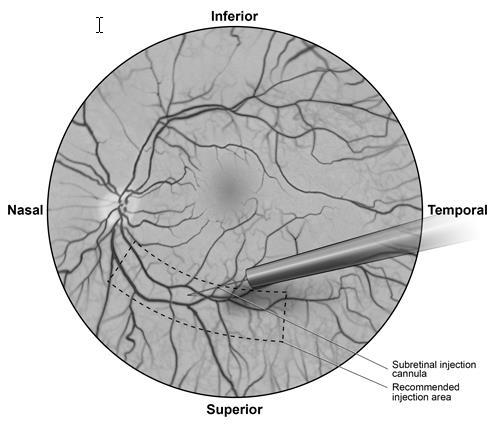
- Under direct visualization, the tip of the subretinal injection cannula is brought into contact with the retinal surface. The recommended injection site should be along the superior vascular arcade, at least 2 mm away from the center of the fovea. A small amount of product is injected slowly until initial observation of a subretinal bleb, then the remaining volume is injected slowly for a total of 0.3 mL (Figure 1).
Figure 1Tip of the subretinal injection cannula positioned within the recommended injection site (surgeon’s view)
- Upon completion of the injection, the subretinal injection cannula is removed from the eye.
- After the injection, unused product must be discarded. The backup syringe cannot be stored.
- A fluid-air exchange is performed, carefully avoiding drainage of fluids near the retinotomy made for the subretinal injection. In the post-operative period, immediate supine positioning of the head is assumed, which must be maintained by the patient for 24 hours following discharge.
ANNEX IV
SCIENTIFIC CONCLUSIONS AND JUSTIFICATION FOR THE VARIATION OF THE
TERMS OF THE MARKETING AUTHORISATION
Scientific conclusions
Considering the assessment by the Pharmacovigilance and Risk Assessment Committee
(PRAC) of the Periodic Safety Update Report (PSUR) for voretigene neparvovec, the
PRAC’s scientific conclusions are as follows:
In light of the available data on chorioretinal atrophy, the PRAC concluded that the information on the
medicinal product containing voretigene neparvovec must be amended accordingly.
Update of section 4.8 of the SmPC to add the adverse reaction “chorioretinal atrophy”
to the list of those related to voretigene neparvovec with a frequency of “not known” and further details
updated accordingly.
Having examined the PRAC recommendation, the Committee for Human Medicinal Products
(CHMP) agrees with the related overall conclusions and with the justification for the recommendation.
Justification for the variation of the terms of the marketing authorisation
Based on the scientific conclusions on voretigene neparvovec, the CHMP considers that the benefit/risk
ratio of the medicinal product containing voretigene neparvovec remains unchanged subject to the
proposed changes to the product information.
The CHMP recommends the variation of the terms of the marketing authorisation.

Не уверены, подходит ли вам это лекарство?
Обсудите симптомы и варианты лечения с врачом онлайн.

Уже начали прием и появились вопросы?
Обсудите свое состояние и дальнейшие шаги с врачом онлайн.

- Страна регистрации
- Форма выпускаInjectable solution, 5 X 10^12
- Код АТХS01XA27
- Действующее вещество
- Отпускается по рецептуДа
- Производитель
- Информация на этой странице носит справочный характер и не является медицинской консультацией. Перед началом приема лекарства обязательно проконсультируйтесь с врачом.
- Аналоги LUXTURNAФорма выпуска: Eye drops, solution, 5%Действующее вещество: АцетилцистеинПроизводитель: BRUSCHETTINI S.R.L.Отпускается без рецептаФорма выпуска: Eye drops, solution, 10MG/MLДействующее вещество: artificial tears and other indifferent preparationsПроизводитель: ABBVIE S.R.L.Отпускается без рецептаФорма выпуска: Eye drops, solution in single-dose container, 0.9 MG/MLДействующее вещество: ciclosporinПроизводитель: SUN PHARMACEUTICAL INDUSTRIES (EUROPE) B.V.Отпускается без рецепта
Аналоги LUXTURNA в других странах
Лекарства с тем же действующим веществом, доступные в других странах.
Аналог LUXTURNA в Испания
Аналог LUXTURNA в Польша
Аналог LUXTURNA в Украина
Врачи онлайн по LUXTURNA
Обсудите применение LUXTURNA и возможные следующие шаги — по оценке врача.









Получите рецепт на LUXTURNA онлайн
Заполните форму за 2 минуты
Расскажите о симптомах, истории болезни и нужном препарате.
Выберите врача или мы назначим
Выберите специалиста или мы подберём ближайшего доступного врача.
Врач рассматривает ваш случай
Обычно в течение 30 минут. Может задать уточняющие вопросы в чате.
Получите в любой аптеке
Электронный рецепт отправляется на вашу почту — действителен по всей Польше.
Часто задаваемые вопросы
LUXTURNA требует рецепта в Италия. Вы можете уточнить у врача онлайн, подходит ли это лекарство для вашей ситуации.
Действующее вещество LUXTURNA — Воретиген непарвовек. Эта информация помогает определить лекарства с тем же составом под другими торговыми названиями.
LUXTURNA производится компанией NOVARTIS EUROPHARM LIMITED. Упаковка и торговое название могут отличаться в зависимости от дистрибьютора.
Врачи, включая Семейные врачи, Психиатры, Дерматологи, Кардиологи, Эндокринологи, Гастроэнтерологи, Пульмонологи, Нефрологи, Ревматологи, Гематологи, Инфекционисты, Аллергологи, Гериатры, Педиатры, Онкологи, могут оценить целесообразность применения LUXTURNA с учетом вашей ситуации и местных правил. Вы можете записаться на онлайн-консультацию, чтобы обсудить возможные варианты.
Польша имеет хорошо развитую систему здравоохранения в крупных городах, таких как Варшава, Краков, Вроцлав и Гданьск. Аптеки широко доступны и работают в соответствии с действующим законодательством, обеспечивая доступ к рецептурным препаратам.
Вы можете купить LUXTURNA в Варшаве, Кракове, Вроцлаве или Гданьске в любой аптеке при наличии действующего рецепта.
Чтобы получить рецепт, вы можете воспользоваться Oladoctor:
Другие лекарства с тем же действующим веществом (Воретиген непарвовек) включают BRUNAK, KELLUVISK, KEQUA. Они могут отличаться торговым названием или формой выпуска, но содержат одинаковый терапевтический компонент. Перед изменением лечения рекомендуется проконсультироваться с врачом.
