



LUXAMIDE 25 мг Коированная таблетка

Рассмотрение рецепта онлайн
Врач рассмотрит ваш случай и примет решение о назначении рецепта, если это медицински оправдано.

Поговорите с врачом об этом лекарстве
Обсудите симптомы и возможные дальнейшие шаги на онлайн-консультации.



Инструкция по применению LUXAMIDE
Содержание инструкции
- What is Luxamide and what is it used for
- What you need to know before taking Luxamide
- How to take Luxamide
- Possible side effects
- How to store Luxamide
- Contents of the pack and other information
- Luxamide 25 mg tablets
Luxamide, 50 mg tablets
Luxamide, 100 mg tablets
Levosulpiride
Generic medicine
Read this leaflet carefully before taking this medicine because it contains important
information for you.
- Keep this leaflet. You may need to read it again.
- If you have any questions, ask your doctor or pharmacist.
- This medicine has been prescribed for you only. Do not pass it on to others, even if they have the same symptoms as you, as it may be harmful.
- If you get any side effects, even those not listed in this leaflet, tell your doctor or pharmacist. See section 4.
- Contents of this leaflet:
- 1. What Luxamide is and what it is used for
- 2. What you need to know before you take Luxamide
- 3. How to take Luxamide
- 4. Possible side effects
- 5. How to store Luxamide
- 6. Contents of the pack and other information.
1. What is Luxamide and what is it used for
Luxamideis a medicine that contains the active substance called levosulpiride, which belongs to a
group of drugs called psycholeptics and antipsychotics (neuroleptics). It works by blocking the effects of
dopamine, a substance naturally present in the brain.
Luxamideis used in adults for the treatment of mental disorders such as:
- psychiatric alterations characterized by physical symptoms without any underlying bodily disease (“Somatic Symptom Disorders”)
- long-lasting or permanent diseases that cause a severe and persistent alteration of behavior, affect, thought and perception (feeling, perceiving or seeing things that are not actually there) (“Chronic Schizophrenias presenting negative symptoms”).
2. What you need to know before taking Luxamide
Do not take Luxamide:
- if you are allergic to levosulpiride or any of the other ingredients of this medicine (listed in section 6)
- if you are at risk of developing a tumor of the adrenal gland called pheochromocytoma.
- if you suffer from seizures (epilepsy)
- if you suffer from mood disorders that can make you feel excited (manic states with hyperactivity, irritation, irritability or decreased need for sleep);
- if you have breast cancer (malignant mastopathy)
- if you have gastrointestinal bleeding, intestinal blockage (which may be characterized by abdominal cramps, vomiting, constipation) or ulcers (lesions of the stomach/intestinal wall); if you are or suspect you are pregnant or are breastfeeding (see “Pregnancy and breastfeeding”)
Warnings and precautions
Consult your doctor or pharmacist before taking Luxamide. It is very important that you inform your doctor first:
- if you suffer from a disease that reduces your ability to remember, speak and reason (dementia);
- if you are elderly;
- if you have a predisposition to stroke, or have heart and/or circulation problems;
- if you or a family member suffers or has suffered from a heart disease that causes irregular heartbeat (“long QT syndrome”);
- if you or someone else in your family has a history of blood clot formation (thrombosis), as drugs like Levopraid have been associated with the formation of blood clots in the veins.
After taking this medicine, you experience a combination of symptoms such as fever, severe muscle stiffness,
severe difficulty in movements (akinesia), excessive sweating, if you have a rapid heartbeat,
altered pressure or if you have loss of consciousness. These are symptoms of a very serious and
potentially fatal condition called “Neuroleptic Malignant Syndrome”. In this case you must stop
taking Luxamide and contact your doctor immediatelywho will prescribe appropriate therapy.
If you are taking anticholinergic medicines (drugs that block the action of acetylcholine, a substance involved
in the transmission of nerve impulses), narcotics and analgesics (pain relievers) as they may reduce the effects
of Luxamide (see section “Other medicines and Luxamide")
.
Other medicines and Luxamide
Tell your doctor or pharmacist if you are taking, have recently taken or might take any
other medicine.
Association with other drugs requires particular caution and vigilance on the part of the doctor to avoid unexpected
adverse effects from interaction.
Pay particular attention and inform your doctor if you are taking the following medicines:
- psychotropic drugs, medicines that act on the central nervous system used to treat psychiatric disorders, in particular neuroleptics, because the association with Luxamide requires caution medicines that can affect the levels of minerals (electrolytes) in the blood, because the association with Luxamide should be avoided;
- medicines that alter the heartbeat (prolong the QT interval), because the association with Levopraid increases the risk of developing heart rhythm abnormalities (cardiac arrhythmias); medicines called anticholinergics (drugs that block the action of acetylcholine, a substance involved in the transmission of nerve impulses), medicines used for sleeping (narcotics) and medicines used against pain (analgesics) as they affect the effects of Luxamide on the motility of the stomach and intestines. Luxamide with food, drinks and alcoholDo not drink alcohol while taking this medicine, as it may increase the sedative effect of the medicine.
Pregnancy, breastfeeding and fertility
Do not use Luxamideduring pregnancy, if you are possibly pregnant or if you are planning a pregnancy.
The following symptoms have been observed in newborns of mothers who have used conventional or atypical antipsychotics,
including levosulpiride, during the last trimester (last 3 months of pregnancy): tremor, stiffness and/or weakness
muscle, drowsiness, agitation, breathing problems and difficulty feeding. If your
child shows any of these symptoms, consult your doctor immediately.
Breastfeeding
Do not useLuxamide while breastfeeding.
Driving and operating machinery
DO NOT drive vehicles, DO NOT use machinery and DO NOT participate in activities that require particular attention
while taking this medicine.
This medicine can cause a feeling of numbness, dizziness (vertigo) and make you perform
involuntary movements. Luxamideimpairs the ability to drive vehicles or operate machinery.
Luxamide contains lactose.If your doctor has diagnosed you with intolerance to some sugars, contact
him before taking this medicine.
3. How to take Luxamide
Take this medicine following exactly the instructions of your doctor or pharmacist. If you have any doubts
consult your doctor or pharmacist.
You must always follow the precise dose that your doctor has prescribed for you. The recommended doses are:
Adults
The recommended dose is:
- 2-3 tablets of 100 mg per day.
- maintenance therapy: 3 tablets of 50 mg per day. This dose can be gradually reduced.
Use in children and adolescents
This medicine should not be used in children and adolescents because relevant data are not available.
Elderly
If you are elderly, the dosage must be carefully established by your doctor who will have to assess a possible
reduction of the dosages mentioned above.
If you take more Luxamide than you should
If you accidentally swallow/take a dose higher than you should, immediately inform your doctor
An overdose can cause tremors, difficulty and slowness in movements (extrapyramidal disorders) or sleep disorders.
If you forget to take Luxamide
Do not take a double dose to make up for the missed dose.
If you stop taking Luxamide
If you have any doubts about the use of this medicine, consult your doctor or pharmacist.
4. Possible side effects
Like all medicines, this medicine can cause side effects, although not everybody gets them.
The following side effects have also been observed with the use of other medicines of the same class and/or with
prolonged administrations:
Very common (may affect more than 1 in 10 people):
- drowsiness, temporary loss of sensitivity and reflexes (torpor).
Common (may affect up to 1 in 10 people):
- dizziness, vertigo (feeling a false sensation of movement).
Rare (may affect up to 1 in 1,000 people):
- heartbeat alterations (prolongation of the QT interval, ventricular arrhythmias such as torsades de pointes, ventricular tachycardia, ventricular fibrillation), cardiac arrest.
Very rare (may affect up to 1 in 10,000 people):
- weight gain;
- "parkinsonism" (symptoms similar to those present in Parkinson's disease such as, e.g., tremor, difficulty and slowness of movements, rigidity and postural instability); involuntary muscle movements (dyskinesias); tremor; repetitive twisting movements or abnormal fixed positions (dystonia); psychomotor agitation (restlessness and aimless involuntary movements);
- disorders of the autonomic nervous system (e.g. sweating, pallor, feeling of fainting, especially when getting up from a lying or sitting position, low blood pressure, slowed heartbeat);
- cases of sudden death.
Not known (frequency cannot be estimated from available data):
- "Neuroleptic Malignant Syndrome" (see paragraph “Special care with Luxamide”).
- formation of blood clots (venous thrombosis), especially in the legs (symptoms include swelling, pain, redness of the leg), which can reach the lungs and cause chest pain and difficulty breathing.
- neonatal withdrawal symptoms (see section 2 “Pregnancy and breastfeeding”), movement disorders (extrapyramidal symptoms);
- absence of menstruation in women of childbearing potential (amenorrhea), development of breast tissue in men (gynecomastia), feeling of tension in the breasts, spontaneous milk production from the breasts not associated with childbirth or breastfeeding (galactorrhea), changes in sexual desire (libido);
- increased levels of a hormone called prolactin in the blood (hyperprolactinemia).
Luxamide is not indicated for the treatment of dementia. In elderly patients with dementia, a small increase in the
number of deaths has been observed in patients taking antipsychotics compared to those not
taking antipsychotics.
Reporting of side effects
If you get any side effects, talk to your doctor or pharmacist. This includes any possible side effects not listed in this
leaflet. You can also report side effects directly through the national reporting system at: https://www.aifa.gov.it/content/segnalazioni-reazioni-avverse. By reporting side effects you can help provide more
information on the safety of this medicine.
5. How to store Luxamide
Keep this medicine out of the sight and reach of children.
This medicine does not require any special storage conditions.
Do not use this medicine after the expiry date which is stated on the pack after the wording “EXP.”. The
expiry date refers to the last day of that month.
Do not dispose of any medicine in waste water or household waste. Ask your pharmacist how to dispose of medicines you no longer use. This will help protect the environment.
6. Contents of the pack and other information
What Luxamide contains
- The active ingredient is levosulpiride.
- The other ingredients are: microcrystalline cellulose (E460), lactose monohydrate, sodium starch glycolate type A, magnesium stearate (E572).
Description of the appearance of Luxamide and contents of the pack
Luxamide50 mg tablets: white, round, convex tablet with a diameter of 8 mm, imprinted with "50" on one side.
Luxamide100 mg tablets: white, round, convex tablet with a diameter of 10.3 mm.
Packs of 20 tablets contained in blisters (PVC/PVDC/Al and PVC/PCTFE/Al).
Marketing authorisation holder and manufacturer
Alfasigma S.p.A. - Via Ragazzi del ’99, n. 5 - 40133 Bologna (BO)
Manufacturer:
MEDOCHEMIE LTD, 1-10 Constantinoupoleos Street, CY 3011 Limassol, Cyprus.
Luxamide 25 mg tablets
Levosulpiride
Generic medicine
Read this leaflet carefully before taking this medicine as it contains
important information for you.
- Keep this leaflet. You may need to read it again.
- If you have any questions, ask your doctor or pharmacist.
- This medicine has been prescribed for you only. Do not pass it on to others, even if they have the same symptoms as you, as it may be harmful.
- If you get any side effects, even those not listed in this leaflet, tell your doctor or pharmacist. See section 4.
Contents of this leaflet:
- 1. What Luxamide is and what it is used for
- 2. What you need to know before you take Luxamide
- 3. How to take Luxamide
- 4. Possible side effects
- 5. How to store Luxamide
- 6. Contents of the pack and other information.
1. What is Luxamide and what is it used for
Luxamide is a medicine that contains the active substance called levosulpiride, it belongs to a group
of drugs called “psycholeptics, antipsychotics (neuroleptics)” and increases the motility of the stomach and
intestines (gastrointestinal prokinetic).
Luxamide is used in adults for the short-term treatment of:
- Dyspeptic syndrome: this syndrome, or a set of various symptoms, related to poor digestion, which may be due to organic causes, i.e. lesions of digestive organs, or to the poor functioning of these organs, even due to incorrect lifestyles, without lesions detectable in the digestive organs themselves, is predominantly linked to a difficulty of the stomach to empty. Some disorders of the organism (such as delayed gastric emptying in case of diabetes, or some tumors) or psychological disorders (such as anxiety and depression which can determine alterations of visceral function) can make digestion difficult.
- The stomach has difficulty emptying and manifests as: stomach pain and heartburn, loss of appetite (anorexia), flatulence, stomach bloating and tension, headache after meals, belching, diarrhea and constipation. Luxamide is prescribed to you by your doctor because you have not previously responded to therapy with other medicines; vomiting and nausea, induced by anticancer drugs, when previous therapies have not worked;
- dizziness (vertigo), symptoms of a disease affecting the inner ear (Ménière's syndrome) causing balance problems and ear disorders (such as ringing, whistling, crackling), hearing loss and nausea.
2. What you need to know before taking Luxamide
Do not take Luxamide:
- if you are allergic to levosulpiride or any of the other ingredients of this medicine (listed in section 6)
- if you are at risk of developing a tumor of the adrenal glands called pheochromocytoma
- if you suffer from seizures (epilepsy)
- if you suffer from mood disorders that can make you feel excited (manic states with hyperactivity, irritation, irritability or decreased need for sleep);
- if you have breast cancer (malignant mastopathy);
- if you have gastrointestinal bleeding, intestinal blockage (which may be characterized by abdominal cramps, vomiting, constipation) or ulcers (lesions of the stomach/intestinal wall);
- if you are or suspect you are pregnant or are breastfeeding (see “Pregnancy and breastfeeding”).
Warnings and precautions
Talk to your doctor or pharmacist before taking Luxamide .
It is very important that you inform your doctor first:
- if you suffer from a disease that reduces your ability to remember, speak and reason (dementia);
- if you are elderly;
- if you have a predisposition to stroke, or have heart and/or circulatory disorders;
- if you or a family member suffers or has suffered from a heart disease that causes irregular heartbeat (“long QT syndrome”);
- if you or someone in your family has a history of blood clot formation (thrombi), as drugs like Levopraid have been associated with the formation of blood clots in the veins.
Warn your doctor immediatelyif:
After taking this medicine you experience a combination of symptoms such as fever, severe muscle stiffness, severe difficulty in movement (akinesia), excessive sweating, if you have a rapid heartbeat, altered blood pressure or if you lose consciousness. These are symptoms of a very serious and potentially life-threatening condition called “Neuroleptic Malignant Syndrome”. In this case you must stop taking Luxamide and contact your doctor immediatelywho will prescribe appropriate therapy.
If you are taking anticholinergic medicines (drugs that block the action of acetylcholine, a substance involved in nerve impulse transmission), narcotics and analgesics (pain relievers) as they may reduce the effects of Luxamide (see section “Other medicines and Luxamide")
Other medicines and Luxamide
Tell your doctor or pharmacist if you are taking, have recently taken or might take any other medicine.
Association with other drugs requires particular caution and vigilance on the part of the doctor to avoid undesirable interaction effects.
Pay particular attention and inform your doctor if you are taking the following medicines:
- psychotropic drugs, medicines that act on the central nervous system used to treat psychiatric disorders, in particular neuroleptics, because the association with Luxamide requires caution;
- medicines that can affect the levels of minerals (electrolytes) in the blood, because the association with Luxamide should be avoided;
- medicines that alter the heartbeat (prolong the QT interval), because the association with Luxamide increases the risk of developing heart rhythm abnormalities (cardiac arrhythmias);
- medicines called anticholinergics (drugs that block the action of acetylcholine, a substance involved in nerve impulse transmission), medicines used for sleeping (narcotics) and medicines used against pain (analgesics) as they affect the effects of Luxamide on stomach and intestinal motility.
Luxamide with food, drinks and alcohol
Do not drink alcohol while taking this medicine, as it may increase the sedative effect of the medicine.
Pregnancy, breastfeeding and fertility
Do not use Luxamideduring pregnancy, if you are possibly pregnant or if you are planning a pregnancy.
The following symptoms have been observed in newborns of mothers who have used conventional or atypical antipsychotics, including levosulpiride, during the last trimester (last 3 months of pregnancy): tremor, rigidity and/or muscle weakness, drowsiness, agitation, breathing problems and difficulty feeding. If your child shows any of these symptoms, consult your doctor immediately.
Breastfeeding
Do not useLuxamide while breastfeeding.
Driving and using machines
DO NOT drive vehicles, DO NOT use machines and DO NOT participate in activities that require particular attention while taking this medicine. High doses of this medicine can cause drowsiness, a feeling of numbness and make you perform involuntary movements. Luxamideimpairs the ability to drive vehicles or operate machinery.
Luxamide contains lactose.If your doctor has diagnosed you with lactose intolerance, contact them before taking this medicine.
3. How to take Luxamide
Take this medicine following exactly the instructions of your doctor or pharmacist. If you have any doubts
consult your doctor or pharmacist.
You must always follow the precise dose that your doctor has prescribed for you. The recommended doses are:
Adults
The recommended dose in adults (according to medical prescription) is 1 tablet 3 times a day before
meals.
Use in children and adolescents
This medicine should not be used in children and adolescents because relevant data are not available.
Elderly
If you are elderly, the dosage must be carefully established by the doctor who will have to assess a possible
reduction of the above dosages.
If you take more Luxamide than you should
If you accidentally ingest/take a dose higher than you should, immediately inform your doctor
An overdose may cause tremors, difficulty and slowness in movements (extrapyramidal disorders) or disorders
of sleep.
If you forget to take Luxamide
Do not take a double dose to make up for the missed dose.
If you stop taking Luxamide
If you have any doubts about the use of this medicine, consult your doctor or pharmacist.
4. Possible side effects
Like all medicines, this medicine can cause side effects, although not everybody gets them.
The following side effects have also been observed with the use of other medicines of the same class and/or with
prolonged administrations:
Rare (may affect up to 1 in 1,000 people):
- heartbeat alterations (prolongation of the QT interval, ventricular arrhythmias such as torsades de pointes, ventricular tachycardia, ventricular fibrillation), cardiac arrest.
Very rare (may affect up to 1 in 10,000 people):
- drowsiness, "parkinsonism" (symptoms similar to those present in Parkinson's disease such as, e.g., tremor, difficulty and slowing of movements, rigidity and postural instability); involuntary muscle movements (dyskinesias); tremor; repetitive twisting movements or abnormal fixed positions (dystonia); Neuroleptic Malignant Syndrome (see paragraph “ Immediately inform your doctor if”).
- cases of sudden death.
Not known (frequency cannot be estimated based on available data):
- formation of blood clots (venous thrombosis), especially in the legs (symptoms include swelling, pain, redness of the leg), which can reach the lungs and cause chest pain and difficulty breathing.
- neonatal withdrawal symptoms (see section 2 “Pregnancy and breastfeeding”), movement disorders (extrapyramidal symptoms).
- absence of menstruation in women of childbearing age (amenorrhea), development of breast tissue in men (gynecomastia), feeling of tension in the breasts, spontaneous leakage of milk from the breasts not associated with childbirth or breastfeeding (galactorrhea), changes in sexual desire (libido).
- increased levels of a hormone called prolactin in the blood (hyperprolactinemia).
Luxamide is not indicated for the treatment of dementia. In elderly patients with dementia, a small increase in the
number of deaths has been observed for patients taking antipsychotics compared to those not
taking antipsychotics
Reporting of side effects
If you get any side effects, talk to your doctor or pharmacist. You can also report side effects directly through the national
reporting system at: https://www.aifa.gov.it/content/segnalazioni-reazioni-avverse . By reporting side
effects you can help provide more information on the safety of this medicine.
5. How to store Luxamide
Keep this medicine out of sight and reach of children.
This medicine does not require any special storage conditions.
Do not use this medicine after the expiry date which is stated on the pack after the designation “EXP.”. The
expiry date refers to the last day of that month.
Do not dispose of any medicine in wastewater or household waste. Ask your pharmacist how to dispose of
medicines you no longer use. This will help protect the environment.
6. Contents of the pack and other information
What Luxamide contains
- The active ingredient is levosulpiride.
- The other ingredients are: microcrystalline cellulose (E460), lactose monohydrate, sodium starch glycolate type A, magnesium stearate (E572).
Description of the appearance of Luxamide and contents of the pack
Luxamide tablets are white, round, convex, with a diameter of 6 mm, with "MC" imprinted on one
side.
Packs of 20 tablets contained in blisters (PVC/PVDC/Al and PVC/PCTFE/Al).
Marketing authorisation holder and manufacturer
Marketing authorisation holder:
Alfasigma S.p.A. - Via Ragazzi del ’99, n. 5 - 40133 Bologna (BO)
Manufacturer:
MEDOCHEMIE LTD, 1-10 Constantinoupoleos Street, CY 3011 Limassol, Cyprus.

Не уверены, подходит ли вам это лекарство?
Обсудите симптомы и варианты лечения с врачом онлайн.

Уже начали прием и появились вопросы?
Обсудите свое состояние и дальнейшие шаги с врачом онлайн.
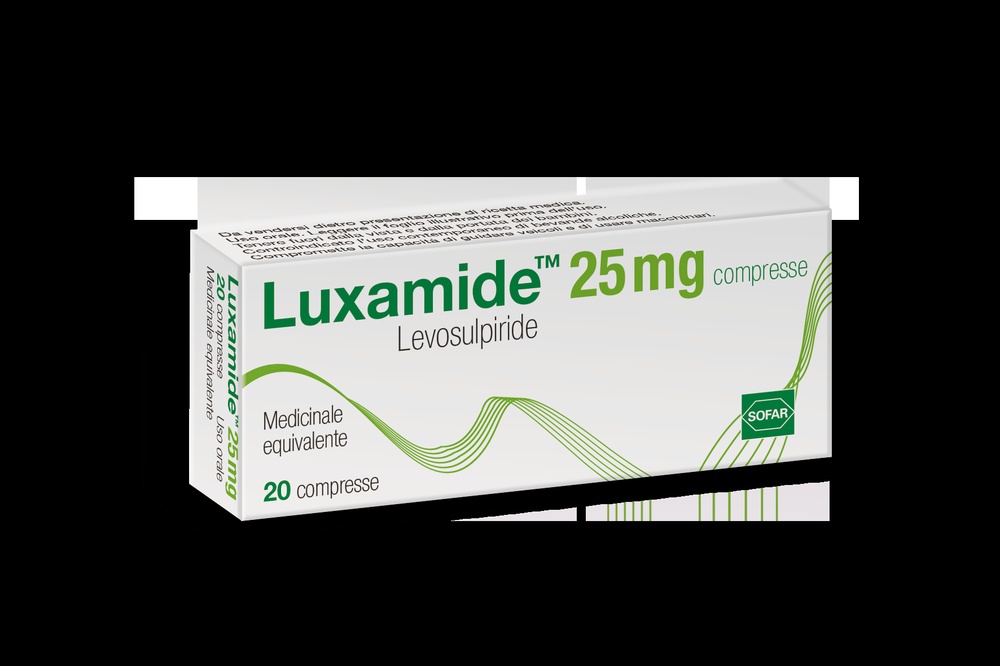
- Страна регистрации
- Форма выпускаCoated tablet, 25 MG
- Код АТХN05AL07
- Действующее вещество
- Отпускается по рецептуДа
- Производитель
- Информация на этой странице носит справочный характер и не является медицинской консультацией. Перед началом приема лекарства обязательно проконсультируйтесь с врачом.
- Аналоги LUXAMIDEФорма выпуска: Oral drops, solution, 25 MG/MLДействующее вещество: levosulpirideПроизводитель: DOMPE' FARMACEUTICI S.P.A.Отпускается по рецептуФорма выпуска: Oral drops, solution, 25 MG/MLДействующее вещество: levosulpirideПроизводитель: EPIFARMA S.R.LОтпускается по рецептуФорма выпуска: Coated tablet, 25 MGДействующее вещество: levosulpirideПроизводитель: NEOPHARMED GENTILI S.P.A.Отпускается по рецепту
Аналоги LUXAMIDE в других странах
Лекарства с тем же действующим веществом, доступные в других странах.
Аналог LUXAMIDE в Испания
Врачи онлайн по LUXAMIDE
Обсудите применение LUXAMIDE и возможные следующие шаги — по оценке врача.







Получите рецепт на LUXAMIDE онлайн
Заполните форму за 2 минуты
Расскажите о симптомах, истории болезни и нужном препарате.
Выберите врача или мы назначим
Выберите специалиста или мы подберём ближайшего доступного врача.
Врач рассматривает ваш случай
Обычно в течение 30 минут. Может задать уточняющие вопросы в чате.
Получите в любой аптеке
Электронный рецепт отправляется на вашу почту — действителен по всей Польше.
Часто задаваемые вопросы
LUXAMIDE требует рецепта в Италия. Вы можете уточнить у врача онлайн, подходит ли это лекарство для вашей ситуации.
Действующее вещество LUXAMIDE — levosulpiride. Эта информация помогает определить лекарства с тем же составом под другими торговыми названиями.
LUXAMIDE производится компанией ALFASIGMA S.P.A.. Упаковка и торговое название могут отличаться в зависимости от дистрибьютора.
Врачи, включая Семейные врачи, Психиатры, Дерматологи, Кардиологи, Эндокринологи, Гастроэнтерологи, Пульмонологи, Нефрологи, Ревматологи, Гематологи, Инфекционисты, Аллергологи, Гериатры, Педиатры, Онкологи, могут оценить целесообразность применения LUXAMIDE с учетом вашей ситуации и местных правил. Вы можете записаться на онлайн-консультацию, чтобы обсудить возможные варианты.
Польша имеет хорошо развитую систему здравоохранения в крупных городах, таких как Варшава, Краков, Вроцлав и Гданьск. Аптеки широко доступны и работают в соответствии с действующим законодательством, обеспечивая доступ к рецептурным препаратам.
Вы можете купить LUXAMIDE в Варшаве, Кракове, Вроцлаве или Гданьске в любой аптеке при наличии действующего рецепта.
Чтобы получить рецепт, вы можете воспользоваться Oladoctor:
Другие лекарства с тем же действующим веществом (levosulpiride) включают ARGOPRO, LEVAIR, LEVOBREN. Они могут отличаться торговым названием или формой выпуска, но содержат одинаковый терапевтический компонент. Перед изменением лечения рекомендуется проконсультироваться с врачом.
