



LUXABIOTIC 3 мг/мл + 1 мг/мл Глазные капли, суспензия

Рассмотрение рецепта онлайн
Врач рассмотрит ваш случай и примет решение о назначении рецепта, если это медицински оправдано.

Поговорите с врачом об этом лекарстве
Обсудите симптомы и возможные дальнейшие шаги на онлайн-консультации.



Инструкция по применению LUXABIOTIK
Содержание инструкции
Luxabiotic 3 mg/ml + 1 mg/ml eye drops, suspension
Tobramycin Desamethasone
Read this leaflet carefully before you start using this medicine as it contains
important information for you.
- Keep this leaflet. You may need to read it again.
- If you have any questions, ask your doctor or pharmacist.
- This medicine has been prescribed for you only. Do not pass it on to others, even if their symptoms are the same as yours, as it could be harmful.
- If you get any side effects, even those not listed in this leaflet, tell your doctor or pharmacist. See section 4.
Contents of this leaflet:
- 1. What Luxabiotic is and what it is used for
- 2. What you need to know before you use Luxabiotic
- 3. How to use Luxabiotic
- 4. Possible side effects
- 5. How to store Luxabiotic
- 6. Contents of the pack and other information
1. What is Luxabiotic and what is it used for
Luxabiotic contains a combination of two medicines: desamethasone, which belongs to the class
of corticosteroids and has an anti-inflammatory effect, and tobramycin, which belongs to the class
of aminoglycoside antibiotics and acts against various bacteria that can cause eye infections.
Luxabiotic is indicated in adults and children from two years of age and older for the treatment of
eye inflammations when a corticosteroid is necessary and when an eye infection exists or the risk of eye infection.
2. What you need to know before using Luxabiotic
Do not use Luxabiotic:
- If you are allergic to tobramycin, dexamethasone or any other of the ingredients of this medicine (listed in section 6). If you suffer from:
- inflammation of the cornea (the transparent membrane covering the colored part of the eye) caused by the Herpes simplex virus (Herpes simplex keratitis)
- smallpox vaccination, chickenpox or other viral infections of the cornea and conjunctiva (the transparent membrane covering the white part of the eye and the inside of the eyelids)
- untreated fungal (eye mycosis) or parasitic infections of the eye
- tuberculosis of the eye
- high pressure in the eyes
- inflammatory eye conditions with pus production (acute purulent ophthalmias, purulent conjunctivitis and purulent and herpetic blepharitis), which may be masked or aggravated by corticosteroids
- stye.
Warnings and precautions
Talk to your doctor or pharmacist before using Luxabiotic.
- In some patients, sensitization (allergic reaction) to aminoglycoside antibiotics such as tobramycin, administered to the eyes, may occur. This allergic reaction can range from localized skin itching or redness to severe general allergic reactions (anaphylactic reactions) or severe skin reactions. If these symptoms occur during the use of Luxabiotic eye drops, stop treatment and consult your doctor. Also, be aware that this allergic sensitivity may also occur with other antibiotics belonging to the same class of aminoglycosides, administered both to the eyes and systemically (by injection).
- Talk to your doctor if you have or have ever had conditions such as myasthenia gravis or Parkinson's disease. These types of antibiotics may worsen muscle weakness.
- Serious toxic effects on the nervous system, ears and kidneys have occurred in patients who have been given aminoglycoside antibiotics, such as tobramycin, systemically (by injection). Be careful and consult your doctor if you are using Luxabiotic together with aminoglycoside antibiotics given systemically (by injection).
- Long-term application to the eyes of corticosteroids can cause increased pressure in the eyes (including a condition called glaucoma, with damage to the optic nerve), vision problems and cataract formation (clouding of the lens inside the eye, called the crystalline lens). If you use Luxabiotic eye drops for a long period of time, you should regularly and frequently check the pressure in your eyes. This is particularly important in children, as the risk of increased eye pressure caused by corticosteroids may be greater in children under six years of age and may occur sooner than in adults. Ask your doctor for advice, especially if you need to use Luxabiotic eye drops in children. The risk of increased eye pressure induced by corticosteroids and/or cataract formation is increased in predisposed patients (e.g. in diabetic patients).
- Manifestation of Cushing's syndrome, caused by the passage of the medicine into the blood. Consult your doctor if you feel swelling and weight gain around the trunk and face, as these are usually the first manifestations of a syndrome called Cushing's syndrome. Suppression of the function of the adrenal glands can develop after discontinuation of prolonged or intensive treatment with Luxabiotic. Consult your doctor before stopping treatment on your own. These risks are particularly important in children and in patients treated with a medicine called ritonavir or cobicistat (see section “Other medicines and Luxabiotic”).
- With the use of Luxabiotic, you may become more susceptible to eye infections caused by bacteria, viruses, fungi or parasites: if your symptoms worsen or suddenly reappear, consult your doctor.
- If you have a corneal ulcer that does not heal, stop therapy and consult your doctor.
- Consult your doctor before using this medicine if you suffer from diseases that cause thinning of the tissues of the eye, as perforation may occur with the administration of corticosteroids to the eyes.
- Corticosteroids applied to the eyes can slow down the healing of corneal wounds. NSAIDs (Non-Steroidal Anti-Inflammatory Drugs) applied to the eyes are also known to slow down or delay healing. Concurrent application of NSAIDs and corticosteroids to the eyes may potentially increase problems with healing of eye wounds (see section “Other medicines and Luxabiotic”).
- Do not wear contact lenses during the treatment of an eye inflammation or infection. Also read the section “Luxabiotic eye drops contains benzalkonium chloride”.
- Use Luxabiotic eye drops under the direct supervision of a doctor.
- Use Luxabiotic eye drops only for application to the eyes.
- Contact your doctor if you experience blurred vision or other visual disturbances.
Other medicines and Luxabiotic
Tell your doctor or pharmacist if you are taking, have recently taken or might
take any other medicines, including those obtained without a prescription.
Tell your doctor especially if you are taking other medicines for the eyes that contain
drugs belonging to the class of NSAIDs (Non-Steroidal Anti-Inflammatory Drugs).
Concurrent application of NSAIDs and corticosteroids to the eyes may potentially
increase problems with healing of the cornea.
Consult your doctor if you are using ritonavir or cobicistat, as they may increase the level of
dexamethasone in the blood.
Incompatibilities
The tyloxapol component contained in Luxabiotic eye drops is incompatible with tetracycline.
Do not use Luxabiotic eye drops together with other products for the eyes that contain tetracycline.
Pregnancy, breastfeeding and fertility
If you are pregnant, suspect you are pregnant or are planning to become pregnant, or if you are
breastfeeding, ask your doctor or pharmacist for advice before using this medicine.
Pregnancy
Data relating to the use of tobramycin and dexamethasone in the eyes in pregnant women are not
available or are limited. Studies in animals have shown reproductive toxicity
following systemic (oral or injection) administration of dexamethasone and tobramycin.
Luxabiotic is not recommended during pregnancy. Consult your doctor, who will decide whether you should
use Luxabiotic during pregnancy.
Breastfeeding
It is not known whether tobramycin or dexamethasone are excreted in breast milk after
administration to the eyes. Tobramycin is excreted in breast milk after systemic administration
(by injection). No data are available on the passage of dexamethasone into human breast
milk. The risk to infants cannot be excluded. Consult your doctor, who will decide whether
you should stop breastfeeding or stop therapy with Luxabiotic.
Fertility
No studies have been conducted to evaluate the effect of tobramycin on human or
animal fertility. Clinical data to evaluate the effect of dexamethasone on male or female fertility
are limited.
Driving and operating machinery
For a certain period of time after instillation of Luxabiotic, blurred
vision or other visual disturbances may occur that may impair your ability to drive
vehicles and operate machinery. If these effects occur, wait until your vision clears
before driving vehicles and using machinery.
Luxabiotic contains benzalkonium chloride
This medicine contains 73.5 micrograms of benzalkonium chloride per drop equivalent to 0.1
mg/ml.
Benzalkonium chloride can be absorbed by soft contact lenses and can lead to
changes in their color. Remove contact lenses before using this medicine and wait 15
minutes before re-applying them.
Benzalkonium chloride can also cause eye irritation, especially if you have dry eyes or
corneal disorders (the most superficial transparent layer of the eye). If you experience an abnormal
sensation in your eye, burning or pain after using this medicine, talk to your doctor.
3. How to use Luxabiotic
Apply Luxabiotic only to the eyes.
Use this medicine following exactly the instructions of your doctor. If you have any doubts
consult your doctor or pharmacist.
Recommended dose:
Instill 1 or 2 drops 4-5 times a day, following the indications provided by your doctor.
Use the medicine for the period of time prescribed by your doctor.
The following operation is useful to limit the amount of medicine that passes into the blood after
application to the eyes: keep the eyelid closed and apply gentle
pressure with a finger on the inner corner of the eye near the nose for at least 2 minutes.
If you are using other eye drops or ophthalmic ointments, allow at least 5 minutes to pass between
the instillation of each medicine. The ophthalmic ointment should be used last.
Use in children
Do not use Luxabiotic in children under two years of age given that in this population safety and efficacy have not
been established and no data are available.
Luxabiotic can be used in children from two years of age and older at the same doses as provided for
adults.
How to apply Luxabiotic eye drops
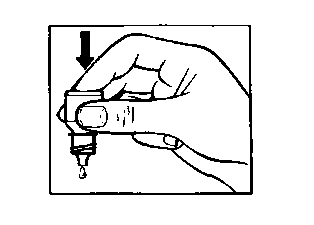
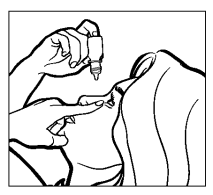
1 2
- Wash your hands.
- Take the bottle and shake it well before unscrewing the cap.
- If you are opening the bottle for the first time, remove the ring detached from the cap before using the medicine.
- Hold the bottle upside down between your thumb and middle finger.
- Tilt your head back. Lower the eyelid with a clean finger to form a pouch between the eyelid and the eye. The drop should be instilled in this area (figure 1).
- Bring the tip of the bottle close to the eye.
- Do not touch the eye, eyelid, surrounding areas or other surfaces with the tip of the dropper to avoid infecting the drops remaining in the bottle.
- Gently press the base of the bottle releasing one drop of Luxabiotic at a time.
- Do not squeeze the bottle: it is designed so that only gentle pressure on the bottom is sufficient (figure 2).
- If you instill drops in both eyes, repeat the same operation for the other eye.
- Immediately replace the cap after use, screwing it on tightly. If a drop does not enter the eye, try again.
If you use more Luxabiotic than you should
Considering that the medicine is applied to the eyes, it is unlikely that cases of
overdose will occur. However, if this should happen, wash your eye thoroughly with running water.
Do not use more of the medicine until the time scheduled for the next administration.
If you forget to use Luxabiotic
If you forget to use Luxabiotic, do not worry and apply it as soon as you remember. However, if it is
almost time to administer the next dose, skip the missed dose and return to the regular
administration schedule.
Do not use a double dose to compensate for forgetting the dose.
If you have any doubts about the use of this medicine, consult your doctor or pharmacist.
4. Possible side effects
Like all medicines, Luxabiotic can cause side effects, although not everybody gets them.
With the use of Luxabiotic, the following side effects have been reported. Uncommon side effects (may affect up to 1 in 100 people)
- Effects on the eyes: increased pressure in the eye(s), eye pain, eye itching, eye discomfort, eye irritation.
Rare side effects (may affect up to 1 in 1,000)
- Effects on the eyes: inflammation of the eye surface, eye allergy, blurred vision, dry eye, eye redness.
- General side effects: unpleasant taste.
Side effects of unknown frequency (the frequency cannot be estimated on the basis of the available data
)
- Effects on the eyes: swelling of the eyelids, redness of the eyelids, increased pupil size, increased tear production.
- Hormonal problems: increased hair growth on the body (especially in women), weakness and muscle atrophy, purple stretch marks on the skin of the body, increased blood pressure, irregular or absent menstrual cycle, changes in protein and calcium levels in the body, delayed growth in children and adolescents and swelling and weight gain of the body and face (called “Cushing’s syndrome”) (see section 2, “Warnings and precautions”).
- General side effects: severe allergic reactions (hypersensitivity), dizziness, headache, nausea, abdominal discomfort, skin rash, severe skin reactions (erythema multiforme), facial swelling, itching.
Reporting of side effects
If you get any side effects, even those not listed in this leaflet, tell your doctor or pharmacist.
You can also report side effects directly through the national reporting system at: https://www.aifa.gov.it/content/segnalazioni-reazioni-avverse.
By reporting side effects you can help provide more information on the safety of
this medicine.
5. How to store Luxabiotic
Keep this medicine out of the sight and reach of children.
Do not use the bottle if its tamper-evident seal is broken before first use.
Do not use this medicine after the expiry date which is stated on the bottle and on the packaging
after “Exp.”. The expiry date refers to the last day of that month.
Do not use the medicine for more than 28 days after first opening the container, even if
it still contains some of the solution.
Do not dispose of any medicine in waste water or household waste. Ask your pharmacist how to
dispose of medicines you no longer use. This will help protect the environment.
6. Contents of the pack and other information
What Luxabiotic contains
- The active ingredients are tobramycin and dexamethasone
- 1 ml of solution contains 3 mg of tobramycin and 1 mg of dexamethasone.
The other ingredients are: benzalkonium chloride as a preservative, sodium edetate, hydroxyethylcellulose,
purified water, sodium chloride, sodium sulfate, sulfuric acid and/or sodium hydroxide, tyloxapol.
Description of the appearance of Luxabiotic and contents of the pack
Plastic bottle containing 5 ml of a milky white suspension.
Marketing authorisation holder and manufacturer
Marketing authorisation holder
OmniVision Italia S.r.l.
Via Montefeltro, 6
20156 Milano
Manufacturer
Tubilux Pharma S.p.A.
via Costarica 20/22
00071 Pomezia (RM), Italy
This medicinal product is authorised in the Member States with the following denominations:
Italy
Luxabiotic 3 mg/ml + 1 mg/ml eye drops, suspension

Не уверены, подходит ли вам это лекарство?
Обсудите симптомы и варианты лечения с врачом онлайн.

Уже начали прием и появились вопросы?
Обсудите свое состояние и дальнейшие шаги с врачом онлайн.
- Страна регистрации
- Форма выпускаEye drops, suspension, 3 MG/ML + 1 MG/ML
- Код АТХS01CA01
- Действующее вещество
- Отпускается по рецептуНет
- Производитель
- Информация на этой странице носит справочный характер и не является медицинской консультацией. Перед началом приема лекарства обязательно проконсультируйтесь с врачом.
- Аналоги LUXABIOTIKФорма выпуска: Eye drops, suspension, 0.2% + 0.5%Действующее вещество: dexamethasone and antiinfectivesПроизводитель: BAUSCH & LOMB-IOM S.P.A.Отпускается без рецептаФорма выпуска: Eye drops, suspension, 3 mg/ml + 1 mg/mlДействующее вещество: dexamethasone and antiinfectivesПроизводитель: BRUSCHETTINI S.R.L.Отпускается без рецептаФорма выпуска: Eye drops, solution, <3 mg/ml + 1 mg/mlДействующее вещество: dexamethasone and antiinfectivesПроизводитель: FIDIA FARMACEUTICI S.P.A.Отпускается по рецепту
Аналоги LUXABIOTIK в других странах
Лекарства с тем же действующим веществом, доступные в других странах.
Аналог LUXABIOTIK в Польша
Аналог LUXABIOTIK в Украина
Аналог LUXABIOTIK в Испания
Врачи онлайн по LUXABIOTIK
Обсудите применение LUXABIOTIK и возможные следующие шаги — по оценке врача.









Получите рецепт на LUXABIOTIK онлайн
Заполните форму за 2 минуты
Расскажите о симптомах, истории болезни и нужном препарате.
Выберите врача или мы назначим
Выберите специалиста или мы подберём ближайшего доступного врача.
Врач рассматривает ваш случай
Обычно в течение 30 минут. Может задать уточняющие вопросы в чате.
Получите в любой аптеке
Электронный рецепт отправляется на вашу почту — действителен по всей Польше.
Часто задаваемые вопросы
LUXABIOTIK не требует рецепта в Италия. Вы можете уточнить у врача онлайн, подходит ли это лекарство для вашей ситуации.
Действующее вещество LUXABIOTIK — dexamethasone and antiinfectives. Эта информация помогает определить лекарства с тем же составом под другими торговыми названиями.
LUXABIOTIK производится компанией OMNIVISION ITALIA SRL. Упаковка и торговое название могут отличаться в зависимости от дистрибьютора.
Врачи, включая Семейные врачи, Психиатры, Дерматологи, Кардиологи, Эндокринологи, Гастроэнтерологи, Пульмонологи, Нефрологи, Ревматологи, Гематологи, Инфекционисты, Аллергологи, Гериатры, Педиатры, Онкологи, могут оценить целесообразность применения LUXABIOTIK с учетом вашей ситуации и местных правил. Вы можете записаться на онлайн-консультацию, чтобы обсудить возможные варианты.
Польша имеет хорошо развитую систему здравоохранения в крупных городах, таких как Варшава, Краков, Вроцлав и Гданьск. Аптеки широко доступны и работают в соответствии с действующим законодательством, обеспечивая доступ к рецептурным препаратам.
Вы можете купить LUXABIOTIK в Варшаве, Кракове, Вроцлаве или Гданьске в любой аптеке при наличии действующего рецепта.
Чтобы получить рецепт, вы можете воспользоваться Oladoctor:
Другие лекарства с тем же действующим веществом (dexamethasone and antiinfectives) включают KLORADEX, KOMBISTILL, KOMBITIMOR. Они могут отличаться торговым названием или формой выпуска, но содержат одинаковый терапевтический компонент. Перед изменением лечения рекомендуется проконсультироваться с врачом.
