



KESOL 50 MICROGRAMS Spray do nosa, zawiesina

Ocena recepty online
Lekarz przeanalizuje Twój przypadek i zdecyduje, czy wystawienie recepty jest medycznie uzasadnione.

Porozmawiaj z lekarzem o tym leku
Omów swoje objawy i opcje leczenia podczas szybkiej konsultacji online.



Jak stosować KESOL
Treść ulotki
KESOL 50 micrograms Nasal Spray, suspension, 100 micrograms Nasal Spray, suspension
Budesonide
Equivalent Medicinal Product
Read this leaflet carefully before you start using this medicine as it contains important
information for you.
- Keep this leaflet. You may need to read it again.
- If you have any questions, ask your doctor or pharmacist.
- This medicine has been prescribed for you only. Do not pass it on to others, even if their symptoms are the same as yours, as it could be harmful.
- If you get any side effects, even those not listed in this leaflet, tell your doctor or pharmacist. See section 4.
Contents of this leaflet:
- 1. What KESOL is and what it is used for
- 2. What you need to know before you use KESOL
- 3. How to use KESOL
- 4. Possible side effects
- 5. How to store KESOL
- 6. Contents of the pack and other information
1. What is KESOL and what it is used for
KESOL contains the active substance budesonide, belonging to a group of medicines called
corticosteroids which are used to reduce inflammation of the nasal mucosa.
This medicine is indicated in adults and children from 6 years of age for the treatment:
- of inflammation of the nasal mucosa, even due to allergies (seasonal allergic rhinitis, perennial allergic and non-allergic rhinitis);
- of a disease of the nasal cavities that makes breathing difficult (nasal polyposis).
- for the prevention of the recurrence of nasal polyposis, after surgery on the nasal cavities (polypectomy).
2. What you need to know before using KESOL
Do not use KESOL
- if you are allergic to budesonide, or to any of the other ingredients of this medicine (listed in section 6).
Warnings and precautions
Talk to your doctor or pharmacist before using KESOL.
In particular, tell your doctor if:
- you suffer from nasal infections due to fungi or viruses;
- you have widespread (systemic) infections due to fungi, bacteria or viruses;
- you suffer from eye infections caused by a Herpes virus (Herpes Simplex);
- you suffer from an infectious disease called tuberculosis. In this case, the doctor will assess the benefits of therapy compared to possible undesirable effects;
- you are taking corticosteroids by mouth (orally). In this case, the switch to using KESOL must occur in a controlled manner, to avoid problems at the level of the nervous system and hormonal system (imbalance of the hypothalamus-pituitary-adrenal axis).
During treatment with this medicine, especially at high doses and for prolonged periods, the following effects may occur:
- typical symptoms of Cushing's disease, such as increased hair growth (hirsutism), hair loss, irregular menstrual cycles in women, loss of muscle tone, irritability, fatigue and difficulty concentrating, or typical symptoms of Cushingoid appearance such as sudden weight gain, especially localized on the abdomen (trunk obesity), rounding and redness of the face, appearance of a slight hump;
- decreased activity of a gland called the adrenal gland (adrenal suppression);
- reduction of mineral substances in the bones (reduction of bone mineral density);
- eye problems (onset of increased intraocular pressure, cataracts or glaucoma); behavioral and psychological disorders such as psychomotor agitation, anxiety, depression, aggression (particularly in children) or sleep disturbances. After treatment with this medicine, allergic reactions (immediate hypersensitivity reactions or contact dermatitis) may rarely occur. Contact your doctor if you experience blurred vision or other visual disturbances.
The use of this medicine is not recommended if you have recently had lesions (ulcers) on the nasal septum or have undergone surgery or trauma to the nose, because the use of the medicine could make it more difficult to heal the scars (on the skin).
Stoptreatment with KESOL if you notice irritation at the local level after using the medicine.
Children
This medicine should not be used in children under 6 years of age.
The doctor will assess the benefits of using KESOL or similar medicines (intranasal corticosteroids) in children over 6 years of age and the possible risks to growth. During treatment with this medicine, the doctor will regularly monitor height growth, as delayed growth has been reported in children.
Other medicines and KESOL
Tell your doctor or pharmacist if you are taking, have recently taken or might take any other medicines, including medicines obtained without a prescription.
The use of cimetidine, (a medicine used to treat stomach problems such as gastric ulcers and reflux) simultaneously with KESOL may alter its absorption.
Some medicines may increase the effects of KESOL and your doctor may want to keep you under close observation if you are taking these medicines (including some medicines for the treatment of HIV: ritonavir, cobicistat).
Laboratory tests and KESOL
Tell your doctor if you/the child need to undergo blood tests to evaluate the functionality of some glands (ACTH stimulation test) as, during the use of corticosteroids, the test may give false results.
Pregnancy, breastfeeding and fertility
If you are pregnant, suspect you may be pregnant or are planning to become pregnant, or if you are breastfeeding, ask your doctor or pharmacist for advice before using this medicine.
Pregnancy
The use of KESOL during pregnancy is not recommended, especially in the first three months of pregnancy.
Breastfeeding
It is preferable not to use Kesol during breastfeeding.
Driving and using machines
This medicine does not impair the ability to drive vehicles or use machines.
3. How to use KESOL
Use this medicine following exactly the instructions of your doctor or pharmacist. If you have any doubts
consult your doctor or pharmacist.
The dose and duration of treatment will be established by the doctor based on your health conditions.
Treatment of inflammation of the nasal mucosa (rhinitis) in adults and children over 6 years of age:
The recommended dose is 2 sprays of 50 micrograms per each nostril (100 micrograms/nostril), 2
times a day, morning and evening or 2 sprays of 100 micrograms per each nostril (200
micrograms/nostril) 1 time a day, in the morning.
During the treatment of inflammation of the nasal mucosa due to allergies (allergic rhinitis
seasonal) it may be useful to know that:
- treatment with KESOL should be started before exposure to substances that cause allergy (allergens).
- you may be prescribed a therapy with an anti-allergic drug (antihistamine) to control the symptoms due to allergy affecting the eyes.
- In case you have difficulty breathing through your nose (nasal passage blockage) you may be prescribed
- a medicine capable of clearing the nostrils (nasal decongestant) in the first two or three days of therapy with KESOL
Treatment or prevention of nasal polyposis:The recommended dose is 1 spray of 100
micrograms per each nostril, 2 times a day.
Instructions for use
Before each use:
- Shake the bottle well;
- Remove the protective cap from the nasal applicator with a gentle rotating movement;
- Activate the dosing valve, holding the bottle in a vertical position and away from your face, then pressing it between your fingers firmly, until a fine spray is obtained (figure 1).
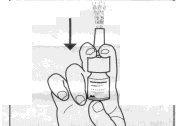
Figure 1
After this operation the valve remains activated unless you disassemble the bottle or use it very
rarely.
- Gently blow your nose to clear the nostrils
- Hold your head slightly bent, close one nostril with your finger and gently insert the nasal applicator into the other nostril;
- Press upwards on the bottom of the bottle to produce a spray (figure 2).
- Remove the bottle from your nose and keep your head back to allow the medicine to spread in your nose.
- Repeat the procedure in the other nostril.
- Reapply the protective cap.
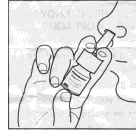
In case of blockage of the applicator, remove it and wash it in warm water for a few minutes. Do not use any
sharp object to try to clear the blockage.
If you use more KESOLthan you should
Using KESOL in excessive quantities does not cause serious health problems.
In case of ingestion/accidental intake of KESOL contact your doctor or go immediately to the
nearest hospital.
If you forget to use KESOL
Do not use a double dose to make up for the missed dose.
If you have any doubts about the use of this medicine, ask your doctor or pharmacist.
4. Possible side effects
Like all medicines, this medicine can cause side effects, although not everybody gets them.
The side effects that may occur are listed below:
Common(may affect up to 1 in 10 people)
- nosebleeds
Uncommon(may affect up to 1 in 100 people)
- allergic reactions, including delayed ones (immediate and delayed hypersensitivity) affecting the skin (itching, hives, rash, dermatitis, angioedema);
- sudden and involuntary muscle contraction (muscle spasm).
Rare(may affect up to 1 in 1,000 people)
- symptoms of systemic corticosteroid effects, including decreased activity of the adrenal gland (adrenal suppression) and growth retardation;
- lesions (ulceration) of the nasal mucosa, perforation of the nasal septum;
- allergic reactions, including severe ones (anaphylactic reactions);
- alteration of voice (dysphonia);
- bruising;
- blurred vision.
Frequency not known(the frequency cannot be estimated from available data)
- eye problems (cataract, glaucoma).
In rare cases, signs or symptoms of systemic side effects due to glucocorticosteroids may occur
with nasal glucocorticosteroids, probably depending on the dose, duration of exposure, concomitant and previous
exposure to corticosteroids, and individual sensitivity.
Additional side effects in children and adolescents
The use of KESOL at high doses and/or for prolonged periods may lead to widespread
(systemic) side effects such as growth retardation in children and adolescents.
Reporting of side effects
If you get any side effects, talk to your doctor or pharmacist. You can also report side effects directly
through the national reporting system at https://www.aifa.gov.it/content/segnalazioni-reazioni-avverse.
Figure 2
By reporting side effects you can help provide more information on the safety of
this medicine.
5. How to store KESOL
Keep this medicine out of the sight and reach of children.
Do not use this medicine after the expiry date which is stated on the pack after “Scad”. The expiry date
refers to the last day of that month.
Keep the container tightly closed. Store in the original packaging.
Do not store at temperatures above 25°C.
Each bottle must be used within 3 months of first opening.
Do not dispose of any medicine in wastewater or household waste. Ask your pharmacist how to dispose of
medicines you no longer use. This will help protect the environment.
6. Contents of the pack and other information
What KESOL 50 micrograms Nasal Spray, suspension contains
- The active ingredient is budesonide. 10 ml of suspension contains 10 mg of budesonide.
- The other ingredients are anhydrous glucose,
- microcrystalline cellulose, sodium carboxymethylcellulose (Avicel RC-591), potassium sorbate, polysorbate 80, disodium edetate, hydrochloric acid, purified water.
What KESOL 100 micrograms Nasal Spray, suspension contains
- The active ingredient is budesonide. 10 ml of suspension contains 20 mg of budesonide.
- The other ingredients are anhydrous glucose, microcrystalline cellulose, sodium carboxymethylcellulose (Avicel RC-591), potassium sorbate, polysorbate 80, disodium edetate, hydrochloric acid, purified water.
Description of the appearance of KESOL and contents of the pack
Amber glass bottle fitted with a metering valve.
Marketing Authorisation Holder
Genetic S.p.A.
Via G. Della Monica, 26
84083 Castel San Giorgio (SA)
Manufacturer
Genetic S.p.A. Contrada Canfora 84084 Fisciano (SA)

Nie jesteś pewien, czy ten lek jest odpowiedni dla ciebie?
Omów swoje objawy i leczenie z lekarzem online.

Zacząłeś przyjmować lek i masz pytania?
Omów swoje objawy i leczenie z lekarzem online.

- Kraj rejestracji
- Postać farmaceutycznaNasal spray, suspension, 50 MICROGRAMS
- Kod ATCR01AD05
- Substancja czynna
- Wymaga receptyNie
- Producent
- Te treści mają charakter wyłącznie informacyjny i nie zastępują konsultacji lekarskiej.
- Zamienniki KESOLPostać farmaceutyczna: Nasal spray, suspension, 50 MICROGRAMSSubstancja czynna: budesonideProducent: SCHARPER S.P.A.Bez receptyPostać farmaceutyczna: Nasal drops, suspension, 400 MICROGRAMSSubstancja czynna: fluticasoneProducent: GENETIC S.P.A.Bez receptyPostać farmaceutyczna: Nasal spray, suspension, 50 MICROGRAMSSubstancja czynna: mometasoneProducent: D.M.G. ITALIA S.R.L.Bez recepty
Odpowiedniki KESOL w innych krajach
Leki z tą samą substancją czynną dostępne w innych krajach.
Odpowiednik KESOL w Polska
Odpowiednik KESOL w Ukraina
Odpowiednik KESOL w Hiszpania
Lekarze online w sprawie KESOL
Omów stosowanie KESOL, bezpieczeństwo i ocenę zasadności recepty zgodnie z obowiązującymi przepisami.
Uzyskaj receptę na KESOL online
Wypełnij 2-minutowy formularz
Opisz swoje objawy, historię choroby i lek, o który prosisz.
Wybierz lekarza lub pozwól nam przydzielić
Wybierz specjalistę lub dopasujemy Cię do najbliższego dostępnego lekarza.
Lekarz analizuje Twój przypadek
Zazwyczaj w ciągu 30 minut. Może zadawać dodatkowe pytania przez czat.
Odbierz w dowolnej aptece
Recepta elektroniczna wysłana na Twój e-mail — ważna w całej Polsce.
Często zadawane pytania
KESOL nie wymaga recepty w Włochy. Możesz skonsultować się z lekarzem online, aby sprawdzić, czy ten lek może być odpowiedni w Twojej sytuacji.
Substancją czynną w KESOL jest budesonide. Informacja ta pomaga rozpoznać leki o tym samym składzie, ale pod różnymi nazwami handlowymi.
KESOL jest produkowany przez GENETIC S.P.A.. Nazwy handlowe i opakowania mogą się różnić w zależności od dystrybutora.
Lekarze, tacy jak Lekarze rodzinni, Psychiatrzy, Dermatolodzy, Kardiolodzy, Endokrynolodzy, Gastroenterolodzy, Pulmonolodzy, Nefrolodzy, Reumatolodzy, Hematolodzy, Zakaźnicy, Alergolodzy, Geriatrzy, Pediatrzy, Onkolodzy, mogą ocenić, czy stosowanie KESOL jest odpowiednie w Twoim przypadku, w zależności od sytuacji klinicznej i lokalnych przepisów. Możesz umówić konsultację online, aby omówić objawy i możliwe dalsze kroki.
Polska posiada dobrze rozwiniętą infrastrukturę ochrony zdrowia w dużych miastach, takich jak Warszawa, Kraków, Wrocław i Gdańsk. Apteki są łatwo dostępne i działają zgodnie z obowiązującymi przepisami, zapewniając dostęp do leków na receptę.
Możesz kupić KESOL w Warszawie, Krakowie, Wrocławiu lub Gdańsku w każdej aptece, posiadając ważną receptę.
Aby uzyskać receptę, możesz skorzystać z Oladoctor:
Inne leki zawierające tę samą substancję czynną (budesonide) to m.in. ELTAIR, AKTANOS, ARINIT. Mogą one różnić się nazwą handlową lub postacią, ale zawierają ten sam składnik terapeutyczny. Przed zmianą lub rozpoczęciem nowego leku skonsultuj się z lekarzem.
