



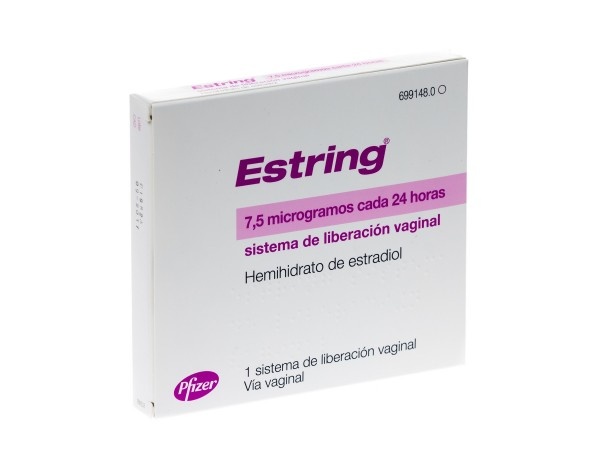
ESTRING 7.5 MICROGRAMS/24 HOURS Вагинальная система доставки

Рассмотрение рецепта онлайн
Врач рассмотрит ваш случай и примет решение о назначении рецепта, если это медицински оправдано.

Поговорите с врачом об этом лекарстве
Обсудите симптомы и возможные дальнейшие шаги на онлайн-консультации.



Инструкция по применению ESTRING
Содержание инструкции
Estring 7.5 micrograms/24 hours, vaginal device
estradiol hemihydrate
Read this leaflet carefully before using this medicine as it contains important
information for you.
- Keep this leaflet. You may need to read it again.
- If you have any questions, ask your doctor or pharmacist.
- This medicine has been prescribed for you only. Do not pass it on to others, even if they have the same symptoms as you, as it may be harmful.
- If you get any side effects, even those not listed in this leaflet, tell your doctor or pharmacist. See section 4.
Contents of this leaflet:
- 1. What Estring is and what it is used for
- 2. What you need to know before you use Estring
- 3. How to use Estring
- 4. Possible side effects 5 How to store Estring
- 6. Contents of the pack and other information
1. What Estring is and what it is used for
The Estring vaginal device is a vaginal ring that contains the active substance estradiol hemihydrate, a
natural form of estrogen, the main female sex hormone.
As the menopause approaches, women's ovaries produce a decreasing amount of
estrogens (also referred to as “the change”). Low levels of estrogen can cause symptoms such as
vaginal dryness, inflammation or itching, which in turn can lead to ulcers or painful sensations during
sexual intercourse, as well as an increased susceptibility to vaginal or urinary infections.
The Estring vaginal device is part of hormone replacement therapy (HRT) and acts locally in the
vagina to maintain adequate levels of estrogen to relieve these symptoms in post-
menopausal women. It does not treat other symptoms of menopause, such as hot flushes and sweating. Inform your doctor if
you also have these problems.
2. What you need to know before using Estring
Checking medical conditions
Estring may not be suitable for all women. Before starting to use Estring, your doctor should ask you
some questions about your medical history and your family history. Your doctor may decide to examine your breast
and/or abdomen and to perform a gynecological examination, but only if these examinations are necessary
for you or if you have particular concerns.
After starting HRT, it is important that you visit your doctor regularly for check-ups (at least
once a year). During check-ups, your doctor can assess with you the benefits and risks associated with
continuing HRT.
Pay attention to:
- Regularly undergoing breast screening testsand tests performed on a cervical smear (PAP test).
- Regularly checking your breastsfor any changes such as skin dimpling, nipple alterations or any visible or palpable lump.
Do not use Estring if you have the following conditions:
- If you are allergic to estradiol or to similar medicines for hormone replacement therapy or to any of the other ingredients of this medicine (listed in section 6).
- Hereditary blood disorders (porphyria).
- Estrogen-sensitive malignant tumor, such as endometrial cancer (uterine cancer) or if you suspect you have it.
- Current or previous presence of an ‘embolus’ (blood clots that move in the bloodstream and obstruct blood vessels in the leg or elsewhere, also known as deep vein thrombosis (DVT)).
- Malignant breast tumor, previous or current, or if you suspect you have it.
- Vaginal bleeding that your doctor is unaware of.
- Previous or current liver disease, if liver function tests are still abnormal.
- Excessive growth of the tissue lining the uterus (untreated endometrial hyperplasia).
- Current or previous obstruction of the arteries that could cause cardiovascular disease such as angina or heart attack.
- Blood coagulation disorder (thrombophilic disorder such as protein C, protein S or antithrombin deficiency).
If any of the above conditions should occur when you first use Estring, stop using it immediately
and consult your doctor immediately.
Warnings and precautions
Talk to your doctor or pharmacist before using Estring.
Before prescribing Estring, your doctor will assess your health status and carefully discuss with you the risks
and benefits of hormone replacement therapy. Tell your doctor if you now or have had in the past any
of the following conditions, to help them decide if you are suitable for treatment with Estring:
- A prolapse (weakening of the structures that support the internal organs) or if you have had surgery for a prolapse in the past.
- You are undergoing long-term steroid therapy or have problems with your adrenal glands, for example a disease called Cushing's disease (which can cause thinning or reddening of the skin).
- Vaginal disorders, bleeding or pain in the vagina including irritation or discharge that may be caused by ulcers or infection.
- If you have a short and narrow vagina due to previous surgery or as a result of a condition called vaginal atrophy.
- Fluid retention due to heart or kidney problems.
- High levels of triglycerides (a type of fat) in the blood.
- Liver disease (including liver tumors).
- Diabetes.
- Cases of malignant tumors (especially breast cancer) in the family.
- Risk factors for the formation of blood clots in the veins (venous thromboembolism or deep vein thrombosis), see section 2 below for the risks of taking Estring.
- High blood pressure.
- Migraine or severe headache.
- Uterine fibroids (growth of the uterine walls).
- Convulsions (epilepsy).
- Gallstones.
- Autoimmune disease, systemic lupus erythematosus (SLE).
- Diagnosis of endometrial hyperplasia (increased number of cells lining the uterus internally).
- Endometriosis (presence of tissues that line the uterus internally in areas other than the uterus).
- Problems with hearing caused by scarring in the ear (otosclerosis).
- Asthma.
- Estrogen-containing products can induce or exacerbate the symptoms of angioedema, especially in women with hereditary angioedema. Consult your doctor immediately if you experience symptoms such as swelling in some parts of the body (including the genitals), more frequently in the areas around the face, mouth, tongue and neck.
If any of the above conditions worsen or recur during the use of Estring, you should remove
the Estring vaginal device and see your doctor immediately.
Stop taking Estring and consult your doctor immediately
If you notice any of the following symptoms while taking HRT, remove the Estring vaginal device and
consult your doctor immediately. If you have difficulty or experience pain when trying to remove
the vaginal ring, do not continue and consult your doctor:
- if you develop any of the conditions mentioned in the “DO NOT use Estring” section;
- if you experience yellowing of the skin or whites of the eyes (jaundice). These may be signs of a liver disease;
- if you experience a sharp increase in blood pressure (symptoms may include headache, fatigue, dizziness);
- if you experience headaches similar to migraine that occur for the first time;
- if you become pregnant;
- if you notice signs of a blood clot, such as:
- swollen, red and painful legs;
- sudden chest pain;
- difficulty breathing. For more information, see “Blood clots in a vein (thrombosis)” Note:Estring is not a contraceptive. If less than 12 months have passed since your last menstrual period or if you are under 50 years of age, you may still need to use additional contraception to prevent pregnancy. Talk to your doctor.
HRT and cancer
Excessive thickening of the uterine lining (endometrial hyperplasia) and cancer of the
uterine lining (endometrial cancer)
Taking HRT based on estrogen alone in tablets for a long time can increase the
risk of developing cancer of the uterine lining (the endometrium).
It is not clear whether there is a similar risk with Estring, which is used for repeated or long-term treatments (more than one year). However, Estring has demonstrated very low absorption into the blood, so it is
not necessary to add a progestin.
If you experience bleeding or spotting between periods, it is usually not a cause for concern, but it is good
to make an appointment for a visit to your doctor. It may be a sign that the endometrium has
thickened.
The following risks come from medicines used in HRT that circulate in the blood. However, Estring is
intended for local treatment in the vagina and absorption into the blood is very low. It is less likely that
the following conditions will worsen or recur during treatment with Estring, but you should see your
doctor if you have concerns.
Breast cancer
Evidence suggests that taking combined estrogen-progestin HRT and possibly also estrogen-only HRT increases the risk of breast cancer. The additional risk depends on the
duration of HRT use. The additional risk becomes clear within a few years. However, it returns
to normal within a few years (at most 5) after stopping treatment.
Check your breasts regularly. Consult your doctor if you notice changes such as:
- skin dimpling;
- changes in the nipple;
- any visible or palpable lump;
In addition, it is recommended that you participate in breast screening programs when they are
offered to you.
Ovarian cancer
Ovarian cancer is rare, much rarer than breast cancer. The use of estrogen-only HRT has been associated with a slight increase in the risk of ovarian cancer.
The risk of ovarian cancer varies with age. For example, in women aged 50 to 54 who
do not take HRT, about 2 out of 2000 will be diagnosed with ovarian cancer over a 5-year period. In women who have taken HRT for 5 years, about 3 cases will be detected per 2000 users
(i.e., about 1 additional case).
Effect of HRT on the heart and circulation
Blood clots in a vein (thrombosis)
The risk of blood clots in the veinsis 1.3 to 3 times higher in women who take HRT
compared to those who do not, especially during the first year of use.
Blood clots can be serious, and if one of them reaches the lungsit can cause chest pain,
shortness of breath, collapse or even death. This condition is called pulmonary embolismor PE.
DVT and PE are examples of a condition called venous thromboembolismor VTE.
It is easier to develop a blood clot in a vein if you are older and if one of the
following conditions applies to you. Tell your doctor if one of these situations applies to you:
- if you have cancer;
- if you are severely overweight;
- if you have had a blood clot;
- if a close relative has had blood clots;
- if you have had one or more miscarriages;
- if you have a blood clotting problem that requires treatment with a medicine such as warfarin;
- if you are unable to walk for a long period due to major surgery, an injury or illness;
- if you have a rare disease called SLE.
If any of these points apply to you, talk to your doctor to find out if you can take HRT.
Considering fifty-year-old womenwho do not take HRT, on average over 5 years
4-7 out of 1000 are expected to develop a blood clot.
For fifty-year-old womenwho takeHRT, based on estrogen alone for more than 5 years, the forecast
rises to 5-8 cases per 1000 patients (i.e., 1 additional case).
If you have:
- a swollen and painful leg;
- sudden chest pain;
- difficulty breathing.
See your doctor as soon as possibleand do not take any HRTuntil your doctor
allows you to. These may be signs of a blood clot.
If you are about to undergo surgery,make sure your doctor is aware of this. You may
need to stop taking HRT about 4-6 weeks before the operation, to reduce the risk of
developing a blood clot. Your doctor will tell you when you can start taking it again.
Heart disease
In women who take estrogen-only therapy, there is no increase in the risk of developing
heart disease.
Stroke
The risk of stroke is approximately 1.5 times higher in women who take HRT compared to those who do not. The number of additional cases of stroke due to HRT use will increase with age. Other factors
that can increase the risk of stroke are:
- aging;
- high blood pressure;
- smoking;
- drinking too much alcohol;
- an irregular heartbeat.
If you are concerned about any of these points, or if you have had a stroke in the past, talk to your
doctor to find out if you can take HRT.
Considering fifty-year-old womenwho do not take HRT, on average over 5 years
8 out of 1000 are expected to have a stroke.
For fifty-year-old womenwho take HRT, the forecast over 5 years rises to 11 out of 1000
(i.e., 3 additional cases).
If you have:
- unexplained headaches similar to migraine, with or without visual disturbances see your doctor as soon as possibleand do not take any HRTuntil your doctor allows you to. These headaches may be an early sign of a stroke.
Other information
HRT will not prevent memory loss. In one study of women who started
using combined or estrogen-only HRT, a slight increase in the risk of dementia was observed after the age of 65.
Women who already have high levels of triglycerides in the blood may experience further sharp increases in
triglycerides, which can cause inflammation of the pancreas (pancreatitis). Symptoms of pancreatitis
include abdominal pain, a bloated abdomen, fever, and nausea or vomiting.
Blood tests
If you are about to have blood tests (for example to check for an excess of triglycerides, a
type of fat in the blood), you should tell your doctor that you are using Estring, as the use
of the vaginal device may affect the tests.
Other medicines and Estring
Tell your doctor or pharmacist if you are taking or have recently taken any other medicines,
including those available without a prescription.
In particular, tell your doctor if you are taking:
- anticonvulsants, used in the treatment of epilepsy, such as phenobarbital, phenytoin or carbamazepine;
- antimicrobials, such as rifampicin or rifabutin;
- medicines used to treat HIV, such as ritonavir, nelfinavir, nevirapine, or efavirenz;
- herbal preparations based on St John's wort ( Hypericum perforatum). It is recommended to remove the ring if you experience constipation or during the use of vaginal preparations.
Pregnancy and breastfeeding
Estring must not be used during pregnancy. If you become pregnant while using Estring, you should stop
using it immediately and tell your doctor that you are pregnant. Estring must not be used during
breastfeeding. Before taking any medicine while breastfeeding, ask your doctor or
pharmacist for advice.
Driving and using machines
No particular precautions are necessary; if you feel well you can drive or use machines.
3. How to use Estring
Use this medicine following the instructions of your doctor exactly. If you have any doubts, consult your doctor
or pharmacist. Carefully follow the instructions below. Before inserting the vaginal device
Estring, wash your hands thoroughly.
To insert Estring into the vagina
- Relax and find a comfortable position, for example standing with one foot on a stool, or lying on your back with your knees bent upwards.
- With one hand, widen the folds of skin around the vagina.
- With the other hand, compress the ring to give it an oval shape.
- Push the ring as far as possible inside the vagina, upwards and backwards, towards the lower back.
- Finally, wash your hands. If the ring comes out, you should rinse it with lukewarm (not hot) water and then reinsert it.
During use of Estring
You may feel the presence of the ring at first, but this is a sensation that should not
persist. It may take several weeks for the ring to reach full effectiveness. As soon as the ring
starts to work, you may notice an increase in vaginal lubrication (moisture), which is normal, essentially a return to the condition before menopause. Most women and their
partners have found the presence of the ring in the vagina acceptable during sexual intercourse. If the ring is uncomfortable for you or
your partner, or if you cannot accept it, it can be removed. During the effort
required to have a bowel movement, the ring may slide down the vagina and you may feel its
presence. If this happens, you can simply put it back in place with your finger. If you know you suffer from
constipation or need to strain to have a bowel movement, remove the ring preventively.
To remove Estring from the vagina
- Relax and find a comfortable position, for example standing with one foot on a stool, or lying on your back with your knees bent upwards.
- With one hand, widen the folds of skin around the vagina.
- With the other hand, hook the ring with your finger.
- Gently remove the ring by pulling it downwards and forwards.
- Finally, wash your hands.
How long can the ring be used
Each ring can be left in continuously for 3 months, so, if necessary, it should be replaced with
a new one. The maximum recommended duration for continuous therapy is two years. The doctor will try to
prescribe the minimum effective dose and the intake of HRT should only continue as long as the
benefits in terms of relief from important symptoms outweigh the risks.
Routine checks during use of Estring
You should regularly participate in national screening programmes for breast cancer and for
cervical cancer. Your doctor will provide you with further details. You should also report to
your doctor as soon as possible any changes in your breasts.
If you stop treatment with the ring
Symptoms may return after about 3 weeks.
Use in children
The use of Estring vaginal device is not recommended in children.
If you have any doubts about the use of this medicine, ask your doctor or pharmacist.
4. Possible side effects
Like all medicines, this medicine can cause side effects, although not everybody gets them.
The following conditions are reported more often in women taking medicines used in HRT (hormone replacement therapy) that
circulate in the blood compared to women who are not taking HRT. These risks are reduced for treatments administered vaginally such as Estring:
- breast cancer;
- ovarian cancer;
- blood clots in the legs or lungs (venous thromboembolism);
- stroke;
- possible memory loss if HRT is started over the age of 65.
For more information about these side effects, see paragraph 2.
If you develop any of the conditions listed in “Do not use Estring if” or those listed in “Stop using Estring and consult your doctor immediately” or if you experience any of the side effects listed below, remove Estring vaginal device and see your doctor immediately. If you have difficulty or pain when trying to remove the vaginal ring, do not continue and see your doctor.
- symptoms of an allergic reaction, including skin rash, hives, itching. These occur with uncommonfrequency (may affect up to 1 in 100 people using Estring);
- persistent or severe vaginal discomfort, ulcer or swelling after inserting the ring. These occur rarely(may affect up to 1 in 1000 people using Estring).
There have been rare reports of the vaginal ring adhering to the vaginal wall, making it difficult to remove the ring. Some women have had to undergo surgery to remove the vaginal ring.
Common side effectscan affect 1 in 10 people using Estring:
- urinary tract infection;
- infection and itching inside and around the vagina;
- discomfort/pain in the upper abdomen;
- persistent awareness of the ring in the vagina or pressure on the bladder and/or rectum;
- pain when urinating;
- generalised itching;
- increased sweating.
The above symptoms occur more often in untreated postmenopausal women.
Other side effectsreported during treatment of patients with other forms of estrogen therapy include:
Common side effectscan affect up to 1 in 10 people
- depression;
- hair loss;
- joint pain;
- leg cramps;
- unusual and unexpected bleeding or spotting between periods;
- vaginal discharge;
- breast pain, painful breasts to the touch, breast swelling, nipple discharge;
- weight changes (increase or decrease);
- changes in triglyceride levels (fats in the blood);
Uncommon side effectscan affect up to 1 in 100 people
- blood clot in the legs or lungs. See “ Stop using Estring and consult your doctor immediately”;
- vaginal inflammation;
- candidiasis (thrush) infection;
- changes in sex drive (increased or decreased libido);
- mood changes;
- anxiety;
- headache or migraine;
- dizziness;
- difficulty wearing contact lenses;
- feeling unwell, feeling bloated, abdominal pain;
- gallbladder disease
- changes in skin colour, especially on the face or neck, known as “chloasma” (pregnancy spots);
- increased hair growth;
- pruritus (itching);
- skin rash;
- changes in menstrual flow;
- changes in vaginal discharge;
- visible swelling of the face or ankles;
The following side effects have been reported with other HRT:
Not known(frequency cannot be estimated from the available data)
- memory loss (dementia);
- painful and reddish skin nodules (erythema nodosum);
- skin rash with redness or blister-like lesions in a target shape (erythema multiforme).
Reporting of side effects
If you get any side effects, talk to your doctor or pharmacist. This includes any possible side effects not listed in this leaflet. You can also report side effects directly through the national reporting system at http://www.aifa.gov.it/content/segnalazioni-reazioni-avverse . .
By reporting side effects you can help provide more information on the safety of this medicine.
5. How to store Estring
Do not store at a temperature above 25 C.
Keep this medicine out of the sight and reach of children.
Do not use the medicine after the expiry date which is stated on the pack and also on the sachet after
“Exp.” The expiry date refers to the last day of that month.
Do not use the Estring vaginal device if it appears discolored, deformed or if the surface is not smooth.
Used rings still contain some of the hormonal active substance. The used ring must be placed
in the original sachet or in a plastic bag that will be sealed and disposed of safely, out of the reach
and sight of children.
Do not dispose of any medicine in wastewater or household waste. Ask your pharmacist how to eliminate
medicines that you no longer use. This will help protect the environment.
6. Contents of the pack and other information
What Estring contains
- The active ingredient in Estring is estradiol hemihydrate 2 mg, equivalent to 1.94 mg of estradiol.
- The other components are liquid silicone, barium sulfate, silicone elastomer Q7-4735A, silicone elastomer Q7-4735B.
Description of the appearance of Estring and contents of the pack
The Estring vaginal ring is a slightly opaque ring made of silicone elastomer, with a whitish core
containing the reservoir of the active ingredient, estradiol hemihydrate.
Estring is individually packaged in a heat-sealed rectangular sachet consisting of (from the outside
inwards): polyester/aluminum/low-density polyethylene. Each sachet has, on one side, a notch
for tear-open access and is packaged in a cardboard box.
Marketing authorization holder and manufacturer
Marketing authorization holder
Pfizer Italia Srl, Via Isonzo 71, 04100 Latina
Manufacturer
QPharma AB, Agneslundsvägen, 27, SE-201 25, Malmö, Sweden
This medicinal product is authorised in the Member States of the European Economic Area under the following
names:
| e Spain, France, Italy, Luxembourg, Slovenia, Belgium, United Kingdom | Estring |

Не уверены, подходит ли вам это лекарство?
Обсудите симптомы и варианты лечения с врачом онлайн.

Уже начали прием и появились вопросы?
Обсудите свое состояние и дальнейшие шаги с врачом онлайн.
- Страна регистрации
- Форма выпускаVaginal delivery system, 7.5 MICROGRAMS/24 HOURS
- Код АТХG03CA03
- Действующее вещество
- Отпускается по рецептуДа
- Производитель
- Информация на этой странице носит справочный характер и не является медицинской консультацией. Перед началом приема лекарства обязательно проконсультируйтесь с врачом.
- Аналоги ESTRINGФорма выпуска: Transdermal patch, 25 MICROGRAMS/24 HOURSДействующее вещество: ЭстрадиолПроизводитель: EXELTIS ITALIA S.R.L.Отпускается по рецептуФорма выпуска: Transdermal patch, 25 MCGДействующее вещество: ЭстрадиолПроизводитель: Merus Labs Luxco II S.a.r.l.Отпускается по рецептуФорма выпуска: Gel, <0.1%Действующее вещество: ЭстрадиолПроизводитель: THERAMEX IRELAND LIMITEDОтпускается по рецепту
Аналоги ESTRING в других странах
Лекарства с тем же действующим веществом, доступные в других странах.
Аналог ESTRING в Испания
Аналог ESTRING в Польша
Аналог ESTRING в Украина
Врачи онлайн по ESTRING
Обсудите применение ESTRING и возможные следующие шаги — по оценке врача.


Получите рецепт на ESTRING онлайн
Заполните форму за 2 минуты
Расскажите о симптомах, истории болезни и нужном препарате.
Выберите врача или мы назначим
Выберите специалиста или мы подберём ближайшего доступного врача.
Врач рассматривает ваш случай
Обычно в течение 30 минут. Может задать уточняющие вопросы в чате.
Получите в любой аптеке
Электронный рецепт отправляется на вашу почту — действителен по всей Польше.
Часто задаваемые вопросы
ESTRING требует рецепта в Италия. Вы можете уточнить у врача онлайн, подходит ли это лекарство для вашей ситуации.
Действующее вещество ESTRING — Эстрадиол. Эта информация помогает определить лекарства с тем же составом под другими торговыми названиями.
ESTRING производится компанией PFIZER ITALIA S.R.L.. Упаковка и торговое название могут отличаться в зависимости от дистрибьютора.
Врачи, включая Семейные врачи, Психиатры, Дерматологи, Кардиологи, Эндокринологи, Гастроэнтерологи, Пульмонологи, Нефрологи, Ревматологи, Гематологи, Инфекционисты, Аллергологи, Гериатры, Педиатры, Онкологи, могут оценить целесообразность применения ESTRING с учетом вашей ситуации и местных правил. Вы можете записаться на онлайн-консультацию, чтобы обсудить возможные варианты.
Польша имеет хорошо развитую систему здравоохранения в крупных городах, таких как Варшава, Краков, Вроцлав и Гданьск. Аптеки широко доступны и работают в соответствии с действующим законодательством, обеспечивая доступ к рецептурным препаратам.
Вы можете купить ESTRING в Варшаве, Кракове, Вроцлаве или Гданьске в любой аптеке при наличии действующего рецепта.
Чтобы получить рецепт, вы можете воспользоваться Oladoctor:
Другие лекарства с тем же действующим веществом (Эстрадиол) включают DERMESTRIL, ESTRADERM MX, ESTREVA. Они могут отличаться торговым названием или формой выпуска, но содержат одинаковый терапевтический компонент. Перед изменением лечения рекомендуется проконсультироваться с врачом.
