



DESMOPRESSINA 60 MICROGRAMS Sublingual tablet

Запит на рецепт онлайн
Лікар розгляне ваш випадок і визначить, чи є рецепт медично доцільним.

Поговоріть з лікарем про ці ліки
Обговоріть симптоми та можливі подальші кроки під час короткої онлайн-консультації.



Інструкція із застосування DESMOPRESSINA TSENTIVA
Зміст інструкції
Desmopressina Zentiva 60 micrograms sublingual tablets, 120 micrograms sublingual tablets, 240 micrograms sublingual tablets
Generic medicine
Read this leaflet carefully before you start taking this medicine as it contains important information for you.
- Keep this leaflet. You may need to read it again.
- If you have any questions, ask your doctor or pharmacist.
- This medicine has been prescribed for you only. Do not pass it on to others, even if their symptoms are the same as yours, as it could be harmful.
- If you get any side effects, even those not listed in this leaflet, tell your doctor or pharmacist. See section 4.
Contents of this leaflet
- 1. What Desmopressina Zentiva is and what it is used for
- 2. What you need to know before you take Desmopressina Zentiva
- 3. How to take Desmopressina Zentiva
- 4. Possible side effects
- 5. How to store Desmopressina Zentiva
- 6. Contents of the pack and other information
1. What is Desmopressina Zentiva and what is it used for
Desmopressin, the active ingredient of Desmopressina Zentiva, acts like the natural hormone
vasopressin and regulates the kidneys' ability to concentrate urine.
Desmopressina Zentiva is used to treat:
- Central diabetes insipidus (a pituitary disorder that leads to severe thirst and the excretion of a large amount of urine, usually pale and similar to water).
- Nocturnal enuresis in children aged 5 years and over with normal urine concentrating ability (involuntary urination at night during sleep).
- Nocturia in adults under 65 years of age (a condition in which a person frequently wakes up during the night to urinate).
2. What you need to know before you take Desmopressina Zentiva
Do not take Desmopressina Zentiva:
- if you are allergic to desmopressin or any of the other ingredients of this medicine (listed in section 6)
- if you suffer from polydipsia (abnormally high fluid intake), heart failure and other conditions that require treatment with diuretics
- if you have moderately or severely reduced kidney function
- if you have low levels of sodium in the blood
- if you are unable to comply with fluid restriction
- if you have a disturbed hormone secretion (so-called SIADH)
- if you are over 65 years of age and suffer from nocturia (see section 1)
- if your child is under 5 years of age and suffers from nocturnal enuresis (see section 1)
Warnings and precautions
The management of nocturnal enuresis (involuntary night-time urination) in children begins with lifestyle measures and a nocturnal enuresis alarm (a device that makes a sound or vibrates when urine is lost). If these measures fail or pharmacological therapy is necessary, treatment with desmopressin can be started. Tell your doctor before using
Desmopressina Zentiva:
- if you suffer from coronary heart disease (blood vessels that supply the heart) or hypertension
- if you have a thyroid (gland in the neck) or adrenal gland (gland above the kidney) disease.
- if you develop a disease during treatment that causes fever, vomiting, diarrhea.
- if you experience headache, loss of appetite, nausea, vomiting, weight gain, confusion (difficulty understanding words, difficulty concentrating) or convulsions (violent and involuntary contractions of one or more limbs) during treatment; these symptoms may be signs of a dangerous condition known as hyponatremia (low sodium levels in the blood)
- for the treatment of central diabetes insipidus: reduce water intake and consult a doctor immediately. The doctor will reduce the doses or interrupt the treatment for a few hours.
- for the treatment of nocturnal enuresis or nocturia: stop treatment, reduce water intake and consult a doctor immediately.
- if you are at risk of increased pressure in the skull
In the treatment of nocturnal enuresis and nocturia, fluid intake should be limited to the minimum possible to manage thirst during the period from 1 hour before and 8 hours after
taking this medicine.
Desmopressina Zentiva should be used with caution in patients with fluid balance disturbances.
Talk to your doctor if, in relation to an acute illness, you have a disturbed fluid and/or electrolyte balance.
Children
In children, the use of this medicine should be carried out under the supervision of an adult. Do not
give this medicine to children under 5 years of age.
Other medicines and Desmopressina Zentiva
Tell your doctor or pharmacist if you are taking, have recently taken or might take any other
medicines, including those available without a prescription.
The effect of Desmopressina Zentiva may be increased, with a higher risk of an abnormal amount of
residual fluid in the body, if taken at the same time as some medicines used to treat:
- depression (such as tricyclic antidepressants, selective serotonin reuptake inhibitors)
- psychosis (such as chlorpromazine)
- epilepsy (such as carbamazepine)
- diabetes (so-called sulfonylureas, for example chlorpropamide)
- diarrhea (such as loperamide)
- pain and inflammation (so-called NSAIDs)
The effect of Desmopressina Zentiva may be reduced if taken at the same time as some
medicines for:
- stomach gas (such as dimethicone)
Desmopressina Zentiva with food and drink
If you are taking this medicine for nocturnal enuresis or nocturia, you should limit fluid intake from 1 hour before taking the tablet up to 8 hours after taking the tablet.
The effect of this medicine may be reduced if the tablet is taken with food.
Pregnancy and breastfeeding
If you are pregnant or breastfeeding, think you may be pregnant or are planning to become pregnant, ask
your doctor or pharmacist for advice before taking this medicine. Experience with the use of
desmopressin during pregnancy is limited. Desmopressina Zentiva passes into breast milk, but it is
unlikely to have effects on breastfed babies.
Driving and operating machinery
Desmopressina Zentiva has no or negligible effect on the ability to drive vehicles and operate
machinery.
Desmopressina Zentiva contains lactose
Desmopressina Zentiva contains lactose (a type of sugar). If you have been told by your doctor that you
have an intolerance to some sugars, contact your doctor before taking this medicine.
Desmopressina Zentiva contains sodium
This medicine contains less than 1 mmol (23 mg) of sodium per tablet, i.e. essentially
‘sodium-free’.
For athletes
The use of the drug without therapeutic necessity constitutes doping and may still result in positive anti-doping tests.
3. How to take Desmopressina Zentiva
Take this medicine following the instructions of your doctor exactly. Check with your doctor or
pharmacist if you are not sure.
The dose is established by the doctor, who will adjust it individually for you. Desmopressina Zentiva must
always be taken at the same time in relation to food intake.
The sublingual tablet should be placed under the tongue where it dissolves without water.
Diabetes insipidus
The usual dose for adults and children is 1-2 tablets under the tongue (tablet of 60 micro-
grams) 3 times a day.
Nocturnal enuresis
The usual dose is 1-2 tablets (tablet of 120 micrograms) under the tongue in the evening. You must
take this medicine before going to bed. Fluid intake should be limited.
The doctor will check every three months to see if the treatment needs to be continued. The doctor may
establish a treatment-free period of at least one week.
Nocturia in adults
The usual dose is 1 tablet (tablet of 60 micrograms) under the tongue before going to bed.
Fluid intake should be limited.
Use in children
This medicine is used for the treatment of diabetes insipidus and nocturnal enuresis (see above
the dosage for the different treatment conditions). The dosage is the same for children and adults only
for diabetes insipidus.
If you take more Desmopressina Zentiva than you should
If you take more medicine than you should or if, for example, a child has accidentally ingested the
medicine, contact a doctor, hospital or pharmacist immediately for a risk assessment and advice. Taking too much Desmopressina Zentiva can prolong the effect of this medi-
cine and increase the risk of fluid retention in the body and a low level of sodium in the blood. Symptoms of severe fluid retention include convulsions and loss of consciousness.
If you forget to take Desmopressina Zentiva
Do not take a double dose to make up for a missed tablet. If you have further questions about the use of this product, ask your doctor or pharmacist.
If you stop taking Desmopressina Zentiva
If you have any doubts about the use of this medicine, ask your doctor or pharmacist.
4. Possible side effects
Like all medicines, this medicine can cause side effects, although not everybody gets them.
If fluid intake is not limited according to the above instructions, abnormal amounts of fluid can accumu-
late in the body, which can lead to headache, stomach pain, nausea/vo-
miting, weight gain, dizziness, confusion, malaise, a feeling of spinning, and, in severe cases, convul-
sions and coma. These signs may reflect more or less significant fluid retention. They usually occur with high doses of Desmopressina Zentiva and disappear when the dose is reduced.
Adults
Very common(may affect more than 1 in 10 people)
- Headache
Common(may affect up to 1 in 10 people)
- Low sodium levels in the blood
- Dizziness
- Hypertension
- Stomach pain
- Nausea
- Diarrhea
- Constipation
- Vomiting
- Discomfort in the bladder and urethra
- Swelling of hands, arms, feet or legs
- Fatigue
Uncommon(may affect up to 1 in 100 people)
- Difficulty sleeping
- Drowsiness
- Tingling
- Visual disturbances
- General feeling of rotation (vertigo)
- Feeling the heartbeat
- Low blood pressure when getting up from a lying position
- Shortness of breath
- Stomach disorders (indigestion, flatulence, bloating)
- Sweating
- Itching
- Skin rash
- Urticaria
- Muscle spasms
- Muscle pain
- Chest pain
- Flu-like symptoms
- Weight gain
- Increased liver enzymes
- Low potassium levels in the blood.
Rare(may affect up to 1 in 1,000 people)
- Confusion
- Allergic skin inflammation.
Frequency not known(the frequency cannot be estimated on the basis of available data)
- Anaphylactic reaction (severe allergic reaction)
- Dehydration
- High sodium levels in the blood
- Convulsions
- Weakness
- Coma.
Children
Common(may affect up to 1 in 10 people)
- Headache.
Uncommon(may affect up to 1 in 100 people)
- Rapidly changing emotions
- Aggression
- Nausea
- Stomach pain
- Vomiting
- Diarrhea
- Discomfort in the bladder and urethra
- Swollen hands and feet
- Fatigue.
Rare(may affect up to 1 in 1,000 people)
- Anxiety
- Nightmares
- Mood swings
- Drowsiness
- Hypertension
- Irritability.
Frequency not known(the frequency cannot be estimated on the basis of available data)
- Anaphylactic reaction (severe allergic reaction)
- Low sodium levels in the blood
- Abnormal behavior
- Emotional disorders
- Depression
- Hallucinations
- Difficulty sleeping
- Reduced attention
- Increased muscle movements
- Cramps
- Nosebleeds
- Skin rash
- Allergic skin inflammation
- Sweating
- Urticaria.
Reporting of suspected adverse reactions
If you get any side effects, even those not listed in this leaflet, tell your
doctor or pharmacist. You can also report side effects directly through the national
reporting system at: https://www.aifa.gov.it/content/segnalazioni-reazioni-avverse .
By reporting side effects you can help provide more information on the safety of
this medicine.
5. How to store Desmopressina Zentiva
Keep this medicine out of the sight and reach of children.
Do not use this medicine after the expiry date which is stated on the blister, label, outer pack or bottle after “EXP”. The expiry date refers to the last day of that month.
[For blisters]
Store in the original blister pack to protect from moisture. This medicine does not require any particular storage temperature.
[For HDPE containers]
Store in the original packaging. Keep the bottle tightly closed to protect it from moisture. Do not
store above 30°C.
Do not dispose of any medicine in wastewater or household waste. Ask your pharmacist how to eliminate medicines you no longer use. This will help protect the environment.
6. Package Contents and Other Information
What Desmopressina Zentiva Contains
The active ingredient is desmopressin.
Desmopressina Zentiva 60 micrograms sublingual tablets
Each tablet contains 60 micrograms of desmopressin (as desmopressin acetate)
Desmopressina Zentiva 120 micrograms sublingual tablets
Each tablet contains 120 micrograms of desmopressin (as desmopressin acetate)
Desmopressina Zentiva 240 micrograms sublingual tablets
Each tablet contains 240 micrograms of desmopressin (as desmopressin acetate)
- The other ingredients are: lactose monohydrate, corn starch, citric acid (E 330), sodium croscarmellose (E 468), magnesium stearate (E 470b)
Description of the appearance of Desmopressina Zentiva and contents of the pack
Desmopressina Zentiva 60 micrograms sublingual tablets
White or almost white, round, biconvex tablet with “I” imprinted on one side and flat on the other side, with a diameter of 6.5 mm and a thickness of 2 mm.
Desmopressina Zentiva 120 micrograms sublingual tablets
White or almost white, octagonal, biconvex tablet with “II” imprinted on one side and flat on the other side, with a length/width of 6.5 mm and a thickness of 2 mm.
Desmopressina Zentiva 240 micrograms sublingual tablets
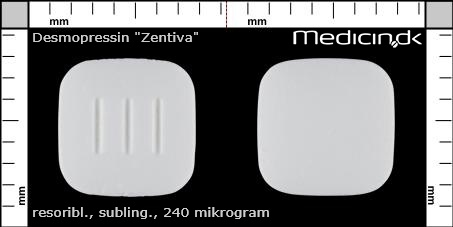
White or almost white, square, biconvex tablet with ‘III’ imprinted on one side and flat on the other side with a length/width of 6 mm and a thickness of 2 mm.
Desmopressina Zentiva is supplied in a cardboard box containing OPA/Al/PVC/PE-Al blister packs with an integrated desiccant in packs of 10, 20, 30, 50, 60, 90, 100 sublingual tablets or perforated blisters for unit dose of 10 x 1, 20 x 1, 30 x 1, 50 x 1, 60 x 1, 90 x 1 and 100 x 1 sublingual tablets, or in HDPE bottles with a PP cap with an integrated desiccant containing 30 or 100 sublingual tablets.
Not all pack sizes may be marketed.
Marketing Authorisation Holder and Manufacturer
Marketing Authorisation Holder
Zentiva Italia S.r.l.
Via P. Paleocapa, 7
20121 Milan
Manufacturer
Haupt Pharma Mϋnster GmbH
Schleebrüggenkamp 15,
D-48159 Münster, Germany
Adalvo Ltd.
Malta Life Sciences Park,
Building 1, Level 4, Sir Temi Zammit Buildings,
San Gwann, SGN 3000 Malta
This medicinal product is authorised in the Member States of the European Economic Area with the
following denominations:
Iceland, Denmark, Finland, Norway and Sweden - Desmopressin Zentiva
Italy - Desmopressina Zentiva
France - DESMOPRESSINE ZENTIVA 60 micrograms, sublingual tablet
DESMOPRESSINE ZENTIVA 120 micrograms, sublingual tablet
DESMOPRESSINE ZENTIVA 240 micrograms, sublingual tablet
Portugal (60/120 mcg only) - Desmopressina Zentiva

Не впевнені, чи підходить вам цей лікарський засіб?
Обговоріть симптоми та можливі варіанти лікування з лікарем онлайн.

Виникли питання під час прийому ліків?
Обговоріть свої симптоми та лікування з лікарем онлайн.
- Країна реєстрації
- Лікарська формаSublingual tablet, 60 MICROGRAMS
- Код АТХH01BA02
- Діюча речовина
- Потрібен рецептТак
- Виробник
- Ця інформація надана лише для ознайомлення і не є медичною порадою. Рішення щодо лікування завжди приймає лікар.
- Альтернативи до DESMOPRESSINA TSENTIVAЛікарська форма: Sublingual tablet, 60 MICROGRAMSДіюча речовина: ДезмопрессинВиробник: TEVA ITALIA S.R.L.Потрібен рецептЛікарська форма: Injectable solution, 4 MCG/0.5 MLДіюча речовина: ДезмопрессинВиробник: KEDRION S.P.A.Потрібен рецептЛікарська форма: Injectable solution, 4 MCG/MLДіюча речовина: ДезмопрессинВиробник: FERRING S.P.A.Рецепт не потрібен
Аналоги DESMOPRESSINA TSENTIVA в інших країнах
Препарати з тією самою діючою речовиною, доступні в інших країнах.
Аналог DESMOPRESSINA TSENTIVA у Іспанія
Аналог DESMOPRESSINA TSENTIVA у Польща
Аналог DESMOPRESSINA TSENTIVA у Україна
Лікарі онлайн щодо DESMOPRESSINA TSENTIVA
Застосування, безпека та можливість призначення рецепта — за результатами медичної оцінки.









Отримайте рецепт на DESMOPRESSINA TSENTIVA онлайн
Заповніть форму за 2 хвилини
Розкажіть про симптоми, історію хвороби та потрібний препарат.
Оберіть лікаря або ми призначимо
Оберіть спеціаліста або ми підберемо найближчого доступного лікаря.
Лікар розглядає ваш випадок
Зазвичай протягом 30 хвилин. Може ставити уточнювальні запитання в чаті.
Отримайте в будь-якій аптеці
Електронний рецепт надсилається на вашу пошту — дійсний по всій Польщі.
Часті запитання
DESMOPRESSINA TSENTIVA потребує рецепта в Італія. Ви можете обговорити з лікарем онлайн, чи підходить цей лікарський засіб для вашої ситуації.
Діюча речовина у DESMOPRESSINA TSENTIVA — Дезмопрессин. Це допомагає визначити препарати з тим самим складом, але під іншими торговими назвами.
DESMOPRESSINA TSENTIVA виробляється компанією ZENTIVA ITALIA S.R.L.. Назва бренду та упаковка можуть відрізнятися залежно від дистрибʼютора.
Лікарі, зокрема Сімейні лікарі, Психіатри, Дерматологи, Кардіологи, Ендокринологи, Гастроентерологи, Пульмонологи, Нефрологи, Ревматологи, Гематологи, Інфекціоністи, Алергологи, Геріатри, Педіатри, Онкологи, можуть оцінити доцільність застосування DESMOPRESSINA TSENTIVA з урахуванням вашого стану та місцевих правил. Ви можете записатися на онлайн-консультацію, щоб обговорити симптоми та можливі подальші кроки.
Польща має добре розвинену систему охорони здоров'я у великих містах, таких як Варшава, Краків, Вроцлав і Гданськ. Аптеки широко доступні та працюють відповідно до чинного законодавства, забезпечуючи доступ до рецептурних препаратів.
Ви можете придбати DESMOPRESSINA TSENTIVA у Варшаві, Кракові, Вроцлаві або Гданську в будь-якій аптеці за наявності дійсного рецепта.
Щоб отримати рецепт, ви можете скористатися Oladoctor:
Інші препарати з тією самою діючою речовиною (Дезмопрессин) включають DESMOPRESSINA TEVA, EMOSINT, MINIRIN/DDAVP. Вони можуть відрізнятися торговою назвою або формою випуску, але містять той самий терапевтичний компонент. Перед зміною або початком прийому нового препарату варто проконсультуватися з лікарем.
