



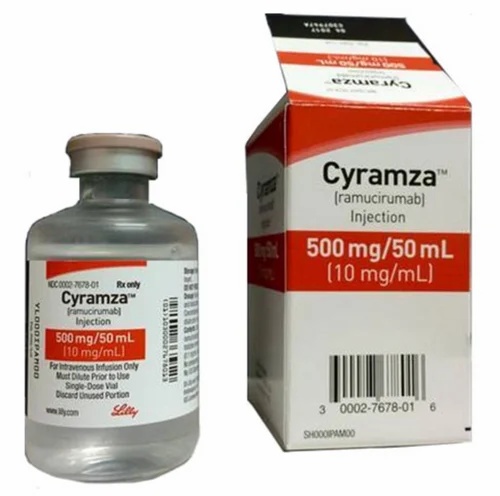
CYRAMZA 10 mg /Ml Koncentrat Do Sporządzania Roztworu Infuzyjnego

Ocena recepty online
Lekarz przeanalizuje Twój przypadek i zdecyduje, czy wystawienie recepty jest medycznie uzasadnione.

Porozmawiaj z lekarzem o tym leku
Omów swoje objawy i opcje leczenia podczas szybkiej konsultacji online.



Jak stosować KYRAMTSA
Treść ulotki
Cyramza 10 mg/ml concentrate for solution for infusion
ramucirumab
Read this leaflet carefully before you are given this medicine as it contains
important information for you.
- Keep this leaflet. You may need to read it again.
- If you have any questions, ask your doctor.
- If you get any side effects, even those not listed in this leaflet, tell your doctor. See section 4.
Contents of this leaflet
- 1. What Cyramza is and what it is used for
- 2. What you need to know before you are given Cyramza
- 3. How to be given Cyramza
- 4. Possible side effects
- 5. How to store Cyramza
- 6. Contents of the pack and other information
1. What is Cyramza and what is it used for
Cyramza is a cancer medicine that contains the active substance ramucirumab, which is a monoclonal
antibody. This is a specialized protein able to recognize and bind to another protein
present on blood vessels and called ‘VEGF receptor 2’. This receptor is necessary for the development
of new blood vessels. To grow, cancer needs new blood vessels for development. By binding
to ‘VEGF receptor 2’ and blocking it, the medicine interrupts the blood supply to cancer cells.
Cyramza is administered in association with paclitaxel, another anticancer medicine, for the treatment
of advanced stomach cancer (or cancer of the junction between the esophagus and stomach) in adults in
whom the disease has worsened after treatment with other anticancer medicines.
Cyramza is used for the treatment of advanced stomach cancer (or cancer of the junction
between the esophagus and stomach) in adults in whom the disease has worsened after treatment with other
anticancer medicines and for whom treatment with Cyramza in association with paclitaxel is not suitable.
Cyramza is used to treat advanced cancers of the colon or rectum (parts of the large intestine)
in adults. It is administered together with other medicines called ‘FOLFIRI chemotherapy’, including
'5-fluorouracil', 'folinic acid' and 'irinotecan'.
Cyramza is administered in association with erlotinib, another anticancer medicine, as first-line therapy
for the treatment of adult patients with advanced non-small cell lung cancer when the
cancer cells have had specific changes (mutations) in the gene of the epidermal growth factor
receptor.
Cyramza is administered in association with docetaxel, another anticancer medicine, for the treatment of
advanced lung cancer in adult patients in whom the disease has progressed after treatment
with other anticancer medicines.
Cyramza is used to treat advanced or unresectable liver cancer
in adults who have previously been treated with another anticancer drug
(sorafenib) and who have a high level of a particular protein in the blood (alpha-fetoprotein).
2. What you need to know before you take Cyramza
Do not take Cyramza
- if you are allergic to ramucirumab or any of the other ingredients of this medicine (listed in section 6).
- if X-rays show that the lung cancer has a cavity or excavation inside it, or if the lung cancer is located near the major blood vessels.
Warnings and precautions
Talk to your doctor or nurse beforetaking Cyramza if you:
- have any condition that increases the risk of bleeding. Also, tell your doctor if you are taking any other medicines that may increase the risk of bleeding or that interfere with the blood's ability to clot. In such cases, your doctor will perform regular blood tests to monitor the risk of bleeding.
- have liver cancer and have previously experienced bleeding due to enlarged veins in the food pipe (esophagus) or have high blood pressure in the portal vein that carries blood from the intestine and spleen to the liver.
- have lung cancer and have recently experienced bleeding in the lung (coughing up bright red blood) or are regularly taking non-steroidal anti-inflammatory drugs, or medicines that interfere with the blood's ability to clot.
- have high blood pressure. Cyramza may increase the incidence of high blood pressure. Before starting treatment with Cyramza, your doctor will make sure that, if you already have high blood pressure, it is kept under control before starting treatment with Cyramza. Your doctor will check your blood pressure and, if necessary, adjust your blood pressure medication during treatment with Cyramza. It may be necessary to temporarily stop treatment with Cyramza until your blood pressure is controlled with medication, or to stop it permanently if your blood pressure cannot be adequately controlled.
- if you have or have had an aneurysm (bulging and weakening of a blood vessel wall) or a tear in a blood vessel wall.
- are planning to have surgery, have recently had surgery, or have had poor wound healing after surgery. Cyramza may increase the risk of problems with wound healing. You should not receive Cyramza for at least 4 weeks before undergoing planned surgery, and your doctor will decide when to restart treatment. If you have a wound that is healing very slowly during treatment, the dose of Cyramza will be suspended until the wound is fully healed.
- have severe liver disease (“cirrhosis”) and associated conditions, such as excessive fluid accumulation in the abdomen (“ascites”). Your doctor will discuss with you whether the potential benefits of treatment are considered to outweigh the potential risks. If you have liver cancer, your doctor will monitor you for signs and symptoms of confusion and/or disorientation associated with chronic liver problems and will stop treatment with Cyramza if you develop these signs and symptoms.
- have severe kidney problems. Limited data are available on the use of Cyramza in patients with severe kidney impairment.
Contact your doctor or nurse immediatelyif any of the following applies to you (or if you are not
sure) during treatmentwith Cyramza or at any time afterwards:
- Blockage of the arteries caused by a blood clot('arterial thromboembolic events'): Cyramza can cause blood clots to form in the arteries. Arterial blood clots can lead to serious conditions, including heart attack or stroke. Symptoms of a heart attack may include chest pain and a feeling of heaviness in the chest. Symptoms of a stroke may include sudden numbness or weakness in the arm, leg, and face, a feeling of confusion, difficulty speaking or understanding others, sudden difficulty walking, or loss of balance or coordination, or sudden dizziness. Cyramza will be stopped permanently if a blood clot develops in the arteries.
- A hole in the intestinal wall('gastrointestinal perforation'): Cyramza may increase the risk of developing a hole in the intestinal wall. Symptoms include severe abdominal pain, feeling unwell (vomiting), fever or chills. Cyramza will be stopped permanently if a hole develops in the intestinal wall.
- Severe bleeding: Cyramza may increase the risk of severe bleeding. Symptoms may include: extreme fatigue, weakness, dizziness, or changes in stool color. Cyramza will be stopped permanently if severe bleeding occurs.
- Infusion-related reactions: Infusion-related reactions can occur during treatment, because Cyramza is administered by intravenous infusion via a drip (see section 3). Your doctor or nurse will monitor for side effects during the infusion. Symptoms may include: increased muscle tension, back pain, chest pain and/or chest tightness, chills, flushing, difficulty breathing, wheezing, and a sensation of tingling or numbness in the hands or feet. In more severe cases, symptoms may include shortness of breath caused by narrowing of the airways, a rapid heartbeat, and a feeling of fainting. Cyramza will be stopped permanently if a severe infusion-related reaction occurs.
- A rare but serious condition of the braincalled “reversible posterior encephalopathy syndrome” or “PRES”: Cyramza may increase the risk of developing this brain condition. Symptoms may include seizures, headache, feeling unwell (nausea), feeling sick (vomiting), blindness, or decreased levels of consciousness, with or without high blood pressure. Cyramza will be stopped if you develop this brain condition.
- Heart failure:Cyramza, when given in combination with chemotherapy or erlotinib, may increase the risk of heart failure. Symptoms may include weakness and fatigue, swelling and fluid buildup in the lungs that can cause shortness of breath. Your symptoms will be assessed and suspension of treatment with Cyramza may be considered.
- Tube-like connections or abnormal passages in the body('fistula'): Cyramza may increase the risk of tube-like connections or abnormal passages in the body between internal organs and skin or other tissues. Cyramza will be stopped permanently if a fistula develops.
- Abnormal urine tests('proteinuria'): Cyramza may increase the risk of developing or worsening abnormal levels of protein in the urine. Treatment with Cyramza may need to be temporarily suspended until protein levels in the urine decrease and then treatment may be resumed at a lower dose, or discontinued permanently if the protein level in the urine does not decrease sufficiently.
- Inflammation of the mouth('stomatitis'): Cyramza, when given in combination with chemotherapy, may increase the risk of developing inflammation of the mouth. Symptoms may include a burning sensation in the mouth, ulceration, blisters, or swelling. Your doctor may prescribe treatment to help with these symptoms.
- Fever or infection: You may develop a temperature of 38°C or higher during treatment (as you may have fewer white blood cells than normal, which is very common). Symptoms may
include sweating or other signs of infection, such as headache, limb pain, or loss of appetite. Infection (sepsis) can be serious and can lead to death.
- Elderly patients with lung cancer: Your doctor will carefully assess the most appropriate treatment for you.
Children and adolescents
Cyramza should not be given to patients under 18 years of age, because there is no
information on how it works in this age group.
Other medicines and Cyramza
Tell your doctor if you are taking, have recently taken, or might take any other medicines.
This includes medicines obtained without a prescription and herbal medicines.
Pregnancy, breastfeeding and fertility
You must tell your doctor if you are pregnant, or if you are
breastfeeding, if you suspect you might be pregnant, or if you are planning a pregnancy before starting treatment.
You must avoid becoming pregnant while taking this medicine and for at least 3 months after taking the last dose of
Cyramza. Talk to your doctor about the best methods of contraception for you.
As Cyramza inhibits the development of new blood vessels, it may decrease the likelihood of becoming or
remaining pregnant. It may also cause harm to the unborn child. You must not use this medicine
during pregnancy. If you become pregnant during treatment with Cyramza, your doctor will discuss with
you whether the benefit of treatment outweighs any possible risk to you or the unborn child.
It is not known whether the medicine passes into breast milk and could harm a breastfed baby.
Therefore, it is recommended not to breastfeed during treatment with Cyramza and
for at least 3 months after taking the last dose.
Driving and using machines
Cyramza does not affect or has a negligible effect on your ability to drive and operate machines.
However, if
symptoms occur that affect your ability to concentrate and react, do not drive or operate
machinery until the effect has worn off.
Cyramza contains sodium
Each 10 mL vial contains less than 1 mmol (23 mg) of sodium, which is essentially ‘sodium-free’.
Each 50 mL vial contains approximately 85 mg of sodium (the main component of table salt
). This is equivalent to approximately 4% of the recommended maximum daily intake
of sodium with diet for an adult.
3. How to use Cyramza
This cancer treatment will be administered by a doctor or nurse.
Dosage and frequency of administration
The correct amount of Cyramza needed to treat the disease will be calculated by the doctor or hospital pharmacist
and depends on body weight.
The recommended dose of Cyramza for the treatment of gastric cancer, for the treatment of
advanced colon or rectal cancer and for the treatment of hepatocellular carcinoma is 8 mg per
kilogram of body weight once every 2 weeks.
The recommended dose of Cyramza for the treatment of lung cancer is 10 mg per kilogram of
body weight once every 2 weeks when administered in combination with erlotinib or once
every 3 weeks when administered in combination with docetaxel.
The number of infusions you will receive depends on how you respond to the treatment. The doctor will discuss this with you.
Premedication
Before receiving Cyramza, you may have been prescribed other medicines to reduce the risk of an
infusion-related reaction. If an infusion-related reaction occurs during therapy with
Cyramza, you will be given premedication for all subsequent infusions.
Dose adjustments
During each infusion, the doctor or nurse will check for the occurrence of side effects.
If an infusion-related reaction occurs during treatment, the infusion time will be increased
for the remainder of that infusion and for all subsequent infusions.
The amount of protein in the urine will be checked regularly during treatment. Depending on the level
of protein measured, Cyramza may be temporarily suspended. Once the protein level
in the urine has decreased to a certain value, treatment may be resumed with a lower dose.
Method and route of administration
Cyramza is a concentrate for solution for infusion (also called a "sterile concentrate"). Before use,
a hospital pharmacist, nurse or doctor will have diluted the contents of the vial with sodium
chloride 9 mg/mL (0.9%). This medicine is administered by infusion via intravenous drip for a period
of approximately 60 minutes.
Treatment with Cyramza will be temporarily suspended if:
- your blood pressure increases, until it is controlled with an anti-hypertensive medicine;
- you experience problems with wound healing, until the wound has healed;
- you are scheduled to undergo surgery, four weeks before the surgery.
Treatment with Cyramza will be permanently discontinued if:
- a blood clot forms in the arteries
- a hole forms in the intestinal wall
- you experience a severe bleeding episode
- you experience a severe infusion-related reaction
- you experience an increase in blood pressure that cannot be controlled with medication
- you have an increase in protein in your urine or if you develop a severe kidney disease (nephrotic syndrome)
- connections similar to tubes or abnormal passages develop in the body between internal organs and skin or other tissues (fistulas)
- confusion and/or disorientation associated with chronic liver problems occur
- worsening of kidney function (in the context of liver dysfunction)
If you receive Cyramza in combination with paclitaxel or docetaxel
Paclitaxel and docetaxel are also administered via intravenous drip into a vein (intravenous infusion) in a
period of approximately 60 minutes. If you are receiving Cyramza in combination with paclitaxel or docetaxel on the same
day, Cyramza will be administered first.
The amount of paclitaxel or docetaxel needed depends on the body surface area. The doctor or
hospital pharmacist will calculate the body surface area by measuring height and weight and determine
what the correct dose is.
The recommended dose of paclitaxel is 80 mg per square meter (m²) of body surface area to be
administered once a week for 3 weeks, followed by 1 week without treatment.
The recommended dose of docetaxel is 75 mg per m² of body surface area to be administered once
every 3 weeks. If you are originally from East Asia, you may receive a reduced initial dose of docetaxel
of 60 mg per m² of body surface area to be administered once every 3 weeks.
Before you are given an infusion of paclitaxel, blood tests must be performed to verify that the blood cell count is high enough and that the liver is functioning properly.
When you receive Cyramza in combination with FOLFIRI
FOLFIRI chemotherapy is administered by intravenous infusion, after completing the Cyramza infusion.
Read the package leaflets of the other medicines that are part of the treatment to see if
these are suitable for you. If you are not sure, ask your doctor, pharmacist or nurse if there is any
reason why you cannot use these medicines.
When you receive Cyramza in combination with erlotinib
for you.
If you are not sure, ask your doctor, pharmacist or nurse if there are other reasons why you cannot
use erlotinib.
4. Possible side effects
Like all medicines, this medicine can cause side effects, although not everybody gets them.
Tell your doctor immediatelyif you experience any of the following serious side effects that have been
observed during treatment with Cyramza (see also What you need to know before you take
Cyramza):
Common side effects(may affect up to 1 in 10 people):
- hole in the intestinal wall:this is a perforation that develops in the wall of the stomach, small intestine or large intestine. Symptoms include severe abdominal pain, feeling unwell (vomiting), fever or chills.
- severe bleeding in the intestine:symptoms may include extreme fatigue, weakness, dizziness or changes in stool color.
- blood clots in the arteries:arterial blood clots can lead to heart attack or stroke. Symptoms of a heart attack may include chest pain and a feeling of heaviness in the chest. Symptoms of a stroke may include sudden numbness or weakness of the arm, leg, and face, a feeling of confusion, difficulty speaking or understanding others, sudden difficulty walking, or loss of balance or coordination, or sudden dizziness.
Rare side effects(may affect up to 1 in 1000 people):
- a condition of the braincalled reversible posterior encephalopathy syndrome: symptoms may include seizures, headache, feeling unwell (nausea), vomiting, blindness or decreased levels of consciousness, with or without high blood pressure.
Tell your doctor if you experience any of the following other side effects:
Very common side effects(may affect more than 1 in 10 people):
- feeling tired or weak
- low number of white blood cells in the blood (may increase the risk of infection)
- infections
- diarrhea
- hair loss
- nosebleeds
- inflammation of the lining of the mouth
- high blood pressure
- reduction in red blood cells that may cause paleness of the skin
- swelling of the hands, feet and legs caused by fluid retention
- low number of platelets (blood cells that help the blood to clot)
- abdominal pain
- protein in the urine (abnormal urine test) headache inflammation of mucous membranes, such as those of the digestive and respiratory tract
Common side effects(may affect up to 1 in 10 people):
- fever accompanied by low levels in the white blood cell count in the blood
- low levels of a specific protein called albumin
- infusion-related reactions
- skin rash
- redness, swelling, numbness/tingling or pain and/or peeling of the skin on the hands and/or feet (called hand-foot syndrome)
- hoarseness
- bleeding in the lungs
- low levels of sodium in the blood (hyponatremia), which can cause fatigue and confusion or muscle spasm
- bleeding gums
- confusion and/or disorientation in patients with chronic liver problems
- bowel obstruction; symptoms may include constipation and abdominal pain
- underactive thyroid gland which can cause fatigue or weight gain (hypothyroidism)
- abnormal growth of blood vessels
- severe infection (sepsis)
- low levels of potassium in the blood (hypokalaemia), which can cause muscle weakness, spasm or irregular heartbeat
Uncommon side effects(may affect up to 1 in 100 people):
- a heart condition in which the heart muscle does not pump blood as it should, causing shortness of breath and swelling of the legs and feet
Rare side effects(may affect up to 1 in 1000 people):
- abnormal blood clotting in small blood vessels
Not known(frequency cannot be estimated from available data):
Dilation and weakening of the wall of a blood vessel or a tear in the wall of a
blood vessel (aneurysms and arterial dissections).
Cyramza can cause changes in laboratory tests. As results from the side effects listed above,
these are: low number of white blood cells; low number of platelets; low levels of albumin, potassium
or sodium in the blood; presence of protein in the urine.
Reporting of side effects
If you get any side effects, talk to your doctor. You can also report side effects directly through the national
reporting system listed in Annex V . By reporting side effects you can help provide
more information on the safety of this medicine.
5. How to store Cyramza
Keep this medicine out of the sight and reach of children.
Do not use this medicine after the expiry date which is stated on the pack and on the vial label after Exp. The expiry date refers to the last day of that month.
Store in a refrigerator (2 C–8 C).
Do not freeze.
Keep the vial in the outer packaging to protect the medicine from light.
Do not freeze or shake the infusion solution. Do not administer the solution if you notice the presence of particulate matter or signs of colour change.
Do not dispose of any medicine in wastewater or household waste. Ask your pharmacist how to dispose of medicines you no longer use. This will help protect the environment.
6. Package contents and other information
What Cyramza contains
- The active substance is ramucirumab. 1 mL of concentrate for solution for infusion contains 10 mg of ramucirumab.
- Each vial containing 10 mL contains 100 mg of ramucirumab.
- Each vial containing 50 mL contains 500 mg of ramucirumab.
- The other components are histidine, histidine monohydrochloride, sodium chloride, glycine (E640), polysorbate 80 (E433) and water for injections (see section 2 “Cyramza contains sodium”).
Description of the appearance of Cyramza and contents of the pack
The concentrate for solution for infusion (called a sterile concentrate) is a solution that appears from clear
to slightly opalescent and from colourless to slightly yellow, in a glass vial with a
rubber closure.
Cyramza is available in packs of:
- 1 vial of 10 mL
- 2 vials of 10 mL
- 1 vial of 50 mL
Not all pack sizes may be marketed.
Marketing Authorisation Holder
Eli Lilly Nederland B.V.
Papendorpseweg 83
3528 BJ Utrecht
The Netherlands
Manufacturer:
Lilly, S.A.
Avda de la Industria, 30
Alcobendas
28108 Madrid
Spain
Lilly France Fegersheim
2 rue du Colonel Lilly
67640 Fegersheim
France
For further information on this medicinal product, contact the local representative of the marketing
authorisation holder:
Belgique/België/Belgien
Eli Lilly Benelux S.A./N.V.
Tél/Tel: + 32-(0)2 548 84 84
Lietuva
Eli Lilly Lietuva
Tel. +370 (5) 2649600
България
TP "Eli Lilly Nederland" B.V. - България
tel. + 359 2 491 41 40
Luxembourg/Luxemburg
Eli Lilly Benelux S.A./N.V.
Tél/Tel: + 32-(0)2 548 84 84
Česká republika
ELI LILLY ČR, s.r.o.
Tel: + 420 234 664 111
Magyarország
Lilly Hungária Kft.
Tel: + 36 1 328 5100
Danmark
Eli Lilly Danmark A/S
Tlf: +45 45 26 60 00
Malta
Charles de Giorgio Ltd.
Tel: + 356 25600 500
Deutschland
Lilly Deutschland GmbH
Tel. + 49-(0) 6172 273 2222
Nederland
Eli Lilly Nederland B.V.
Tel: + 31-(0) 30 60 25 800
Eesti
Eli Lilly Nederland B.V.
Tel: +372 6 817 280
Norge
Eli Lilly Norge A.S.
Tlf: + 47 22 88 18 00
Ελλάδα
ΦΑΡΜΑΣΕΡΒ-ΛΙΛΛΥ Α.Ε.Β.Ε.
Τηλ: +30 210 629 4600
Österreich
Eli Lilly Ges.m.b.H.
Tel: + 43-(0) 1 711 780
España
Lilly S.A.
Tel: + 34-91 663 50 00
Polska
Eli Lilly Polska Sp. z o.o.
Tel: +48 22 440 33 00
France
Lilly France
Tél: +33-(0) 1 55 49 34 34
Portugal
Lilly Portugal Produtos Farmacêuticos, Lda
Tel: + 351-21-4126600
Hrvatska
Eli Lilly Hrvatska d.o.o.
Tel: +385 1 2350 999
România
Eli Lilly România S.R.L.
Tel: + 40 21 4023000
Ireland
Eli Lilly and Company (Ireland) Limited
Tel: + 353-(0) 1 661 4377
Slovenija
Eli Lilly farmacevtska družba, d.o.o.
Tel: +386 (0)1 580 00 10
Ísland
Icepharma hf.
Sími + 354 540 8000
Slovenská republika
Eli Lilly Slovakia, s.r.o.
Tel: + 421 220 663 111
Italia
Eli Lilly Italia S.p.A.
Tel: + 39- 055 42571
Suomi/Finland
Oy Eli Lilly Finland Ab
Puh/Tel: + 358-(0) 9 85 45 250
Κύπρος
Phadisco Ltd
Τηλ: +357 22 715000
Sverige
Eli Lilly Sweden AB
Tel: + 46-(0) 8 7378800
Latvija
Eli Lilly (Suisse) S.A Pārstāvniecība Latvijā
Tel: +371 67364000
United Kingdom (Northern Ireland)
Eli Lilly and Company (Ireland) Limited
Tel: + 353-(0) 1 661 4377
Other sources of information
More detailed information on this medicinal product is available on the website of the European Medicines
Agency http://www.ema.europa.eu
--------------------------------------------------------------------------------------------------------------------------
The following information is intended exclusively for healthcare professionals:
Do not shake the vial.
Prepare the solution for infusion using aseptic technique to ensure the sterility of the prepared
solution.
Each vial is for single use only. Before dilution, check the contents of the vials for
particulate matter and signs of colour change (the concentrate for solution for infusion should
appear from clear to slightly opalescent and from colourless to slightly yellow, without the presence of
visible particles). If particulate matter or colour change is identified, discard the vial.
Calculate the dose and volume of ramucirumab required to prepare the solution for infusion. The vials
contain 100 mg or 500 mg as a ramucirumab solution of 10 mg/mL. Use only sodium chloride
9 mg/mL (0.9%) solution for injection as a diluent.
When using a pre-filled intravenous infusion container
Based on the calculated volume of ramucirumab, remove the corresponding volume of sodium chloride
9 mg/mL (0.9%) injection solution from the 250 mL pre-filled intravenous infusion container. Aseptically
transfer the calculated volume of ramucirumab to the intravenous infusion container. The final total
volume in the container must be 250 mL. The container should be gently inverted to ensure adequate
mixing. DO NOT FREEZE OR SHAKE the infusion solution. DO NOT dilute with other solutions or co-administer
for infusion with other electrolytes or medicinal products.
When using an empty intravenous infusion container
Aseptically transfer the calculated volume of ramucirumab into an empty intravenous infusion
container. Add sufficient volume of sodium chloride 9 mg/mL (0.9%) injection solution to the
container to make a total volume of 250 mL. The container should be gently inverted to ensure adequate
mixing. DO NOT FREEZE OR SHAKE the infusion solution. DO NOT dilute with other solutions or co-administer
for infusion with other electrolytes or medicinal products.
After dilution and preparation, the medicinal product must be used immediately. If not used
immediately, the user is responsible for the storage conditions and times, which should not exceed 24 hours
at temperatures between 2°C and 8°C.
Parenteral medicinal products must be visually inspected for particulate matter before
administration. If particulate matter is identified, discard the infusion solution.
Discard any unused portion of ramucirumab remaining in the vial, as the medicinal product
does not contain antimicrobial preservatives.
Administer using an infusion pump. A separate infusion line with a 0.22 micron “protein sparing” filter
must be used and the line must be flushed with sodium chloride 9 mg/mL (0.9%) injection solution at the end
of the infusion.
Unused medicinal product and waste materials derived from such medicinal product should be disposed of in
accordance with local regulations.

Nie jesteś pewien, czy ten lek jest odpowiedni dla ciebie?
Omów swoje objawy i leczenie z lekarzem online.

Zacząłeś przyjmować lek i masz pytania?
Omów swoje objawy i leczenie z lekarzem online.
- Kraj rejestracji
- Postać farmaceutycznaConcentrate for infusion solution, 10 MG/ML
- Kod ATCL01FG02
- Substancja czynna
- Wymaga receptyTak
- Producent
- Te treści mają charakter wyłącznie informacyjny i nie zastępują konsultacji lekarskiej.
- Zamienniki KYRAMTSAPostać farmaceutyczna: Concentrate for infusion solution, 25 MG / MLSubstancja czynna: bevacizumabProducent: BIOSIMILAR COLLABORATIONS IRELAND LIMITEDWymaga receptyPostać farmaceutyczna: Concentrate for infusion solution, 25 MG / MLSubstancja czynna: bevacizumabProducent: MABXIENCE RESEARCH SLWymaga receptyPostać farmaceutyczna: Infusion solution, 400 MGSubstancja czynna: bevacizumabProducent: ROCHE REGISTRATION GMBHWymaga recepty
Odpowiedniki KYRAMTSA w innych krajach
Leki z tą samą substancją czynną dostępne w innych krajach.
Odpowiednik KYRAMTSA w Ukraina
Odpowiednik KYRAMTSA w Hiszpania
Uzyskaj receptę na KYRAMTSA online
Wypełnij 2-minutowy formularz
Opisz swoje objawy, historię choroby i lek, o który prosisz.
Wybierz lekarza lub pozwól nam przydzielić
Wybierz specjalistę lub dopasujemy Cię do najbliższego dostępnego lekarza.
Lekarz analizuje Twój przypadek
Zazwyczaj w ciągu 30 minut. Może zadawać dodatkowe pytania przez czat.
Odbierz w dowolnej aptece
Recepta elektroniczna wysłana na Twój e-mail — ważna w całej Polsce.
Często zadawane pytania
KYRAMTSA wymaga recepty w Włochy. Możesz skonsultować się z lekarzem online, aby sprawdzić, czy ten lek może być odpowiedni w Twojej sytuacji.
Substancją czynną w KYRAMTSA jest ramucirumab. Informacja ta pomaga rozpoznać leki o tym samym składzie, ale pod różnymi nazwami handlowymi.
KYRAMTSA jest produkowany przez ELI LILLY NEDERLAND B.V.. Nazwy handlowe i opakowania mogą się różnić w zależności od dystrybutora.
Lekarze, tacy jak Lekarze rodzinni, Psychiatrzy, Dermatolodzy, Kardiolodzy, Endokrynolodzy, Gastroenterolodzy, Pulmonolodzy, Nefrolodzy, Reumatolodzy, Hematolodzy, Zakaźnicy, Alergolodzy, Geriatrzy, Pediatrzy, Onkolodzy, mogą ocenić, czy stosowanie KYRAMTSA jest odpowiednie w Twoim przypadku, w zależności od sytuacji klinicznej i lokalnych przepisów. Możesz umówić konsultację online, aby omówić objawy i możliwe dalsze kroki.
Polska posiada dobrze rozwiniętą infrastrukturę ochrony zdrowia w dużych miastach, takich jak Warszawa, Kraków, Wrocław i Gdańsk. Apteki są łatwo dostępne i działają zgodnie z obowiązującymi przepisami, zapewniając dostęp do leków na receptę.
Możesz kupić KYRAMTSA w Warszawie, Krakowie, Wrocławiu lub Gdańsku w każdej aptece, posiadając ważną receptę.
Aby uzyskać receptę, możesz skorzystać z Oladoctor:
Inne leki zawierające tę samą substancję czynną (ramucirumab) to m.in. ABEVMY, ALYMSYS, AVASTIN. Mogą one różnić się nazwą handlową lub postacią, ale zawierają ten sam składnik terapeutyczny. Przed zmianą lub rozpoczęciem nowego leku skonsultuj się z lekarzem.
