



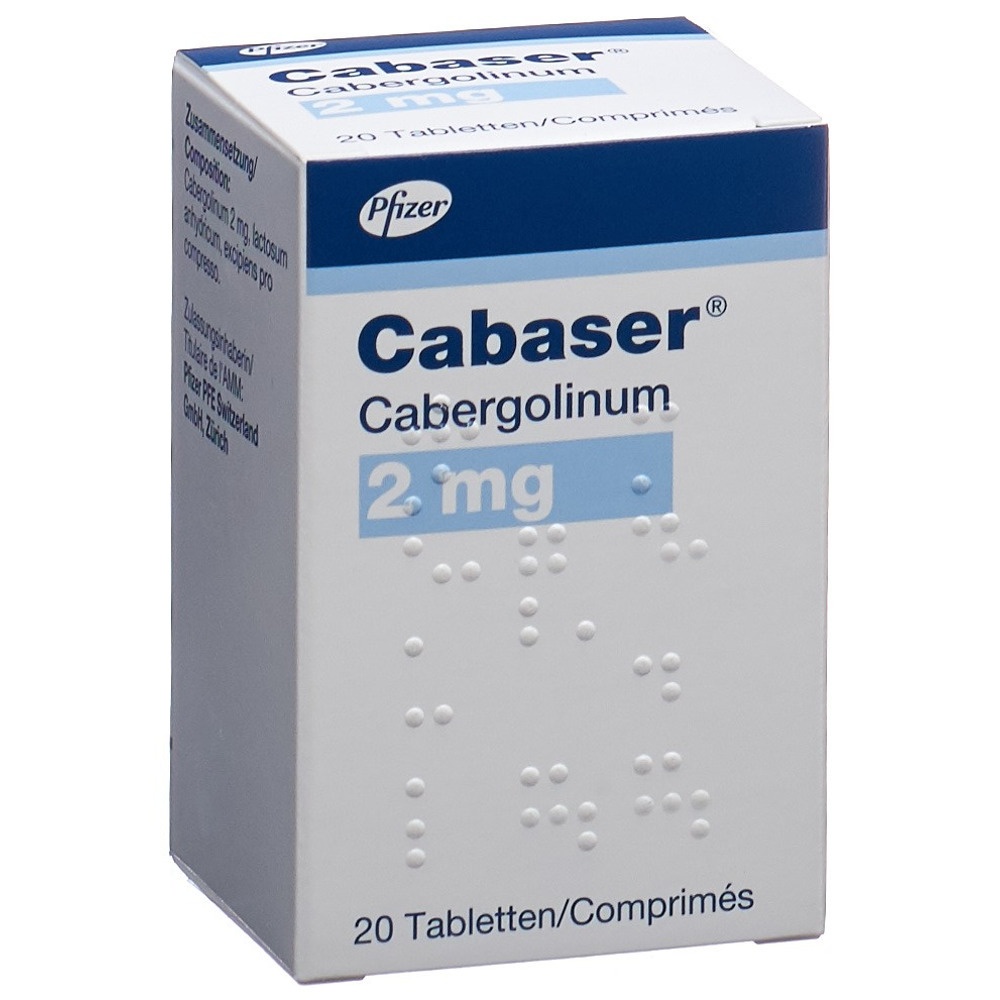
CABASER 1 мг Таблетка

Рассмотрение рецепта онлайн
Врач рассмотрит ваш случай и примет решение о назначении рецепта, если это медицински оправдано.

Поговорите с врачом об этом лекарстве
Обсудите симптомы и возможные дальнейшие шаги на онлайн-консультации.



Инструкция по применению KABASER
Содержание инструкции
CABASER 1 mg COMPRESSES
CABASER 2 mg COMPRESSES
cabergoline
PHARMACOTHERAPEUTIC CATEGORY
Dopamine agonist.
THERAPEUTIC INDICATIONS
When treatment of the signs and symptoms of Parkinson's disease with a dopaminergic agonist drug is deemed appropriate, cabergoline is indicated as a second-line therapy in patients intolerant to drugs not derived from ergotamine or who have not responded to such therapy, both as monotherapy or in association with levodopa in combination with a peripheral decarboxylase inhibitor.
Treatment must be initiated under the supervision of a physician specializing in Neurology, Neuropsychiatry, Geriatrics or Psychiatry. The benefit derived from continued treatment must be checked periodically taking into account the risk of fibrotic reactions and valvulopathy (see “Contraindications”, “Special warnings”, “Precautions for use” and “Undesirable effects”).
CONTRAINDICATIONS
The patient must not take the medicine if:
they are hypersensitive to cabergoline or any of the excipients or any of the ergot alkaloids;
they will undergo treatment with cabergoline for a long period and have or have had fibrotic (scar tissue) reactions affecting the heart (see Special warnings - Fibrosis and cardiac valvulopathy);
if they have or have had a history of pulmonary, pericardial or retroperitoneal fibrosis.
PRECAUTIONS FOR USE
See section “Special warnings”
INTERACTIONS
Inform your doctor or pharmacist if you have recently taken any other medicines, even those without a prescription.
There are medicines that can reduce the therapeutic effect of CABASER or can modify its bioavailability.
The concomitant use of other non-dopaminergic anti-Parkinson's drugs (selegiline, amantadine, biperiden, trihexyphenidyl) has been allowed in clinical studies on patients undergoing cabergoline therapy. No interaction was observed in studies where the pharmacokinetic interactions of cabergoline with L-dopa or selegiline were evaluated.
Although there is no information on any interactions between cabergoline and other ergot alkaloids, it is recommended not to use cabergoline in association with these drugs in long-term treatment.
Since cabergoline exerts its therapeutic effect with direct stimulation of dopamine receptors, it should not be administered concurrently with drugs with dopamine antagonist activity (such as phenothiazines, butyrophenones, thioxanthenes, metoclopramide) because this could determine a reduction in the therapeutic effect of cabergoline.
Cabergoline, like other ergot derivatives, should not be used concurrently with macrolide antibiotics (e.g. erythromycin) as this could increase systemic bioavailability.
SPECIAL WARNINGS
General
Like other ergot derivatives, cabergoline should be administered with caution in subjects with severe cardiovascular disease, Raynaud's syndrome, peptic ulcer or gastrointestinal bleeding, or with a history of severe mental disorders, especially if psychotic.
Important information on some excipients
If your doctor has diagnosed you with intolerance to certain sugars, contact him before taking this medicine.
Hepatic insufficiency:
In patients with severe hepatic insufficiency, a lower dosage should be considered. In patients with severe hepatic insufficiency (Child-Pugh Class C) who have taken a single dose of 1 mg, an increase in AUC has been observed compared to healthy volunteers and patients with milder forms of hepatic insufficiency.
Postural hypotension:
Following the administration of cabergoline, postural hypotension may occur, especially in the first days of starting therapy. Caution should be exercised when cabergoline is administered together with other drugs that are known to lower blood pressure.
Fibrosis and cardiac valvulopathy and clinical phenomena possibly related
The patient should pay particular attention if they have or have had fibrotic reactions (scar tissue) involving the heart, lungs or abdomen.
If fibrotic reactions develop, treatment should be discontinued.
After prolonged use of ergotamine derivatives, including cabergoline, fibrotic and inflammatory disorders of the serous membranes have occurred, such as pleuritis, pleural effusion, pleural fibrosis, pulmonary fibrosis, pericarditis, pericardial effusion, cardiac valvulopathy involving one or more valves (aortic, mitral and tricuspid) or retroperitoneal fibrosis. In some cases, the symptoms or manifestations of cardiac valvulopathy have improved after discontinuation of cabergoline treatment. The erythrocyte sedimentation rate (ESR) has been abnormally increased in association with pleural effusion/fibrosis. A chest X-ray is recommended in case of an unexplained and abnormally increased ESR.
An analysis of serum creatinine levels may prove useful in the diagnosis of fibrosis. Following the diagnosis of pleural effusion/pulmonary fibrosis or cardiac valvulopathy, the related symptoms and manifestations have been found to improve with discontinuation of cabergoline treatment (see Contraindications).
Valvulopathy has been associated with the use of cumulative doses; therefore, patients should be treated with the lowest effective dose. At each visit, the risk-benefit ratio of treatment for the patient must be reassessed to determine whether it is appropriate to continue treatment with cabergoline.
Before starting long-term treatment:
If undergoing cabergoline therapy for a long period, the doctor will check, before starting treatment, whether the heart, lungs and kidneys are in good condition. The doctor will also perform an echocardiogram (an ultrasound examination of the heart) before starting treatment and at regular intervals during treatment to establish the potential presence of asymptomatic valve disease.
Before starting therapy, it is also useful to perform an analysis of the erythrocyte sedimentation rate (ESR) or other inflammatory markers, a pulmonary function test/chest X-ray and renal function tests.
It is not known whether treatment with cabergoline in patients with valve reflux may worsen the underlying disease. If valvular fibrosis is diagnosed, the patient should not be treated with cabergoline.
During long-term treatment:
Fibrotic pathologies can have an insidious onset and patients must be constantly monitored to avoid the risk of possible manifestations of progressive fibrosis.
During treatment, it is therefore recommended to pay attention to signs and symptoms of:
- Pleuropulmonary disorders, such as dyspnea, shortness of breath, persistent cough or chest pain.
- Renal insufficiency or obstruction of the ureter or abdomen causing flank/back pain and edema of the lower limbs, as well as the possible presence of abdominal mass or tenderness that may indicate retroperitoneal fibrosis.
- Heart failure, because cases of pericardial fibrosis have often manifested with heart failure; constrictive pericarditis should be ruled out if such symptoms appear.
- Heart failure: because cases of valvular fibrosis have often manifested with heart failure; valvular fibrosis should be ruled out if such symptoms appear.
Appropriate clinical and diagnostic monitoring is recommended for the development of fibrotic pathologies. A first control echocardiogram should be performed within 3-6 months of starting therapy, after which the frequency of echocardiographic monitoring should be determined by an appropriate individual clinical assessment, paying particular attention to the aforementioned signs and symptoms, but always with a minimum frequency of 6-12 months.
Treatment with cabergoline should be discontinued if an echocardiogram reveals a new valve reflux or worsening of an existing reflux, valve stenosis or thickening of the valve leaflets (see Contraindications).
The need for further clinical examinations (e.g. physical examination, careful heart auscultation, radiography, echocardiogram, CT scan) must be determined on an individual basis.
Further examinations such as erythrocyte sedimentation rate (ESR) and serum creatinine measurements should be performed, if necessary, to support a diagnosis of fibrotic pathology.
Drowsiness / Sudden sleep attacks
Cabergoline has been associated with drowsiness and episodes of sudden sleep attacks, particularly in subjects with Parkinson's disease.
Sudden sleep attacks have been reported during daily activities, in some cases without awareness and without warning signs. A reduction in dosage or discontinuation of therapy may be considered (see section “Effects on the ability to drive and operate machinery”).
Psychiatric disorders Inform your doctor if you or someone in your family/or who cares for the patient notices that you are developing urges or desires to behave in ways that are unusual for you and you cannot resist the urge or temptation to perform certain activities that could harm yourself or others. These are called impulse control disorders and can include behaviors such as gambling addiction, overeating or excessive spending, an abnormal, exaggerated sexual desire or an increase in sexual thoughts or feelings. Your doctor may need to adjust or discontinue the dose.
Pregnancy and breastfeeding
Ask your doctor or pharmacist for advice before taking any medicine.
Pregnancy
There are no adequate, well-controlled studies on the use of cabergoline in pregnant women. Animal studies have not shown teratogenic effects, but simultaneously with the pharmacodynamic activity, reduced fertility and embryonic toxicity have been observed.
Following an observational study lasting twelve years on the effects of cabergoline therapy during pregnancy, information relating to 256 pregnancies is now available. Of these 256 pregnancies, seventeen (6.6%) resulted in severe congenital malformations or abortions. Information is available for 23 of 258 children who had a total of 27 neonatal anomalies, more or less severe. The most common neonatal anomalies were musculoskeletal system disorders (10), followed by anomalies affecting the cardiopulmonary system (5). There is no information on perinatal diseases or long-term effects on children who have been exposed to cabergoline in utero. Based on recently published literature, a prevalence of major congenital malformations of 6.9% or greater has been reported in the general population.
The percentage of congenital anomalies varies in different populations. It is not possible to accurately determine whether there is an increased risk as a control group was not included.
It is recommended to use a method of contraception during treatment with cabergoline.
Cabergoline should be used during pregnancy only if clearly indicated and after careful assessment of the risks/benefits.
Due to the long half-life of the drug and limited data on intrauterine exposure, women planning a pregnancy should discontinue taking cabergoline one month before the expected conception. If conception occurs during therapy, treatment should be discontinued as soon as pregnancy is confirmed to limit fetal exposure to the drug.
Breastfeeding
In rats, cabergoline and/or its metabolites are excreted in milk. No information is available on the excretion of the drug in human milk; however, based on its dopamine agonist action, CABASER is expected to inhibit/suppress lactation. Mothers treated with CABASER should be advised not to breastfeed.
Remember that this medicine is prescribed for you and may only be prescribed by a doctor. Never give CABASER to others, as it could harm them even if they have the same symptoms as you.
Effects on the ability to drive and operate machinery
During the initial phase of treatment, patients must be careful when performing actions that require quick and accurate reactions.
CABASER can cause drowsiness (excessive sleepiness) and episodes of sudden sleep attacks. For this reason, the patient must refrain from driving or undertaking any activity in which altered attention could expose themselves or others to the risk of serious harm or death (e.g. operating machinery) until such recurrent episodes and drowsiness have resolved (see also section “Special warnings”).
DOSAGE, METHOD AND TIME OF ADMINISTRATION
CABASER should be administered orally, once a day, preferably during meals.
Your doctor will determine the effective daily dose starting from doses of 0.5 mg-1 mg.
If you forget to take a dose, take the next dose as scheduled.
The maximum daily dose is 3 mg/day.
OVERDOSAGE
Symptoms of overdose are likely to be due to hyperstimulation of dopaminergic receptors, such as nausea, vomiting, gastrointestinal disturbances, postural hypotension, and confusion/psychosis or hallucinations.
If necessary, supportive measures should be adopted to eliminate any unabsorbed drug and to maintain blood pressure.
Administration of dopamine antagonist drugs may also be advisable.
In case of accidental ingestion/intake of an excessive dose of CABASER, immediately notify your doctor or go to the nearest hospital
UNDESIRABLE EFFECTS
Like all medicines, CABASER can cause undesirable effects, although not everyone will experience them.
The following undesirable effects have been observed and reported during treatment with CABASER with the frequencies indicated below: very common ( 1/10), common ( 1/100, <1/10), uncommon ( 1/1,000, <1/100), rare ( 1/10,000, <1/1,000), very rare (<1/10,000), not known (the frequency cannot be defined based on available data).
Classification by systems and
organs according to MedDRA
FrequencyUndesirable effects
Valvulopathy (including regurgitation) and related disorders (pericarditis and pericardial effusion)
Common*Angina pectoris
Very common
Cardiac disordersCommon
CommonDyspnea
UncommonPleural effusion, pulmonary fibrosis
Very rareFibrosis (including pleural fibrosis)
Respiratory, thoracic and mediastinal disorders
Not known
Respiratory disorders, respiratory failure, pleurisy, chest pain
Immune system disorders
UncommonHypersensitivity reactions
CommonHeadache, somnolence, dizziness/vertigo, dyskinesia
UncommonHyperkinesia
Not knownSudden onset of sleep, syncope, tremor
Eye disordersNot knownImpaired vision
Nervous system disorders
Hallucinations, sleep disturbances, increased libido, confusion
UncommonDelusions, psychotic disorders
Common
Psychiatric disorders
Not known
Aggression, hypersexuality, pathological gambling
Vascular disordersCommonCabaser generally exerts a hypotensive effect in patients undergoing long-term treatment, orthostatic hypotension
UncommonErythromelalgia
Not knownVasospasm of the fingers
Gastrointestinal disordersVery commonNausea
CommonConstipation, dyspepsia, gastritis, vomiting
Systemic disorders and
conditions related to the site
of administration
Very commonPeripheral edema
CommonAsthenia
UncommonEdema, fatigue
Hepato-biliary disordersUncommonAbnormal liver function
Skin and subcutaneous tissue disorders
UncommonSkin rash
Not knownAlopecia
Musculoskeletal and connective tissue disorders
Not knownLeg cramps
Laboratory testsCommonAbnormal liver function tests, decrease in hemoglobin, hematocrit and/or red blood cells (>15% compared to baseline values)
Not knownIncreased plasma levels of creatine phosphokinase
*In case of concomitant use with levodopa
The following undesirable effects may occur:
- inability to resist the urge to perform actions that could be harmful, which may include:
- a strong urge to gamble excessively, despite serious personal or family consequences
- altered or increased sexual interest and behavior that causes significant concern to you or others, for example, an increased sexual desire
- compulsive shopping or excessive spending
- compulsive eating (eating large amounts of food in a short period of time) or bulimia (eating more food than normal and more than is needed to satisfy your hunger).
Inform your doctor if any of these behaviors occur, so he can decide how to
intervene to manage or reduce the symptoms.
Reporting of suspected adverse reactions
If you experience any side effects, including those not listed in this leaflet, tell your doctor or pharmacist. Adverse reactions can also be reported directly through the national reporting system at
www.agenziafarmaco.gov.it/it/responsabili”. Reporting of adverse reactions
helps to provide more information on the safety of this medicine .
EXPIRY DATE AND STORAGE
Expiry date: see the expiry date indicated on the packaging.
WARNING: do not use the medicine after the expiry date indicated on the packaging.
This date refers to the product in intact packaging and stored correctly.
DO NOT USE IN CASE OF OBVIOUS SIGNS OF DETERIORATION.
Keep the medicine out of the reach and sight of children.
Medicines should not be disposed of via wastewater or household waste. Ask your
pharmacist how to dispose of medicines you no longer use. This will help protect the environment.
COMPOSITION
CABASER 1 mg TABLETS
Each tablet contains: active ingredient: cabergoline 1 mg.
Excipients: anhydrous lactose, leucine.
CABASER 2 mg TABLETS
Each tablet contains: active ingredient: cabergoline 2 mg.
Excipients: anhydrous lactose, leucine.
PHARMACEUTICAL FORM AND CONTENT
1 mg tablets: white, oval-shaped, concave on both sides, with a notch on one
side and with “7” imprinted to the left and “01” to the right of the notch;
2 mg tablets: white oval-shaped, concave on both sides, with a notch on one
side and with “7” imprinted to the left and “02” to the right of the notch;
20 tablets 1 mg
20 tablets 2 mg
ORAL USE
Not all pack sizes may be marketed.
MARKETING AUTHORISATION HOLDER
Pfizer Italia S.r.l.
Via Isonzo, 71 – 04100 Latina
MANUFACTURER
Pfizer Italia S.r.l., Località Marino del Tronto - 63100 Ascoli Piceno (AP)
OF THE MEDICINAL PRODUCT:

Не уверены, подходит ли вам это лекарство?
Обсудите симптомы и варианты лечения с врачом онлайн.

Уже начали прием и появились вопросы?
Обсудите свое состояние и дальнейшие шаги с врачом онлайн.
- Страна регистрации
- Форма выпускаTablet, 1 MG
- Код АТХN04BC06
- Действующее вещество
- Отпускается по рецептуДа
- Производитель
- Информация на этой странице носит справочный характер и не является медицинской консультацией. Перед началом приема лекарства обязательно проконсультируйтесь с врачом.
- Аналоги KABASERФорма выпуска: Infusion solution, 50 MG/5 MLДействующее вещество: apomorphineПроизводитель: CHIESI ITALIA S.P.AОтпускается по рецептуФорма выпуска: Sublingual film, 10 mgДействующее вещество: apomorphineПроизводитель: BIAL -PORTELA & CA ,SAОтпускается по рецептуФорма выпуска: Coated tablet, 0.088 MGДействующее вещество: прамипексолПроизводитель: BOEHRINGER INGELHEIM INTERNATIONAL GMBHОтпускается по рецепту
Аналоги KABASER в других странах
Лекарства с тем же действующим веществом, доступные в других странах.
Аналог KABASER в Испания
Врачи онлайн по KABASER
Обсудите применение KABASER и возможные следующие шаги — по оценке врача.



Получите рецепт на KABASER онлайн
Заполните форму за 2 минуты
Расскажите о симптомах, истории болезни и нужном препарате.
Выберите врача или мы назначим
Выберите специалиста или мы подберём ближайшего доступного врача.
Врач рассматривает ваш случай
Обычно в течение 30 минут. Может задать уточняющие вопросы в чате.
Получите в любой аптеке
Электронный рецепт отправляется на вашу почту — действителен по всей Польше.
Часто задаваемые вопросы
KABASER требует рецепта в Италия. Вы можете уточнить у врача онлайн, подходит ли это лекарство для вашей ситуации.
Действующее вещество KABASER — каберголина. Эта информация помогает определить лекарства с тем же составом под другими торговыми названиями.
KABASER производится компанией PFIZER ITALIA S.R.L.. Упаковка и торговое название могут отличаться в зависимости от дистрибьютора.
Врачи, включая Семейные врачи, Психиатры, Дерматологи, Кардиологи, Эндокринологи, Гастроэнтерологи, Пульмонологи, Нефрологи, Ревматологи, Гематологи, Инфекционисты, Аллергологи, Гериатры, Педиатры, Онкологи, могут оценить целесообразность применения KABASER с учетом вашей ситуации и местных правил. Вы можете записаться на онлайн-консультацию, чтобы обсудить возможные варианты.
Польша имеет хорошо развитую систему здравоохранения в крупных городах, таких как Варшава, Краков, Вроцлав и Гданьск. Аптеки широко доступны и работают в соответствии с действующим законодательством, обеспечивая доступ к рецептурным препаратам.
Вы можете купить KABASER в Варшаве, Кракове, Вроцлаве или Гданьске в любой аптеке при наличии действующего рецепта.
Чтобы получить рецепт, вы можете воспользоваться Oladoctor:
Другие лекарства с тем же действующим веществом (каберголина) включают APOFIN, KYNMOBI, MIRAPEXIN. Они могут отличаться торговым названием или формой выпуска, но содержат одинаковый терапевтический компонент. Перед изменением лечения рекомендуется проконсультироваться с врачом.
