



AZACITIDINA 25 mg /Ml Proszek Do Sporządzania Zawiesiny Do Wstrzykiwań

Ocena recepty online
Lekarz przeanalizuje Twój przypadek i zdecyduje, czy wystawienie recepty jest medycznie uzasadnione.

Porozmawiaj z lekarzem o tym leku
Omów swoje objawy i opcje leczenia podczas szybkiej konsultacji online.



Jak stosować ATSAKITIDINA SANDOTS
Treść ulotki
Azacitidina Sandoz 25 mg/ml powder for injectable suspension
Generic medicine
Read this leaflet carefully before using this medicine as it contains
important information for you.
- Keep this leaflet. You may need to read it again.
- If you have any questions, ask your doctor, pharmacist or nurse.
- If any side effects occur, including those not listed in this leaflet, tell your doctor, pharmacist or nurse. See section 4.
Contents of this leaflet:
- 1. What Azacitidina Sandoz is and what it is used for
- 2. What you need to know before you use Azacitidina Sandoz
- 3. How to use Azacitidina Sandoz
- 4. Possible side effects
- 5. How to store Azacitidina Sandoz
- 6. Contents of the pack and other information
1. What is Azacitidina Sandoz and what it is used for
What is Azacitidina Sandoz
Azacitidina Sandoz is an anticancer agent that belongs to a group of medicines called
“antimetabolites”. Azacitidina Sandoz contains the active substance “azacitidine”.
What is Azacitidina Sandoz used for
Azacitidina Sandoz is used in adults who are not able to receive stem cell
transplantation for the treatment of:
- high-risk myelodysplastic syndromes (MDS);
- chronic myelomonocytic leukemia (CMML);
- acute myeloid leukemia (AML).
These diseases affect the bone marrow and can cause problems with the normal production of
blood cells.
How Azacitidina Sandoz works
Azacitidina Sandoz works by preventing cancer cells from growing. Azacitidine is incorporated
into the genetic material of cells (ribonucleic acid (RNA) and deoxyribonucleic acid (DNA)).
It is believed to work by altering the way the cell activates and deactivates genes and also interfering with
the production of new RNA and DNA. These actions are thought to correct problems related to
the maturation and growth of young blood cells in the bone marrow, which cause myelodysplastic disorders, and to kill cancer cells in leukemia.
Ask your doctor or nurse if you have any questions about how Azacitidina
Sandoz works or why it has been prescribed for you.
2. What you need to know before using Azacitidina Sandoz
Do not use Azacitidina Sandoz
- if you are allergic to azacitidine or any of the other ingredients of this medicine (listed in section 6).
- if you have advanced liver cancer.
- if you are breastfeeding.
Warnings and precautions
Talk to your doctor, pharmacist or nurse before using Azacitidina Sandoz:
- if you have a reduced platelet count, red blood cells or white blood cells
- if you have kidney disease
- if you have liver disease if you have had heart disease or a heart attack in the past or if you have a history of lung disease.
Blood tests
Before starting treatment with Azacitidina Sandoz and at the beginning of each treatment period
(called a “cycle”), blood tests will be performed to check if you have a sufficient number of blood cells and if your liver and kidneys are functioning normally.
Children and adolescents
The use of Azacitidina Sandoz is not recommended in children and adolescents under 18 years of
age.
Other medicines and Azacitidina Sandoz
Tell your doctor or pharmacist if you are taking, have recently taken or might take any other
medicines. This is because Azacitidina Sandoz can affect the way other medicines work.
Other medicines can, in turn, affect the way Azacitidina Sandoz works.
Pregnancy, breastfeeding and fertility
Pregnancy
You must not use Azacitidina Sandoz during pregnancy, as it may be harmful to the baby.
Use effective contraception during and for up to 3 months after treatment. Tell your
doctor immediately if you become pregnant during treatment.
If you are pregnant, suspect you are pregnant, are planning a pregnancy or are breastfeeding
ask your doctor or pharmacist for advice before taking this medicine.
Breastfeeding
You must not breastfeed while using Azacitidina Sandoz. It is not known whether this medicine passes into
breast milk.
Fertility
During treatment with Azacitidina Sandoz, male patients must not father a
child. Use effective contraception during and for up to 3 months after treatment with this
medicine.
Talk to your doctor if you wish to preserve sperm before starting this treatment.
Driving and using machines
Do not drive and do not use tools or machines if you experience side effects, such as fatigue.
3. How to use Azacitidina Sandoz
Before administering Azacitidina Sandoz, your doctor will give you another medicine to prevent nausea and
vomiting at the beginning of each treatment cycle.
- The recommended dose is 75 mg per m of body surface area. Your doctor will decide the dose of this medicine depending on your general condition, height and body weight. Your doctor will monitor your progress and, if necessary, modify the dose.
- Azacitidina Sandoz is administered every day for one week, followed by a 3-week break. This “treatment cycle” will be repeated every 4 weeks. Usually, at least 6 treatment cycles are administered.
This medicine will be administered to you by a doctor or nurse via injection under the
skin (subcutaneous). The injection can be given under the skin of the thigh, abdomen or
upper arm.
If you have any questions about the use of this medicine, ask your doctor, pharmacist or nurse.
4. Possible side effects
Like all medicines, this medicine can cause side effects, although not everybody gets them.
manifest.
Immediately inform your doctor if you notice any of the following side effects:
- Sleepiness, tremor, jaundice, abdominal swelling and easy bruising. These can be symptoms of liver failure and be life-threatening.
- Swollen legs and feet, back pain, decreased urine, increased thirst, rapid pulse, dizziness and nausea, vomiting or reduced appetite and confusion, restlessness or fatigue.These can be symptoms of kidney failure and be life-threatening.
- Fever. This may be due to an infection caused by a reduced number of white blood cells, which can be life-threatening.
- Chest pain or shortness of breath, possibly accompanied by fever. This may be due to an infection of the lungs called “pneumonia” and be life-threatening.
- Bleeding.For example, blood in the stool due to bleeding in the stomach or intestines, or bleeding inside the head. These may be symptoms of low platelet levels in the blood.
- Difficulty breathing, swollen lips, itching or skin rash.These may be due to an allergic reaction (hypersensitivity).
Other side effects include:
Very common side effects(may affect more than 1 in 10 people)
- Low red blood cell count (anemia). You may feel tired and weak.
- Low white blood cell count. This may be accompanied by fever. You are also more likely to get infections.
- Low platelet count in the blood (thrombocytopenia). You are more prone to bleeding and bruising.
- Constipation, diarrhea, nausea, vomiting.
- Pneumonia.
- Chest pain, shortness of breath.
- Fatigue.
- Reaction at the injection site, with redness, pain or skin reaction.
- Loss of appetite.
- Joint pain.
- Bruising.
- Skin rash.
- Red or purple spots under the skin.
- Abdominal pain.
- Itching.
- Fever.
- Irritation of the nose and throat.
- Dizziness.
- Headache.
- Difficulty sleeping (insomnia).
- Nosebleeds (epistaxis).
- Muscle pain.
- Weakness (asthenia).
- Weight loss.
- Low potassium levels in the blood.
Common side effects(may affect up to 1 in 10 people)
- Bleeding inside the head.
- Blood infection due to bacteria (sepsis), which may be caused by a reduced number of white blood cells in the blood.
- Bone marrow failure, which can cause a reduction in the number of red blood cells, white blood cells and platelets.
- A type of anemia with a reduction in red blood cells, white blood cells and platelets.
- Urinary tract infection.
- Viral infection causing irritation (herpes).
- Bleeding gums, blood in the stomach or intestines, blood from the anus due to hemorrhoids (hemorrhoidal bleeding), blood in the eye, blood under the skin or in the skin (hematoma).
- Blood in the urine.
- Ulcers in the mouth or on the tongue.
- Skin changes at the injection site, including swelling, hard nodule, bruising, blood in the skin (hematoma), rash, itching and changes in skin color.
- Skin redness.
- Skin infection (cellulitis).
- Infection of the nose and throat, or sore throat.
- Irritated nose or sinuses, or runny nose (sinusitis).
- High or low blood pressure (hypertension or hypotension).
- Shortness of breath during exertion
- Sore throat and larynx.
- Indigestion.
- Lethargy.
- General feeling of discomfort.
- Anxiety.
- Confusion.
- Hair loss.
- Kidney failure.
- Dehydration.
- White coating on the tongue, inside of the cheeks and sometimes the palate, gums and tonsils (oral fungal infection).
- Fainting.
- Drop in blood pressure when standing up (orthostatic hypotension), which causes dizziness when getting up or sitting down.
- Sleepiness, drowsiness.
- Bleeding due to the catheter.
- Disease affecting the intestine and can cause fever, vomiting and stomach pain (diverticulitis).
- Fluid around the lungs (pleural effusion).
- Chills.
- Muscle spasms.
- Raised, itchy rash on the skin (urticaria).
- Fluid collection around the heart (pericardial effusion).
Uncommon side effects(may affect up to 1 in 100 people)
- Allergic reaction (hypersensitivity).
- Tremor.
- Liver failure.
- Appearance on the skin of large, raised, painful, plum-colored patches, with fever.
- Painful skin ulceration (pyoderma gangrenosum).
- Inflammation of the lining around the heart (pericarditis).
Rare side effects(may affect up to 1 in 1,000 people)
- Dry cough.
- Painless swelling of the fingertips (clubbing of the fingers).
- Tumor lysis syndrome - metabolic complications that can occur during cancer treatment and sometimes even in the absence of treatment. These complications are caused by the product of dying cancer cells and can include the following complications: changes in hematological parameters; high levels of potassium, phosphorus and uric acid; and low levels of calcium leading, consequently, to changes in kidney function, heartbeat, seizures and, sometimes, death.
Not known(frequency cannot be estimated from the available data)
- Infection of the deeper layers of the skin, which spreads rapidly damaging the skin and tissues that can be fatal (necrotizing fasciitis).
Reporting of side effects
If you get any side effects, talk to your doctor or pharmacist. This includes any side effects not listed in this
leaflet. You can also report side effects directly through the national reporting system at
https://www.aifa.gov.it/content/segnalazioni-reazioni-avverse.
By reporting side effects you can help provide more information on the safety of this medicine.
5. How to store Azacitidina Sandoz
Keep this medicine out of the sight and reach of children.
Do not use this medicine after the expiry date which is stated on the package and on the label of the
vial after Exp.
The expiry date refers to the last day of that month.
The doctor, pharmacist or nurse are responsible for the storage of Azacitidina Sandoz. They are
also responsible for the preparation and correct disposal of unused Azacitidina Sandoz.
For closed vials of this medicine:
This medicine does not require any particular storage conditions.
For immediate use
Once prepared, the suspension must be administered within 60 minutes.
For subsequent use
If Azacitidina Sandoz suspension is reconstituted with water for injections not
refrigerated, the suspension must be placed in a refrigerator (2 °C 8 °C) immediately after preparation and
kept in a refrigerator for a maximum of 24 hours.
If Azacitidina Sandoz suspension is reconstituted with refrigerated water for injections
(2 °C 8 °C), the reconstituted suspension must be placed in a refrigerator (2 °C 8 °C) immediately
after preparation and kept in a refrigerator for a maximum of 36 hours packaged in the vial and for
30 hours at 2 °C 8 °C if stored in the syringe.
Before administration, wait up to 30 minutes for the suspension to reach
room temperature (20 °C- 25 °C)
Do not use this medicine if there are large particles present.
6. Contents of the pack and other information
What Azacitidine Sandoz contains
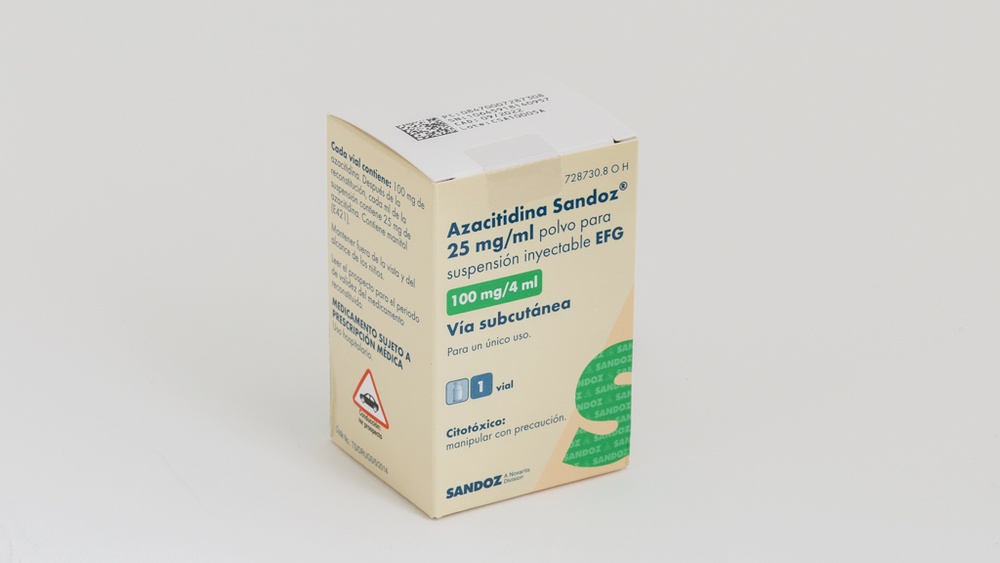
- The active substance is azacitidine. One vial contains 100 mg of azacitidine. After reconstitution with 4 mL of water for injections, the reconstituted suspension contains 25 mg/ml of azacitidine.
- The other component is mannitol (E421).
Description of the appearance of Azacitidine Sandoz and contents of the pack
Azacitidine Sandoz is a white powder for suspension for injection, supplied in a glass vial
with a rubber stopper and an aluminium crimp with a plastic flip-off cap, containing 100 mg of
azacitidine. The vial is packaged in a carton.
Pack size: 1 vial.
Marketing Authorisation Holder
Sandoz S.p.A.,
L.go U. Boccioni 1,
21040 Origgio (VA),
Italy
Manufacturer
Pharmadox Healthcare Ltd
KW20A Kordin Industrial Park
PLA 3000 Paola
Malta
LEK Pharmaceuticals d.d.
Verovskova ulica 57
1526 Ljubljana
Slovenia
Salutas Pharma GmbH
Otto-von-Guericke-Allee 1
39179 Barleben
Germany
This medicinal product is authorised in the Member States of the European Economic Area under the
following denominations:
Austria Azacitidin Sandoz 25 mg/ml – Pulver zur Herstellung einer
Injektionssuspension
Belgium Azacitidin Sandoz 25 mg/ml powder for suspension for injection
Bulgaria Азацитидин Сандоз 25 mg/ml прах за инжекционна суспензия
Croatia Azacitidin Sandoz 25 mg/ml prašak za suspenziju za injekciju
Denmark Azacitidine Sandoz
Finland Azacitidine Sandoz
France AZACITIDINE SANDOZ 25 mg/ml poudre pour suspension injectable
Germany Azacitidin HEXAL 25 mg/ml Pulver zur Herstellung einer
Injektionssuspension
Greece Azacitidine/Sandoz 25 mg/ml κόνις για ενέσιμο εναιώρημα
Ireland Azacitidine Rowex 25 mg/ml Powder for suspension for injection
Iceland Azacitidine Sandoz
Italy Azacitidina Sandoz
Norway Azacitidine Sandoz
Netherlands Azacitidine Sandoz 25 mg/ml, poeder voor suspensie voor injectie
Poland Azacitidine Sandoz
Portugal Azacitidina Sandoz
United Kingdom Azacitidine Sandoz 25 mg/ml powder for suspension for injection
Czech Republic Azacitidin Sandoz
Slovakia Azacitidine Sandoz 25 mg/ml prášok na injekčnú suspenziu
Romania Azacitidină Sandoz 25 mg/ml pulbere pentru suspensie injectabilă
Slovenia Azacitidin Sandoz 25 mg/ml prašek za suspenzijo za injiciranje
Spain Azacitidina Sandoz 25mg/ml polvo para suspensión inyectable EFG
Sweden Azacitidine Sandoz
Hungary Azacitidin Sandoz 25 mg/ml por szuszpenziós injekcióhoz
---------------------------------------------------------------------------------------------------------------------------
The following information is intended exclusively for healthcare professionals:
Recommendations for safe handling
Azacitidine Sandoz is a cytotoxic medicine and therefore, as with other potentially
toxic substances, caution is required during handling and preparation of azacitidine suspensions.
Appropriate procedures for handling and disposal of anti-cancer medicines must be used.
If reconstituted azacitidine comes into contact with the skin, wash immediately and thoroughly with water
and soap. If contact with mucous membranes occurs, rinse thoroughly with water.
Incompatibilities
This medicine must not be mixed with other medicines except those mentioned below
(see section “Procedure for reconstitution”).
Procedure for reconstitution
Azacitidine Sandoz must be reconstituted with water for injections. The shelf life of the
reconstituted medicine may be extended if reconstitution is carried out with refrigerated water for injections
(2°C-8°C). Details on the storage of the reconstituted medicine are provided below.
- 1. Prepare the following: vial(s) of azacitidine; vial(s) of water for injections; non-sterile surgical gloves; alcohol swabs; syringe(s) 5 ml with needle(s).
- 2. Draw 4 ml of water for injections into the syringe, ensuring that any remaining air bubbles in the syringe are eliminated.
- 3. Insert the needle of the syringe containing the 4 ml of water for injections into the rubber stopper of the azacitidine vial and then inject the water for injections into the vial.
- 4. After removing the syringe and needle, shake the vial vigorously until a uniform opaque suspension is formed. After reconstitution, each ml of the suspension will contain 25 mg of azacitidine (100 mg/4 ml). The reconstituted product is a homogeneous, opaque suspension, free of aggregates. The suspension must be discarded if it contains large particles or aggregates. Do not filter the suspension after reconstitution as this may remove the active substance. It should be noted that some adapters, needles and closed systems contain filters; therefore, such systems should not be used for administering the medicine after reconstitution.
- 5. Clean the rubber stopper and insert a new syringe with a needle already attached into the vial. Invert the vial, ensuring that the tip of the needle is below the level of the liquid. Then pull the plunger to draw the amount of medicine necessary for the correct dose, ensuring that any remaining air bubbles in the syringe are eliminated. Then, remove the syringe with the needle from the vial and dispose of the needle.
- 6. At this point, firmly attach a new needle for subcutaneous use to the syringe (the use of 25 gauge needles is recommended). The suspension should not be pushed into the needle before injection, in order to reduce the incidence of local reactions at the injection site.
- 7. When more than 1 vial is needed, repeat the steps described for preparing the suspension. For doses requiring more than 1 vial, divide the dose evenly (e.g. 150 mg dose = 6 ml, 2 syringes with 3 ml each). Due to retention in the vial and needle, it may not be possible to draw all the suspension from the vial.
- 8. The contents of the dosing syringe must be resuspended immediately before administration. Before administration, wait up to 30 minutes for the syringe filled with the reconstituted suspension to reach a temperature of approximately 20 ºC-25 ºC. If more than 30 minutes have elapsed, the suspension must be discarded and disposed of appropriately and a new dose must be prepared. To resuspend, roll the syringe vigorously between the palms of your hands until a uniform opaque suspension is obtained. The suspension must be discarded if it contains large particles or aggregates.
Storage of the reconstituted medicine
When Azacitidine Sandoz is reconstituted with non-refrigerated water for injections, chemical and physical
stability in use of the reconstituted medicine has been demonstrated at 25 °C for 60 minutes and at 2 °C -8 °C for
24 hours stored in the vial and in the syringe
The shelf life of the reconstituted medicine may be extended if reconstitution is carried out with refrigerated water for
injections (2 °C-8 °C). When Azacitidine Sandoz is reconstituted with refrigerated water for
injections (2 °C-8 °C), chemical and physical stability in use of the reconstituted medicine has been
demonstrated at 2 °C – 8 °C for 36 hours stored in the vial and at 2 °C -8 °C for 30 hours stored
in the syringe.
From a microbiological point of view the reconstituted product must be used immediately. If not
used immediately, the conditions and period of storage before use are the responsibility of the
user and must not be longer than 24 hours between 2 °C – 8 °C.
Individual dose calculation
The total dose according to body surface area (BSA) can be calculated as follows:
Total dose (mg) = Dose (mg/m²) x BSA (m²)
The following table is only an example of how to calculate individual doses of azacitidine based on
an average BSA of 1.8 m².
Route of administration
Do not filter the suspension after reconstitution.
The reconstituted solution of Azacitidine Sandoz must be injected subcutaneously (insert the needle with
an angle of 45-90°) in the upper arm, thigh or abdomen, using a 25
gauge needle.
Doses greater than 4 ml must be injected at two different sites. Alternate injection sites in rotation.
Subsequent injections must be administered at least 2.5 cm away from the previous site and
never in sensitive, bruised, reddened or hardened areas.
Unused medicine and waste derived from such medicine must be disposed of in accordance with
current local regulations.
| Dose mg/m2 (% of the recommended initial dose) | a Total dose based on a BSA of 1.8 m2 | Number of vials required | Total volume of reconstituted suspension |
| 75 mg/m2 (100 %) | i 135 mg | 2 vials | 5,4 ml |
| 37,5 mg/m2 (50 %) | l 67,5 mg | 1 vial | 2,7 ml |
| 25 mg/m2 (33 %) | 45 mg | 1 vial | 1,8 ml |

Nie jesteś pewien, czy ten lek jest odpowiedni dla ciebie?
Omów swoje objawy i leczenie z lekarzem online.

Zacząłeś przyjmować lek i masz pytania?
Omów swoje objawy i leczenie z lekarzem online.
- Kraj rejestracji
- Postać farmaceutycznaPowder for injectable suspension, 25 MG/ML
- Kod ATCL01BC07
- Substancja czynna
- Wymaga receptyNie
- Producent
- Te treści mają charakter wyłącznie informacyjny i nie zastępują konsultacji lekarskiej.
- Zamienniki ATSAKITIDINA SANDOTSPostać farmaceutyczna: Powder for injectable suspension, 25 MG/MLSubstancja czynna: azacitidineProducent: ACCORD HEALTHCARE, S.L.U.Bez receptyPostać farmaceutyczna: Powder for injectable suspension, 25 MG/MLSubstancja czynna: azacitidineProducent: BETAPHARM ARZNEIMITTEL GMBHBez receptyPostać farmaceutyczna: Powder for injectable suspension, 25 mg/mlSubstancja czynna: azacitidineProducent: FRESENIUS KABI DEUTSCHLAND GMBHBez recepty
Odpowiedniki ATSAKITIDINA SANDOTS w innych krajach
Leki z tą samą substancją czynną dostępne w innych krajach.
Odpowiednik ATSAKITIDINA SANDOTS w Hiszpania
Odpowiednik ATSAKITIDINA SANDOTS w Polska
Odpowiednik ATSAKITIDINA SANDOTS w Ukraina
Uzyskaj receptę na ATSAKITIDINA SANDOTS online
Wypełnij 2-minutowy formularz
Opisz swoje objawy, historię choroby i lek, o który prosisz.
Wybierz lekarza lub pozwól nam przydzielić
Wybierz specjalistę lub dopasujemy Cię do najbliższego dostępnego lekarza.
Lekarz analizuje Twój przypadek
Zazwyczaj w ciągu 30 minut. Może zadawać dodatkowe pytania przez czat.
Odbierz w dowolnej aptece
Recepta elektroniczna wysłana na Twój e-mail — ważna w całej Polsce.
Często zadawane pytania
ATSAKITIDINA SANDOTS nie wymaga recepty w Włochy. Możesz skonsultować się z lekarzem online, aby sprawdzić, czy ten lek może być odpowiedni w Twojej sytuacji.
Substancją czynną w ATSAKITIDINA SANDOTS jest azacitidine. Informacja ta pomaga rozpoznać leki o tym samym składzie, ale pod różnymi nazwami handlowymi.
ATSAKITIDINA SANDOTS jest produkowany przez SANDOZ S.P.A.. Nazwy handlowe i opakowania mogą się różnić w zależności od dystrybutora.
Lekarze, tacy jak Lekarze rodzinni, Psychiatrzy, Dermatolodzy, Kardiolodzy, Endokrynolodzy, Gastroenterolodzy, Pulmonolodzy, Nefrolodzy, Reumatolodzy, Hematolodzy, Zakaźnicy, Alergolodzy, Geriatrzy, Pediatrzy, Onkolodzy, mogą ocenić, czy stosowanie ATSAKITIDINA SANDOTS jest odpowiednie w Twoim przypadku, w zależności od sytuacji klinicznej i lokalnych przepisów. Możesz umówić konsultację online, aby omówić objawy i możliwe dalsze kroki.
Polska posiada dobrze rozwiniętą infrastrukturę ochrony zdrowia w dużych miastach, takich jak Warszawa, Kraków, Wrocław i Gdańsk. Apteki są łatwo dostępne i działają zgodnie z obowiązującymi przepisami, zapewniając dostęp do leków na receptę.
Możesz kupić ATSAKITIDINA SANDOTS w Warszawie, Krakowie, Wrocławiu lub Gdańsku w każdej aptece, posiadając ważną receptę.
Aby uzyskać receptę, możesz skorzystać z Oladoctor:
Inne leki zawierające tę samą substancję czynną (azacitidine) to m.in. ATSAKITIDINA AKKORD, ATSAKITIDINA BETAPARM, ATSAKITIDINA KABI. Mogą one różnić się nazwą handlową lub postacią, ale zawierają ten sam składnik terapeutyczny. Przed zmianą lub rozpoczęciem nowego leku skonsultuj się z lekarzem.
